
Radio Control: Electrics
Bob Kopski 25 West End Dr. Lansdale, PA 19446
This month's topics
- Electric Connection Service, plus a request
- Electric meets — PSEMF, LVRCS, NCRCC
- Reader response — this "Topics" box
- Reader response: motor size
- Reader response — speed control "trouble"
- Electric as competitive sport
- Coming up in future columns
Electric Connection Service (ECS)
The Electric Connection Service is now over a half-year old, and quite a few people have availed themselves of this opportunity to find others in their locale to share in the fun of electric flight. Any electric modeler or club interested in attracting attention (since there's no engine noise to do that!) can simply request inclusion by writing me, and I'll list your name in an upcoming column.
One more request: if you've been successful in receiving responses to your ECS listing, please let me know. Otherwise I might think the ECS isn't working and be tempted to use this column space for something else. With that in mind, please check out these folks who want to meet up with other locals and share in the joy of electric flight:
- Robert Osorio, 1903 Sans Souci Blvd., N. Miami, FL 33181
- Don Schneider, P.O. Box 5441, Eugene, OR 97405 (tel. 1-503/683-6301)
Electric meets
Some electric meets have been announced:
Puget Sound Electric Model Fliers — 8th Annual Electric RC Fly-In
- Sponsor: Puget Sound Electric Model Fliers, a division of the Boeing Hawks RC Fliers
- Date: June 23–24
- Site: Boeing Kent Space Center Field, Kent, WA
- Events/prizes: trophies for Most Aerobatic, Best Scale, Longest Flight, Most Impressive, Best Multi-Motor, plus special achievement awards; AMA event 609 will be flown
- Info: Bernard Cawley, CD, 29838 48th Ave. S., Auburn, WA 98001 (tel. 1-206/839-9157) or Ben Almojuela, Asst. CD, 1941 6th Ave. W., Seattle, WA 98119 (tel. 1-206/283-3407)
Lehigh Valley Radio Control Society — 3rd Annual Electric Fun-Fly
- Date: July 21–22
- Site: Near Easton, PA (100-acre facility with a 500-ft grass runway)
- Events: Duration and Aerobatics for all skill levels; open flying all day both days
- Info: Ellis Grumer, 321 Aurora St., Phillipsburg, NJ 08865 (tel. 1-201/859-0969), or Tom Castellano (tel. 1-215/759-6937)
Northern Connecticut Radio Control Club (NCRCC) — 3rd Annual Electric Fly-In
- Date: Sunday, July 22
- Site: NCRCC Ellington Field
- Events: Duration, Aerobatics and other competitive classes; electric clinic by Larry Sribnick of SR Batteries; includes a seven-minute precision flight with spot landing and a Pylon event
- Info: Ronald Torrito, 1625 Main St., East Hartford, CT 06108 (tel. 1-203/528-2227); Meet CD: Larry Neal (tel. 1-203/537-4001)
Reader response — the "Topics" box
The "Topics" box that's appeared in columns since the January 1990 issue has brought reader reaction. I've received several very favorable comments and no negative ones. One reader thought the Model Aviation (MA) column should adopt the format. Apparently the box is helpful — it's often too hard to find a subject you remember seeing somewhere, and the Topics box addresses that.
Model notes and gear
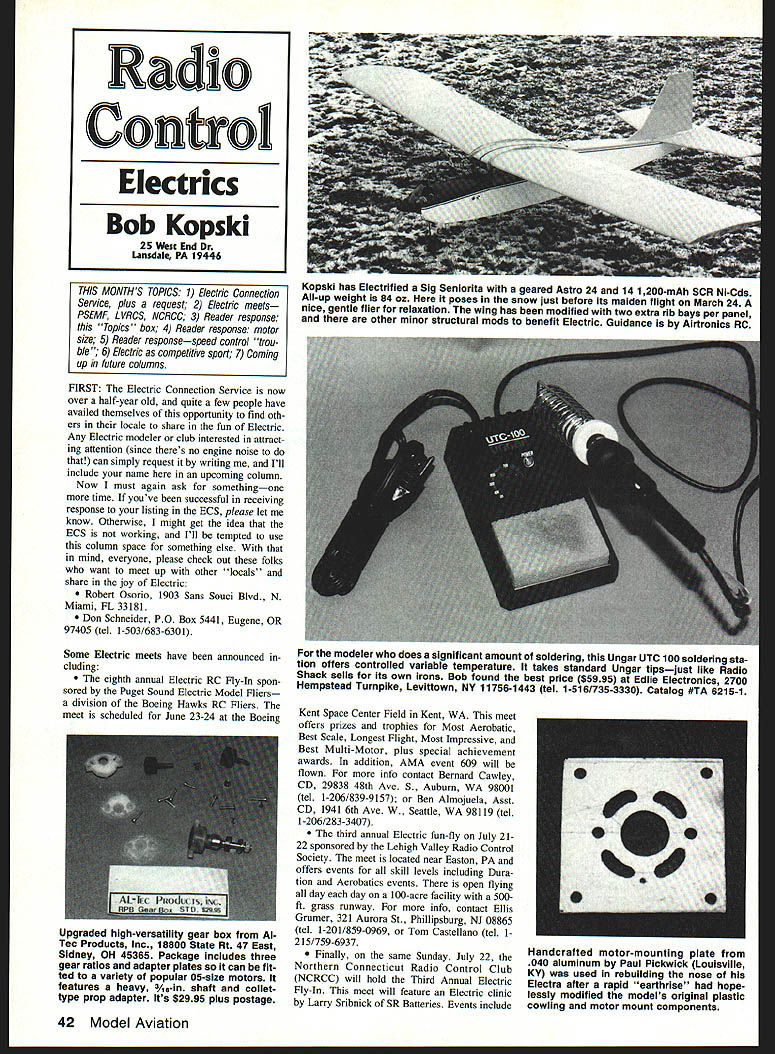
- Kopski has electrified a Sig Señorita using a geared Astro .24 (14:1) with 1,200‑mAh Ni‑Cads. All-up weight is about 84 oz. It posed in snow just before its maiden flight on March 24 — a nice, gentle flier. The wing was modified with two extra rib bays per panel and a few other minor structural changes to better suit electric power.
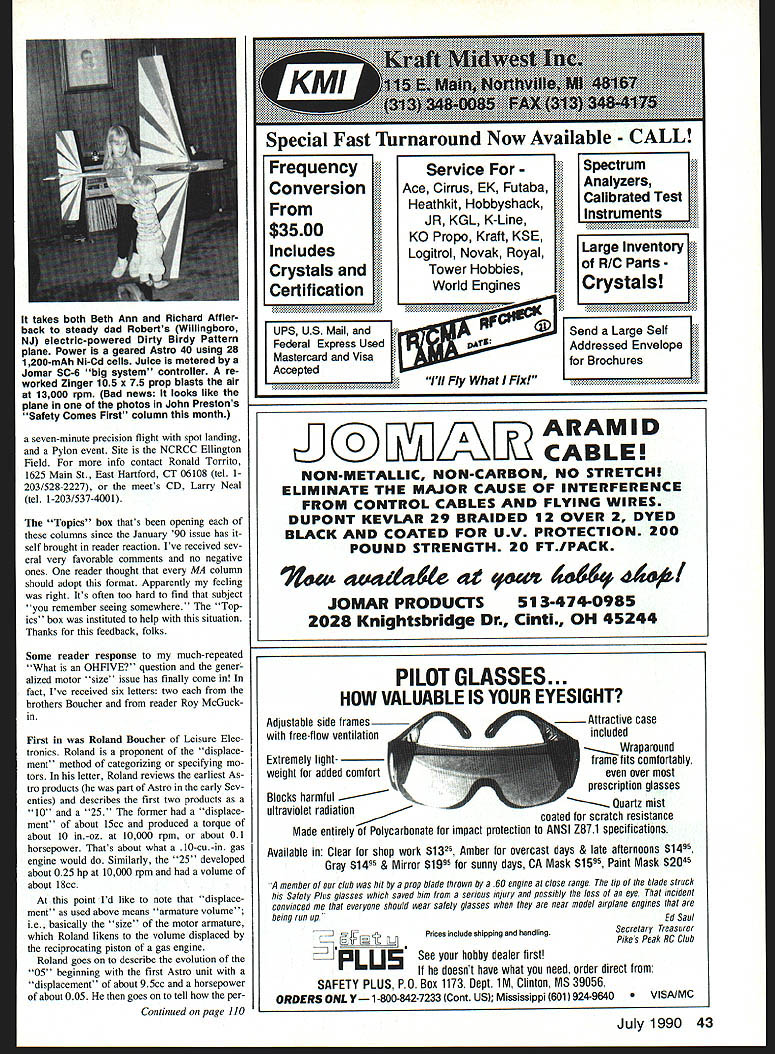
- Ungar UTC-100 soldering station: controlled variable temperature, accepts standard Ungar tips (the same tips Radio Shack sells for its irons). Best price found: $59.95 at Eddie Electronics, 2700 Hempstead Turnpike, Levittown, NY 11756-1443 (tel. 1-516/735-3330). Catalog #TA 6215-1.
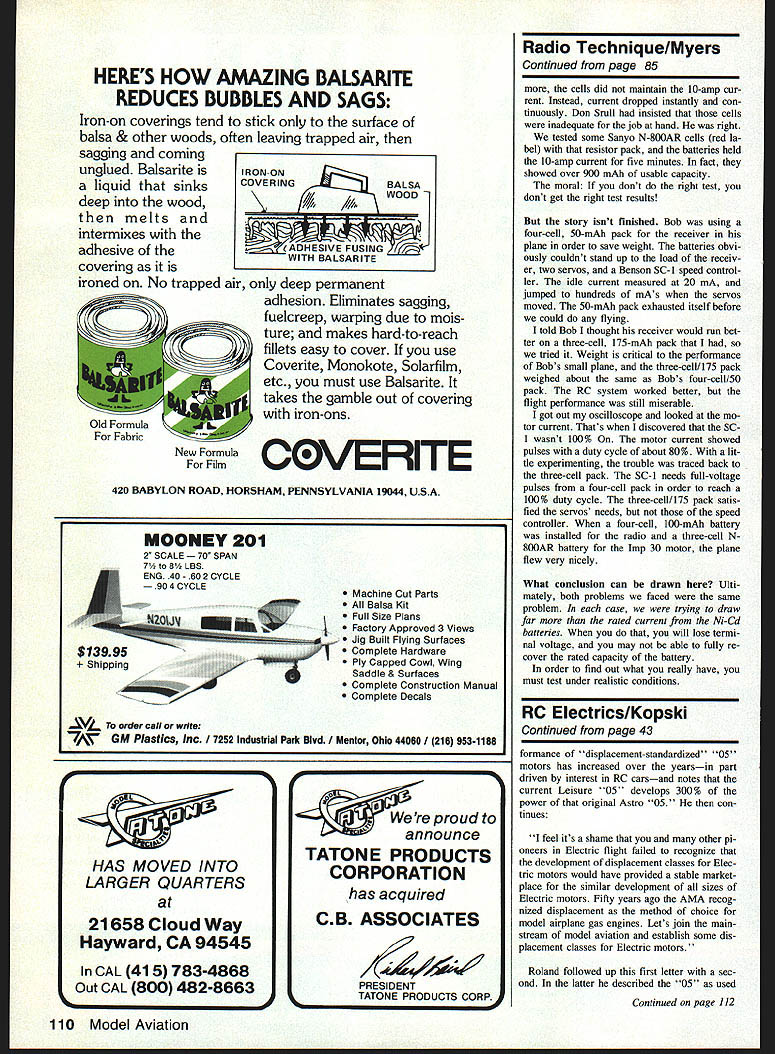
- Ai‑Tec Products, Inc. upgraded gear box: includes three gear ratios and adapter plates so it fits a variety of popular .05-size motors. Features a heavy .200-in. shaft and collet-type prop adapter. Price: $29.95 plus postage. Ai‑Tec Products, Inc., 18800 State Rt. 47 East, Sidney, OH 45365.
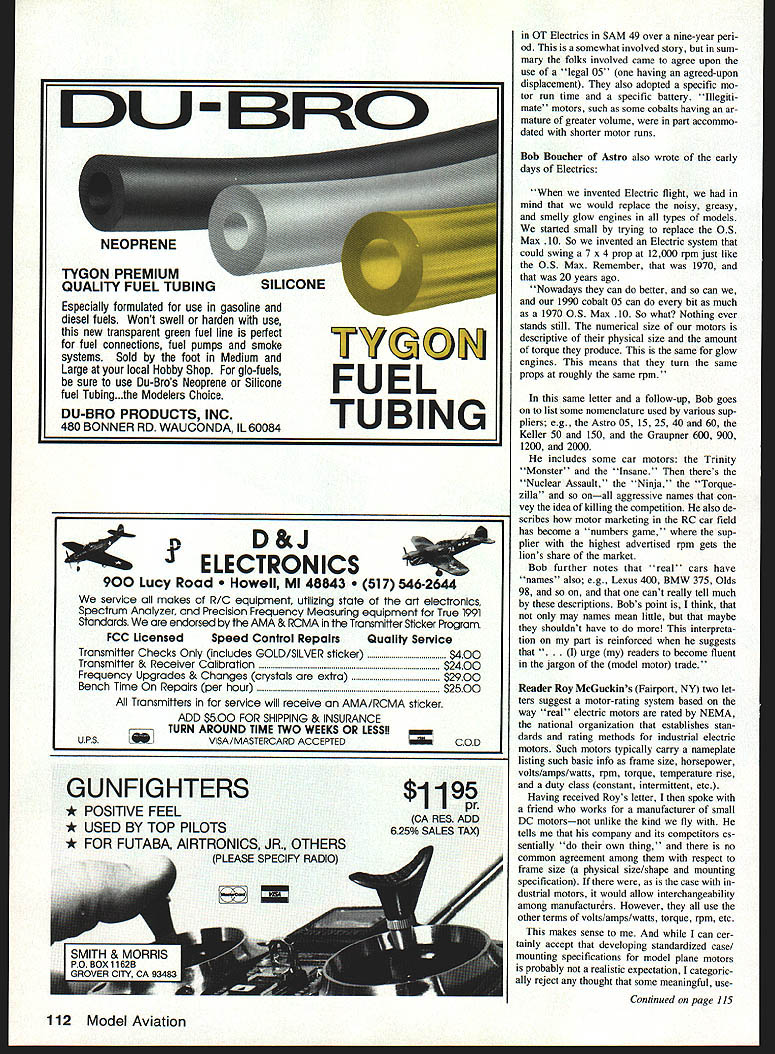
- Handcrafted motor-mounting plate from .040 aluminum by Paul Pickwick (Louisville, KY) was used rebuilding the nose of an Electra after a rough landing had damaged the original plastic cowling and motor-mount components.
Reader response — motor size
Several readers responded to my repeated question "What is an OHM/EV?" and to the general motor-size issue. I received six letters total, two each from Roland Boucher, Bob Boucher, and Roy McGuckin.
Roland Boucher — displacement method
Roland Boucher (Leisure Electronics) supports a "displacement" method of categorizing motors. He reviews the earliest Astro products (he was with Astro in the early '60s) and describes early motors labeled "10" and "25." The "10" had an armature volume (displacement) of about 15 cc and produced about 10 in‑oz torque at 10,000 rpm — roughly 0.1 hp, similar to a .10 cu. in. gas engine. The ".25" developed about 0.25 hp at 10,000 rpm with a volume of about 18 cc.
Note: Roland uses "displacement" to mean armature volume — essentially the physical volume of the motor armature, analogous to piston displacement in a gas engine.
He also describes the evolution of the .05 beginning with the first Astro unit: a .05 displacement of about 9.5 cc and roughly 0.05 hp. He notes that current .05 motors have increased performance (in part due to RC car demand) — Leisure's current .05 develops about 300% of the power of that original Astro .05.
Roland argues that standardized displacement classes for electric motors would stabilize the market, similar to how AMA used displacement for gas engine classes, and urges the establishment of displacement classes for electric motors.
Bob Boucher — historical perspective and nomenclature
Bob Boucher of Astro recounts early electric flight efforts: they aimed to replace noisy glow engines (e.g., O.S. Max .10) and developed electric systems to swing comparable props at similar rpm. In 1970 their goal was to match a 7x4 prop at 12,000 rpm. He notes that today's motors outperform those early units; a modern 1990 cobalt .05 can equal the performance of a 1970 O.S. Max .10.
Bob emphasizes that numeric motor sizes describe physical size and torque, similar to glow engines. He lists various supplier nomenclature: Astro 05, 15, 25, 40, 60; Keller 50, 150; Graupner 600, 900, 1200, 2000; plus many aggressive RC car names (e.g., Trinity "Monster", "Insane", "Nuclear Assault", "Ninja", "Torque-zilla"). He notes that marketing in the RC car field has become a numbers game and that product names can be emotionally loaded but not necessarily informative.
Roy McGuckin — nameplate and NEMA analogy
Roy McGuckin (Fairport, NY) suggests a motor-rating system modeled on NEMA industrial motor nameplates, which list frame size, horsepower, volts/amps, rpm, torque, temperature rise, and duty cycles. I spoke with small DC motor manufacturers who confirmed there's no common agreement on frame size or other specs for hobby motors. The situation resembles the gas-engine world where shared numbers don't guarantee consistent specifications across makers.
Roy's idea is promising: some standardization is possible and useful, though full frame-size standardization may be unrealistic. I believe a compact set of meaningful nameplate specs could be adopted for model motors.
My view on nameplate information
I support adopting useful label standards. Reasonable and useful parameters for a motor nameplate include:
- Voltage (number of cells)
- Maximum current (to protect brushes/armature)
- RPM (what to expect the prop to do)
- Watts (input power when properly propped; helps predict performance)
Reject marketing "killer names" as unhelpful.
(And yes, I had some fun imagining a ridiculous "MASTODON" motor label — a tongue-in-cheek example of what not to do.)
I also recommend reading Ted Davey's "Silent Power" column in the April 1990 issue of RCM for more on motor size and batteries. Thanks to Roland, Bob, and Roy for taking the time to write; more input from other readers would be appreciated.
Reader response — speed controls: frame-rate vs high-rate
Some readers misunderstood my recent discussion on frame-rate versus high-rate speed controls. Comments like "I have had no trouble with the frame-rate control I am using" miss the point I intended.
Frame-rate controls can work fine and many flights have been trouble-free with them. My point is about efficiency: power systems with frame-rate controls have much worse power-system efficiency when the control is used in anything other than a simple On/Off manner. High-rate controls maintain much better efficiency during variable throttle use, and that yields longer flights. Flights with both types can be trouble-free, but flights with high-rate controls can be significantly longer. Period.
Electric as competitive sport
Bob Boucher is a strong believer in competition. He prefers contests over fun-flies and designs Astro products with competition in mind. He is concerned about a perceived lack of interest among U.S. modelers in international electric competition and thinks the U.S. could and should do much better. Bob feels the future of model aviation may lie in treating the hobby as a national sport, with the associated business and media aspects — and U.S. domination of international events. He even suggested it might be time for a dedicated electric competition-oriented magazine.
If you have sport-oriented or serious contest inclinations, please write Bob Boucher at Astro Flight, Inc., 13311 Beach Ave., Marina Del Rey, CA 90292 — and tell him Bob sent you.
Coming up in future columns
Future columns will once again include electric basics. My monthly presentations have drifted away from basics a bit, though unintentionally. Model Aviation started its electric coverage in late 1983 with basics, and there are always beginners seeking beginning information. I'll strive for balance between basic material for newcomers and advanced topics for experienced readers.
Closing
It is a drizzly, chilly April 1 (Sunday) as I write, but I have a newly electrified Sig Señorita and I'm anxious to fly — it had its first flight last Saturday in a snowstorm. When I'm hot to fly, I'm hot to fly!
Please direct any comments or questions to me at the address given above, not to the Model Aviation editorial offices. I will reply to all correspondence accompanied by a SASE.
Happy, quiet electric landings, everyone — in rain or snow or whatever, no matter what your motor "size"!
Transcribed from original scans by AI. Minor OCR errors may remain.

