
Radio Control: Electrics
Bob Kopski 25 West End Dr. Lansdale, PA 19446
THIS MONTH'S TOPICS:
- The Electric Connection Service
- Electric meets — The Nats, Michigan, and New York
- Reader reaction — speed control diodes
- Reader reaction — speed control chokes
- Speed control adjustments
- A mall show
- Electric references 'n' writings
1) The Electric Connection Service
AMAZING! The Electric Connection Service (ECS) is worthy of that superlative, because this column feature (initiated with my January '90 column) has brought in more continuous reader participation than anything else ever has—until this month. Until now, every issue has had someone listed who’s seeking to connect with other local electric modelers. In fact, going back two or so issues, there were lots of folks doing this. This month—none! How can this be?
Whatever the reason, the ECS remains available for your use. If you'd like to find others of the electric persuasion close to you, just let me know in writing and I'll list the info here. This service is available to all individuals and clubs.
2) Electric meets — The Nats, Michigan, and New York
Late word just in: there will be three unofficial electric events at this year's Nats. Planned events include FAI Class F3E Seven-Cell, Class A Sailplane (AMA event No. 610), and Class B Sailplane (AMA event No. 612). While this is last-minute, it may be of use to some folks. For more information contact Mark Nankivil, 5206A Devonshire, St. Louis, MO 63109 (tel. 1-314/832-0634).
More late word: this year's Midwest Electric Flys are set for July 21 and 22. These are back-to-back meets hosted by two different clubs and have two different CDs. The Saturday meet is sponsored by Electric Flyers Only; the CD is Ken Myers (tel. 1-313/669-9567). The Sunday meet is sponsored by the Ann Arbor Falcons; the CD is Keith Shaw (tel. 1-313/973-6309). Both meets will be held at the Falcons' field in Saline, MI. Events will include the popular All-Up/Last-Down and other fun events. Call one of the numbers above for details.
August 5 is the date set for the Midwest RC Society Electric Fun Fly. The meet offers All-Up/Last-Down.
Voltaire's, New York, have scheduled a meet August 19 at the Mohawk Valley RC Club field. Fun-fly events include All-Up/Last-Down, Most Rolls, Most Loops, Spot Landing, and Charge Touch 'n' Go. For info contact Bill Griggs, CD, P.O. Box 493, Westmoreland, NY 13490 (tel. 1-315/859-0855); John Fleming (tel. 1-315/622-3178); Jim McMaster (tel. 1-315/676-4870).
3) Reader reaction — speed control diodes
Reader input began to flow regarding the discussion of diodes used in speed controls. The column discussed the importance of properly selecting diodes, especially for use with high-rate controls. One reader, Steve Hageman, suggested high-rate controls must use diodes rated at the maximum motor current.
Reader input since then, including industry response, has argued that may not quite be the case. Several letters and analyses argue the case for diodes rated for much less than the maximum motor current. So what really is the case? I don't know yet. With varying opinions and lack of time to pursue the details myself, I'm waiting to see what settles out. In the meantime, all interested are invited to write me on the subject.
Thanks for all the input, folks. It's this sort of response that lets me know you're out there—and interested.
4) Reader reaction — speed control chokes
Chokes installed in the receiver leads of speed controls were discussed in the December '89 column. That article described a simple, low-cost solution to stubborn motor-noise problems encountered by some receivers. I found last summer that putting one small radio-frequency (RF) choke in each of the three speed-control leads that connect to the receiver could make the difference between flying and not being able to fly. These chokes are available from Ace R/C, Inc. (p/n LL 106).
Since that column appeared, I've received several reader inputs and have seen other reports of success with the method. So far, no one has reported failure. If you have "impossible" receiver motor-noise problems, refer to that past issue for the full how-to info. There are no guarantees it will fix all cases, but it's worth a shot—the total cost is less than $2. And to those who were kind enough to comment—thank you.
5) Speed control adjustments
Speed control adjustments seem to pose problems for some modelers, so here's some help. Every speed control I've seen has at least one adjustment screw; many have two, and I've even seen one with three (a special situation).
These adjustments are basically used to match the operation of the control to your transmitter's throttle-stick travel. Adjustments are necessary because pulse-width modulation characteristics of transmitters vary, and because it would be difficult (and costly) to build speed controls with precise operational characteristics and no adjustments. Adjustments also allow personalization of the control operation—bringing together almost any radio, almost any speed control, and almost any personal preference.
What does this mean in practice? A given speed-control adjustment set up for one radio brand may not work the same with another brand and will likely need readjusting. What you like for one transmitter may not be preferred by another flier, or may not be best for all planes.
Normally, a speed control should be adjusted so that with the throttle stick fully retarded (down) the motor is completely off, and with the stick fully forward (up) the motor is fully on. With the stick at intermediate positions the motor should be at corresponding intermediate speeds.
A useful detail: have a deadband of about two clicks of the throttle stick so that when the stick is down the motor is fully off within a click or two. Then there is the throttle-trim knob. I prefer to set the stick operation as described and then trim fully down (off). That way the stick governs the full range and gives the best feel and finest control.
Sometimes I arrange things so that with the stick full down the motor would just begin if the trim knob were set about midrange. That lets me use trim to set a minimum low-speed level in flight if desired. This can infringe on the stick limits described earlier, but adds versatility useful for some planes.
Single-adjustment controls make such versatility difficult or impossible, because you can't control two independent parameters with a single variable. Controls with two trim screws were once used to set when the control begins to operate and to establish the upper-range limit. Manufacturers may label the adjustments differently ("neutral" and "range"), but the effects are similar. Typically, the adjustments interact—you may set full off, then full on, only to find the latter affected the former. This interaction can be confusing and is often made worse by inadequate instructions. Adjustment sessions can be lengthy and can drain batteries or create safety issues.
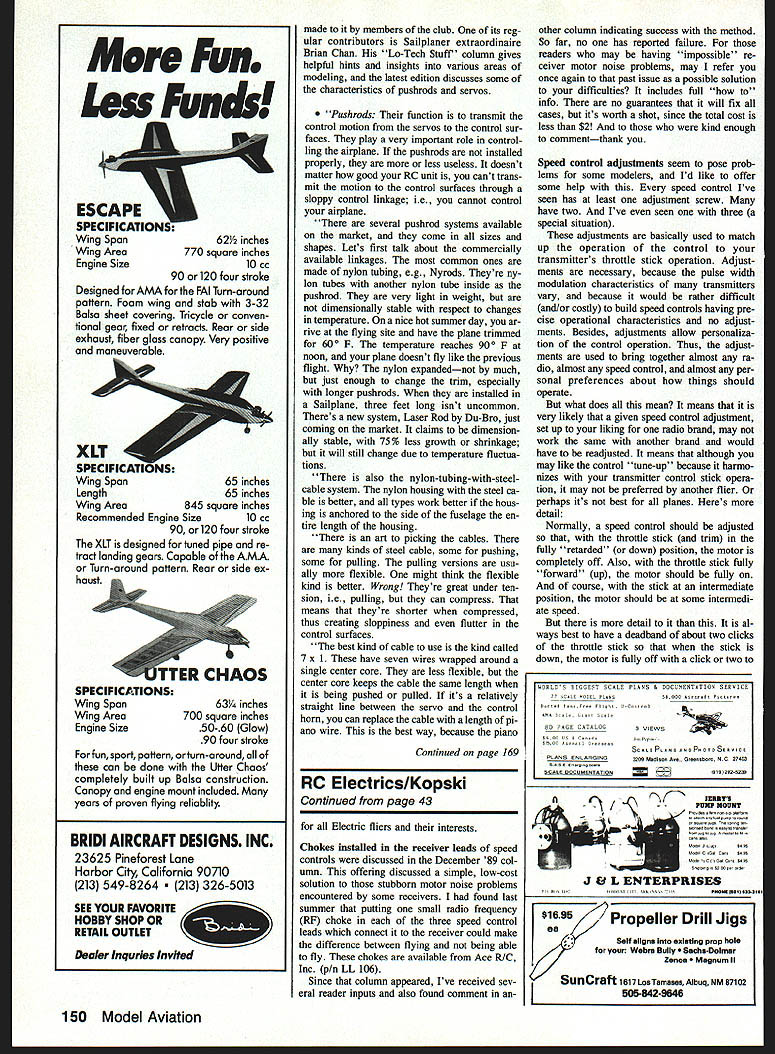
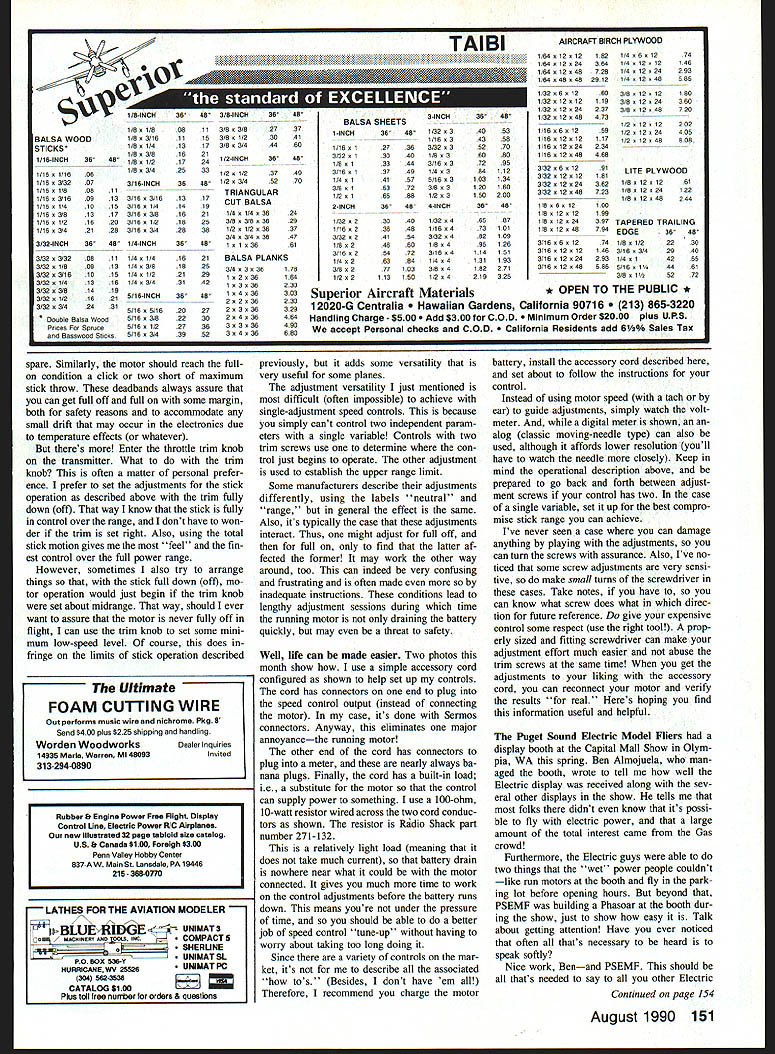
Life can be made easier. I use a simple accessory cord to help set up my controls. The cord has servo connectors on one end to plug into the speed-control output (instead of connecting the motor). This eliminates the major annoyance—the running motor. The other end has banana plugs to connect to a meter. The cord includes a built-in load (a substitute for the motor): a 100-ohm, 10-watt resistor wired across the two conductors. The resistor is Radio Shack part number 271-132.
This is a relatively light load (low current), so battery drain is far less than with the motor connected. That gives you much more time to work on adjustments without being "under the gun," so you can better tune the control.
Since controls vary, I'm not describing all the how-to details. I recommend you change the motor battery, install the accessory cord described here, and follow the instructions for your control. Instead of using motor speed (tach or ear) to guide adjustments, watch the voltmeter. A digital meter is convenient, but an analog (moving-needle) meter also works (with lower resolution).
Keep in mind the operational description above and be prepared to go back and forth between adjustment screws if your control has two. With a single variable, set it for the best possible stick range you can achieve.
I've never seen a case where you can damage anything by playing with the adjustments, so turn the screws with assurance. Some screws are very sensitive—make small turns. Take notes so you know what each screw does and in which direction for future reference. Use the right tool and a properly sized screwdriver to avoid abusing tiny screws. When you get the adjustments to your liking with the accessory cord, reconnect the motor and verify the results.
6) A mall show
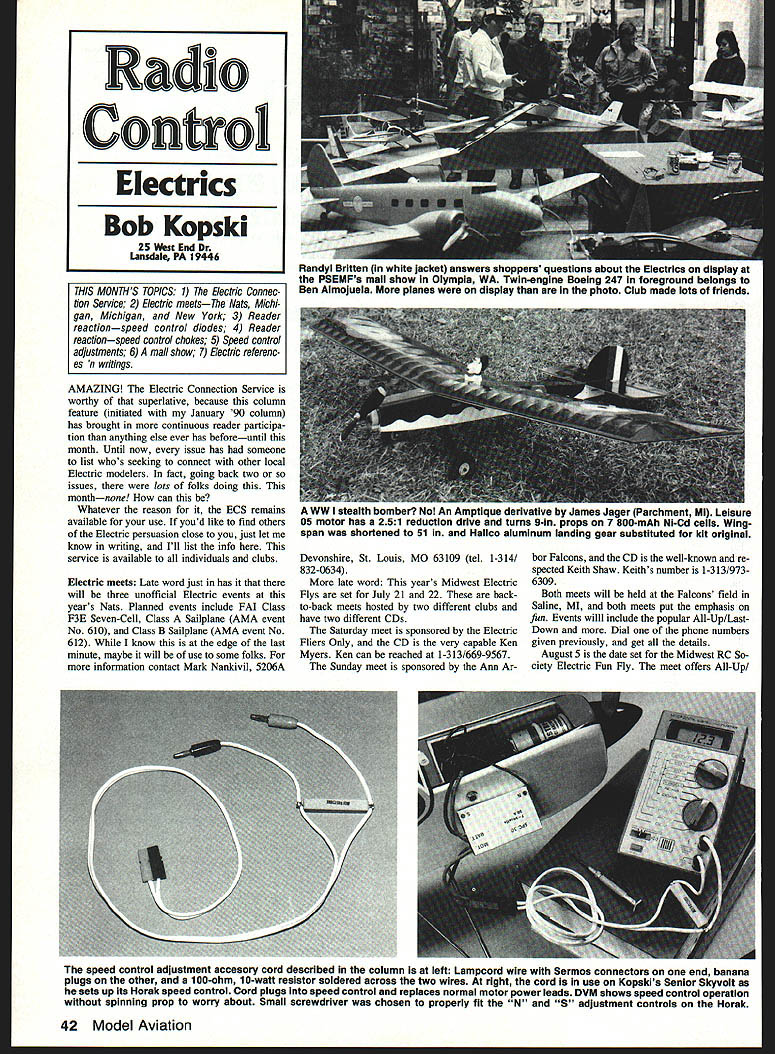
The Puget Sound Electric Model Fliers had a display booth at the Capital Mall Show in Olympia, WA this spring. Ben Almojuela, who managed the booth, reports the electric display was very well received. Most folks there didn't even know it was possible to fly with electric power, and a large portion of the interest came from gas fliers.
The Electric group could do two things the "wet" power people couldn't—run motors at the booth and fly in the parking lot before opening hours. Beyond that, PSEMF built a Phasor at the booth during the show to demonstrate how easy it is. Nice work, Ben—and PSEMF. This should be encouragement to all other electric clubs around the country: go do it!
7) Electric references 'n' writings
Electric references are often requested, so here are several. I haven't seen all of these yet, but I probably will over time. In no particular order:
- How To Choose RC Model Engines — Motorbooks International (has an extensive electric-motor section)
- The Advanced Guide to RC Sport Flying — TAB Books (has a chapter on electrics)
- The Beginner's Guide to Electric RC Flying — (publisher unknown)
All three above were written by Doug Pratt, who also runs ModelNet—AMA's CompuServe forum. I upload this monthly column by modem to CompuServe; Doug downloads it with the AMA modem into AMA's computer the next day. Doug also has electric segments on several RC Video Magazine tapes.
Other books:
- Building and Flying Electric-Powered Model Aircraft — Mitch Poling (Kalmbach)
- Electric Flight — Dave Day (Airlife)
- Introduction to Electric Flight — Ian Peacock (publisher unknown)
- The Quiet Revolution — Bob Boucher (Astro) — arguably the granddaddy of electric books
Many of these publications and tapes are available from Zenith Books, P.O. Box 1, Osceola, WI 54020. Send for a catalog.
If I've missed any, please send additions and I'll list them in future columns.
There are monthly electric columns in several magazines besides Model Aviation, including RCM, Flying Models, RC Reporter, Model Builder, and Model Airplane News.
An interesting note: the authors of these columns are a friendly group. Some readers perceive rivalry among columnists, but I don't see it that way. I know some other columnists personally, respect them, and consider them friends. We've flown together, shared material, and routinely communicate. We don't always agree—that's fine—but the hobby should stay pleasant.
Please address all comments and queries to the author as given in the column header. I will respond to all mail accompanied by an SASE.
Happy humming landings, everyone!
Transcribed from original scans by AI. Minor OCR errors may remain.

