
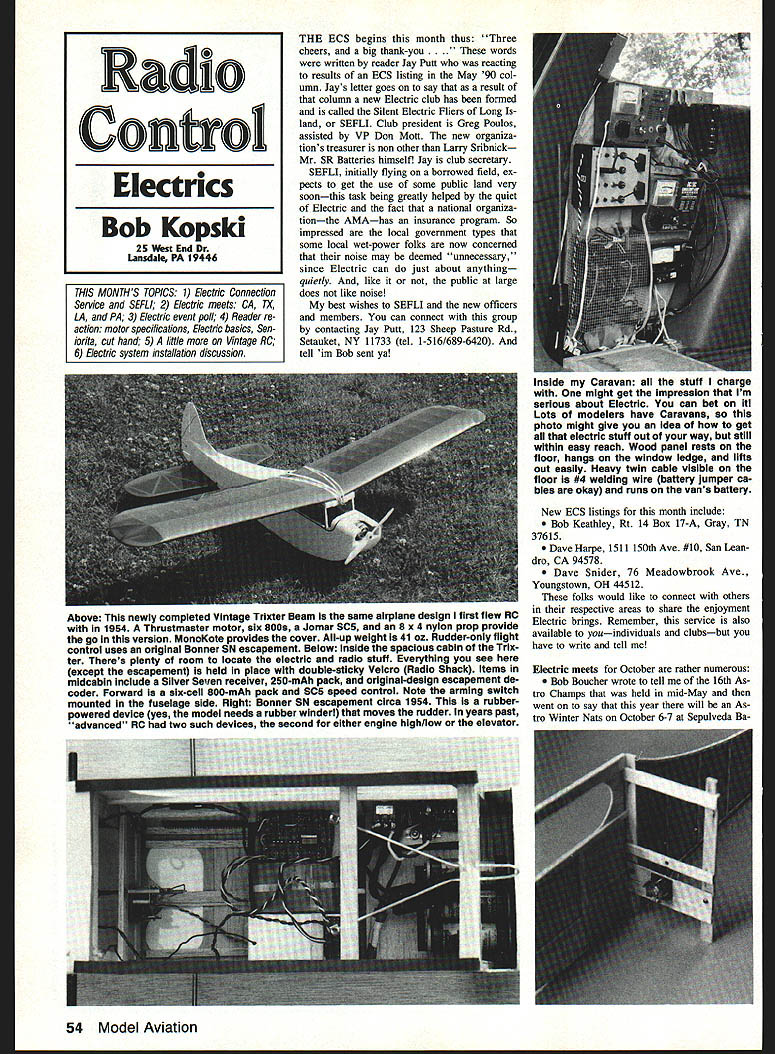
Radio Control: Electrics
Bob Kopski 25 West End Dr. Lansdale, PA 19446
This month's topics
- Electric Connection Service and SEFLI
- Electric meets: CA, TX, LA, and PA
- Electric event poll
- Reader reaction; motor specifications; Electric basics; Seniorita; cut hand
- A little more on Vintage RC
- Electric system installation discussion
Electric Connection Service (ECS) — SEFLI
The ECS begins this month thus: "Three cheers, and a big thank-you . . ." These words were written by reader Jay Putt in reaction to results of an ECS listing in the May '90 column. Jay's letter says that as a result of that column a new electric club has been formed: the Silent Electric Fliers of Long Island (SEFLI). Club president is Greg Poulos, assisted by VP Don Mott. The new organization's treasurer is Larry Sribnick (Mr. SR Batteries). Jay is club secretary.
SEFLI, initially flying on a borrowed field, expects to get use of some public land very soon — a task helped by the quiet of electric flight and the fact that the national organization, the AMA, has an insurance program. Local government types were so impressed that some local wet-power folks are now concerned their noise may be deemed "unnecessary," since electric can do just about anything quietly. And, like it or not, the public at large does not like noise.
Best wishes to SEFLI and the new officers and members. You can connect with this group by contacting:
- Jay Putt, 123 Sheep Pasture Rd., Setauket, NY 11733 (tel. 1-516/689-6420).
Tell him Bob sent you!
New ECS listings
- Bob Keathley, Rt. 14 Box 17-A, Gray, TN 37615.
- Dave Harpe, 1511 150th Ave. #10, San Leandro, CA 94578.
- Dave Snider, 76 Meadowbrook Ave., Youngstown, OH 44512.
These folks would like to connect with others in their areas to share the enjoyment electric flight brings. Remember, this service is also available to you—individuals and clubs—but you have to write and tell me.
Electric meets (October)
Electric meets for October are rather numerous.
Astro Winter Nats — Sepulveda Basin, CA
- Dates: October 6–7
- Events/demos: Pattern, Scale, Pylon, Helicopter, and Free Style.
- Info: Bob Boucher, 13311 Beach Ave., Marina Del Rey, CA 90292.
(This address is the same as Astro.)
Dallas Electric Aircraft Fliers (DEAF) Fun Fly — Dallas area, TX
- Dates: October 6–7
- Saturday events: Longest Flight, Most Aerobatic, Best Scale, Most Impressive.
- Sunday: Four-Hour Team Enduro (rules somewhat involved).
- Two days will be at different fields near Dallas.
- Info: Frank Korman, 5834 Goodwin, Dallas, TX 75206 (tel. 1-214/821-0393).
WESS Electric Fly-In — Blairsville, PA
- Date: Sunday, October 7
- Sponsored by: Westmoreland (PA) Electric Soaring Society (WESS).
- Activities: All-Up/Last-Down, Pilot's Choice, Most Aerobatic, Best Scale, Best Old-Timer, Best Sailplane, Largest, Smallest, Best Original, Farthest Traveled.
- Contest Director: Bob Marcel of RPM.
- Site: Blairsville, PA (about 40 minutes from the Monroeville exit of the Pennsylvania Turnpike).
- Info: Bob Marcel, Rt. 3, Sandy Hill Rd., Irwin, PA 15642 (tel. 1-412/863-0103).
WESS hopes the meet can evolve into a western Pennsylvania version of the KRC ElectriFly. As an honorary member of WESS, I encourage everyone to get out there and help this come true.
Gulf States Electric Fly-In — Metairie/Gulf States, LA
- Dates: October 20–21
- Sponsored by: Tammany Aero Club.
- Events include: AMA events 627, 610, and 623, plus Longest Flight of each day, All-Up/Last-Down, Most Aerobatic, Most Impressive, and Farthest Traveled.
- Info: Boyd O'Brien, P.O. Box 7153, Metairie, LA 70010 (tel. 1-504/883-5212); or Ben Mathews, 101 Mulberry Dr., Metairie, LA 70005 (tel. 1-504/833-5589 [home] or 1-504/366-4511 [office]).
Electric events — poll
Electric events most often take the form of "fun" activities, such as those listed above. Some meets include formal AMA electric events (fully described in the AMA Competition Regulations booklet). This column would like to know your preferences with respect to electric events. Are you a "fun" event person, or a more formal competitor? Let me know what you like, and I'll summarize the results in a future column.
Reader reaction: motor specifications
Reader reaction of note this month includes some misunderstanding of my ongoing crusade for the establishment of meaningful, useful, intelligent, standardized electric motor specifications/descriptions.
To be clear: I am not pushing for standardized motor specs to define "electric classes" for competition. Rather, I'm encouraging sanity and maturity in the way motors are described so everyone can know what a given product is capable of doing — with a little familiarization, of course. This compares very favorably with the confusing and inconsistent system now in use.
Electric system installation discussion — basics and safety
Modern electric system installation — in particular system wiring — was the subject of a recent club talk. It was well received, so I'll give a few ideas here and continue the topic in future columns.
This area has been covered piecemeal in past years, but it's time for a review/update with some old and new ideas. This will require more than one column. This month we'll look at generalities; detailed discussion begins in the next (December) column. The intent is to help you transition from store-bought to custom wiring/installations — even if you now feel such work is beyond your ability.
I normally think of the electric "stuff" in a model as comprised of three things: the motor, the battery, and everything else.
- "Everything else" is basically what connects the first two and makes everything work. It can include speed controls, electronic on/off switches, servo-driven switches (not recommended), and many other components.
- There are many competing manufacturers and connector types, so components often don't interconnect readily.
Common questions include: Does the fuse go before the speed control or after? Where should the arming switch go — or do I need one? Which wire do I cut? Red or black? We'll answer these and more in upcoming columns.
Fusing
Each and every one of my electric installations is fused. I will not fly without a fuse — period. If your system does not include a fuse, get one in. It is a distinct safety consideration. Power loss associated with a properly installed fuse is negligible; there is no excuse for not having one. I would like to see the AMA require a properly installed system fuse as part of insurance conditions.
Arming switch
Arming switches are another system safety item and a practical requirement. The arming switch is the master control of an electric power system. It should never be driven by a servo (servos can glitch or stall) and should be mounted on the surface of the model for ready accessibility. It overrides everything else in the power system, including radio control. It's the last thing I turn on before takeoff and the first thing I turn off after landing. If you don't have one, you should.
Miscellaneous notes
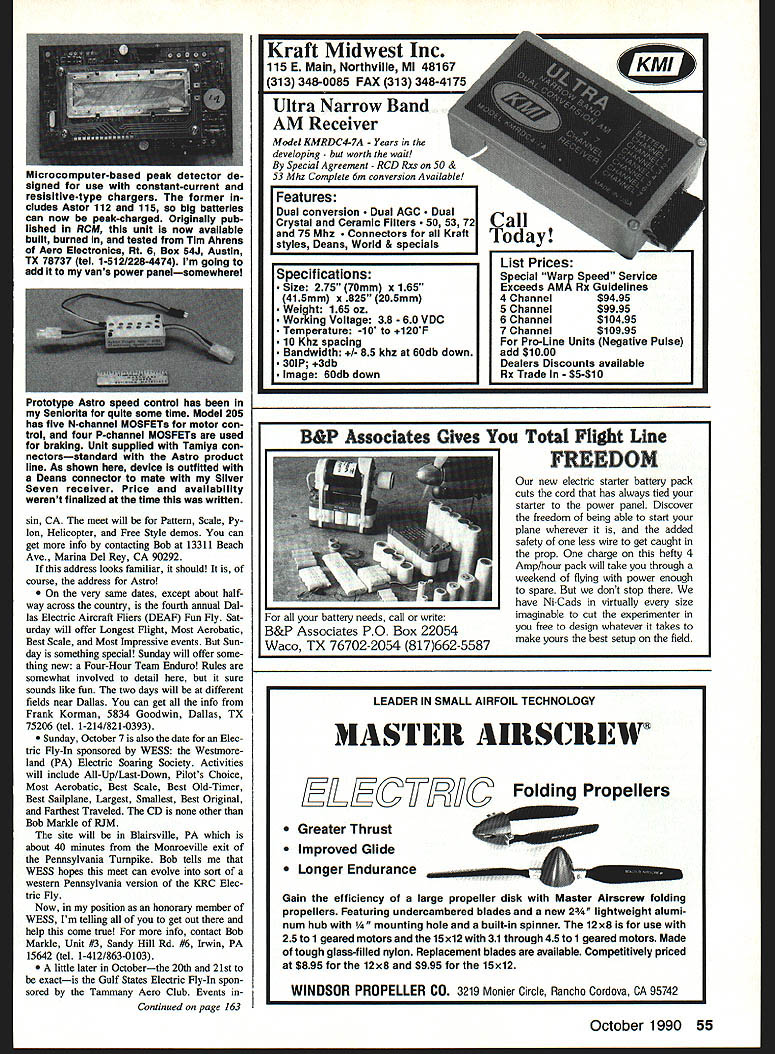
- Modern electric system installation: prototype Astro speed control has been on the Seniorita for some time. Model 205 uses five N‑channel MOSFETs for motor control and four P‑channel MOSFETs for braking. The unit was supplied with Tamiya connectors (standard Astro product line) and was outfitted with a Deans connector mate for the Silver Seven receiver pack. Price and availability were not finalized at the time of writing.
- The next (November) issue will be the annual coverage of the AMA Nats, so there won't be regular columns until the December issue (except Preston's Safety column).
Please send all mail to the author at the address shown in the header. I respond to all correspondence accompanied by a self‑addressed, stamped envelope (SASE).
Happy Electric Landings, Everyone!
Transcribed from original scans by AI. Minor OCR errors may remain.

