
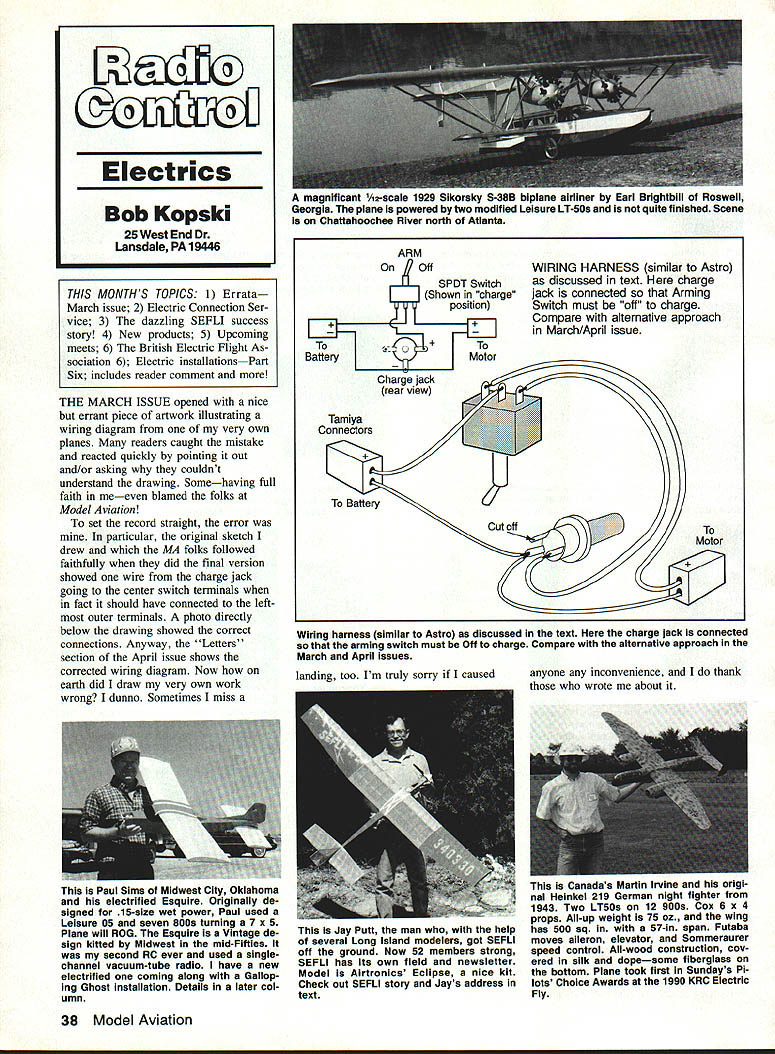

Radio Control: Electrics
Bob Kopski
25 West End Dr. Lansdale, PA 19446
THIS MONTH'S TOPICS:
- 1) Errata — March issue
- 2) Electric Connection Service
- 3) The dazzling SEFLI success story!
- 4) New products
- 5) Upcoming meets
- 6) The British Electric Flight Association; Electric installations — Part Six; includes reader comment and more!
1) Errata — March issue
The March issue opened with a nice but errant piece of artwork illustrating a wiring diagram from one of my very own planes. Many readers caught the mistake and reacted quickly by pointing it out and/or asking why they couldn't understand the drawing. Some—having full faith in me—even blamed the folks at Model Aviation!
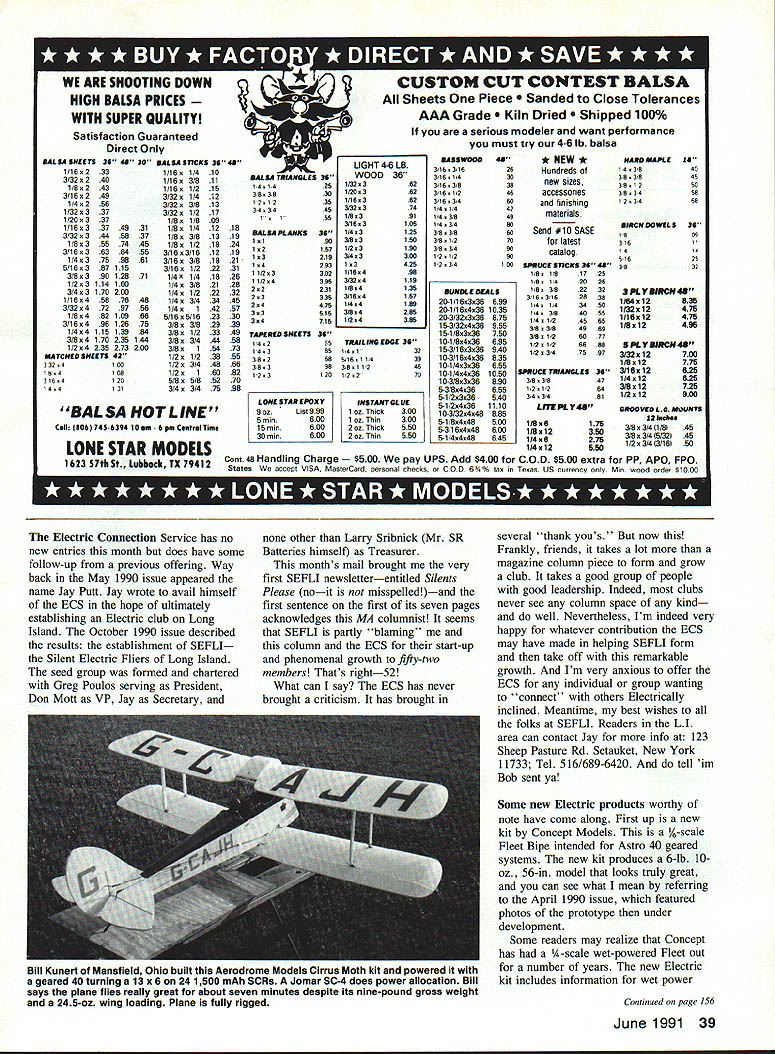
To set the record straight, the error was mine. In particular, the original sketch I drew and which the MA folks followed faithfully when they did the final version showed one wire from the charge jack going to the center switch terminals when in fact it should have connected to the left-most outer terminals. A photo directly below the drawing showed the correct connections. The "Letters" section of the April issue shows the corrected wiring diagram.
Now how on earth did I draw my very own work wrong? I dunno. Sometimes I miss a landing, too. I'm truly sorry if I caused anyone any inconvenience, and I do thank those who wrote me about it.
2) Electric Connection Service
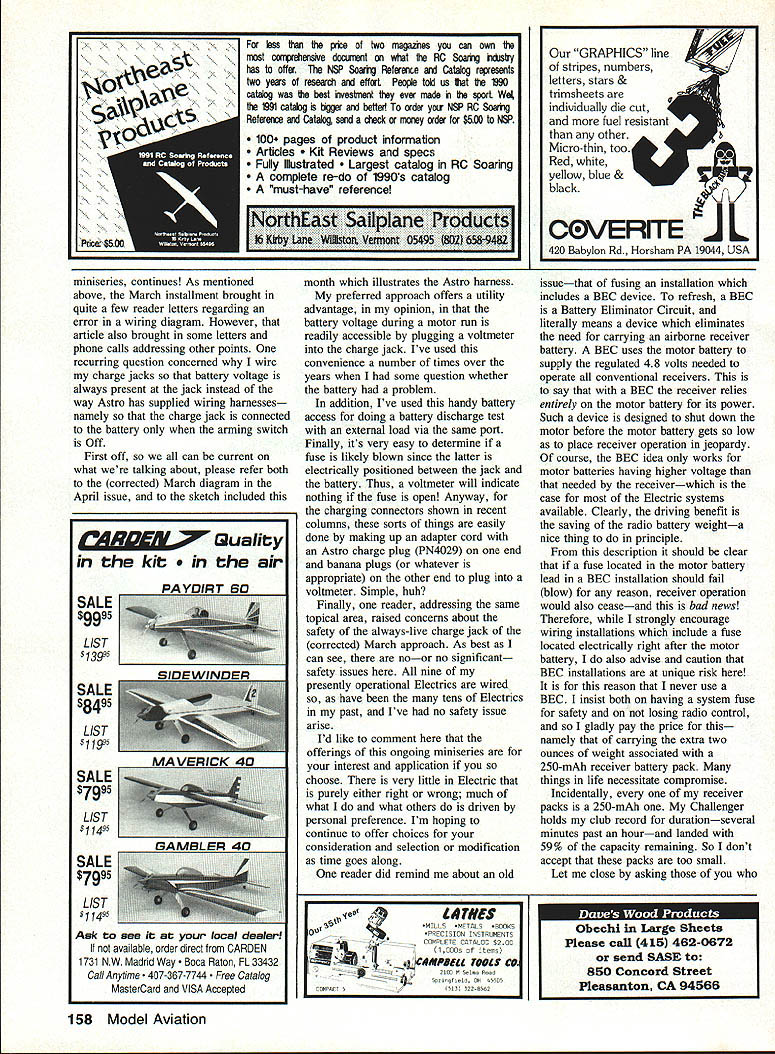
The Electric Connection Service has no new entries this month but does have some follow-up from a previous offering. Way back in the May 1990 issue appeared the name Jay Putt. Jay wrote to avail himself of the ECS in the hope of ultimately establishing an electric club on Long Island. The October 1990 issue described the results: the establishment of SEFLI, the Silent Electric Fliers of Long Island. The seed group was formed and chartered with Greg Poulos serving as President, Don Mott as VP, Jay as Secretary, and Larry Sribnick (Mr. SR Batteries himself) as Treasurer.
This month's mail brought me the very first SEFLI newsletter—entitled Silents Please (no—it is not misspelled!)—and the first sentence on the first of its seven pages acknowledges this MA columnist! It seems that SEFLI is partly "blaming" me and this column and the ECS for their start-up and phenomenal growth to fifty-two members! That's right—52!
What can I say? The ECS has never brought a criticism. It has brought in several "thank you's." But now this! Frankly, friends, it takes a lot more than a magazine column piece to form and grow a club. It takes a good group of people with good leadership. Indeed, most clubs never see any column space of any kind—and do well. Nevertheless, I'm very happy for whatever contribution the ECS may have made in helping SEFLI form and then take off with this remarkable growth. And I'm very anxious to hear of other ECS inquiries from any individual or group wanting to "connect" with others electrically inclined.
Meantime, my best wishes to all the folks at SEFLI. Readers in the Long Island area can contact Jay for more info at: 123 Sheep Pasture Rd., Setauket, New York 11733; Tel. 516/689-6420. And do tell 'im Bob sent ya!
3) New products
Some new electric products worthy of note have come along.
- Concept Models 1/4-scale Fleet Bipe kit: This is a 1/4-scale Fleet Bipe intended for Astro 40 geared systems. The new kit produces a 6-lb. 10-oz., 56-in. model that looks truly great; see the April 1990 issue for photos of the prototype then under development. Concept has had a 1/4-scale wet-powered Fleet out for years. The new electric kit includes information for wet power conversion—although I can't imagine why anyone would want to do that! The Electric Fleet lists at $99.95. Romey Bukolt, Mr. Concept himself, tells me you can buy them at your local hobby shop or from mail-order providers like Tower, or direct from Concept at 2906 Grandview Blvd., Madison, Wisconsin 53713.
- Sermos Connectors accessories: John Sermos of Sermos Connectors recently showed me some new items. One already available is an insertion/extraction tool to aid connector installation and removal; it lists at $5.00. I will have a photo of this handy accessory in the near future. John also has under development some mounting accessories for his connectors—two approaches to mounting Sermos connectors on a model's surface for charger connector interface. I have some samples to try out.
Incidentally, many of you may be surprised to learn that professionally John is an ice skating coach who over the years has helped many young figure skating stars.
Those of you lamenting the lack of large electric kits can now experience some relief in this regard. I'm now trying to decide just when I can schedule my kit on the bench!
4) Upcoming meets
Electric meets are popping up all over. Here is the information I have:
- Dallas Electric Aircraft Fliers (D.E.A.F.): First electric competition on Sunday, May 26 at Eastfield Community College in Dallas, Texas. This is strictly an AMA event; those scheduled include No. 610 and No. 618. In the past, D.E.A.F. has held annual fun flies and will do so again later this year. For info on this early serious meet, contact the CA, Jack Hamilton, 11216 Sesame St., Dallas, TX 75238; Tel. 214/348-4669.
- Lehigh Valley Radio Control Society (LVRC) Electric meet: June 8–9 in Pennsylvania. I've been attending LVRC's electric meet for several years; it is a great fun fly with lots of easygoing activity and plenty of prizes. Contact Ellis Grumer, 321 Aurora St., Phillipsburg, New Jersey 08865; Tel. 908/859-0969.
- Puget Sound Electric Model Flyers (PSEMF) ninth annual Electric RC Fly-In: June 29–30 at Boeing Renton Space Center Field in Kent, Washington. Prizes and trophies for Most Aerobatic, Best Scale, Longest Flight, Most Impressive, plus other Special Achievement awards. Separate categories for AMA event No. 607 and Best Multi‑Motor. Note that there are quite a few channels not available for us; get full details from Bernard Cawley, 29838 4th Ave. S., Auburn, Washington 98001; Tel. 206/839-9157; or Ben Almqvist, 1941 6th Ave. W., Seattle, Washington 98119; Tel. 206/283-3407.
- Mid America Electric Fly (seventh annual): July 20–21, sponsored by Electric Flyers Only, Inc. and the Ann Arbor Falcons. Last year drew 75 pilots; expect another large meet. Field is in Saline, Michigan, near Ann Arbor. Contact Keith Shaw, CD, Ann Arbor Falcons; Tel. 313/973-6309; or Ken Myers, CD, Electric Flyers Only; Tel. 313/669-8124.
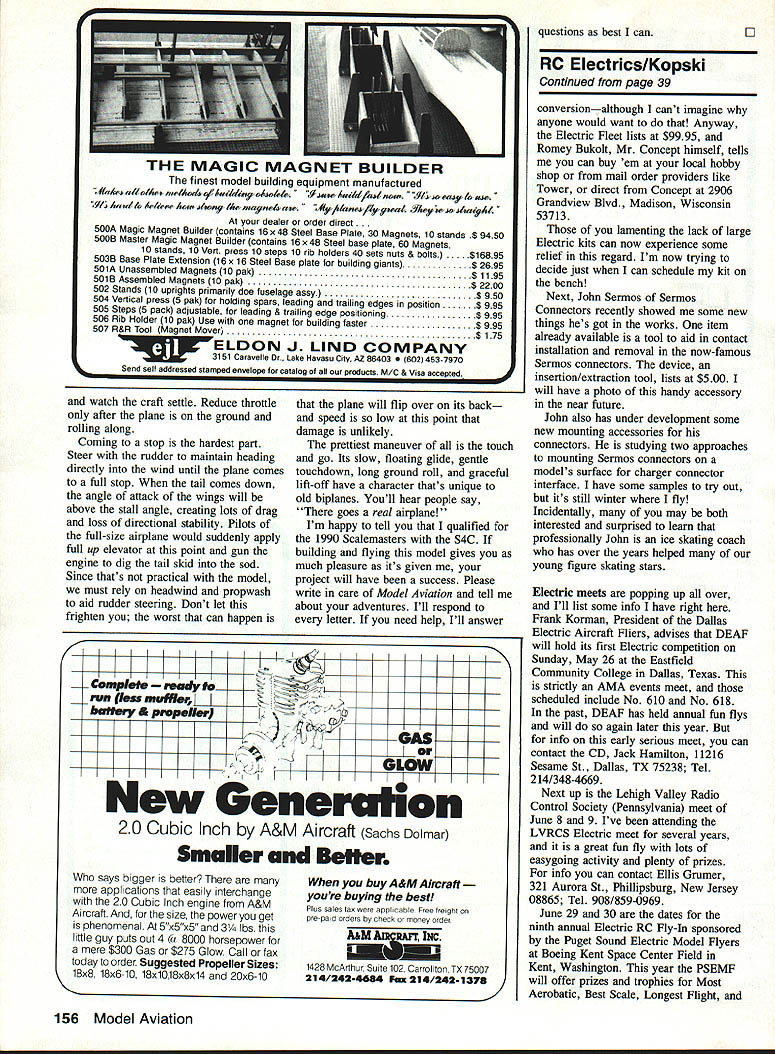
- LVRC Vintage meet: June 22–23, sponsored by the Lehigh Valley Radio Control Society. Vintage meets are for RC designs published or kitted prior to December 31, 1960. Many vintage designs are well suited to electric propulsion. I plan to bring my rudder-only, escapement-controlled Beam and perhaps a new electrified Esquire with Galloping Ghost steering. Contact Charles Yaindl, 226 N. Jordan St., Allentown, Pennsylvania 18102; Tel. 215/432-2050.
5) The British Electric Flight Association
The British Electric Flight Association is a newly formed organization whose aim is to "encourage and further all aspects of electric model flight in the British Isles." The organization publishes an official journal—Electric Flight UK—and welcomes input from friends overseas. This info came from Dave Dunford, editor of the journal. Contact Dave at 32 West Drayton Road, Hillingdon, Middlesex, UB8 3LA, Britain—and tell 'im Bob sent ya! You can subscribe to the journal for 10 pounds sterling including airmail (international money order or equivalent accepted). My best wishes to this organization.
Incidentally, I'm trying to interest Dave in attending this year's KRC meet! We'll have to wait and see what happens.
6) Electric installations — Part Six
The continuing miniseries on electric installations continues. As mentioned above, the March installment brought in quite a few reader letters regarding the wiring-diagram error. That article also brought letters and phone calls addressing other points. One recurring question concerned why I wire my charge jacks so that battery voltage is always present at the jack, instead of the way Astro has supplied wiring harnesses—namely so that the charge jack is connected to the battery only when the arming switch is Off.
Please refer to the corrected March diagram in the April issue and to the sketch included this month that illustrates the Astro harness.
My preferred approach offers a utility advantage: battery voltage during a motor run is readily accessible by plugging a voltmeter into the charge jack. I've used this convenience a number of times over the years when I had some question whether the battery had a problem. I've also used this handy jack to do a battery discharge test with an external load via the same port. Finally, it's very easy to determine if a fuse is likely blown since the fuse is electrically positioned between the jack and the battery. Thus, a voltmeter will indicate nothing if the fuse is open.
For the charging connectors shown in recent columns, these sorts of things are easily done by making up an adapter cord with an Astro charge plug (PN4029) on one end and banana plugs (or whatever is appropriate) on the other end to plug into a voltmeter.
One reader raised concerns about the safety of the always-live charge jack of the (corrected) March approach. As best as I can see, there are no—or no significant—safety issues here. All nine of my presently operational electrics are wired this way, as have been the many tens of electrics in my past, and I've had no safety issue arise.
I want to emphasize that the offerings of this ongoing miniseries are for your interest and application if you so choose. There is very little in electric flight that is purely either right or wrong; much of what I do and what others do is driven by personal preference. I'm hoping to continue to offer choices for your consideration and selection or modification as time goes along.
One reader reminded me about fusing an installation that includes a BEC device. A BEC is a Battery Eliminator Circuit, a device that eliminates the need for carrying an airborne receiver battery by using the motor battery to supply the regulated 4.8 volts needed by conventional receivers. A BEC is designed to shut down the motor before the motor battery gets so low as to place receiver operation in jeopardy. This idea works only when the motor battery voltage is higher than that needed by the receiver—which is the case for most electric systems available. The driving benefit is the saving of the radio battery weight.
However, if a fuse located in the motor battery lead in a BEC installation should fail (blow) for any reason, receiver operation would also cease—and this is bad news. Therefore, while I strongly encourage wiring installations that include a fuse located electrically right after the motor battery, I also caution that BEC installations are at unique risk here. For this reason I never use a BEC. I insist both on having a system fuse for safety and on not losing radio control, and so I gladly pay the price for this—namely carrying the extra two ounces of weight associated with a 250‑mAh receiver battery pack. Many things in life necessitate compromise.
Incidentally, every one of my receiver packs is a 250‑mAh one. My Challenger holds my club record for duration—several minutes past an hour—and landed with 59% of the capacity remaining. So I don't accept that these packs are too small.
Let me close by asking those of you who may write with questions to kindly enclose a SASE with your letter.
Till next month, happy, quiet-powered landings, everyone!
Transcribed from original scans by AI. Minor OCR errors may remain.

