
Radio Control: Electrics
Bob Kopski 25 West End Dr. Lansdale, PA 19446
THIS MONTH'S TOPICS:
- Opening Comment
- Electric Connection — new California Club
- More Vintage RC Electric!
- Electrified Seniorita follow-up
- Basic Trainers
- More on the New Astro Connector
- A Perspective on Power
1. Opening Comment
This issue marks the beginning of my ninth year of association with Model Aviation. That means I've completed eight years of gratifying, satisfying, rewarding fun with the truly fine folks at MA and, more important, with you. This opportunity to share Electric has added considerable dimension to what this hobby brings to me, and I hope and trust that it has been helpful to you — for that is its real purpose. So now I begin Year Nine with a sincere thank you to everyone at MA, and especially to all of you — for your interest and encouragement, sensitivity, thoughtfulness, and steadfast support — through my better days, and especially through some more recent not-so-good times as well. Thank you!
It has always been my intent and policy to provide as much "how to" as possible at all levels of interest. Also, I try to accommodate the need for related information by including new product info, meet announcements, and the unique Electric Connection Service. Sometimes I dwell on a subject, like my ongoing campaign to bring meaning and sense where there is none — namely to motor ratings, for example. Sometimes I go heavy in particular areas of reader interest — as driven by my incoming mail. Sometimes I must be repetitive — often driven by the fact that Electric is enjoying widespread growth — which means there's a steady influx of new folks who are now much in need of information presented here in the past. Something for everyone — over time! OK? Here goes!
2. Electric Connection — new California Club
The Electric Connection Service is happy to announce the formation of a new electric club — the Silent Electric Flyers of San Diego. Officially formed in April as AMA Charter 3078, the club began with 21 members on the roster and the search for a field. If things go for this group like they did for SEFLI of Long Island, the electric (quiet) aspect of their activity should make it relatively easy to interest potential landlords. Electric can be a quiet foot in the door!
Club president is Steve Manganelli, and the vice president is Steve Neu — well-known E-flier and member of last year's US F3E Team. Club secretary and newsletter editor is Roger Jaffe, and the club treasurer — who wrote to tell me all about this — is Chuck Grim. Chuck is inviting everyone interested to contact him at:
Chuck Grim 1319 Reed Ave. San Diego, California 92109-5131 Tel. 619/274-7322
Do tell Chuck that Bob sent you!
Here's wishing these folks all the best with this new undertaking. And do remember, everyone, that electric folks are nice to be around! It is said that one difference between wet and electric fliers is that the former must shower after flying; the latter may do so before! (Actually, all modelers are nice to be around.)
3. More Vintage RC Electric!
Vintage RC is catching on — and in particular with many readers of this column — as evidenced by my mail. I know I've spent some time on this topic not too many columns ago, but readers want more, so here goes!
Vintage is a movement centered on radio control model designs dating up to December 31, 1965, and is represented by the Vintage Radio Control Society (VRCS), a Special Interest Group of the AMA. VRCS is not to be confused with SAM, the Society of Antique Modelers. SAM mostly appeals to really old designs (Old Timers) predating December 1939, which were originally free flight. Today these designs are often flown with RC assist; electrified Old Timers are commonplace. SAM has rules that accommodate OT designs with ignition engines, glow engines, and electric motors.
Vintage, on the other hand, deals with radio control model designs of the past, and there are many famous modelers and model plane designs associated with this area of interest. For example, the VRCS president is retired AMA Executive Director John Worth, and the VP is well-known modeler Art Schroeder. Joe Beshar — a published modeler and active ingredient in US Electric FAI activity in recent years (and an established member of SAM) — is the organization's secretary/treasurer. With a heavyweight team like this leading the way, VRCS seems certain to be an overwhelming success.
I've personally found considerable enjoyment — and apparently many readers have also — in electrifying vintage designs. As previously mentioned in this column, my first RC ever was a mid‑Fifties Quillow Trixter Beam which I've been flying with the original escapement — rudder-only — with a modern radio.
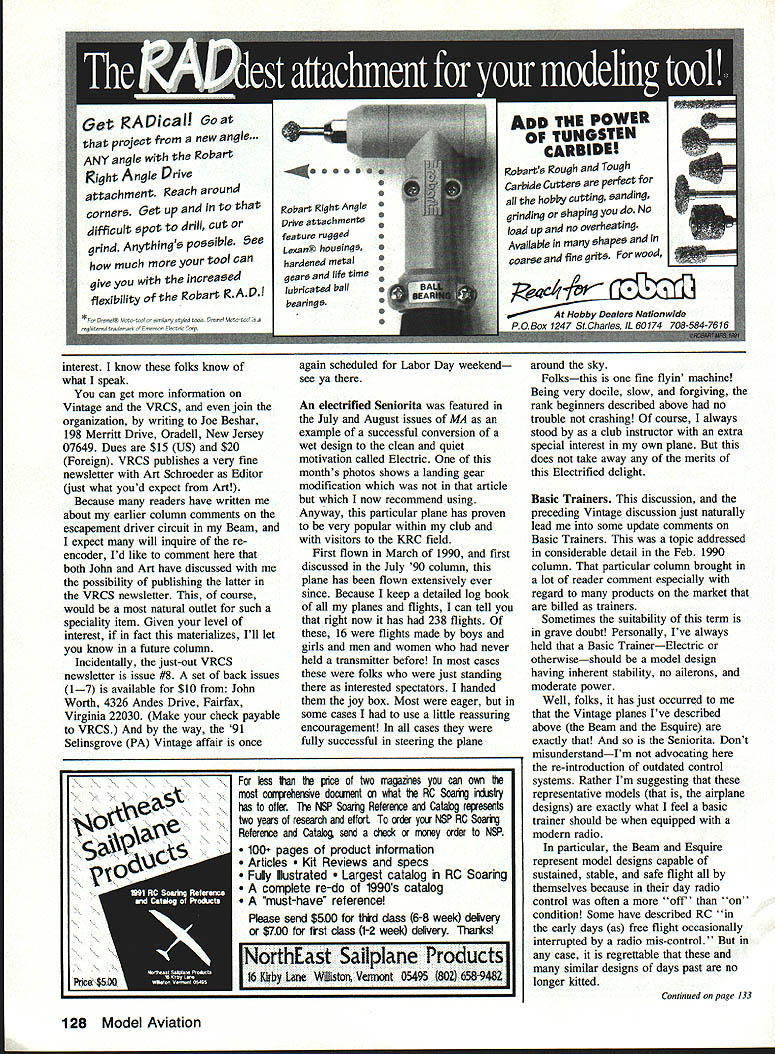
As I write this, I've just, days ago, successfully flown a replica of my second RC model ever, the Esquire. I'm flying it with Galloping Ghost (also known as Simple-Simul), using a modern radio and a Mighty Midget actuator. The original used a single-channel, vacuum-tube CW radio and a K&B Green Head .15. This one uses a Silver Seven, an adapter circuit, a geared cobalt .05, eight 1200s, a 10 x 7, and a JOMAR SM4. But the tail feathers wag, just like in the old days!
The adapter between the Silver Seven receiver and the MM actuator is a 1.7-in. square circuit board which I call the re-encoder. This circuit decodes standard aileron and elevator signals and re-encodes them as the rate/width variable drive needed for the pulsing Mighty Midget to function. This just goes to prove that modern electronics and modern electrics can take one back 35 years without trouble at all!
I realize that many relative newcomers to RC and to electric may not have a clue what I'm saying. But this is primarily intended for a rather large group of this column's readers — those having vintage roots and interest. I know these folks know what I mean.
You can get more information on vintage and the VRCS, and even join the organization, by writing to:
Joe Beshar 198 Merritt Drive Oradell, New Jersey 07649
Dues are $15 (US) and $20 (foreign). VRCS publishes a fine newsletter with Art Schroeder as editor.
Because many readers have written me about my earlier column comments on the escapement driver circuit in my Beam, and because I expect many will inquire about the re-encoder, I'd like to note that both John and Art have discussed with me the possibility of publishing the re-encoder circuit in the VRCS newsletter. This would be a natural outlet for such a specialty item. If this materializes, I'll let you know in a future column.
Incidentally, the just-out VRCS newsletter is issue #8. A set of back issues (1–7) is available for $10 from:
John Worth 4326 Andes Drive Fairfax, Virginia 22030
(Make your check payable to VRCS.) And by the way, the 1991 Selinsgrove (PA) Vintage affair is once again scheduled for Labor Day weekend — see ya there.
4. Electrified Seniorita follow-up
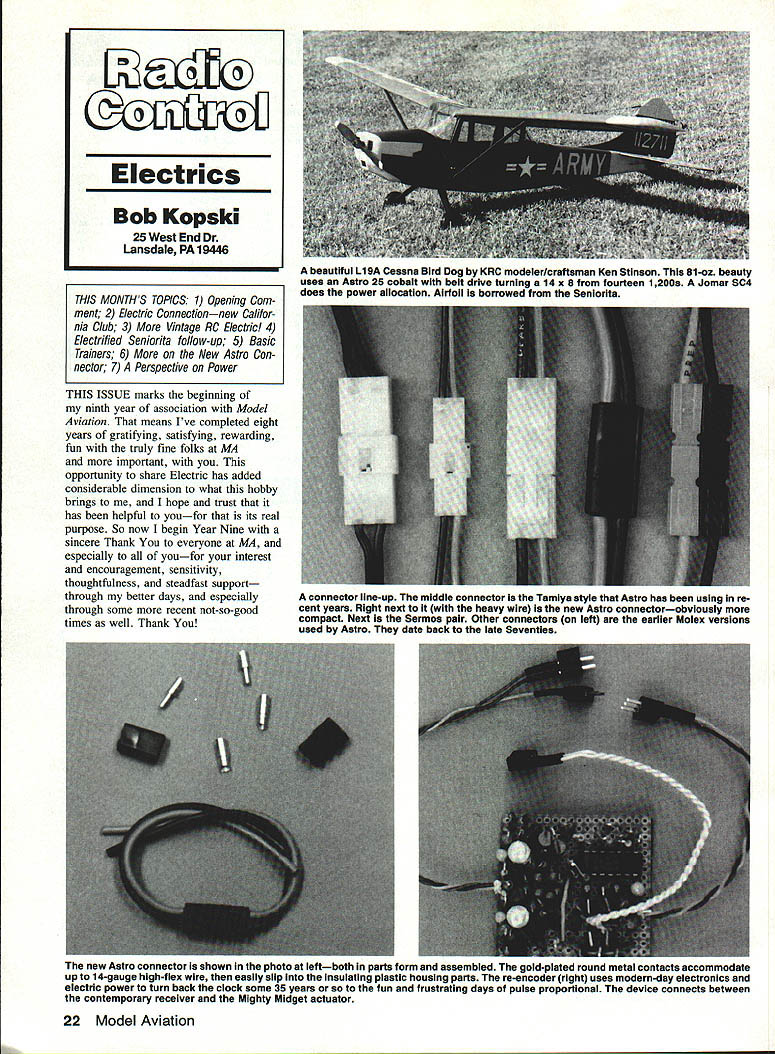
An electrified Seniorita was featured in the July and August issues of MA as an example of a successful conversion of a wet design to the clean and quiet motivation called electric. One of this month's photos shows a landing gear modification which was not in that article but which I now recommend using. This particular plane has proven very popular with my club and with visitors to the KRC field.
First flown in March of 1990, and first discussed in the July '90 column, this model has been flown extensively ever since. Because I keep a detailed logbook of all my planes and flights, I can tell you that right now it has had 238 flights. Of these, 16 were flights made by boys and girls and men and women who had never held a transmitter before! In most cases these were folks who were just standing there as interested spectators. I handed them the joy box. Most were eager, but in some cases I had to use a little reassuring encouragement! In all cases they were fully successful in steering the plane around the sky.
This is one fine-flying machine! Being very docile, slow, and forgiving, the rank beginners described above had no trouble not crashing. Of course, I always stood by as a club instructor with an extra special interest in my own plane. But this does not take away any of the merits of this electrified delight.
5. Basic Trainers
The Vintage discussion naturally leads into some update comments on basic trainers. This was a topic addressed in considerable detail in the February 1990 column. That particular column brought in a lot of reader comment, especially with regard to many products on the market that are billed as trainers. Sometimes the suitability of this term is in grave doubt!
Personally, I've always held that a basic trainer — electric or otherwise — should be a model design having inherent stability, no ailerons, and moderate power.
It has just occurred to me that the vintage planes I've described above (the Beam and the Esquire) are exactly that! And so is the Seniorita. Don't misunderstand — I'm not advocating the re-introduction of outdated control systems. Rather I'm suggesting that these representative models (that is, the airplane designs) are exactly what I feel a basic trainer should be when equipped with a modern radio.
In particular, the Beam and Esquire represent designs capable of sustained, stable, and safe flight all by themselves because in their day radio control was often more "off" than "on." Some have described RC in the early days as free flight occasionally interrupted by a radio mis-control. In any case, it is regrettable that these and many similar designs of days past are no longer kitted.
This leads me to propose a true test for any model design, contemporary or otherwise, to determine whether or not it qualifies as a basic trainer (wet or not): it must successfully fly on rudder-only escapement! (I'd allow a mid-course (MC) assist for safety, too.) Such a test would surely separate those designs that really are basic trainers from those that only claim to be. Now — why didn't someone think of this before? Manufacturers take note! Ah, finally — truth in advertising!
6. More on the New Astro Connector
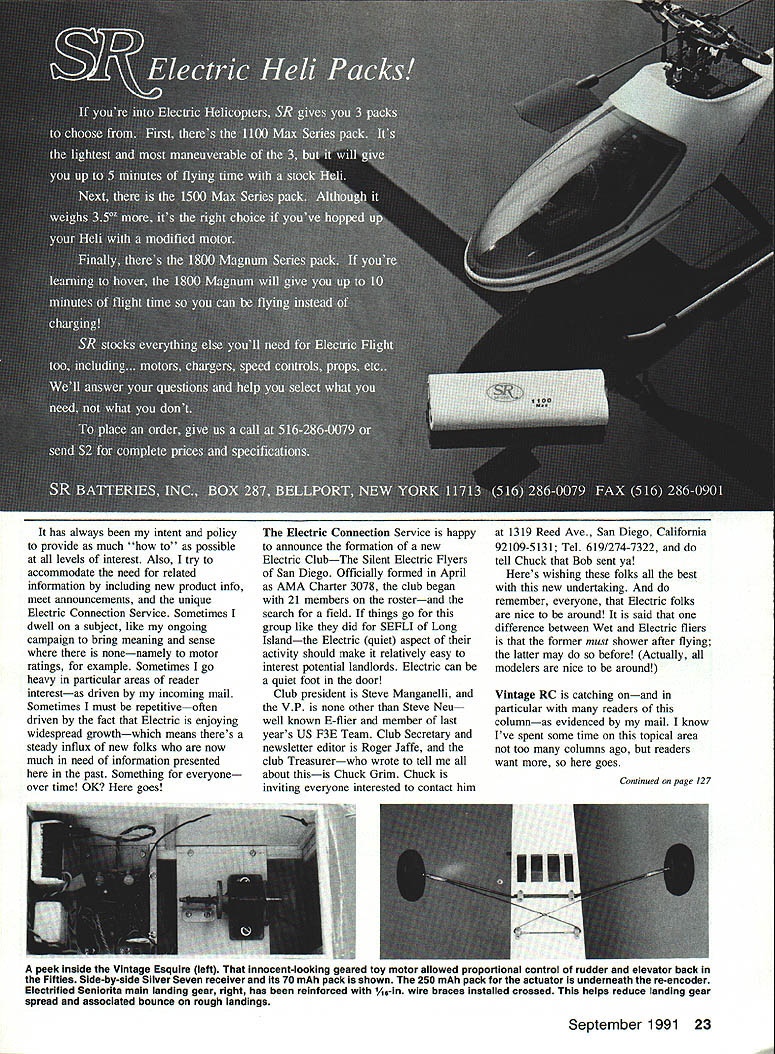
The new Astro connector was mentioned last month. To the best I can recall, this makes the fifth connector variation that Astro has used over its twenty-year history. The very first Astro connector was no connector — just wires emerging from the battery and motor. Shortly afterward, Astro incorporated the large Molex two-pin connector. This was followed by a smaller Molex version, which was soon followed by a gold-plated variant. These proved woefully inadequate as Astro's motor line gradually developed into the impressive, powerful product array of today.
As this growth was taking place, Astro began using the Tamiya-style two-pin connector popularized by RC cars, but most serious electric modelers routinely use the Sermo connector system instead. The new Astro connector appears to be a significant upgrade over all earlier Astro connectors.
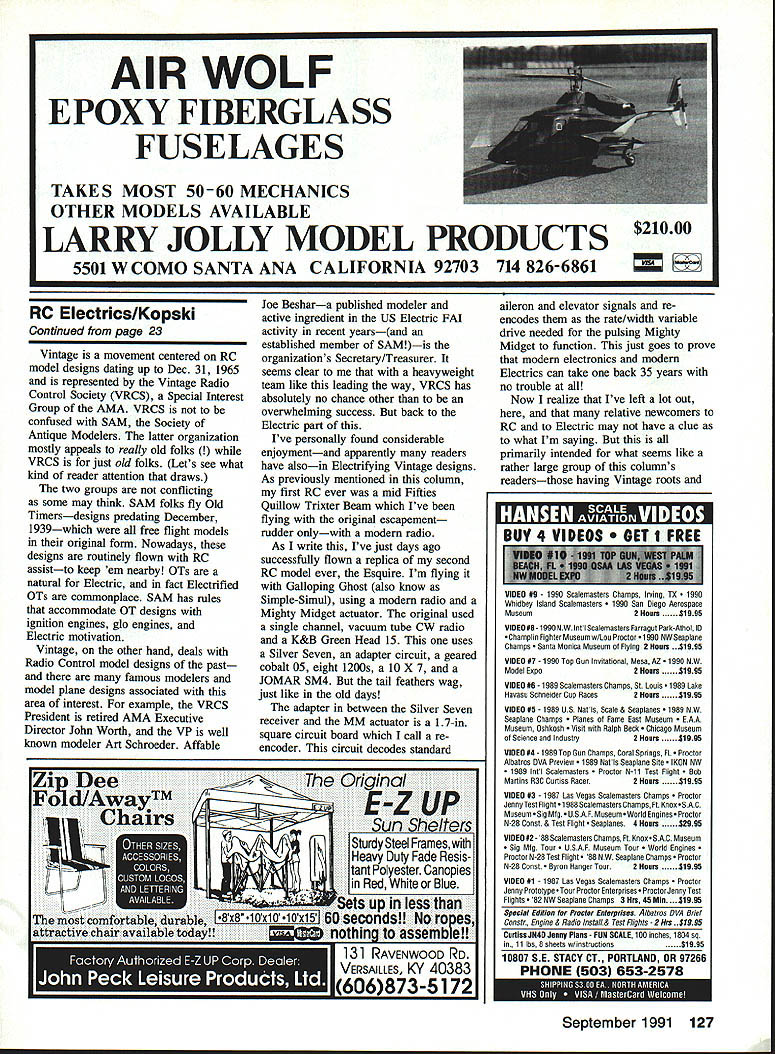
As shown in the photo, these are two-pin connectors having gold-plated pin-and-tube type contacts in a plastic housing. Astro calls these Hyper-Tack. The stock number is 4005. They list at $9.95 a pair (one male and one female set of two contacts each). According to Astro, these connectors are designed for 100 amps peak and 50 amps continuous operation. Astro also claims zero rpm loss with 14-gauge wire.
Connector features and assembly:
- Two plastic shells, two female, and two male contacts.
- Each contact has a solder cup which will accept up to 14-gauge wire.
- Feed the wire through the plastic housing, insert in the solder cup, and solder in place.
- Push the contacts and wire back into the plastic housing.
- Contacts can be easily removed and reused with new wire.
I ran some tests on several contact sets. Six inches of Astro 14-gauge wire was soldered to each contact and an electronically regulated 25.0 amps was passed through several mated pairs. Measuring the voltage drop across the mated contacts and solder joints of the individual contacts, I found contact losses ranging from about 5.2 to 6.2 millivolts (0.0052 to 0.0062 volts) per contact. This data correlates to an average contact resistance of about 228 micro-ohms for the samples I have.
I then measured the total voltage drop for both the wire and the contacts (12 in. wire and one male/female contact each test) and found voltage drops ranging from 58 to 62 millivolts. What this means is that there is about nine times more drop in 12 inches of 14-gauge wire than in the connector!
Of course it's not zero rpm loss when there is a real voltage loss — no matter how small — but the rpm drop associated with losses of this magnitude would not show up on any tach I've ever seen. Even with only a seven-cell pack with a nominal high-current terminal voltage of seven volts (7,000 millivolts) total, 5.7 millivolts (average) would represent only 0.08% loss.
As an example, at 10,000 rpm nominal, the loss associated with one two-pin connector set would be about 16 rpm, and this would not be visible on a three-digit tach. The percentage rpm loss would, of course, be even smaller with higher cell counts.
All this info is for new connectors. Since I have no accumulated history of application, I can't say how the connector performance will hold up in repeated mating. However, I have no reason to expect any significant deterioration in normal modeling use — including use with the charging function, the most often exercised electrical joint for those without a separate charger jack.
7. A Perspective on Power
I'd like to close this month with a short story about power. I'm always impressed with the seemingly awesome power that one can associate with an Astro 60 or with some of the impressive-sounding big imported motors. For example, a 60 on a 28-cell pack with a peak current condition of, say, 30 amps is over one horsepower — 840 watts assuming one volt per cell. Certainly, a kilowatt is in-bounds.
Awesome, huh? Well, just to put things in perspective, I recently enjoyed a social conversation with a third-year physics graduate student. He was telling me of the projects he is working on. In particular, he is developing a power supply for a particle accelerator. This power supply develops one megavolt and supplies one megaampere for 60 nanoseconds. That is to say the supply develops 1,000,000 volts and delivers 1,000,000 amps (or one terawatt) for 0.00000006 seconds. The voltage rise time is 20 nanoseconds, giving a slew rate of about 50 megavolts per second.
Next time you're wallowing in thoughts of the awesome power of your biggest electric, reflect on the above! It kind of puts it all in place, wouldn't you say. Incidentally, can anyone guess what this project uses for a switch? And wire?
Finally, in case you're wondering, Electric Installations will continue in the future. And with that, another column closes. Please have a happy and safe electric flying season! See ya at the Greatest (Electric) Show on Earth — KRC!
Transcribed from original scans by AI. Minor OCR errors may remain.

