
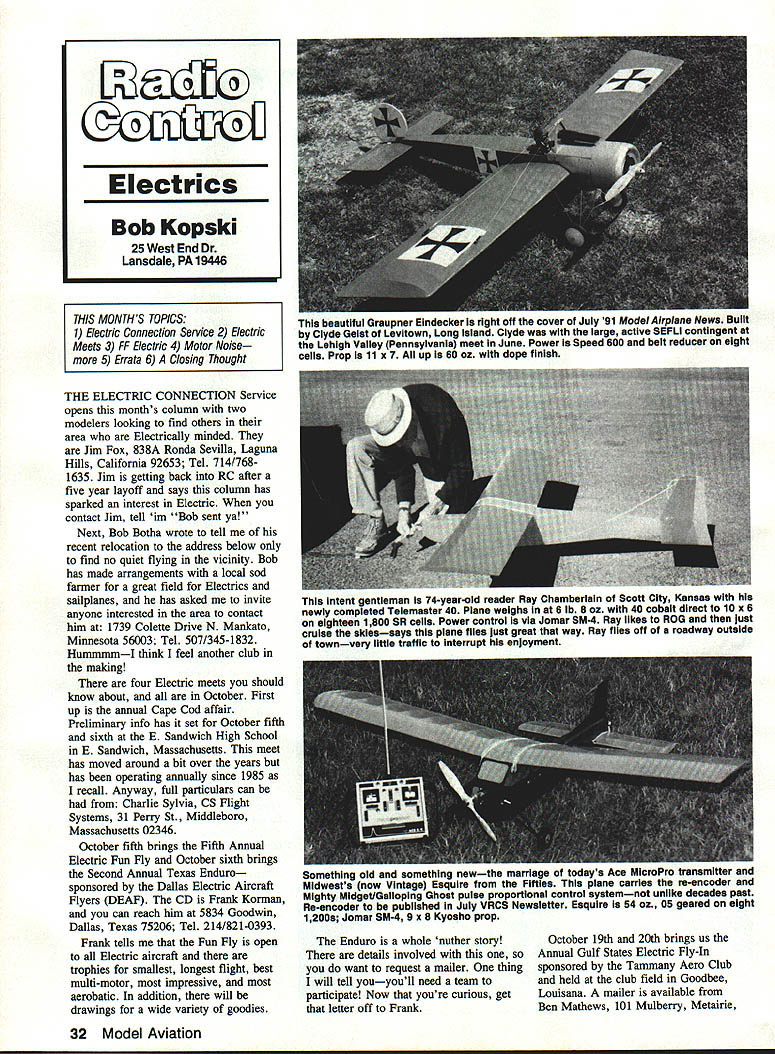
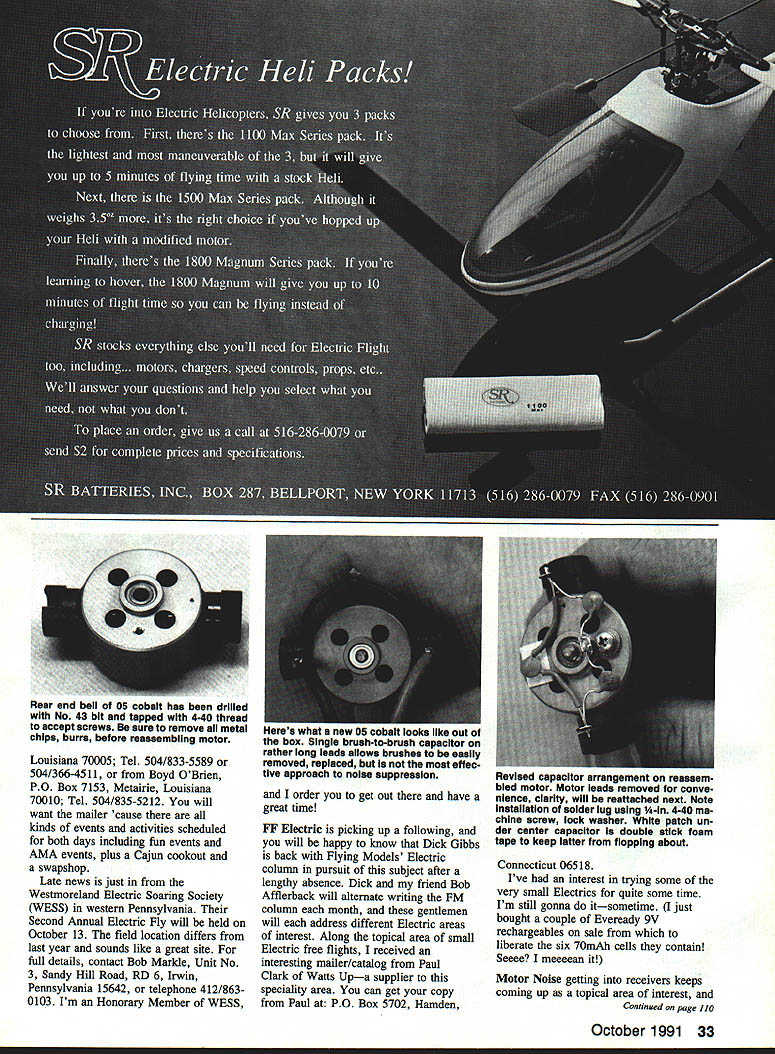
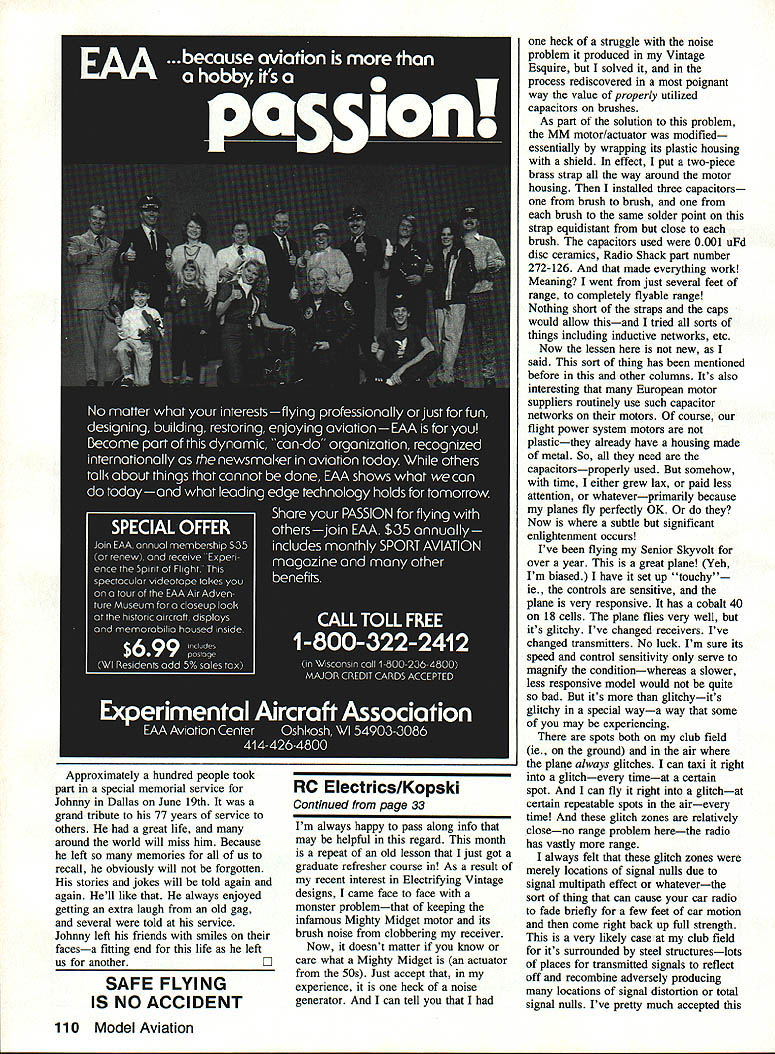
Radio Control: Electrics
Bob Kopski 25 West End Dr. Lansdale, PA 19446
THIS MONTH'S TOPICS
- Electric Connection Service
- Electric Meets
- FF Electric
- Motor Noise — more
- Errata
- A Closing Thought
Electric Connection Service
The Electric Connection Service opens this month's column with two modelers looking to find others in their area who are electrically minded.
- Jim Fox
838A Ronda Sevilla Laguna Hills, CA 92653 Tel. 714/768-1635 Jim is getting back into RC after a five-year layoff and says this column has sparked his interest in electric flight. When you contact Jim, tell him "Bob sent ya!"
- Bob Botha
1739 Colette Drive N. Mankato, MN 56003 Tel. 507/345-1832 Bob recently relocated to the above address and found no quiet flying in the vicinity. He has arranged with a local sod farmer for a great field for electrics and sailplanes and invites interested modelers in the area to contact him.
Electric Meets
There are several electric meets in October you should know about:
- Cape Cod Electric Meet
Preliminary info: October 5–6 at E. Sandwich High School, East Sandwich, MA. This meet has operated annually since the mid-1980s. Mailer/info: Charlie Sylvia, CS Flight Systems, 31 Perry St., Middleboro, MA 02346.
- Dallas Electric Aircraft Flyers (DEAF) events (Dallas, TX)
October 5 — Fifth Annual Electric Fun Fly October 6 — Second Annual Texas Enduro (team participation required) CD: Frank Korman, 5834 Goodwin, Dallas, TX 75206; Tel. 214/821-0393. The Fun Fly is open to all electric aircraft with trophies for smallest, longest flight, best multi-motor, most impressive, and most aerobatic. There will also be drawings and prizes.
- Gulf States Electric Fly-In (Goodbee, LA)
October 19–20 at the Tammany Aero Club field. Mailer/info: Ben Mathews, 101 Mulberry, Metairie, LA 70005; Tel. 504/833-5588 or 504/366-4511. Or Boyd O'Brien, P.O. Box 7153, Metairie, LA 70010; Tel. 504/835-5212. Events include fun events, AMA events, a Cajun cookout, and a swapshop.
- Westmoreland Electric Soaring Society (WESS) — Second Annual Electric Fly (western PA)
October 13 — field location differs from last year. Full details: Bob Markle, Unit No. 3, Sandy Hill Road, RD 6, Irwin, PA 15642; Tel. 412/863-0103. I'm an honorary member of WESS — get out and have a great time!
FF Electric
FF (Free Flight) electric activity is picking up. Good news: Dick Gibbs is back with Flying Models' electric column after a lengthy absence, and he will alternate monthly with Bob Afflerback. Each will address different electric areas of interest.
I also received an interesting mailer/catalog from Paul Clark of "Watts Up," a supplier in the very small electric free-flight specialty: Paul Clark, P.O. Box 5702, Hamden, CT 06518.
I've been meaning to try some very small electrics for a while. I recently bought a couple of Eveready 9V rechargeables on sale to liberate the six 70 mAh cells they contain — I'm still going to build and try those tiny models sometime soon.
Motor Noise — more
Motor noise getting into receivers continues to be a frequent problem. I had a severe case of noise-induced glitches in my Vintage Esquire and solved it, which reaffirmed the value of properly used capacitors on brush motors.
My MM motor/actuator was modified by shielding its plastic housing with a two-piece brass strap and installing three capacitors: one from brush to brush and one from each brush to a common solder point on that strap, equidistant and close to each brush. I used 0.001 µF disc ceramic capacitors (Radio Shack part no. 272-126). That cured the problem — range went from just a few feet to completely flyable.
Key points and remedies that worked for me and others:
- Capacitors on the motor:
- 0.001 µF disc ceramics (brush-to-brush and each brush-to-case/common) are effective for many motors.
- On other motors, a simple setup of a 0.01 µF disc across the brushes and 0.01 µF from each brush to the motor case (ground) worked well.
- Ensure the motor case is grounded to the airframe.
- Shielding:
- For plastic-housed motors, wrap the housing with a grounded metal strap or shielding to give capacitors an effective reference point.
- Lead routing and wiring practices:
- Reroute the receiver antenna and motor leads so they are not parallel.
- Use twisted pair for battery and motor leads if possible.
- Keep the speed control physically away from the receiver.
- Use good solder joints and keep leads short.
- Ferrites and chokes:
- Ferrite sleeves or beads on leads can reduce broadband RF from brushes when capacitors alone don't solve the problem.
- Chokes in the three speed-control leads to the receiver (e.g., Ace No. LL106) help impede undesired RF communication between the receiver and power systems. This is valuable even with opto-isolated speed controls. I first described this technique in the 12/89 issue; it continues to prove invaluable. In one case, removing the chokes reintroduced the problem; reinstalling them made it disappear.
- Opto-couplers and isolation:
- Optical coupling in speed controls helps with conducted interference (no direct electrical connection), but there can still be radiated coupling or parasitic capacitance across components that reduce effectiveness. Chokes, capacitors, ferrites, or a dedicated receiver supply (BEC or separate battery) can further isolate the receiver.
- Understand null zones:
- Signal nulls (from multipath or reflections) are effectively momentary out-of-range situations. The receiver AGC relaxes and becomes more sensitive to noise, so radiated or conducted brush noise can cause glitches even when the model is physically nearby. Good motor suppression becomes critical in such spots.
Practical installation notes (motor capacitor installation):
- Disassemble the motor, remove brushes and rear end bell, drill and tap a small hole (No. 43 drill, 4-40 tap) in the rear end bell to mount a solder lug for a common ground point, clean metal fragments, and reassemble. Remove any OEM capacitor and install the new capacitors as described. This requires basic mechanical and soldering skills and may affect motor warranty and make brush replacement slightly more involved, but the benefits are substantial.
Summary: between optical coupling, chokes in the speed control/receiver leads, good motor capacitor installation, ferrites, grounding, and, if necessary, a separate receiver supply, most motor noise problems should be controllable.
Errata
Some oopses crept into the July and August columns:
- July: A missing pen stroke led to ambiguity. Both sets of switch contacts are to be wired in parallel — this was implicit in the text and wiring note but omitted from the sketch.
- August: The photo (top center of page 40) was printed upside-down. Rotate it in your mind to make the caption sensible.
A Closing Thought
Fun is what the hobby is for — no more, no less — unless you're in the hobby business making your living by providing hobby goods. Fun, excitement, satisfaction, and meaning differ for each person. Please resist the temptation to knock your fellow modeler because his model or flying interests differ from yours. Different strokes, they say — and they're right.
Please enclose a SASE with any correspondence for which you desire a response.
Happy, quiet, safe electric flying, everyone!
Transcribed from original scans by AI. Minor OCR errors may remain.

