
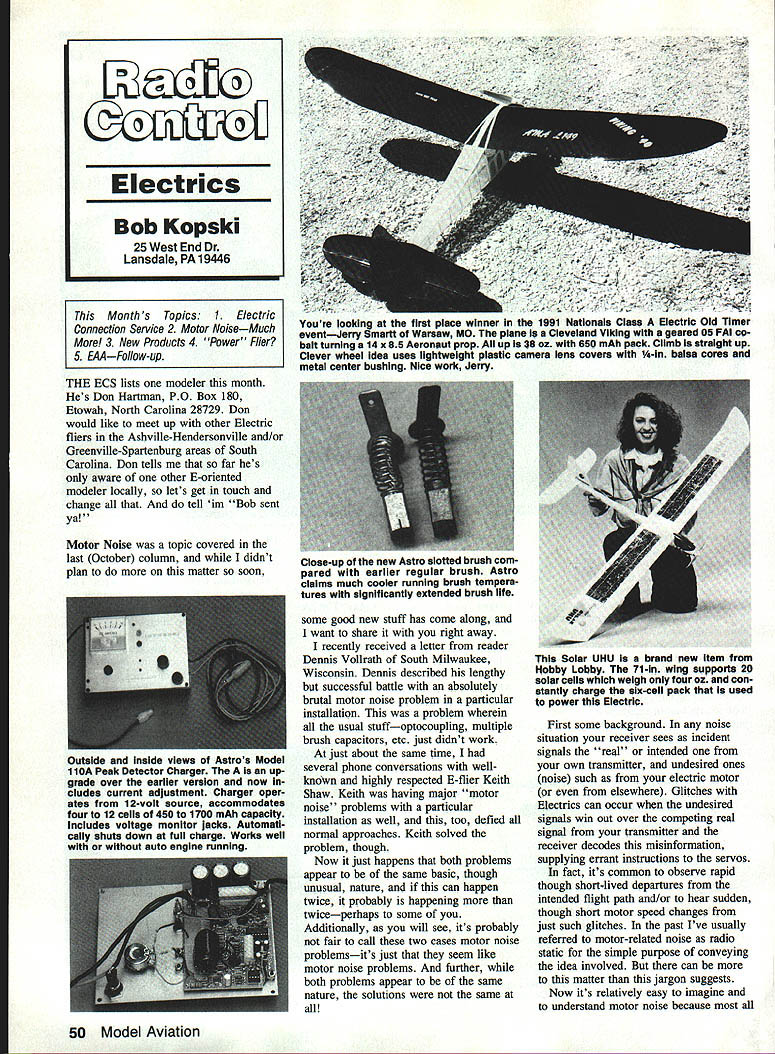
Radio Control: Electrics
Bob Kopski 25 West End Dr. Lansdale, PA 19446
This Month's Topics:
- Electric Connection Service
- Motor Noise—Much More!
- New Products
- "Power" Flier?
- EAA—Follow-up
Electric Connection Service
The ECS lists one modeler this month. He's Don Hartman, P.O. Box 180, Etowah, North Carolina 28729. Don would like to meet up with other electric fliers in the Asheville–Hendersonville and/or Greenville–Spartanburg areas of South Carolina. Don tells me that so far he's only aware of one other E‑oriented modeler locally, so let's get in touch and change all that. And do tell him "Bob sent ya!"
Motor Noise—Much More!
Overview
Motor noise was covered in last month's column, but two recent problem cases warranted a follow-up. Reader Dennis Vollrath (South Milwaukee, WI) described a severe interference problem that resisted the usual fixes (optocoupling, multiple brush capacitors, etc.). Around the same time, respected E‑flier Keith Shaw had a major motor‑noise problem of a similar—and unusual—nature. The root causes appear related, but the solutions were different.
How interference occurs
- Your receiver must pick up the intended signal from your transmitter. Undesired signals (noise) from the motor or elsewhere can compete with that signal.
- Typical motor brush sparking at the commutator produces broad‑spectrum energy, including radio frequencies. That interference can be radiated through the air or conducted through wiring to the receiver.
- Common countermeasures include properly installed brush capacitors, opto‑coupled speed controls, and chokes in speed‑control‑to‑receiver leads. These are often very effective.
The unusual problem: speed‑control switching harmonics
Some speed controls switch the motor voltage on/off very rapidly (short rise/fall times). That fast switching generates high‑frequency components—harmonics—much higher than the basic PWM clock. Critically, many receivers amplify fixed intermediate frequencies (IF): typically 10.7 MHz and 455 kHz (double conversion) or 455 kHz (single conversion). If the switching harmonics contain these IF frequencies, they can couple directly into the receiver's IF strip (often through wiring or by penetrating a nonmetal receiver case) and produce glitches that look like "motor noise" but are actually speed‑control harmonics.
Case 1 — Dennis Vollrath (shielding)
- Symptoms: severe glitching even a few feet from the transmitter; glitches occurred at partial throttle and were much reduced or absent at full throttle (because PWM switching is absent when output is full on).
- Diagnosis: Dennis used a 455 kHz resonant sniffer and an oscilloscope and found bursts of 455 kHz emissions time‑related to the speed control switching.
- Fix: He wrapped the receiver in a plastic bag, then wrapped that with three layers of household aluminum foil (forming a Faraday cage), then bagged it again so the foil wouldn't short anything. The interference disappeared. This illustrates that plastic receiver cases are more vulnerable to this kind of radiated IF coupling than old metal cases.
Case 2 — Keith Shaw (slowing transitions)
- Symptoms and cause were similar (harmonic content in the speed control switching).
- Fix: Keith increased the MOSFET gate‑drive resistor values in his speed control, which slowed the MOSFET switching transitions (increasing rise/fall times). That reduced the high‑frequency harmonics (lowered the higher‑order Fourier coefficients) and eliminated the interference.
- Warning: If you are not experienced with electronic modification, do not attempt this yourself. Send the speed control to the manufacturer or an experienced technician and explain the issue.
Practical guidance
- If you see glitching at mid throttle but not at full throttle, suspect IF‑frequency emissions from speed‑control switching.
- Try shielding the receiver and nearby wiring (a metal case or properly applied foil Faraday cage).
- If shielding fails, have the speed control modified to slow the output transitions or consult the manufacturer.
- Continue to use the standard motor‑noise countermeasures (brush capacitors, opto coupling, chokes) as they are often effective for brush‑spark problems.
- Larger power systems (higher voltages) are more likely to produce these sorts of problems.
Additional reference
Robert Johnson's article in the August 1991 issue of RC Report describes using ferrite toroidal cores with speed‑control and speed‑control/receiver wires wound on them to suppress interference. I have purchased the recommended parts but have not yet evaluated them; readers may find his approach worthwhile.
New Products
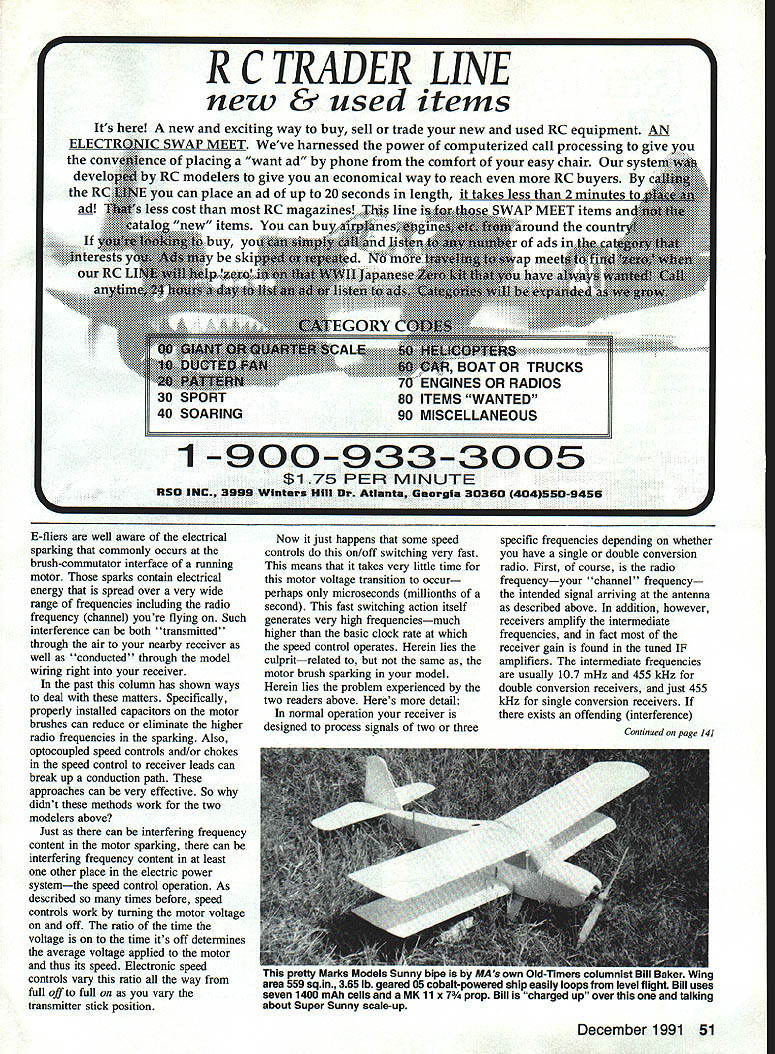
Hobby Lobby continually updates its electric product offerings. Catalog #18 should be available—contact Hobby Lobby, 5614 Franklin Pike Circle, Brentwood, TN 37027 or telephone 615/373‑1444. Jim Martin, head modeler at Hobby Lobby, sent photos and information on new electric items heading into the catalog. One interesting item is the Solar UHU: the wing supports four ounces of 20 solar cells with the caption "Fly for hours...."
"Power" Flier?
One of my pet peeves is the expression "power flier" used to distinguish glow or "wet" power fliers in a macho way. I see no meaningful distinction between electric and glow in terms of power. Others (rubber, CO2, compressed air, solar, springs, steam) also produce usable power for flight. Let's stop the macho labeling and accept electrics as full‑powered alternatives. For those who like thrills, see Byron Blakeslee's "Soaring" column in the October Model Aviation and check the Hobby Lobby catalog—there are some neat glider ideas.
EAA—Follow‑up
I invited reader comment in July 1991 about the Electric Aeromodelling Association (EAA), our SIG within the AMA. The idea was to learn whether the EAA represents the interests of most electric fliers or primarily those pursuing top‑end electric performance. Response was essentially zero—only one letter, which felt I was criticizing the EAA. That was not my intent; I only asked for reader feelings. The lack of response is, in my view, a strong message to the EAA.
This is the final column for 1991. Please enclose a SASE with any letter requesting a response. Have a good electric fall season!
Transcribed from original scans by AI. Minor OCR errors may remain.

