
Radio Control: Electrics
Bob Kopski 25 West End Dr. Lansdale, PA 19446
THIS MONTH'S TOPICS:
- The Electric Connection Service
- Must reading
- Some reader input—plus a video
- The Skyvolt—more
- Which motor/modeler's perspective
- Seniorita flight profile
The Electric Connection Service
The Electric Connection service, a service unique to this column and now 26 months old, is happy to introduce two electric modelers seeking to connect with others locally:
- Doug Evans, 1646 Lancaster Ave., Sarnia, Ontario, Canada N7V 3S8. If you missed the 1991 KRC meet, Doug can tell you all about it!
- Sam Falk, 540 Cress Creek Court, Crystal Lake, IL 60014. Sam has recently completed his electrified Seniorita (see Model Aviation July and August 1991) and is very happy with the elation it brings.
Must reading
I have a suggestion for you — dig up, beg for, borrow, or (well, not really) steal a copy of the December 1991 Model Airplane News and read the article entitled "Electric Twins" by Keith Shaw. In this article, Electric Grand Master Keith tells all about the subject so you can enthusiastically and confidently undertake your dream twin project. As I understand it, this is the longest single-issue article MAN has ever published, but that doesn't mean it's difficult reading. What it does mean is that there's lots of good info from a highly accomplished electric modeler. I think you'll find this a very worthy electric reference even if you're not interested in a multi-motor ship.
Many electric modelers will no doubt remember the "Tigerkitten E" construction article in Model Aviation, September 1991 by noted West Coast modeler Bob Benjamin. Bob and I occasionally share correspondence, and in a recent letter he told me of an inadvertent omission in that reference article. It turns out that a fiberglass cowl for the Tigerkitten is available from Fiberglass Master, and that should ease your construction effort considerably.
Bob also tells me that Model Aviation will be publishing an enlarged version called the Tigercat, scheduled for later in 1992. The Tigercat is designed around a geared cobalt 40 and has a 72-inch span. Based on the clear trend toward larger electrics displayed at the 1991 KRC meet, this should be a well-received article. As an incidental, Bob has entered the MA "RC Electrics" column electric license plate contest. Where's your entry?
Some reader input — plus a video
At about the same time I received this correspondence, another West Coast Bob sent me a draft VHS tape designed to promote electric flight. Bob Boucher, head modeler at Astro Flight, has developed this 30-minute tape to demonstrate the capability electric offers. The Astro tape, entitled "Let's Get Serious About Electric Flight," features — you guessed it — Bob Benjamin, pilot and narrator!
Bob demonstrates several electrics — including the Tigerkitten and Tigercat. The video is good, and pilot Bob does a fine job of describing electric flight, planes, techniques, and accessories. As I write this, price and availability of the final version of the Astro tape are not known, but it is something to watch for. If you or your club needs some electric persuasion, I encourage you to write Astro Flight and find out more about this tape. And do tell 'em Bob sent ya!
Every now and then I receive a letter wherein the reader expresses significant disappointment with his electric endeavors — enough to make him give up on electric. Usually one of the three following reasons appears to be the problem: a plane that's just too heavy (often a wet conversion), an inappropriate match of motor, battery and model, or a poor choice of plane, battery or speed control for that particular model. I'd like to pursue this last reason in more depth.
One experienced modeler wrote about his kind of electric disappointment. For his first electric he chose a popular electric sailplane kit which included a motor. The model name isn't important; in fact there is more than one similar model on the market, so I'll just call his model "T."
The reader explained that it did not fly very long—about five minutes—and would not thermal. He added that it was hard to fly in "just a little wind," and, in all, was a disappointment. I wrote back and asked what the plane weighed, what motor he had, how big a battery, what prop was used, and whether a speed control was used. He replied: plane 58 oz.; motor Astro .05; battery six NiCd cells; prop 7 x 5; no speed control.
My reply was that this was not a good match. The Astro .05 is a nice motor for small, light jobs, but it is not meant to push a wet-conversion sailplane weighing this much. The 7 x 5 prop is too fine a pitch; the battery is marginal; and without a speed control the only way to reduce power on landing or to make the model more manageable is to change props or reduce pack voltage.
I suggested several remedies: lighten the plane where possible; use a larger motor (or a geared drive); use a lower-pitch, larger-diameter prop such as 9 x 6 or 10 x 6; increase battery capacity; and consider a speed control. Any one of these changes — and better yet a combination — would have made the model more satisfactory.
Sometimes a reader will balk at using a speed control because of the cost or perceived complexity. However, a modern electronic speed control will do more to extend usable flight time and make the model easier to fly than almost any other single item you can add. If you buy only one accessory for your electric conversion, make it a speed control.
There are many other variables and combinations, but if you keep weight down, match motor, prop and battery, and use a speed control, you'll be ahead of the game.
That's it for this month. I hope that your winter Giant project is coming along famously and will be ready to fly when the spring zephyrs blow.
Which motor/modeler's perspective
On the other hand, his wet-powered Buzzard Bombshell and his Gentle Lady sailplane (about the same size) flew much better. The wet-powered plane had more power, and both flew long with good ability to thermal.
Now it happens that the kit I often recommend to beginning pilots who enter the hobby electrically (not wet) — and who also express a preference for a sailplane to train with — is an economy electric sailplane kit. I may also recommend this product to more experienced pilots who want an economy electric sailplane just to cruise around with on summer evenings. Indeed, many average modelers doing average flying have had lots of fun with it.
Of the many I've encountered, nearly all were powered with the economy .05 can motor supplied with the kit. This motor is usually intended to drive an 8 x 4 direct using six or seven cells. I'd also say that the overwhelming majority of these planes fell in the 46- to 50-ounce category—about right for a two-meter electric sailplane design. And, while these planes as configured do fly and even thermal, I'd agree that they are probably not competitive with a half-the-weight non-electric sailplane of similar size; nor with a wet-powered O.T., such as this reader was used to.
To be totally candid, the stock kit with its stock motor can at best be described as adequate. These model/motor combinations, while relatively easy to fly in good air, are definitely not spirited. For the available power, the size and weight of the model allow a climb speed just a little greater than glide speed, and the model goes up gently; but that's it. And yes, it doesn't take much headwind to cause a flight struggle.
But all things considered, such a model is often just what a beginning (and not-so-beginning) pilot needs — a more docile, not-too-powerful, economy plane.
Some have argued that economy electric offerings do more harm than good because their "poor performance" gives electric a bad image. While that sometimes happens, I'm satisfied these products are among the best things that have happened to electric in the past decade—on average doing far more good than harm.
This conviction is based on first-hand experience with student and experienced pilots' success and satisfaction on the field, and from my incoming mail. The latter has brought stories of many modelers, even non-beginners, who got their electric start in this economical way and who then continued onward and upward with bigger and better electrics.
So, I have no choice but to applaud the manufacturers who, having been established as wet-model suppliers for many years, have in recent years offered a wide variety of economy electric kits with economy electric motors. I call it merchandising electric—bringing adequate electrics easily into the hands of more modelers than anything else I know of.
At this point, I'm including in this reference only the dozen or so economy electrics with motors that are now on the market—they vary in sailplane configuration or not.
As long as I'm instructing beginners and otherwise assisting modelers at large who often have limited financial resources, I'll continue to suggest planes/power systems such as these—and I'll also be sure to advise of associated limitations.
As my student pilots gain experience and ability, I'll suggest enhancements, or even alternative models or variations.
For example, a sailplane built with a geared cobalt .05 and a folding prop becomes an entirely different model — one having much greater climb capability. In fact, one of my fellow club members recently followed this course—learned to fly with a slower stock .11, then upgraded the same model as described above and got a significant improvement in capability at a time when he had the skill (and resources) to handle it.
Of course, an advancing pilot has more choices than the upgraded one, and these include such kit model options as the Challenger, Electric Hots, Electro Streak, Skyvolt, and others—especially when outfitted with more capable controls.
To summarize, what's important is to suitably match a model and power system to the modeler and his personal interests, expectations, needs, resources, abilities and limitations. There are now plenty of good electric choices on the market for everyone — including those with higher expectations. There's nothing like success to sell electric to yourself and to others, and while success means different things to different people, disappointment means the same thing to everyone: "Electric's not so good!"
If you're not sure what's a good choice for you, write me, and I'll do my utmost to help out. But before you press pen to paper, take a look at my August 1991 column — it will help you more readily get what you really need!
Finally, I can't help feeling strongly about all of the above for a simple reason. Despite the fact that I'm approaching the twentieth anniversary of my first successful electric flight, I still remember well how that flight was made — with a cheap reworked toy motor from Radio Shack, a flimsy homemade gearbox, grossly inappropriate batteries, and a super-light model designed with a tiny custom-built pulse-rudder controller. The plane made one shoulder-height circle around the field and then slowly sank. But it flew! In 1972, it flew! Oh, what joy! The beginning of electric elation for me!
This was no small accomplishment, for it took months of failure to get this far. Indeed, the lowly kit of today would have been a blazing success back then. Folks — everything is relative.
Seniorita flight profile
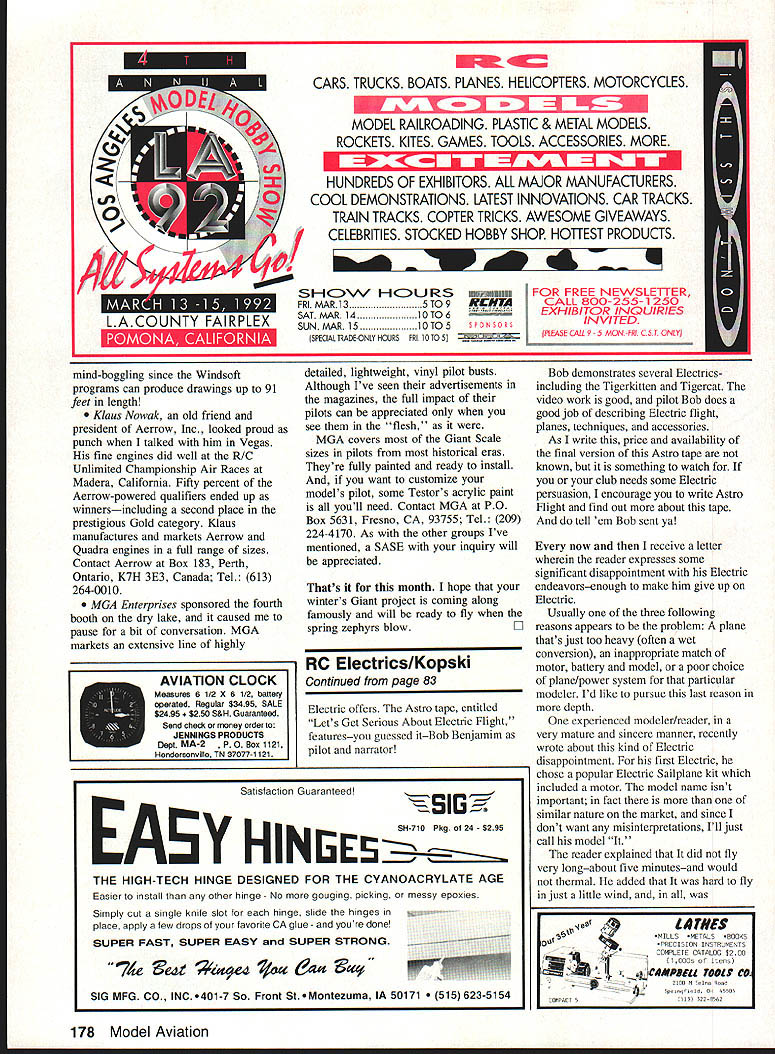
The electrified Seniorita, presented in the July and August 1991 issues as an example of a wet-to-dry kit power conversion, has been a highly successful and popular plane. I find myself flying this electric a lot — not because it's a dynamite ship, but because it's not! Regular readers will recall earlier discussions of how I like to let field visitors take the controls of this gentle flier.
As I was wrapping up this column I wondered what the flight profile of this model would actually look like if plotted, so I tallied up the flights in my logbook. The histogram (shown elsewhere) depicts what flight times look like for this plane. In all, 282 flights are plotted in half-minute segments. It is clear that the vast majority of Seniorita flights fall between eight and 10½ minutes duration.
Those few flights falling below six or seven minutes were special in some way — for example, partial charges, or short test hops to compare props. Flights longer than 11 minutes or so were also special; these might have included evaluations of cruise power levels or even some thermal activity. Those in the big pile-up are just normal flights including taxi, takeoff, some loops, lots of touch-and-goes (which the Seniorita does extremely well) and plain flying around!
By the way, the model uses 14 SCRs turning a geared Cobalt .25, with all charges being timed charges — no peaking is ever done.
With that outlook, another column closes. Please enclose a SASE with any letters for which you'd like a reply.
Meanwhile, come on, Electric Springtime!
Transcribed from original scans by AI. Minor OCR errors may remain.

