
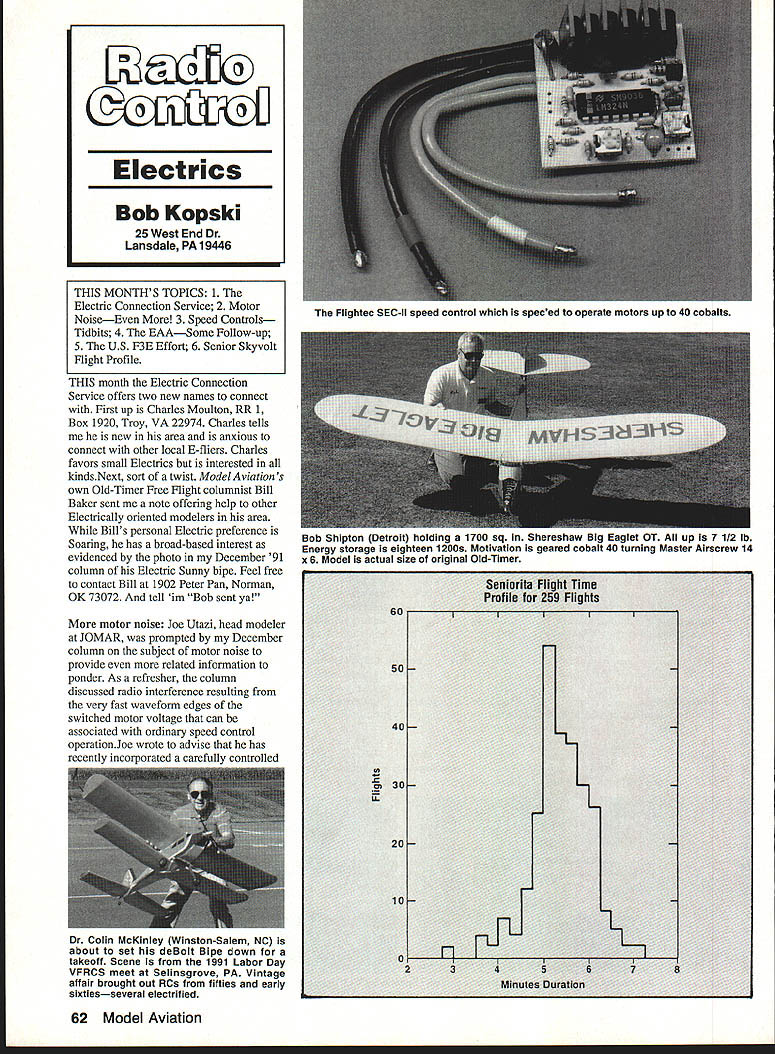
Radio Control: Electrics
Bob Kopski 25 West End Dr. Lansdale, PA 19446
THIS MONTH'S TOPICS:
- The Electric Connection Service
- Motor Noise—Even More!
- Speed Controls—Tidbits
- The EAA—Some Follow-up
- The U.S. F3E Effort
- Senior Skyvolt Flight Profile
Electric Connection Service
This month the Electric Connection Service offers two new names to connect with.
- Charles Moulton
RR 1, Box 1920, Troy, VA 22974 Charles tells me he is new to his area and is anxious to connect with other local E‑fliers. Charles favors small electrics but is interested in all kinds.
- Bill Baker (Model Aviation’s Old‑Timer free‑flight columnist)
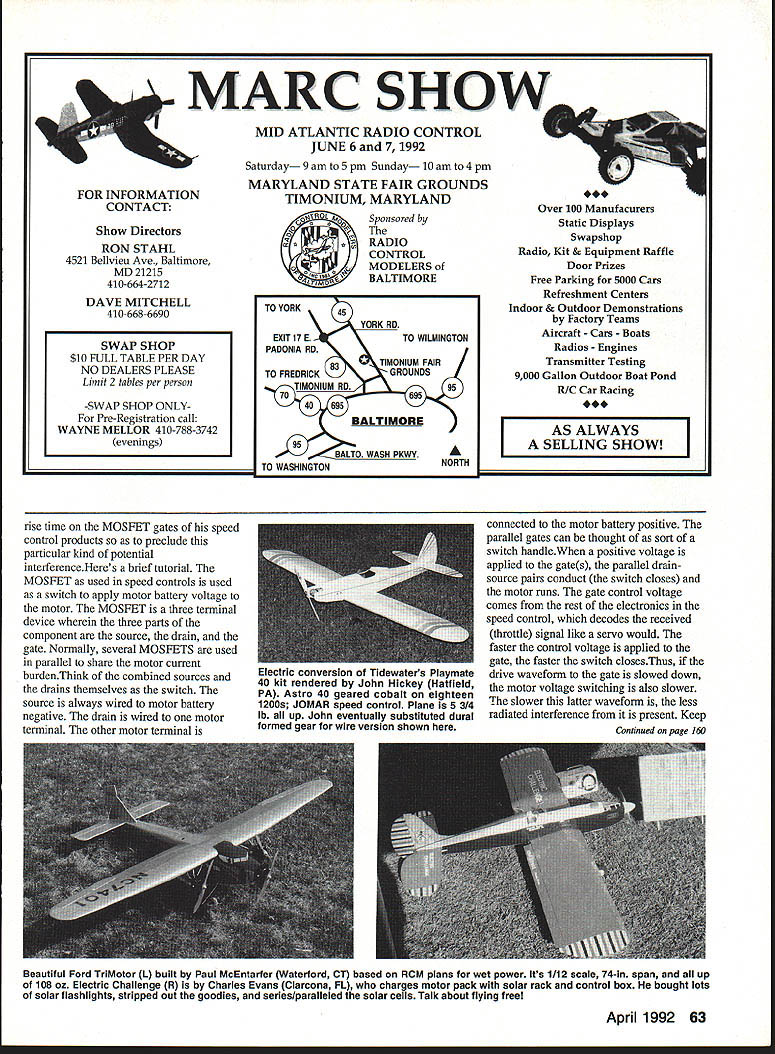
1902 Peter Pan, Norman, OK 73072 Bill sent a note offering help to other electrically oriented modelers in his area. Bill’s personal electric preference is soaring, but he has a broad‑based interest (see the Electric Sunny biplane photo in the December ’91 column). Feel free to contact Bill — tell him “Bob sent ya!”
Motor Noise — Even More!
Joe Utazi, head modeler at JOMAR, responded to the December column on motor noise and provided further information. The December piece discussed radio interference resulting from very fast waveform edges of switched motor voltage associated with ordinary speed‑control operation. Joe advised that he has recently incorporated carefully controlled rise times on the MOSFET gates in his speed controls to reduce this type of potential interference.
MOSFET tutorial (brief)
- A MOSFET used in a speed control is a three‑terminal device: source, drain, and gate.
- Several MOSFETs are normally used in parallel to share motor current; the combined sources and drains form the switch.
- The source is wired to motor battery negative; one drain is wired to a motor terminal; the other motor terminal goes to motor battery positive.
- The gates act like a switch handle: applying a positive voltage causes the drain‑source pairs to conduct and the motor to run.
- The speed control decodes the received throttle signal and applies gate drive voltage accordingly. The faster the gate drive waveform rises, the faster the switch closes and the sharper the motor voltage edges.
- Slowing the gate drive waveform reduces the speed of the motor voltage switching and reduces radiated interference — but not too much. If the gate drive is too slow, MOSFETs run hot and efficiency suffers. Joe’s products are optimized to balance these tradeoffs.
Keep in mind the gate transition times are still extremely short (tens of millions of a second). This switching speed is not the same as the speed control switching rate (frame rate or high rate). Frame rate applies battery voltage about 50 times per second; high rate is usually several thousand times per second. The December 1989 column discussed the relative merits of both types and appears to have accelerated the decline of frame‑rate controls for model aircraft applications.
Joe also noted that power‑system‑related interference can be greater with higher‑resistance batteries. He has found that certain cell types (for example, SCEs) seem to exacerbate noise compared with others (for example, SCRs). In addition, JOMAR has upgraded its SM series speed controls by switching the PCB material to FR4 (more crash resistant than the previous ceramic type) and by using an upgraded automotive‑type regulator design that tolerates line spikes better. “SM” indicates surface‑mount components, which reduce assembly size. JOMAR’s new address: JOMAR, 8606 Susannah Lane, Cincinnati, OH 45244; Tel: 513/474‑0985.
Speed Controls — Tidbits (High Rates, Ratings, and Compatibility)
- High rates: Lately, many RC car speed control manufacturers have adopted high‑rate techniques. Some advertising inflates specs (e.g., claiming 600 A capability) in ways that are likely unrealistic for typical model installations.
Example calculations to show impracticality:
- Consider a connector with contact resistance ~228 micro‑ohms (0.000228 Ω). At 600 A, power loss per contact would be I^2R = 600^2 × 0.000228 ≈ 82 W (164 W for a two‑pin connector) — instant meltdown.
- One foot of #16 wire has a resistance of about 0.00442 Ω. At 600 A, voltage drop ≈ 600 × 0.00442 ≈ 2.7 V and power dissipated ≈ 2.7 × 600 ≈ 1,620 W — melted wire.
Such exaggerated ratings are usually hype. If readers can provide a practical justification for such specifications, I’ll report it; otherwise, be skeptical.
- Compatibility: Some speed controls require higher input‑pulse amplitudes than some receivers provide. Charles (from the Electric Connection Service) found this out the hard way and used an interface buffer to convert the receiver output to a higher voltage swing. I pulled the receiver (Rx) from my Senior Skyvolt and measured servo drive pulses of just over 3 V. The Horak speed control I tried operates below 1 V input, so that particular receiver/control combo worked fine. Other receivers output more than 3 V and other speed controls may require different minimum input amplitudes. If you install a new receiver and speed control and the combo doesn’t work, check for possible incompatibility before assuming you miswired things.
The EAA — Some Follow‑up
In February I described what seemed like a “nobody home” situation at the EAA: several letters and dues checks had gone unanswered. In a recent telephone conversation with Steve Neu (U.S. F3E Team), I learned the situation is largely because a few interested volunteers were trying to do all the work and eventually couldn’t sustain it; some have simply given up. Many clubs suffer from a small active core doing most of the work while the rest of the roster enjoys the benefits. The EAA is at a bit of a standstill and there is discussion of revitalization in the future. If you have written or sent dues and received no response, this helps explain part of why.
The U.S. F3E Effort
Speaking of Steve Neu, I first met him at the 1991 KRC meet where his F3E machines performed spectacularly. The KRC club was so impressed it voted to send a donation in support of the U.S. F3E Team. Most readers are sport fliers with little competitive interest — same here — but I view the U.S. F3E effort as a worthy electric endeavor and encourage clubs or individuals to consider lending support. Steve is scheduled to compete in August 1992. I’ve offered him some column space to describe F3E activity more fully so we can build broader support for the team. Stay tuned.
Senior Skyvolt Flight Profile
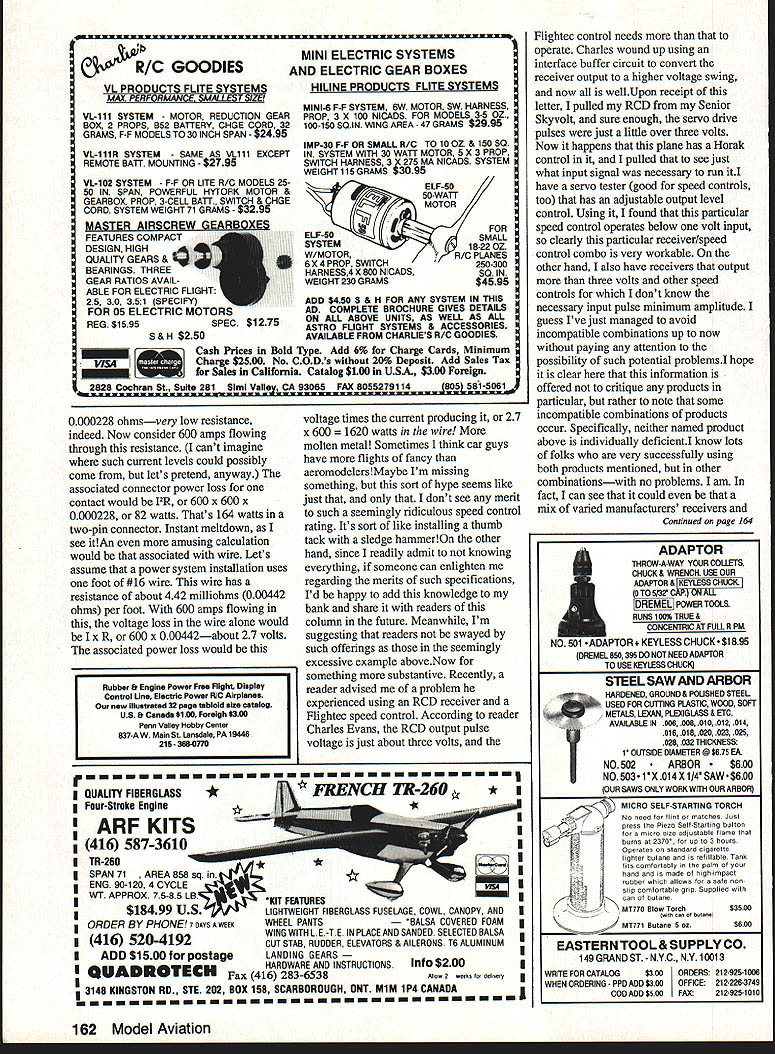
This column presents the flight profile for my Senior Skyvolt. The plot time chart (in the original column) characterizes 259 flights of the big Skyvolt, including flights by other pilots. Flight time is shown in 15‑second increments. The histogram shows the Senior Skyvolt is basically a five‑ to six‑minute airplane. Flights much shorter or longer than that were generally experimental (incomplete charges, prop changes, cruise‑power flights, etc.) and atypical.
For reference:
- The Senior Skyvolt is a scale‑up of the Skyvolt (January 1991 MA).
- It weighs about 85 oz and has about 600 sq in wing area.
- Motor: a .40‑size direct‑drive motor.
- Energy storage: eighteen 1,200 mAh cells.
This plane is a very capable aerobatic craft — in many hands it outperforms the pilot. It is flown differently than my Seniorita; the Skyvolt is almost always flown with essentially continuous maneuvers. I play the throttle throughout the flight to conserve energy when possible and to apply extra power when needed; I believe that yields the best overall flight.
A favorite maneuver set I use to promote electric flight: take off, immediately roll inverted low to the ground, climb through a half loop, roll inverted again and hold briefly, then pull an inverted snap — all within seconds of takeoff. This sequence has convinced more than one electric skeptic.
Charging: Like the Seniorita’s pack, the Skyvolt pack is always time‑charged using the timer control on one of several chargers I own. Peak charging might add some flight time, but I don’t want to wait an extra five minutes or more during charging just to gain a few tens of seconds aloft — after all, I’m a sport flier.
Please enclose a SASE with any correspondence for which you’d like a reply.
Happy electric springtime landings, everyone!
Transcribed from original scans by AI. Minor OCR errors may remain.

