
Radio Control: Electrics
Bob Kopski 25 West End Dr. Lansdale, PA 19446
This month's topics
- Meet announcements — Advance, NC and Kent, WA
- The American F3E effort
- Batteries and charging for beginners
Meet announcements
- Sixth Annual Current News Challenge (Electric meet)
- Dates: May 2–3
- Sponsor: Winston-Salem RC Club
- Contest Director: Charlie Spear (co-author of the monthly Electric column in RC Report magazine)
- Location: Thrift Field, Advance, North Carolina
- Awards: Prizes for Scale, Beauty, Most Impressive, All‑Up/Last‑Down; awards also for AMA events 610 and 618.
- Contact: Charlie Spear, 288 Holly Ln., Mocksville, NC 27028
- Tenth Annual Electric RC Fly‑In (Puget Sound Electric Model Flyers)
- Dates: June 27–28
- Location: PSEMF home field, Boeing Kent Space Center Field, Kent, Washington
- Events/Prizes: Most Aerobatic, Best Scale, Longest Flight, Most Impressive, Best Multi‑Motor; AMA 609 event. CD will also award discretionary Special Achievement awards.
- Contact: Bernard Cawley, 29838 48th Ave. S., Auburn, WA 98001; tel. 206‑839‑9157
- Assistant CD: Ben Almojuela, 1941 6th Ave. W., Seattle, WA 98119; tel. 206‑283‑3407
- Note: Contact Charlie, Bernard, or Ben — tell 'em Bob sent you.
The American F3E effort
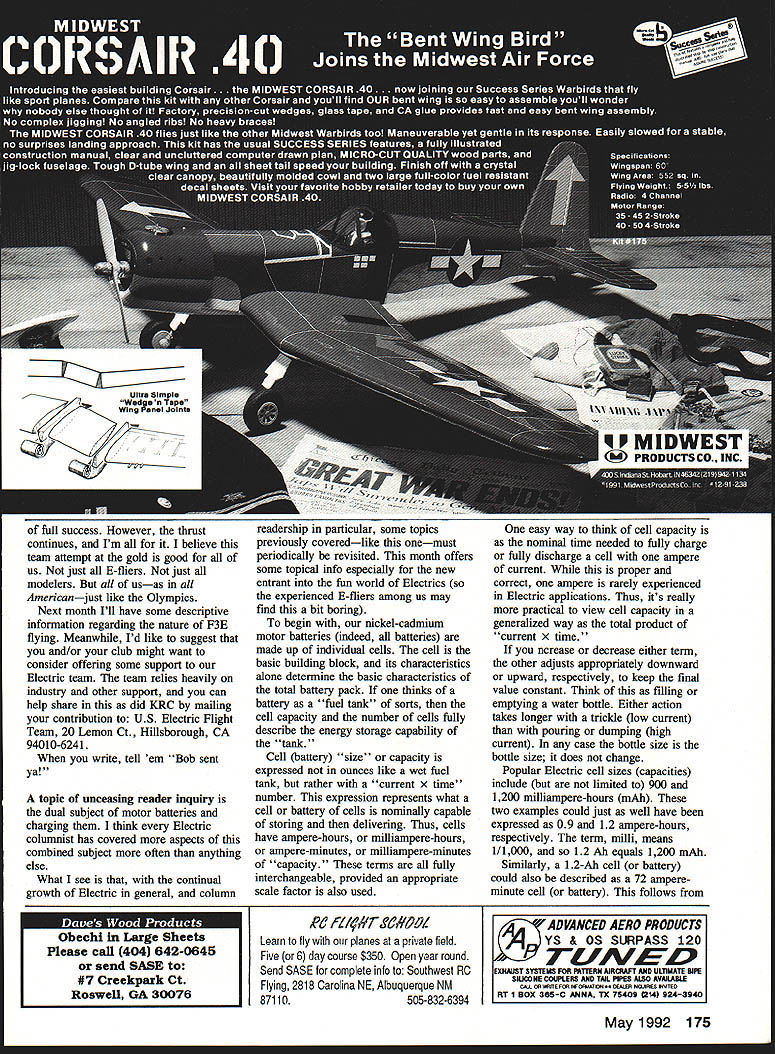
The 1992 U.S. F3E team will be wearing a special emblem at the World Championships in Holland this coming August. Brian Chan, chairman of the F3E Team Fund Raising Committee, invites everyone to support the team by buying raffle tickets for merchandise being donated by the modeling industry. Raffle tickets will be available after donations are tallied.
You can also support now by purchasing a team T‑shirt, patch, and pin for $12, $5, and $3, respectively. Send payment to: U.S. Electric Flight Team, 20 Lemon Ct., Hillsborough, CA 94010‑6214.
Batteries and charging for beginners
A topic of unceasing reader inquiry is motor batteries and charging them. With the growth of electric flight and column readership, basic topics like this should be periodically revisited. This installment is aimed especially at newcomers to electrics.
#### Cells and battery capacity
- Batteries are made up of individual cells. The cell is the basic building block; the characteristics of the cell determine the overall battery characteristics.
- Capacity is expressed as current × time: ampere‑hours (Ah) or milliampere‑hours (mAh). These are interchangeable with appropriate scale factors (1.2 Ah = 1,200 mAh).
- Another useful unit is ampere‑minutes: 1 Ah = 60 A·min. For example, a 1.2 Ah pack = 72 A·min; a 0.9 Ah pack = 54 A·min. The minutes descriptor can be convenient for flight-time estimates.
Examples:
- A motor drawing 20 A from a 1.2 Ah pack would run for 1.2 Ah / 20 A = 0.06 hours = 3.6 minutes (3 min, 36 sec).
- Recharging that same pack at 4 A would take 1.2 Ah / 4 A = 0.3 hours = 18 minutes (nominal).
Note: All capacity values are nominal. Actual capacity varies with manufacturing tolerances and discharge/charge conditions. A pack will show more effective capacity at low discharge currents than at high discharge currents. "Fully charged" often requires somewhat more input than the nominal capacity implies.
#### Cell terminals and wiring
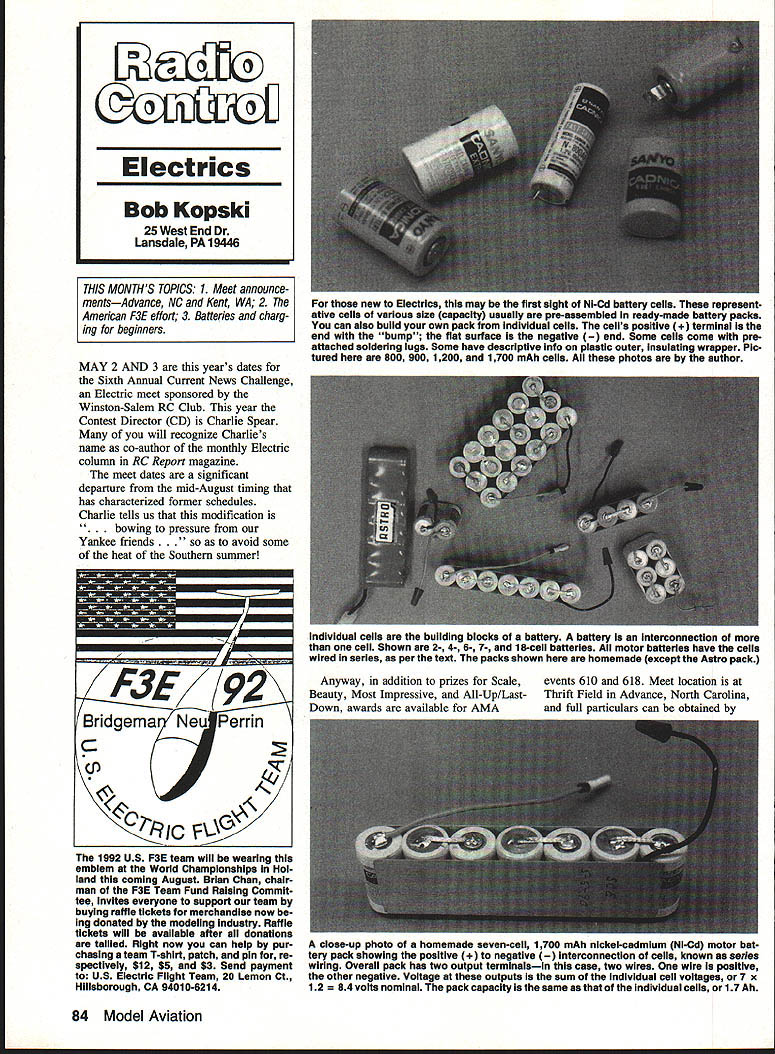
- Every cell has two terminals: positive (usually a centered raised bump) and negative (usually a flat surface). Some cells have + or − markings on the ends or on the wrapper.
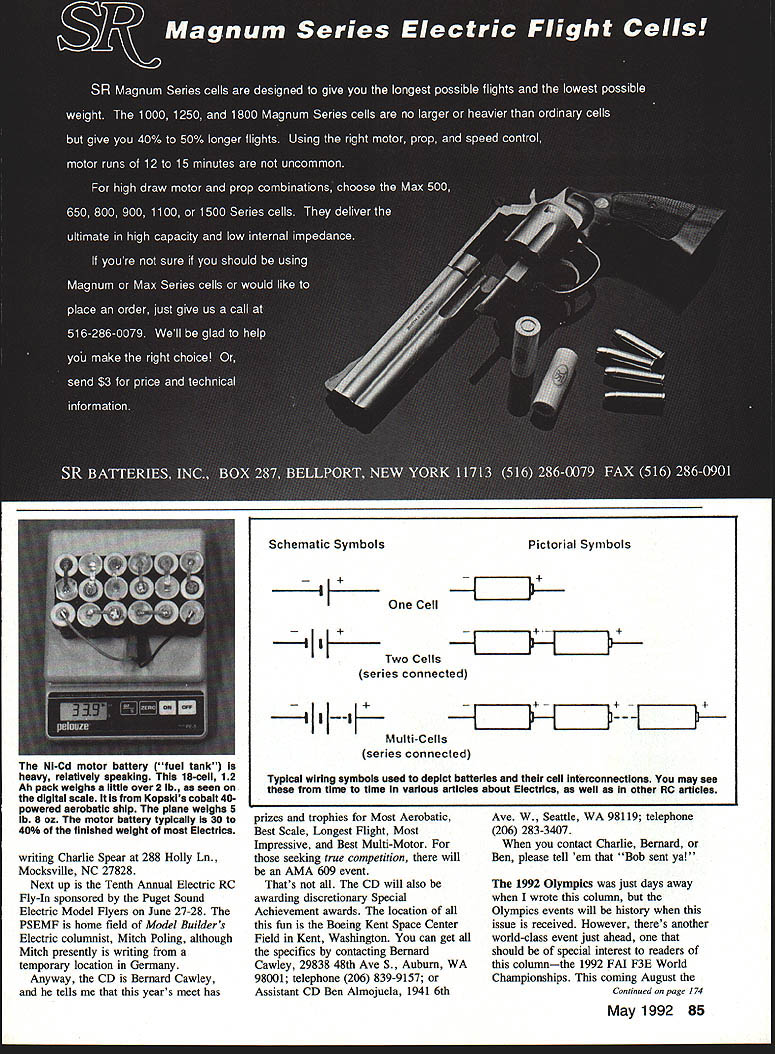
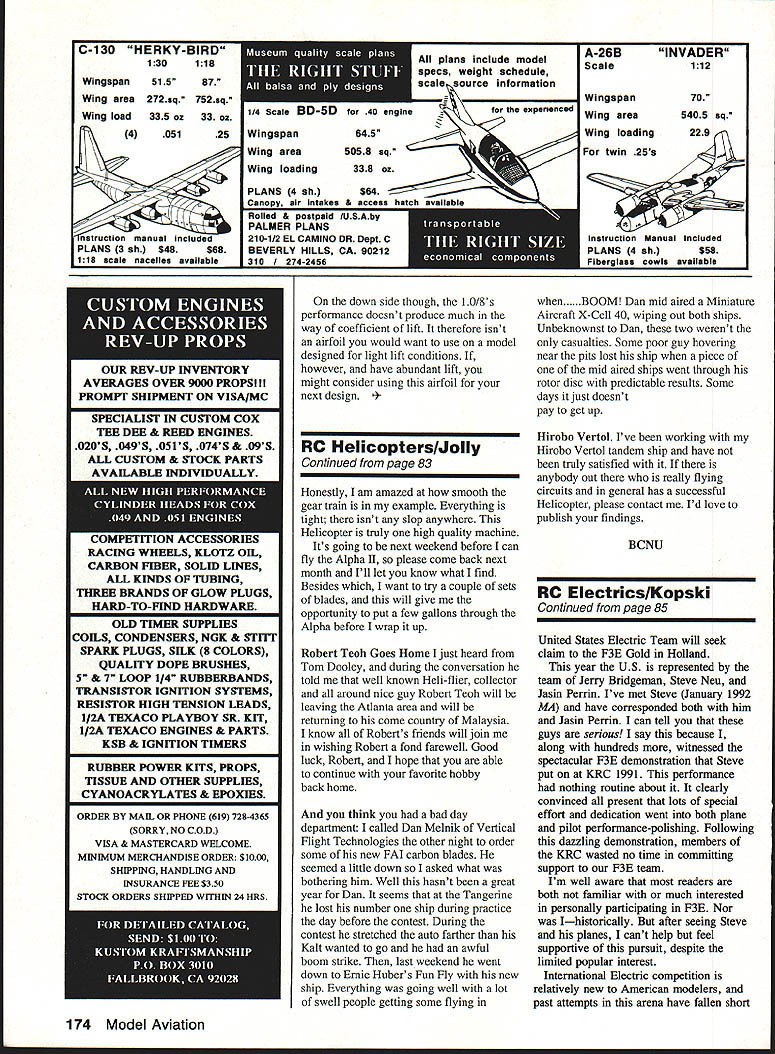
- Motor batteries have cells wired in series: the positive terminal of one cell connects to the negative terminal of the next. The overall pack ends up with one positive and one negative output terminal. Series wiring sums the individual cell voltages, while the ampere‑hour capacity remains equal to that of a single cell in the series string.
- Some cells come preattached with soldering lugs; others have descriptive information on a plastic insulating wrapper.
Captioned illustration (typical wiring symbols and packs):
- Typical wiring symbols depict 2-, 4-, 6-, 7-, and 18‑cell batteries. Motor batteries have cells wired in series. Packs shown may be homemade except for factory packs (e.g., Astro). Close‑up: homemade seven‑cell 1700 mAh Ni‑Cd motor battery pack showing positive terminal connection. Cells wired in series produce an overall voltage equal to the sum of cell voltages (e.g., 7 × 1.2 V nominal). Pack capacity equals individual cell capacity (e.g., 1.7 Ah).
#### Timed chargers vs peak detectors
- Timer‑controlled chargers: practical and fast when used properly. They require you to know or assume the pack's starting state of charge to avoid overfilling. Example field practice: if you choose a desired timer period (e.g., 15 minutes), set the charge current so the pack will be nearly full when the timer ends.
- Peak‑detector (peak‑charge) chargers: detect the end‑of‑charge point and usually provide a fuller charge. They are safer when the pack's starting condition is unknown and are preferred when maximum pack output is required.
Field practice and personal approach:
- I consider a pack "empty" when the airplane shows a telltale rpm drop and cannot maintain level flight — that is when I stop flying. With experience, that "empty" condition is easily recognized.
- For typical 1.2 Ah motor packs, I charge at about 4.5 A for 15 minutes. This delivers a total charge a little below the label value and helps avoid overcharging. If a pack were exactly 1.2 Ah, a 15‑minute (0.25 h) full charge would be 1.2 Ah / 0.25 h = 4.8 A. I choose 4.5 A to be conservative.
- When I want a truly full charge (e.g., for competition or experimentation), I use a peak charger and "set and forget." Peak charging generally takes longer, and for sport flying I prefer the speed and predictability of timed charges. Also, I have more timer‑controlled chargers than peak chargers.
Advantages and limitations:
- Peak chargers: little concern about the beginning‑of‑charge condition; can safely charge a partially charged pack.
- Timer chargers: require knowing or estimating the starting charge; risk of overcharging if the pack was already partially charged.
There is more to cover on batteries and charging; this topic will continue in future columns. Beginning electric fliers may want to save this installment and combine it with future additions.
Please enclose a SASE with any correspondence for which you'd like a reply.
Happy, quiet, electric landings, everyone!
Bob Kopski
Transcribed from original scans by AI. Minor OCR errors may remain.

