
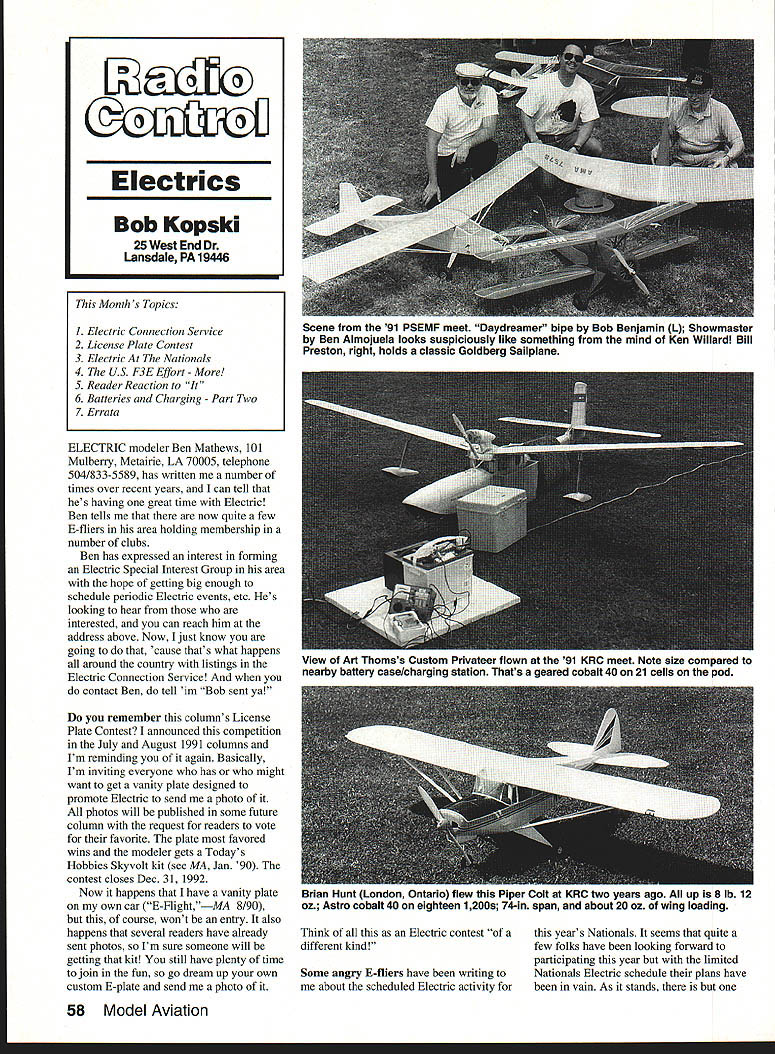
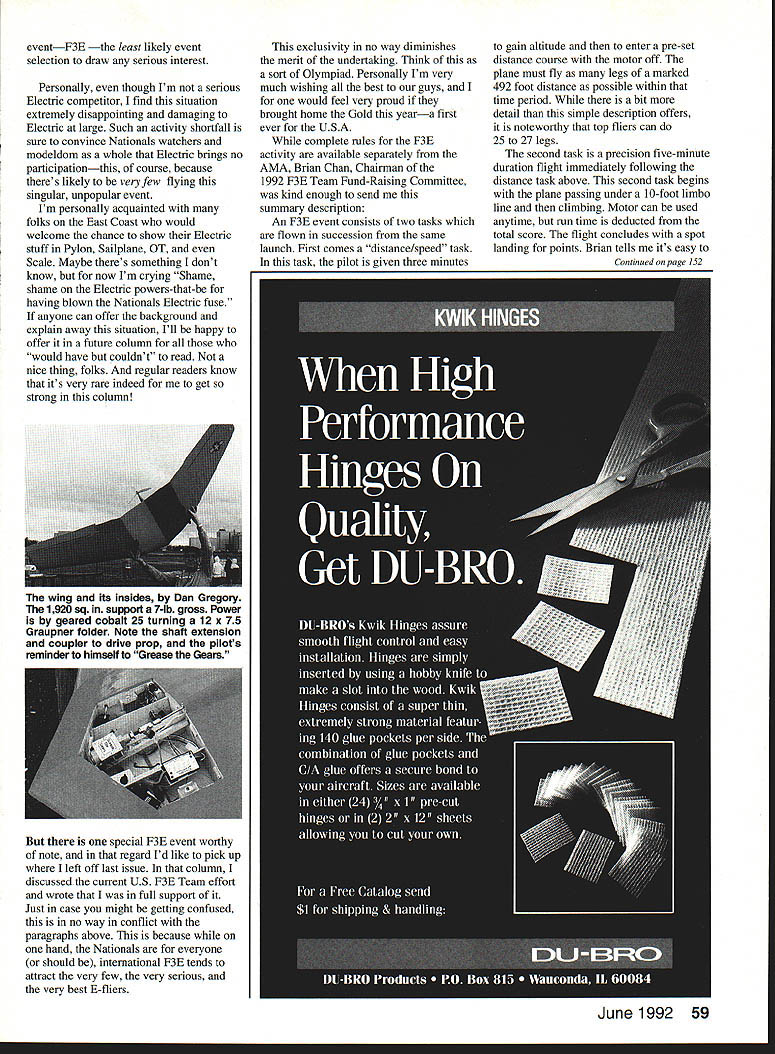
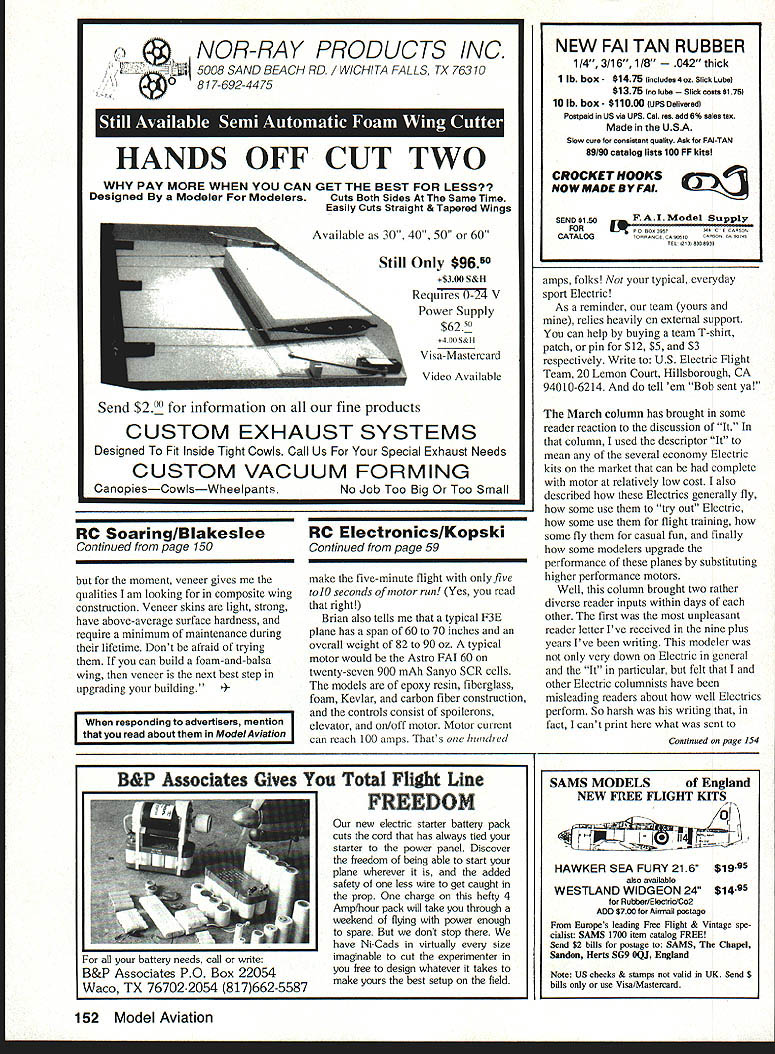
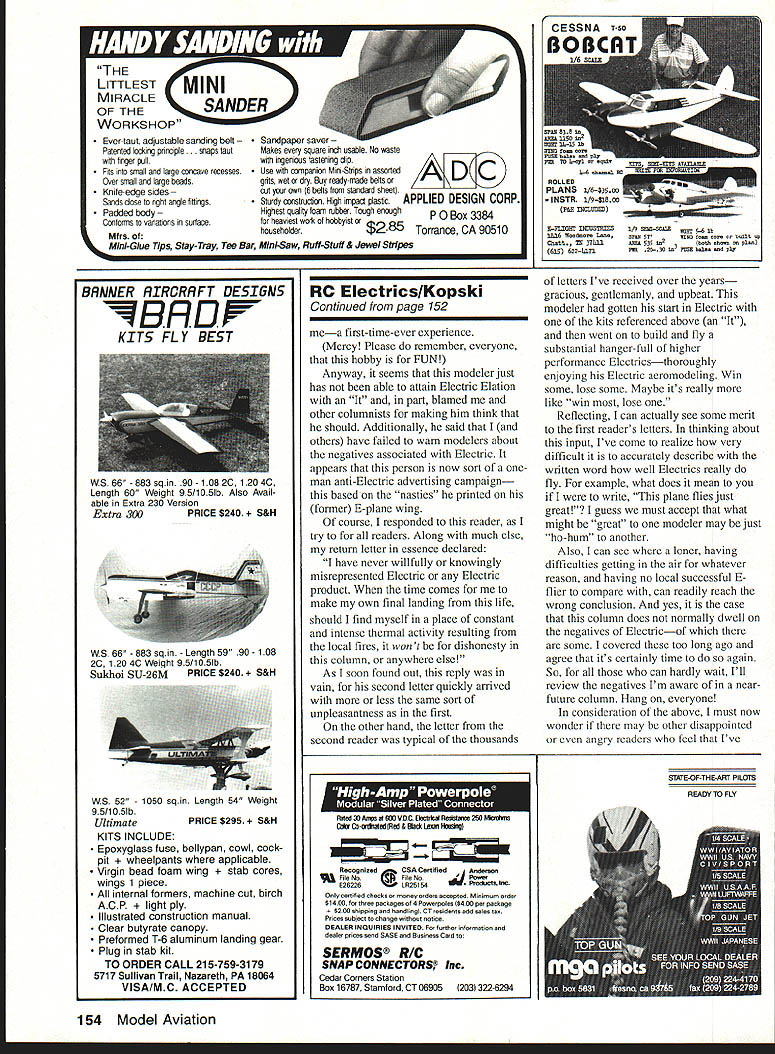
Radio Control: Electrics
Bob Kopski 25 West End Dr. Lansdale, PA 19446
This Month's Topics:
- Electric Connection Service
- License Plate Contest
- Electric at the Nationals
- The U.S. F3E Effort
- Reader Reaction to "It"
- Batteries and Charging — Part Two
- Errata
Electric Connection Service
Electric modeler Ben Mathews 101 Mulberry, Metairie, LA 70005 Tel: 504-833-5589
Ben Mathews has written me numerous times over recent years and I can tell he's having a great time with electric flight. He reports that quite a few E-fliers in his area are members of local clubs. Ben is interested in forming an Electric Special Interest Group in the area with the hope of scheduling periodic electric events. He's looking to hear from interested folks; contact him at the address or telephone above. And when you do, tell him "Bob sent ya!"
License Plate Contest
I'm reminding readers about the License Plate Contest announced in the July/August 1991 columns. I'm inviting anyone who has—or might want to get—a vanity plate designed to promote electric flight to send me a photo. All photos will be published in a future column, and readers will be asked to vote for their favorite. The plate receiving the most votes will win a Today's Hobbies Skyvolt kit (see MA, Jan. 1990).
- Prize: Today's Hobbies Skyvolt kit
- Contest closes: Dec. 31, 1992
Several readers have already sent photos, so someone will win. There's still plenty of time to enter—dream up your custom E-plate and send a photo.
Electric at the Nationals
Several angry E-fliers have written about the limited electric activity at this year's Nationals. Many expected to participate but found the Nationals electric schedule disappointing. As it stands, there is only one event—F3E—which is unlikely to draw broad interest.
Personally, although I'm a serious electric competitor, I find the situation extremely disappointing and damaging to electric modeling in general. A shortfall in scheduled electric events tends to signal to Nationals watchers and modelers that electric brings little participation. I know folks on the East Coast who would welcome a chance to show electric pylon, sailplane, OT scale, and other entries.
If anyone can explain the background to this limited Nationals schedule, please write and I'll publish the explanation in a future column.
The U.S. F3E Effort
I want to reiterate my full support for the current U.S. F3E team effort. International F3E attracts very few, very serious competitors; its exclusivity does not diminish the merit of the undertaking—think of it as an Olympiad. I hope the best guys bring home gold someday.
Complete F3E rules are available from the AMA. Brian Chan, Chairman of the 1992 F3E Team Fund-Raising Committee, sent a summary description:
An F3E event consists of two tasks flown in succession from the same launch.
- Distance/Speed Task
- The pilot has three minutes to gain altitude and enter a pre-set distance course.
- With the motor off, the plane must fly legs marked at 492 feet; the number of legs possible within the time varies. Top fliers can manage about 25–27 legs.
- Precision Duration Task
- Immediately following the distance task, the plane flies a precision five-minute duration.
- The task begins by passing under a 10-foot limbo line, climbing to a pre-set altitude, and performing precise maneuvers for scoring.
- Motor can be used anytime, but run time is deducted from the total score. The flight concludes with a spot landing for points.
Brian also notes that it's easy to reach 100 amps in F3E—far beyond typical sport electric currents.
The U.S. team relies heavily on external support. You can help by buying a team T-shirt ($12), patch ($5), or pin ($3). Write to: U.S. Electric Flight Team, 20 Lemon Court, Hillsborough, CA 94010-6214. And do tell 'em "Bob sent ya"!
Reader Reaction to "It"
The March column discussed "It"—a shorthand for economy electric kits that can be had complete with motor at relatively low cost. I described how these models generally fly, how some use them to try out electric flight, others for training, casual fun, or as a basis for upgrades with higher-performance motors.
Responses to that column were mixed. One reader sent a very unpleasant letter, strongly critical of electric flight in general and of "It" in particular; the tone was harsh enough that I cannot reprint it here. Another reader sent a gracious, upbeat letter: he started with an "It" kit and went on to build and fly a hanger‑full of higher-performance electrics, thoroughly enjoying the hobby.
Reflecting on the criticism, I can see the difficulty of accurately describing electric capabilities to those unfamiliar with electric flying. What one modeler calls "great" may be "ho-hum" to another. A loner having trouble getting airborne with no local successful E-flier to compare with can reach the wrong conclusion. This column has not dwelt on the negatives of electric flight for a while, and I agree it's time to review them again. I'll cover known negatives in a near-future column.
If you feel I've been unfair—either overly critical or too rosy—please write and I'll publish a cross-section of replies to get both sides of the story.
Over the years, KRC has raffled off approximately ten fully equipped, ready-to-fly electrics at the annual Electric Fly. Most were economy kit-and-motor models, all fully flight-tested before delivery (examples: Amphitrite, PT Electric, Mirage, Great Planes Electric Cub, Eclipse, Electra, Le Crate, Electro Streak, UHU). KRC would not give away anything that wasn't a high-quality plane and performer.
I've also met well-meaning modelers who just couldn't make things work despite trying hard. If the shoe fits...
Batteries and Charging — Part Two (brief)
There was so much else to cover this month that I can only touch briefly on the batteries-and-charging topic introduced last month. See the March and April 1992 issues for Flight Profile histograms:
- March: 282 flights of my Electrified Seniorita (graphical format).
- April: 259 flights of my Senior Skylot aerobatic (graphical format). Note: MA goofed and pasted the wrong heading on the April histogram—the April graphic should have been labeled "Senior Skylot," not "Seniorita."
Those trips show quite a few flights—and battery charges and discharges—per plane. Except for a few experimental flights with different packs, all these flights used the original battery packs. In past years I've had planes with over 400 flights on the same pack. Properly cared-for batteries can provide a lot of flying.
To achieve that life and the flight performance shown, I avoid overcharging, do not charge packs while hot, and try to keep packs cool in flight. There will be more on this in future columns, but please leave with the impression that taking good care of a good battery can result in a lot more electric flying than some may think—almost "flying for free" after the initial battery purchase. I feel the packs cited above have not yet reached half their usable life.
Errata
- Feb. 1992: I misspelled Ron Farkas' last name in the photo caption of his Electrified Four Star 40 from the '91 KRC meet. My apologies to Ron.
- April 1992: The Flight Profile for my Senior Skylot was mislabeled "Seniorita" in the April issue.
My Senior Skylot flight profile was shown in the March issue; the April graphic should have read "Senior Skylot," not "Seniorita."
Closing Notes
Please enclose a SASE with any correspondence for which you'd like a reply. Persons who cannot write in a gentlemanly (even if negative) way need not write at all.
OK, everyone out to the electric field on the double—and happy, quiet electric landings to all!
When responding to advertisers, mention that you read about them in Model Aviation.
Transcribed from original scans by AI. Minor OCR errors may remain.

