
Radio Control: Electrics
Bob Kopski 25 West End Dr. Lansdale, PA 19446
THIS MONTH'S TOPICS:
- The Electric Connection Service
- Electric Meets
- Reader Reaction to "It"—More
- Gear Drive Maintenance
- Auto Battery Info
- Late-Arriving New Products
The Electric Connection Service
The Electric Connection Service has a new name to offer this month and one previous offering to follow up on.
- William Whitten
1227 Littlebrook Lane, Birmingham, AL 35235 Telephone: (205) 853-6450 William is eager to connect with other E-fliers locally. He wrote about his keen interest in electric flight and described an inexpensive source of motors for small electrics—replacement motors from electric screwdrivers. He says these motors can be obtained as replacement parts from Black & Decker and Skil for as little as $6. Thanks for the tip, William. When you folks get in touch, do tell him "Bob sent ya!"
- Don Hartman
P.O. Box 180, Etowah, NC 28729 Don was listed in the December 1991 column and now reports making several electric contacts following that issue's appearance. In fact, he now knows enough E-fliers to form a club. I'll have more information in the future, but for now you can get in touch with Don for details. You can also catch up with him (and a zillion others) at the upcoming '92 KRC Electric Fly on September 19 and 20.
Folks — the Electric Connection Service works. And it's free. Just write and tell me you'd like to be listed, and zap! — you're connected!
Electric Meets
We have three electric meet announcements this month.
Fifth Annual Lehigh Valley Radio Control Society (PA) Electric Fun Fly
- Date: June 13–14
- Location: LVRCS field near Easton, Pennsylvania
- Events: Duration Flying, Aerobatics, Limbo, Strictly Novice, and continuous Open Flying
- Fee: $5 for both days
- Info/Mailer: Ellis Grumer at (908) 859-0969 or Nelson Gould at (215) 797-6597
Fourth Annual Burlington County (NJ) R/C Club Electric Fly
- Date: Saturday, July 11
- Location: Columbus, New Jersey — Northern Burlington County Regional High School (about two miles south of New Jersey Turnpike exit 7)
- Notes: A well-run, low-key, fun meet (I've attended in past years).
- Info: Bob Afflerback, 123 Harrington Circle, Willingboro, NJ 08046; telephone (609) 871-8777
Third Annual Voltaires (NY) Electric Fun Fly
- Date: July 25, 1992
- Location: Grenadiers Field, Caughdenoy, New York
- Events: Most Loops, Most Rolls, All Up Last Down, One Charge Touch and Go, Spot Landing
- Notes: Tim tells me this is the best field in central New York; it features a paved runway and lots of open land. I know several Voltaires and am certain they will offer a great meet.
- Info: Tim Smarzo, 4910 Howlett Hill Rd., Marcellus, NY 13108
Reader Reaction to "It"—More
Some readers continue to react to the discussion of "It" in the March column, where I grouped many electric kit motors into a broad category called "It" rather than using individual product names. The June column described two different reader reactions to that article, and since then a few more readers have written with upbeat comments.
One reader from Connecticut called to offer an "upgrade" suggestion: folks in his area have successfully substituted economical Master Airscrew geared motor assemblies for some original kit motors and found significant improvement in performance.
Although almost everyone feels that contemporary cobalt motors provide the best performance, many readers cannot outfit all their planes with the very best. Good lower-cost alternatives are sometimes desirable or necessary. Thanks to everyone for the reactions and comments.
Gear Drive Maintenance
Gear drives are about as popular in electrics as direct drives. The following applies directly to the all-metal Astro gear sets, though many points are generally useful.
Lubrication
Geared motors can be obtained either as a complete assembly or by installing a separately purchased gear set on a direct-drive motor. Factory-assembled motor/drives come with the gear set lubricated. When gears are purchased separately, they are dry and must be lubricated after installation and before use.
It is imperative that you lubricate a new all-metal gear set before using it. If you fail to do so, gear damage will be almost immediate. You may get away with one flight, maybe two, but soon a noticeable noise develops as the gear teeth grind each other away and the drive becomes useless.
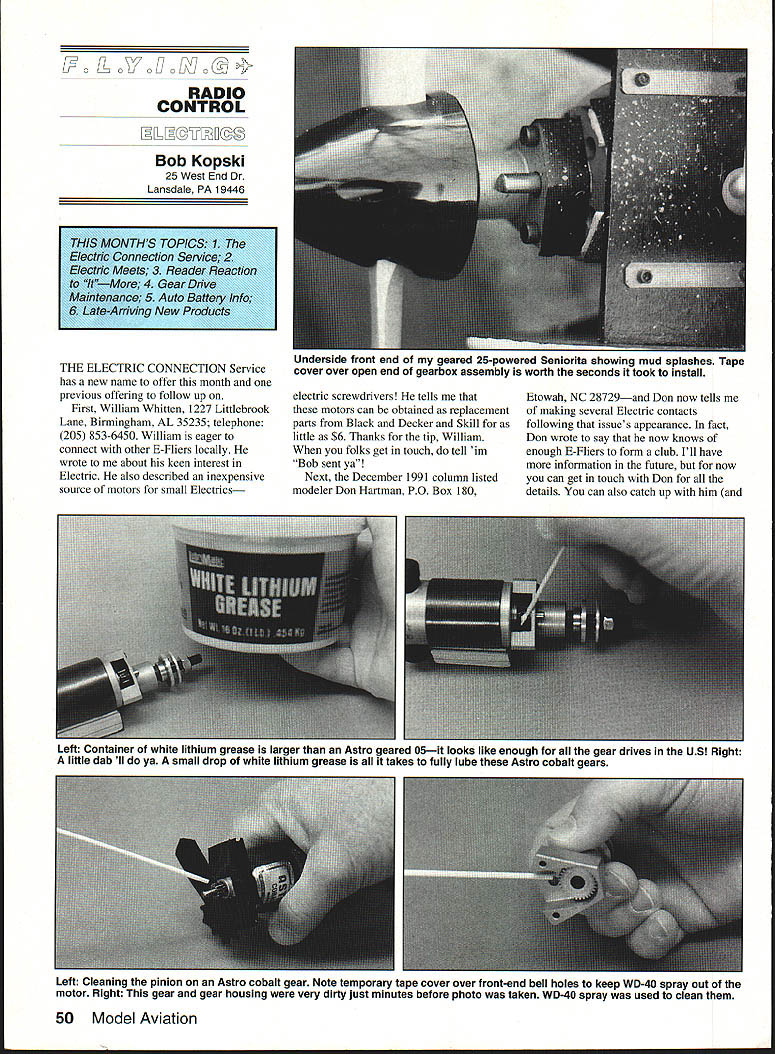
I recommend white lithium grease (available at auto supply stores). My preferred method is to dip a toothpick or similar small stick into the grease and dab a small drop onto the gears. Spin the drive by hand to spread the grease over all the teeth. It takes very little; excess grease will be thrown off when you run the motor, so don't overdo it.
Keeping Dirt Out
After lubricating new gears, keep them clean. Dirt and grit in the gearbox cause rapid gear wear. One low-cost protection is a tape cover over the gearbox opening. A piece of plastic tape carefully fitted over the opening will keep out dust, dirt, mud, and small creatures found on almost any runway. This simple measure can save big bucks later.
Cleaning a Dirty Gear Drive
For gearboxes that have become dirty from use, I've found kerosene or distilled white gasoline (from the hardware store) satisfactory for cleaning. Procedure:
- Disassemble the drive from the motor and wipe off surface dirt with a tissue. You may find "brush dust" on the front of the motor—this stuff seems to get everywhere.
- Cover the motor front-end bell holes (usually four) with plastic tape. Hold the motor front pointed downward.
- Blast the pinion gear and motor shaft with WD-40, getting all around the gear. Use a small disposable brush to sweep the gear teeth clean of stubborn residue, then spray again.
- For the main gear assembly, hold the output shaft up (gear down), spray into the gear area while rotating the shaft to get the solvent into all teeth. Keep the gear pointed down so dirty drips fall away. Use the brush to scrub if necessary.
- Blot off excess drips with tissue. Do this outside or into a plastic bag—don't do it over the living room rug.
I use WD-40 primarily as a cleaning agent. I avoid common solvents like alcohol or acetone because they can dry out lubrication in the gearbox ball bearings. The WD-40 squirt spout is handy. The only time I use solvent is afterward to clean the outer gearbox housing so tape will stick well—tape won't stick to WD-40! These procedures are for Astro all-metal gear drives; I would be reluctant to use the same procedure on plastic parts.
Reassembly and Lube
Reassemble the motor/gear system, then re-lubricate with fresh white lithium grease as described above. I haven't used WD-40 as the only lube. These procedures work well and help keep costly gear drives running smoothly for long life.
Auto Battery Info
The car battery is the most popular source of "fuel" for electric fliers. Generally the car battery is plenty big and reliable—until it's not. With larger power systems becoming more common, a review is warranted.
A typical new car battery can supply around 50 ampere-hours (Ah). This number represents the total charge the battery can deliver before terminal voltage drops rapidly (usually below 11 volts). This is different from the "cold-cranking amps" manufacturers advertise.
Car batteries begin to lose capacity long before starting problems appear, so it's easy to be lulled into a false sense of security. Batteries can lose ampere-hour capacity from the start, and some deteriorate dramatically if ever fully run down. That's why I prefer serviceable batteries that you can add water to.
Example:
- Airborne pack: 14 cells, 1.2-Ah (think of this as two seven-cell packs).
- Charger: constant-current at 4.5 amps, delivering about 21 V × 4.5 A = 95 W.
- Charger efficiency: roughly 60% (0.60), so the charger draws about 95 / 0.60 = 158 W from the car battery.
- At a car battery terminal voltage of 12 V, the battery must deliver 158 / 12 ≈ 13 amps during the charge.
So charging that pack at 4.5 A takes about 13 A from the car battery. In an ideal world a 50-Ah battery could provide roughly 14 such charge cycles, but reality reduces that number considerably. Battery terminal voltage drops during discharge, causing the charger to draw more current and operate less efficiently. Also, many car batteries are not like-new and may be at half capacity.
Reasonable expectations:
- On a typical car battery you might safely get five or six good flights per charging session for the pack described.
- After the fifth or sixth flight, try starting the car before charging the next pack. If starting is a struggle or doesn't happen, consider replacing the car battery.
- If you replace the battery, choose a "serviceable" type (one to which you can add water)—avoid sealed, maintenance-free types for serious electric flying. I use Interstate Megatron 34.
Don't be upset about the expense of a new car battery—it costs no more than a few gallons of fuel and it's necessary for your car's and family's safety, especially in winter.
Late-Arriving New Products
Last-minute arrivals as I closed this column:
- SR Batteries Smart Charger/Cycler (see the February 1992 column)
- Samples of John Sermo's new solvent-safe plastic connectors
- My '92 F3E team shirt (ordered in support of our electric team—my daughter has already claimed it!)
See the May and June columns for ordering information. More on all this new stuff later.
So ends another column. Please enclose a SASE with any correspondence for which you'd like a reply.
Happy, Quiet Electric Landings, Everyone!
Transcribed from original scans by AI. Minor OCR errors may remain.

