
Radio Control: Electrics
Bob Kopski 25 West End Dr. Lansdale, PA 19446
This Month's Topics:
- The Electric Connection Service
- Follow-up on "Electric Is No Good"
- Airfoils—and other computer stuff
- Motor specifications
- Mini-Electric news
1. The Electric Connection Service
The Electric Connection Service has one new offering this month. Mr. O. Lee Duff (70 Main St., Milo, ME 04463; tel. (207) 965-8039) recently wrote with some kind remarks about this column and Electric flying, and asked to become part of ECS. He is looking to associate with other E-fliers in his vicinity and, as an Electric beginner, is seeking help getting started. In the tradition of this service, I'm asking E-fliers in the Milo area to get in touch with him — and do tell him "Bob sent ya."
Please include an SASE with any correspondence for which you'd like a reply.
2. Follow-up on "Electric Is No Good"
Last column I offered a lighthearted (but sincere) response to the oft-heard exclamation "Electric is no good." This month I want to follow up with a more in-depth look at one specific charge frequently leveled against E-power: the "too heavy" complaint.
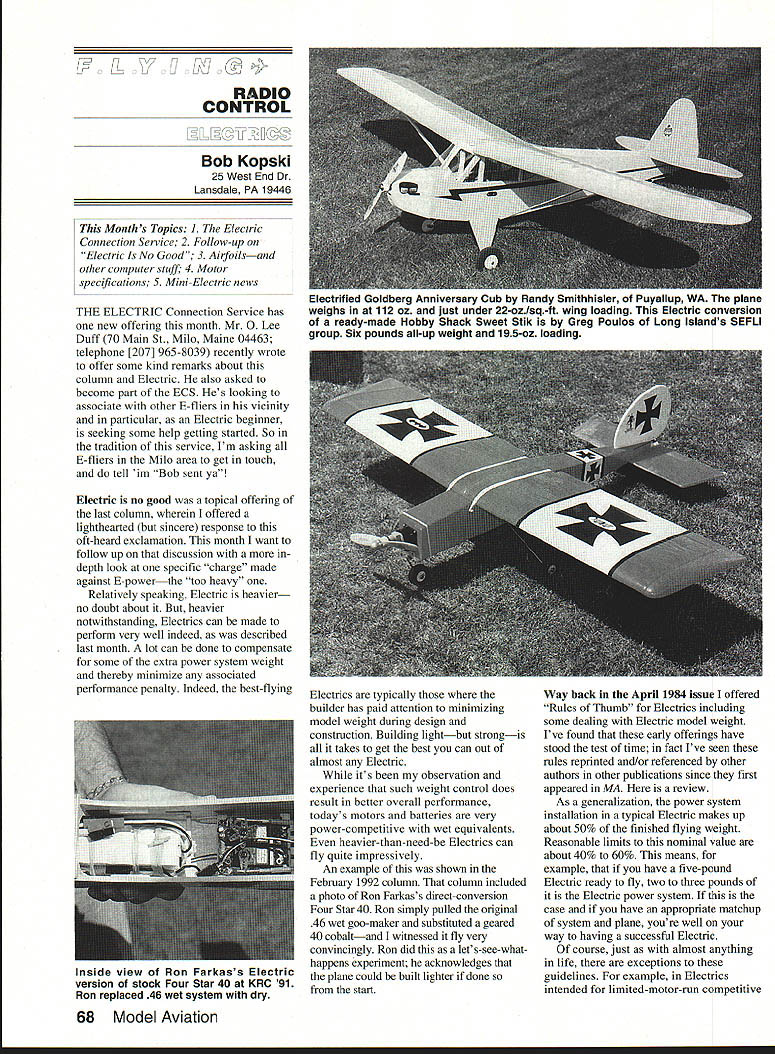
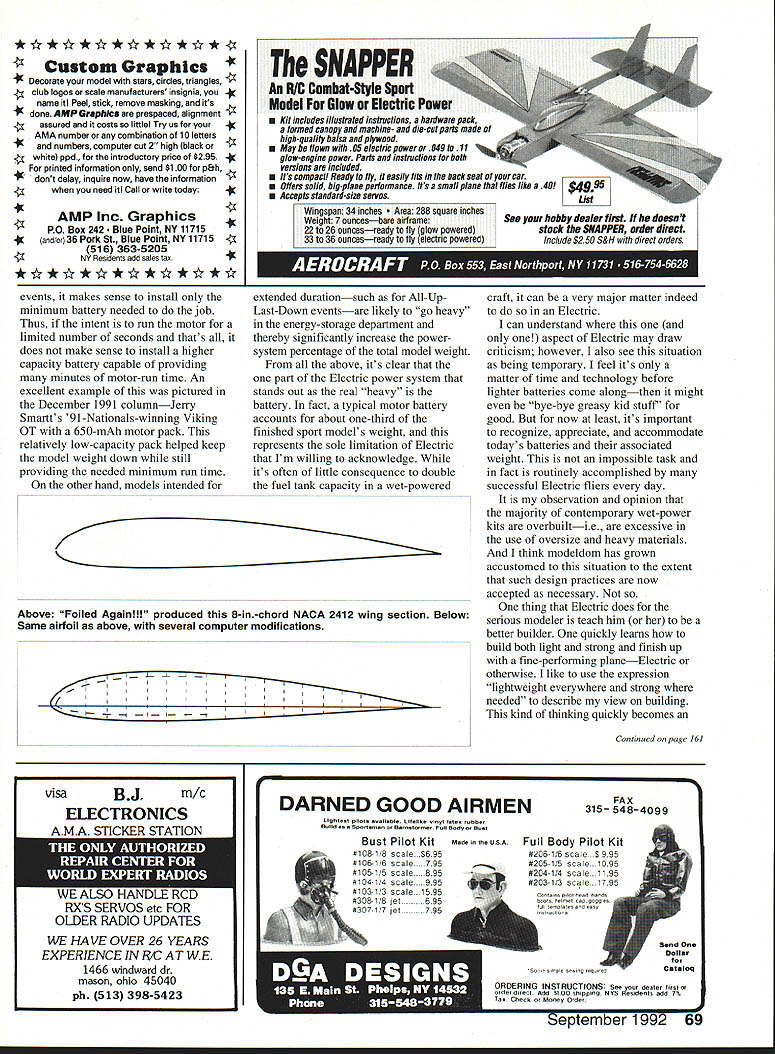
Relatively speaking, Electrics are heavier—no doubt about it. That said, Electrics can be made to perform very well. A lot can be done to compensate for extra power-system weight and thereby minimize any associated performance penalty. The best-flying Electrics typically reflect a builder who paid attention to minimizing model weight during design and construction: build light but strong.
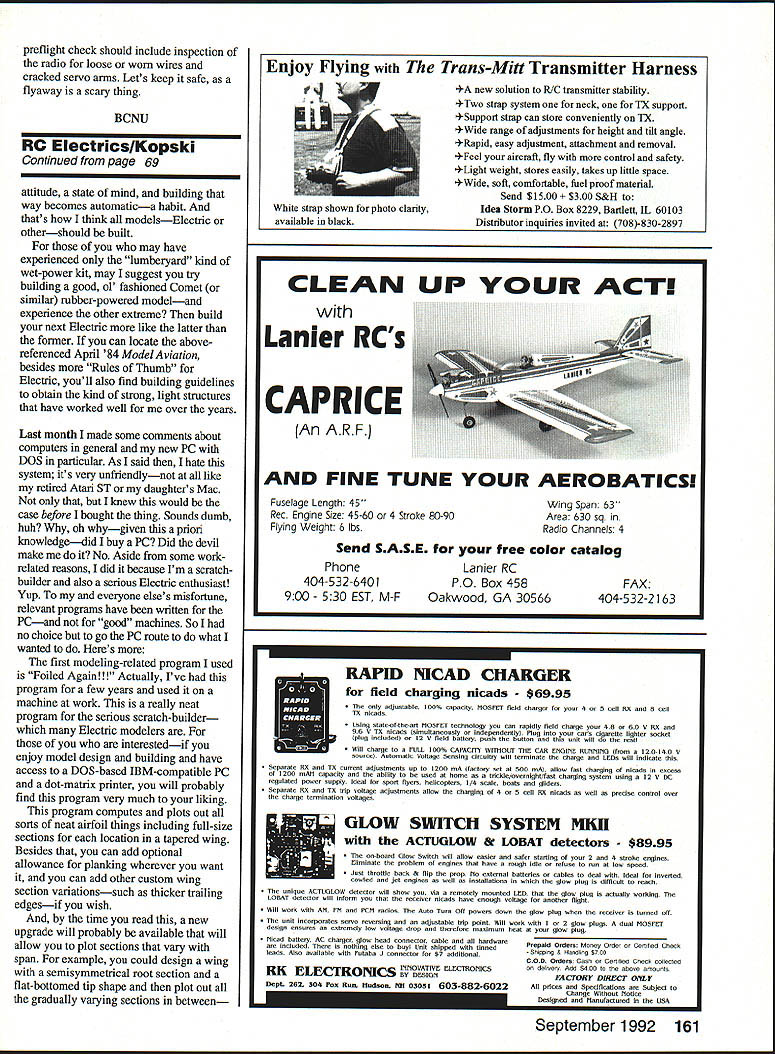
Today's motors and batteries are very power-competitive with wet equivalents. Even heavier-than-need-be Electrics can fly impressively. An example (from the February 1992 column) showed Ron Farkas's direct-conversion Four Star 40. Ron simply removed the original .46 glow engine and substituted a geared .40 cobalt electric motor, and the plane flew very convincingly. Ron acknowledges the plane could have been built lighter if done as an electric from the start.
Way back in April 1984 I offered "Rules of Thumb" for Electrics, including guidance on model weight. Those rules have stood the test of time and have been reprinted and referenced elsewhere.
As a generalization, the power-system installation in a typical Electric makes up about 50% of the finished flying weight. Reasonable limits are about 40% to 60%. So, for example, a five-pound Electric might have a two- to three-pound power system. With an appropriate system-to-plane matchup, you're well on your way to having a successful Electric.
Exceptions exist. For limited-motor-run competitive events it makes sense to install only the minimum battery needed. If your run time is only a few seconds, a lower-capacity pack is appropriate. An example is Jerry Smartt's 1991-Nationals-winning Viking (pictured in the December 1991 column) which used a 650‑mAh pack to keep weight down while providing the required run time.
Conversely, models intended for extended-duration events (such as All-Up/Last-Down) will deliberately go heavy in the energy-storage department, significantly increasing the power-system percentage of total model weight.
From all the above, the single real "heavy" part of the Electric power system is the battery. A typical motor battery accounts for roughly one-third of a finished sport model's weight. While this is a legitimate limitation, I view it as temporary—battery technology improves steadily, and lighter batteries will come. Meanwhile, recognize, accommodate, and design around today's batteries. It's routinely done by many successful Electric fliers.
In my opinion many contemporary glow-power designs are overbuilt with excessive use of heavy materials. Building for electric teaches you to be a better, lighter builder: "lightweight everywhere and strong where needed." Try building a simple Comet or similar rubber-powered model if you've only seen heavy glow kits. That experience can influence your next Electric and make it lighter and better performing.
3. Airfoils—and other computer stuff
Last month I commented on computers and my new DOS-based PC. I find DOS unfriendly compared with my retired Atari ST or a Mac, but many useful modeling programs are written for IBM-compatible PCs, so I went that route despite reservations.
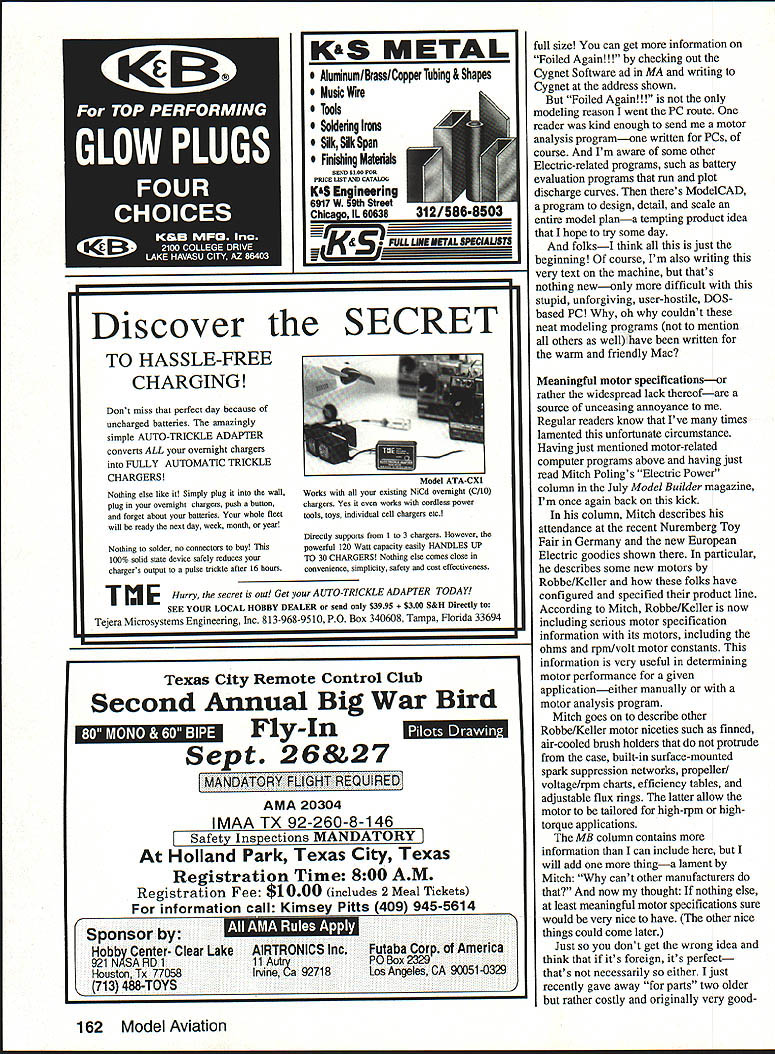
The first modeling program I used is "Foiled Again!!!" — a neat program for the serious scratch-builder. If you enjoy model design and have access to a DOS PC and a dot-matrix printer, you'll likely find it very useful. The program computes and plots airfoil data, including full-size sections for each station in a tapered wing. It can add allowances for planking and custom variations (thicker trailing edges, etc.). Upcoming upgrades allow plotting sections that vary with span (for example, a semisymmetrical root section transitioning to a flat-bottomed tip and all sections between).
You can get more information on "Foiled Again!!!" from Cygnet Software (see their ad in Model Aviation) and write to them at the address shown there.
Other PC programs I’ve tried or received include a motor-analysis program and battery-evaluation programs that run and plot discharge curves. There are also programs such as ModelCAD for designing, detailing, and scaling an entire model. I think this is just the beginning for useful modeling tools on PCs—even if I grumble about having to use DOS.
4. Motor specifications
Meaningful motor specifications — or rather the widespread lack of them — are a continual annoyance. I regularly lament this situation.
Mitch Poling's "Electric Power" column in the July Model Builder described new European motors (Robbe/Keller) shown at the Nuremberg Toy Fair. Robbe/Keller now include useful motor specs: ohms and rpm/volt motor constants. That information is valuable for determining motor performance either manually or with a motor-analysis program.
Mitch also noted other niceties: finned, air-cooled brush housings that don’t protrude from the case; built-in surface-mounted spark-suppression networks; propeller/voltage/rpm charts; efficiency tables; and adjustable flux rings to tailor motors for high-rpm or high-torque applications.
Why can’t other manufacturers provide similar meaningful specifications? That would greatly help modelers. I will add that foreign products are not always perfect: I recently gave away two older but excellent Keller 25/12 motors because of brush failures and the unavailability of spare parts. There is value in having motors and equipment for which you can get replacements and spares — something U.S. manufacturers often provide.
5. Mini-Electric news
Mini-Electrics are very popular, and many modelers devote a major portion of their activity to this phase. Dick Gibbs (every-other-month Electric columnist for Flying Models) covers the low-watt side well; I often refer readers to his column.
Suppliers exist for the small stuff. HiLine Ltd. (long associated with Don Shull and Tom Schmitt) has been sold to Dave and Marie Rees. You can write HiLine at P.O. Box 11558, Goldsboro, NC 27532. Readers interested in mini-Electrics can obtain the current HiLine catalog for $1 — and when you write, tell them "Bob sent ya." My thanks to Don and Tom for providing mini goodies over the years, and my best wishes to Dave and Marie as they continue the business.
See you all at KRC '92 — okay?
---
So ends another column. This is an anniversary issue of sorts — my first Electric article appeared in Model Aviation in September 1983 — and it's been one heck of a great Electric flight ever since!
Now, charge up and fly high, fast, far, long, clean, and quiet — with Electric!
Transcribed from original scans by AI. Minor OCR errors may remain.

