
Radio Control: Electrics
Bob Kopski, 25 West End Dr., Lansdale, PA 19446
KRC Electric Fly
The January column has traditionally described the annual KRC Electric Fly — timing that occurred because that issue was normally written shortly after the event each year. However, Model Aviation (MA) has revised its column submission schedule, and material for the January issue is now due before the traditional meet date (the third weekend in September). That change would suggest the February column as the likely place for meet coverage; however, because of some very good fortune this year, it won't.
The "very good fortune" is that—for the first time ever—Mitch Poling, who has been an electric columnist longer than anyone I know, attended the 1992 meet and agreed to write the feature for Model Aviation. Mitch came all the way from Germany to participate in the annual Greatest Electric Show on Earth. I’m personally delighted and gratified: Mitch’s E-writings during the mid-1970s were instrumental in easing my early entry into electric flight. Now I’ve had the chance to meet, fly, dine with Mitch, and share the pages of MA with him.
[Editor's note: Publication of this article has not yet been scheduled.]
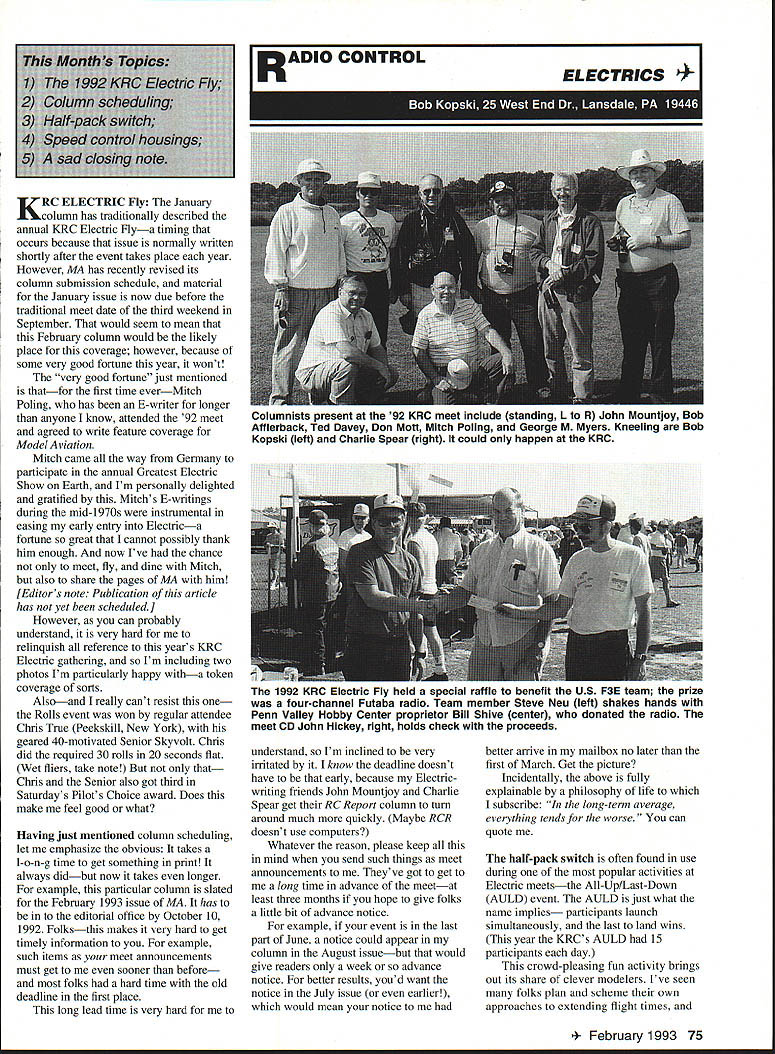
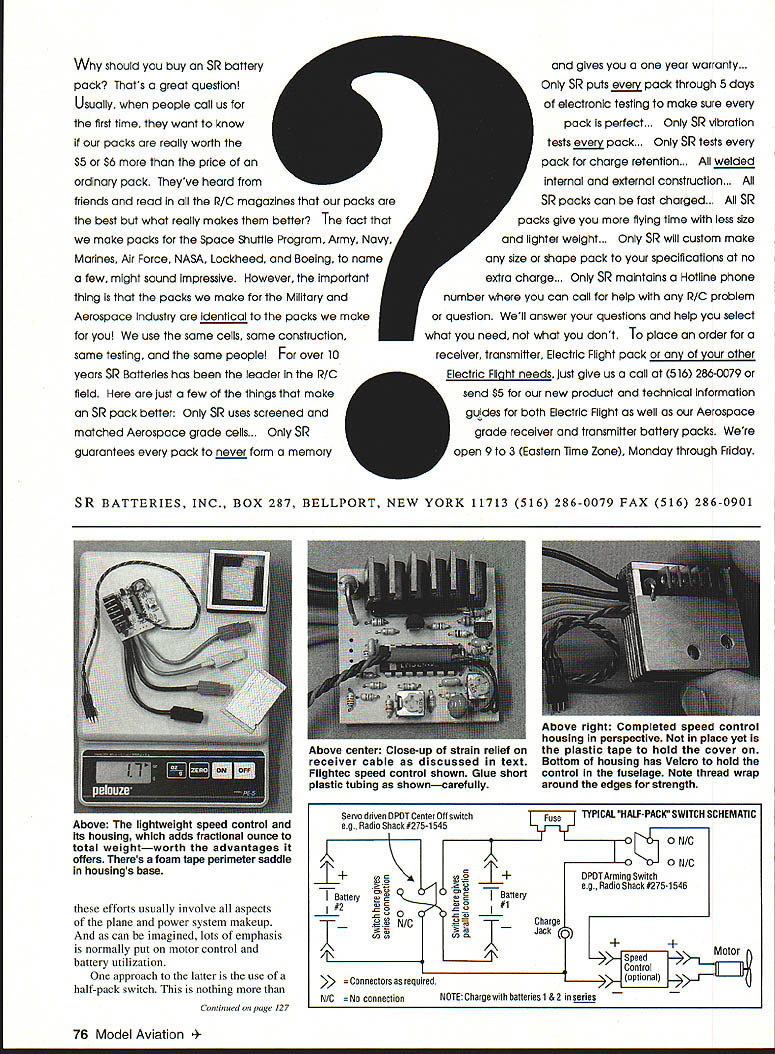
Although Mitch is covering the event in Model Aviation, I can't resist including two photos I'm particularly happy with — a token of coverage. Also, the Rolls event was won by regular attendee Chris True (Peekskill, New York) flying a geared .40-motivated Senior Skyvolt. Chris completed the required 30 rolls in 20 seconds flat (wet fliers, take note!). Chris and the Senior also earned third-day Pilot's Choice. Does this make me feel good? You bet.
Having mentioned column scheduling, let me emphasize the obvious: it takes a long time to get something in print — and now it takes even longer. For example, this column is slated for the February 1993 issue of MA and had to be in the editorial office by October 10, 1992. That makes it very hard to get timely information to you. Meet announcements must get to me even sooner than before — most folks already had a hard time with the original deadline.
Please keep this in mind when sending meet announcements. They need to reach me a long time in advance — at least three months if you hope to give readers meaningful advance notice. For example: an event in late June could have a notice appear in the August issue, giving readers only a week or so notice. For better results you’d want the notice in the July issue (or earlier), which means your notice should arrive no later than the first of March. Get the picture?
Incidentally, the above delay is consistent with a philosophy of life to which I subscribe: "In the long-term average, everything tends for the worse." You can quote me.
Half-Pack Switch and AULD (All-Up/Last-Down)
One of the most popular activities at electric meets is the All-Up/Last-Down (AULD) event: participants launch simultaneously, and the last to land wins. This year the KRC's AULD had 15 participants each day. The event brings out many clever modelers who plan and scheme to extend flight times; much emphasis is placed on motor control and battery utilization.
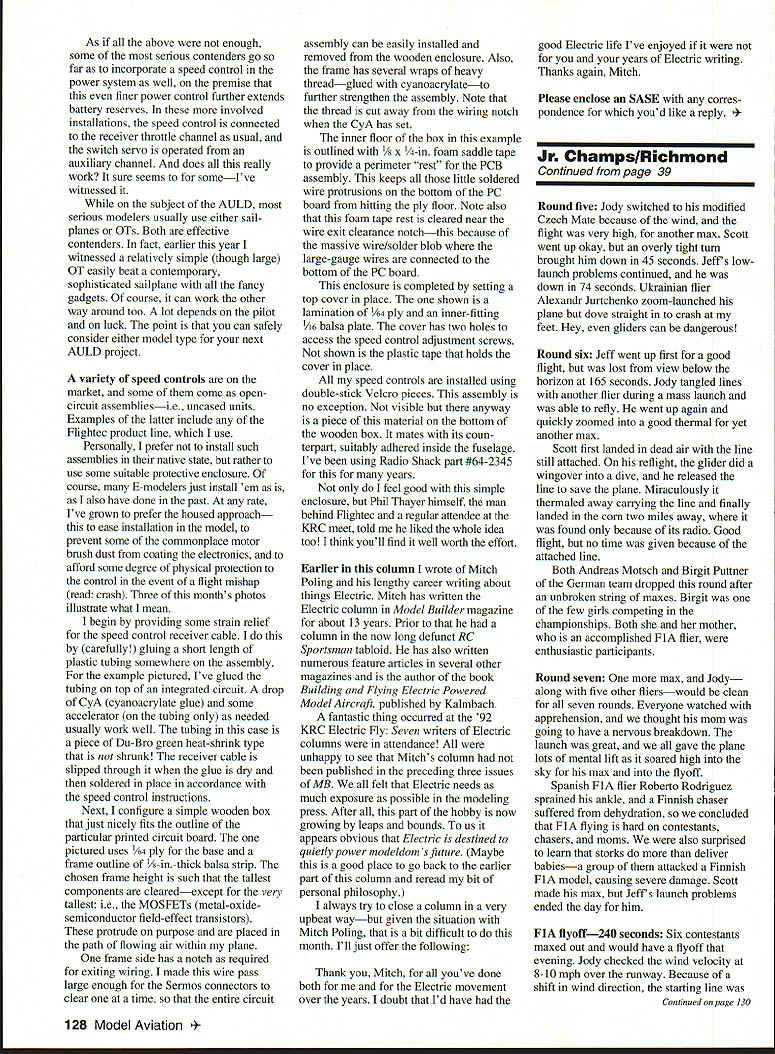
One common approach to extending flight times is the half-pack switch. A typical installation uses a wiring harness incorporating a double-pole, double-throw, center-off (DPDT/CO or DP-on-off-on) switch and a battery made up of two half-packs with identical cell count and cell type.
The idea is:
- Connect the two half-packs in series for high power (maximum voltage).
- Connect the same two half-packs in parallel for cruise power (lower voltage).
- Use a servo-driven switch to change connections in flight between series, parallel, and off.
Important: the cells in this arrangement must be charged in series. Ni-Cd cells (Ni-Cd) are never charged in parallel. In practice, the plane, motor, and prop are configured to cruise or climb slightly on the voltage available from the paralleled half-packs ("half voltage"). Switching to series gives higher voltage and aggressive climb capability when needed; the center-off option allows conserving charge while thermalling.
Battery efficiency during cruise is of special interest. It is argued that parallel-connected half-packs can be more efficient because each half-pack is nominally operating at half the total motor current. Cells tend to show somewhat higher capacity at lower drain rates and somewhat lower capacity at higher currents.
Some serious contenders go further and incorporate a speed control (ESC) in the power system as well, on the premise that finer power control further extends battery reserves. In these installations the speed control is connected to the receiver throttle channel as usual, and the switch servo is operated from an auxiliary channel. Does it work? It sure seems to for some — I’ve witnessed it.
While on the subject of the AULD, most serious modelers usually use either sailplanes or OTs (Old Timers). Both can be effective; earlier this year I saw a relatively simple (though large) OT beat a sophisticated sailplane with all the gadgets. It can work the other way, too — a lot depends on pilot skill and luck. Consider either model type for your next AULD project.
Installing Speed Controls in Protective Enclosures
A variety of speed controls are on the market; some are sold as open-circuit assemblies (unsealed units). Examples include products from Flightec, which I use. Personally, I prefer not to install such assemblies in their native state. I use a protective enclosure to:
- Ease installation in the model.
- Prevent motor brush dust from coating the electronics.
- Afford some physical protection in the event of a crash.
I begin by providing strain relief for the ESC receiver cable. My method:
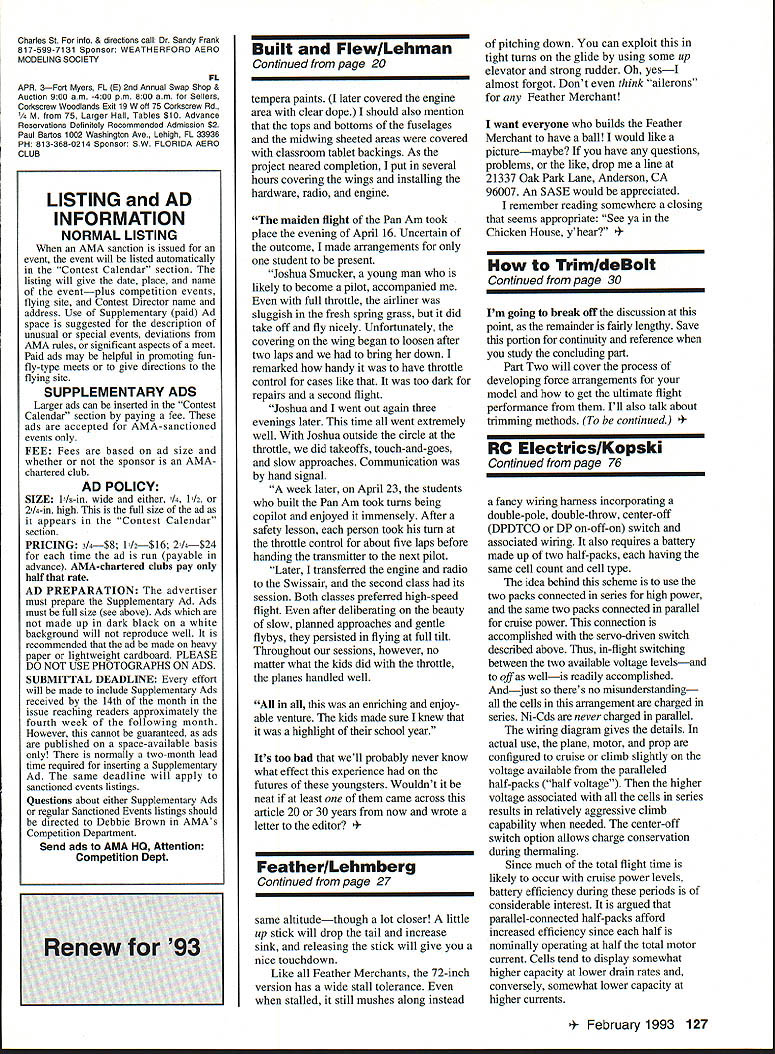
- Glue a short length of plastic tubing somewhere on the assembly (carefully!). In the pictured example I glued the tubing on top of an integrated circuit.
- Use a drop of cyanoacrylate glue (CyA) and accelerator (on the tubing only) as needed. The tubing I used is Du-Bro green heat-shrink type that is not shrunk. Strip the receiver cable through the tubing when the glue is dry and then solder in place per the speed control instructions.
Next, I configure a simple wooden box that just fits the outline of the printed circuit board (PCB). Construction details:
- Base: 1/4-in. plywood.
- Frame outline: 1/8-in.-thick balsa strip sized so the tallest components are cleared — except for the very tallest (the MOSFETs), which I allow to protrude deliberately in the airflow path.
- One frame side has a notch for exiting wiring. Make this notch large enough for the ESC's connectors to clear one at a time so the circuit assembly can be easily installed and removed.
- Strengthen the frame with several wraps of heavy thread glued with CyA; cut away the thread from the wiring notch after the glue has set.
- Outline the inner floor with 1/8 x 1/4-in. foam saddle tape to provide a perimeter rest for the PCB and keep soldered wire protrusions off the ply floor. Clear this foam near the wire exit notch to accommodate the large wire/solder blob where the heavy-gauge wires connect to the bottom of the PCB.
Complete the enclosure with a top cover. My cover is a lamination of 1/16-in. ply and an inner-fitting 1/16-in. balsa plate with two holes to access the ESC adjustment screws. Plastic tape holds the cover in place.
All my speed controls are installed using double-stick Velcro pieces. A small piece of Velcro is glued to the bottom of the wooden box and mates with its counterpart adhered inside the fuselage. I’ve used Radio Shack part #64-2345 for this for many years.
Not only do I feel good about this simple enclosure, but Phil Thayer, the man behind Flightec and a regular KRC attendee, told me he liked the idea too. I think you’ll find it well worth the effort.
Mitch Poling and the Electric Writing Community
Mitch Poling has written the Electric column in Model Builder magazine for about 13 years. Prior to that he had a column in the now-defunct RC Sportsman tabloid. He has also written numerous features in several other magazines and is the author of Building and Flying Electric Powered Model Aircraft (Kalmbach).
A fantastic thing occurred at the 1992 KRC Electric Fly: seven writers of electric columns were in attendance. All were unhappy that Mitch’s column had not been published in the preceding three issues of Model Builder. We all felt that electric flight needs as much exposure as possible in the modeling press. This part of the hobby is growing by leaps and bounds, and it seems obvious that electric is destined to quietly power modeldom’s future. (Maybe this is a good place to reread my earlier bit of personal philosophy.)
I always try to close a column in an upbeat way — but given the situation with Mitch Poling, that is a bit difficult this month. So I’ll offer the following:
Thank you, Mitch, for all you’ve done for me and for the electric movement over the years. I doubt I’d have had the good electric life I’ve enjoyed without you and your years of electric writing. Thanks again, Mitch.
Please enclose an SASE with any correspondence for which you’d like a reply.
- J
Transcribed from original scans by AI. Minor OCR errors may remain.

