
Radio Control: Electrics
Bob Kopski 25 West End Dr., Lansdale, PA 19446
This Month's Topics:
- The Electric Connection Service;
- Some interesting magazine references;
- More computer stuff for modelers;
- Some new E-motor mount ideas;
- My choices in speed controls;
- Odds and ends.
Electric Connection Service (ECS)
ECS activity this month includes three modelers who would like to find others in their locales to share in the fun Electric flight brings.
- Paul Combs
4880 Glenbrook Dr., Boise, ID 83704 Tel.: (208) 376-6119 Paul has been flying mostly seven-cell systems and enjoying them. From his letter I expect he'll move to larger power systems eventually — a trend I see often. About 50% of Astro's current sales are for sizes "15" and above.
- Bill Mecca
912 Center St., Throop, PA 18512 Bill commented that he "can't think of a friendlier group of individuals than those involved in aeromodeling." He is with a group in northwestern Pennsylvania that believes "the future of radio control flying rests in the growth and acceptance of Electric-powered flight." Join forces with Bill and others to help make that happen.
Magazine References and Recent Reading
- I noted that many contemporary wet kits are overbuilt — too heavy to start with. It's important to build both strong and light, no matter what you fly.
- In the November 1992 issue of RCM, Jim Oddino observed that "Pattern fliers have finally figured out that weight is the enemy of flight" and that they're trying to build bigger airplanes and build them lighter.
- The same RCM issue contains articles of interest to Electric modelers:
- Joe Ustasz wrote a construction article for a light-duty, easily adjusted speed-control mounting. Joe supplies fine speed controls under the Jomar name.
- Chuck Cunningham discussed Vintage flying with a scaled-down wet-powered Rudder Bug using the Cox Fail-Safe rudder-only radio. The Cox radio (on 27 MHz) is gaining popularity with E-fliers for small rudder-only Electrics.
- The "Silent Power" column by Ted Dewey (DSC fame) is always worth reading.
Computers and Software for Modelers
- Ken Myers (Walled Lake, MI), editor of the Ampeer (Electric Flyers Only, Inc.), developed a computer program to evaluate motor/battery/plane performance. Available for Apple II or MS-DOS (3.5" or 5.25" disks). MS-DOS orders must specify which BASIC version you run. Program price: $7.50.
Ken Myers — 1911 Bradshaw Ct., Walled Lake, MI 48390. Ampeer subscription: $10/year ($17 outside the U.S.). Tell Ken "Bob sent ya."
- MAG-TRACK: In the December RCM, Dave Garwood and Jim Harrigan presented a BASIC program to create a computerized magazine index. You can type the listing from the article or buy a disk for IBM-PC compatibles: $5 for 5.25" or $7 for 3.5". Order from:
Jim Harrigan — 103 Highland Ave., Rensselaer, NY 12144-1006.
- CD MicroSystems programs: WingDesigner and EditiFor. WingDesigner prints working drawings for almost any wing planform (including tapered and swept outlines), individual ribs, and a materials list. It supports printing in multiple overlapping spans for large designs that are taped together later. These tools let you design everything but the fuselage and save files for commercial plotting.
Motor-Mounting Methods
Several motor-mount photos and descriptions this month illustrate mounting options.
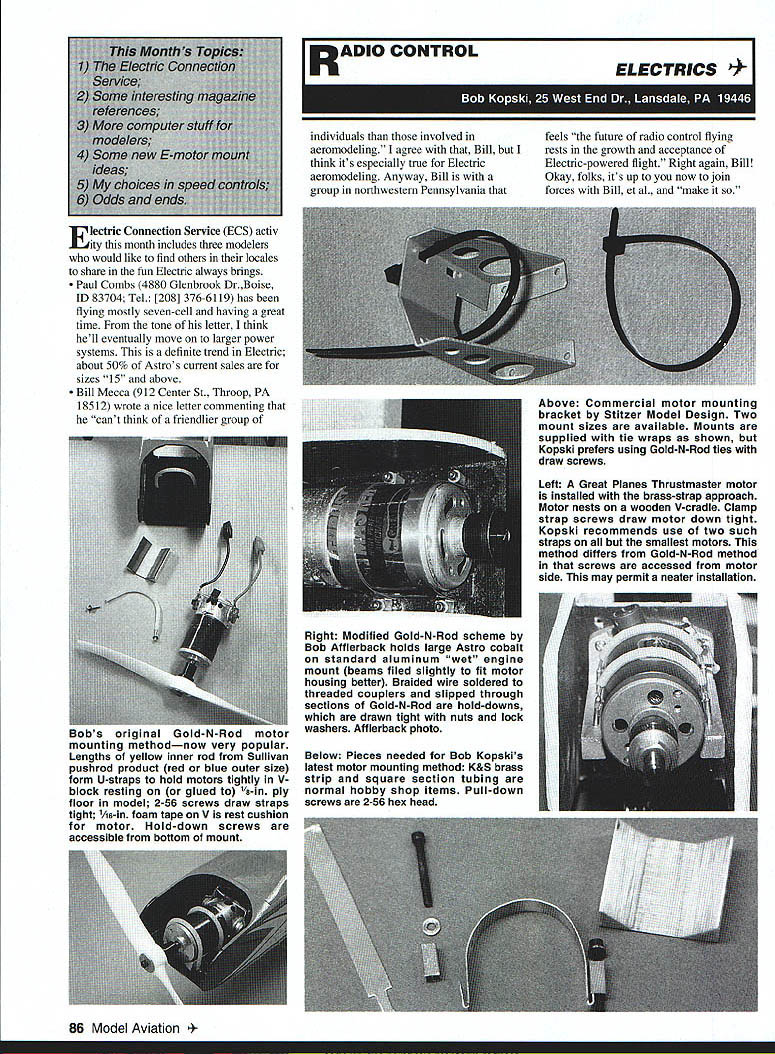
Popular tie-strap method (V-block and tie-wraps)
- Lengths of yellow inner rod (Sullivan pushrod product) or red-blue outer sizes form U-straps that hold motors tightly.
- A V-block is glued to a 1/8" plywood floor of the model.
- 2-56 screws draw the straps tight. A 1/16" foam-tape V-rest cushions the motor.
- Hold-down screws are accessible on the bottom mount.
Great Planes Thrustmaster with brass-strap approach
- The motor nests in a wooden V-cradle and clamp-strap screws draw the motor down tight.
- I recommend two straps for the smallest motors.
- This differs from the Gold-N-Rod method since screws accessed from the motor side may permit a neater installation.
Commercial motor-mount bracket: Stitzer Model Design (Aero-Vee)
- Formed-aluminum mount available in two sizes (one for smaller sport motors, one up to .40-size).
- Designed for mounting against a firewall or former.
- Motor is held with draw straps made of tie-wraps or Gold-N-Rod inner rods — the tie-strap technique introduced earlier.
Sam Stitzer — Stitzer Model Design, 113 William St., Centre Hall, PA 16828.
Modified Gold-N-Rod scheme (Bob Afflerback)
- Uses a large Astro cobalt standard aluminum "wet" engine mount; beams filed slightly to fit the motor housing.
- Braided cable is soldered to threaded couplers slipped through beam sections.
- Gold-N-Rod hold-downs are drawn tight and secured with nuts and lock washers.
- Pieces of Gold-N-Rod runner are slipped over the cable on top of the motor before soldering the threaded ends.
- This reinforced version is extremely strong.
Kopski's brass U-strap blind-nut mount (new variation)
This variation avoids exposed bottom hardware and has worked well on Hi Line 50 (50 W) and Great Planes Thrustmaster (100 W) motors. It should scale to higher-power installations.
Parts and general method:
- Baseplate: ply (usually 1/8" thick) made part of the model structure.
- Wooden V motor rest block sized to the motor; add 1/16" x 1/8" single-sided foam tape on the sloped sides (adhere the sticky to the wood, not the motor).
- Draw straps: 1/4" wide x 0.016" K&S brass strip. Each end is necked down to just under 1/8" wide for about 3/8". Bend the narrowed ends back on the formed main strap to make a U.
- Slip about 1/2" length of 1/8" inside square K&S brass tubing over the U-formed strap ends.
- Use 2-56 draw screws with a small washer under the head; drop screws through the square tubing from the top. The screw/washer bears on the tube end so the tube bears on the strap end.
- The draw screws thread into 2-56 blind mounting nuts installed in the baseplate bottom.
- Ensure the J ends of the formed strap do not touch the baseplate (allow proper tightening).
- Make the V-block no wider than the motor OD and space blind nuts so straps come straight down over the block edges.
- I prefer socket-head screws and a hex driver for tightening.
Pieces needed:
- K&S brass strip
- Square-section brass tubing (1/8" inside)
- 2-56 hex-head or socket-head draw screws and washers
- 2-56 blind mounting nuts
- 1/8" plywood baseplate, wooden V-block, foam tape, and normal hobby-shop items.
Let me know how this method works for you.
Speed Controls — My Selection Criteria
Based on long bench and flight experience, here are the characteristics I look for in a speed control:
- Optical isolation:
- Must be optically coupled (no hard-wired controls) except for very low-power specialty applications. Optical coupling greatly reduces radio interference and glitching.
- High-rate design:
- Prefer high-rate PWM designs for smoother, more efficient control. Frame-rate designs are relatively inefficient but can be acceptable as simple on/off switches for low-power use.
- Notable exception: Futaba Electric receiver/speed control (BEC) for six- and seven-cell systems:
- This combo works well and is convenient (receiver powered by the battery, no separate radio battery needed). I recommend it to beginners despite its frame-rate design. I wish Futaba would upgrade to a high-rate and support more than seven cells.
- Safe power-up behavior:
- Avoid controls that permit a momentary motor burst when the receiver or arming switch is turned on or off.
- Avoid controls that allow sustained motor operation when the receiver is on but the transmitter is off.
- Slightly slowed response:
- I prefer a control that does not respond instantly to stick motion, but has a little lag (like a servo). This helps mask transient glitches.
- Good line rejection:
- Some controls react to small receiver battery voltage shifts when servos move, causing speed changes (often noticeable at low throttle). Choose controls with good rejection to avoid this.
When selecting a new speed control, consider what others at your field use, and balance these criteria with price and availability. Choose a control that meets the most important criteria for your needs.
Odds and Ends
- Amateur radio/Electric activity: For E-fliers who are ham radio operators, Electric-oriented activity occurs on 7243 kHz Friday mornings at 1000 ET. Join AA4L (Bob), W2NDY (John), and W4AZDK (Jim) to discuss Electric subjects. AA4L is Bob Johnson (who explained toroid use to reduce motor glitching in R/C Report, Aug 1991).
- Electric Scale: Growing in popularity and quality, with larger power systems featured. At KRC '92 the Best Scale award went to Steven Stratt (NY) for his Swallow. Steven can supply a photo-package "Fabulous Planes and Plans" by Aerodrome for $10 plus $2.50 first-class postage.
Aerodrome — P.O. Box 1425, FDR Station, New York, NY 10150. Tell Steven "Bob sent ya."
- A note on wet-engine accessories: There has been a proliferation of antivibration products and mufflers. That interest reflects the need to control noise and vibration — another reason Electric flight is attractive for quiet fields and fewer restrictions.
Closing
Thank you for your continuing support and your letters — they make this monthly effort worthwhile and fun. Sorry the March column did not appear due to a "mysterious" set of circumstances; I'll explain later. I have lots to share in upcoming issues.
Please enclose an SASE with any correspondence for which you'd like a reply.
Happy, Quiet Landings, Everyone.
Transcribed from original scans by AI. Minor OCR errors may remain.

