
RADIO CONTROL ELECTRICS
Bob Kopski, 25 West End Dr., Lansdale, PA 19446
This Month's Topics:
- Correction
- The Electric Connection Service
- The license plate contest
- Meet announcements
- Seniorita reference — clarification
- High-rate, high-capacity cells — caveat emptor?
Correction
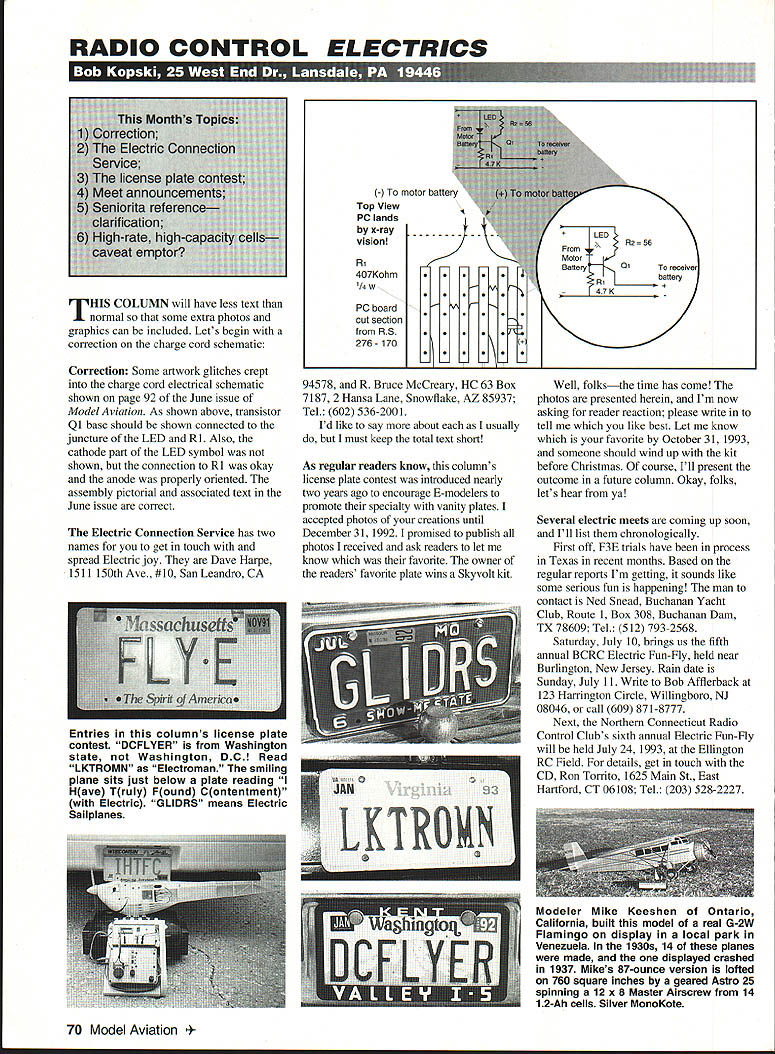
Some artwork glitches crept into the charge-cord electrical schematic shown on page 92 of the June issue of Model Aviation. Transistor Q1 base should be shown connected to the juncture of the LED and R1. Also, the cathode part of the LED symbol was not shown, but the connection to R1 was correct and the anode was properly oriented. The assembly pictorial and associated text in the June issue are correct.
The Electric Connection Service
The Electric Connection Service contacts are:
- Dave Harpe, 1511 150th Ave., #10, San Leandro, CA 94578
- R. Bruce McCreary, HC 63 Box 7187, 2 Hansa Lane, Snowflake, AZ 85937; Tel: (602) 536-2001
I'd like to say more about each, as I usually do, but I must keep the total text short.
License Plate Contest
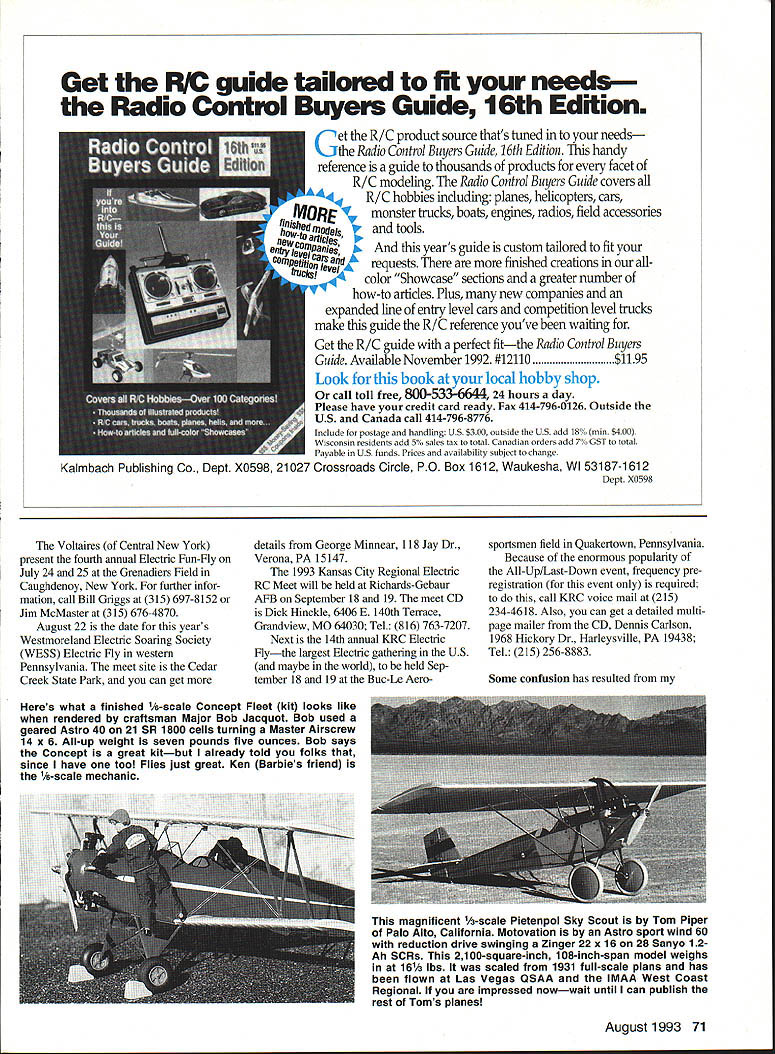
As regular readers know, this column's license-plate contest was introduced nearly two years ago to encourage E-modelers to promote their specialty with vanity plates. I accepted photos of your creations until December 31, 1992. I promised to publish all photos I received and ask readers to let me know which was their favorite. The owner of the readers' favorite plate wins a Skyvolt kit.
The photos are presented herein, and I'm now asking for reader reaction. Please write in to tell me which you like best. Let me know which is your favorite by October 31, 1993, and someone should wind up with the kit before Christmas. I'll present the outcome in a future column.
Upcoming Meets (chronological)
- F3E trials — in process in Texas. Contact: Ned Snead, Buchanan Yacht Club, Route 1, Box 308, Buchanan Dam, TX 78609; Tel: (512) 793-2568.
- Fifth annual BCRC Electric Fun-Fly — Saturday, July 10 (rain date Sunday, July 11), near Burlington, New Jersey. Contact: Bob Afflerback, 123 Harrington Circle, Willingboro, NJ 08046; Tel: (609) 871-8777.
- Northern Connecticut Radio Control Club sixth annual Electric Fun-Fly — July 24, 1993, at the Ellington RC Field. Contact: CD Ron Torrito, 1625 Main St., East Hartford, CT 06108; Tel: (203) 528-2227.
- Voltaires Central New York fourth annual Electric Fun-Fly — July 24–25, Grenadiers Field, Caughdenoy, NY. Contact: Bill Griggs, Tel: (315) 697-8152, or Jim McMaster, Tel: (315) 676-4870.
- Westmoreland Electric Soaring Society (WESS) Electric Fly — August 22, Cedar Creek State Park, western Pennsylvania. Contact: George Minnear, 118 Jay Dr., Verona, PA 15147.
- 1993 Kansas City Regional Electric RC Meet — September 18–19, Richards-Gebaur AFB. Meet CD: Dick Hinckle, 6406 E. 140th Terrace, Grandview, MO 64030; Tel: (816) 763-7207.
- 14th annual KRC Electric Fly — September 18–19, Buc-Le Aero Sportsmen Field, Quakertown, Pennsylvania. This is the largest electric gathering in the U.S. (maybe the world). Due to popularity and frequency congestion, pre-registration is required. Call KRC voicemail at (215) 234-4618. For a detailed multipage mailer, contact CD Dennis Carlson, 1968 Hickory Dr., Harleysville, PA 19438; Tel: (215) 256-8883.
Example: 1/8-Scale Concept Fleet
Here's what a finished 1/8-scale Concept Fleet (kit) looks like when rendered by craftsman Major Bob Jacquot. Bob used a geared Astro 40 on 21 SR 1800 cells turning a Master Airscrew 14 x 6. All-up weight is seven pounds five ounces. Bob says the Concept is a great kit — and I already told you folks that, since I have one too! Flies just great. Ken (Barbie's friend) is the 1/8-scale mechanic.
Seniorita reference — clarification
My Seniorita electric conversion was described in full detail in a two-part feature article in the July and August 1991 issues of Model Aviation. In seeking copies of that article set, some folks mistakenly received copies of the monthly RC Electric column instead. Those two issues included both this regular column and a separate feature article entitled "Electric Conversion." If you're seeking the feature, ask for it by name — not for the column copy.
High-rate, high-capacity cells — caveat emptor?
If there is any product that has caused both excitement and disappointment in the electric sky, it is the 1,700‑mAh high-rate cell. Both Panasonic and Sanyo released these high-capacity cells nearly two years ago, and reports on their performance — or lack thereof — have been popping up ever since.
Performance results are all over the place. The distinct impression is that one simply cannot count on getting good cells — and that has happened to me. What makes this particularly painful is that these cells are expensive.
My experience has been primarily with Sanyo SCRC 1,700‑mAh cells. About a year ago I purchased some six-cell packs under a well-known label that were simply lousy — falling well short of label capacity and about equal to 1,400‑mAh SCRCs based on flight performance. I later learned that early SCRC lots were not so good and that later lots were okay. Later cells could be identified by some green-colored marking on the label. I accepted the loss.
More recently I purchased more SCRCs, making sure they were of later vintage. I assembled three seven-cell packs with all cells having green ink around the code "WR." Surely I had good, high-rate, high-capacity packs — right? Wrong.
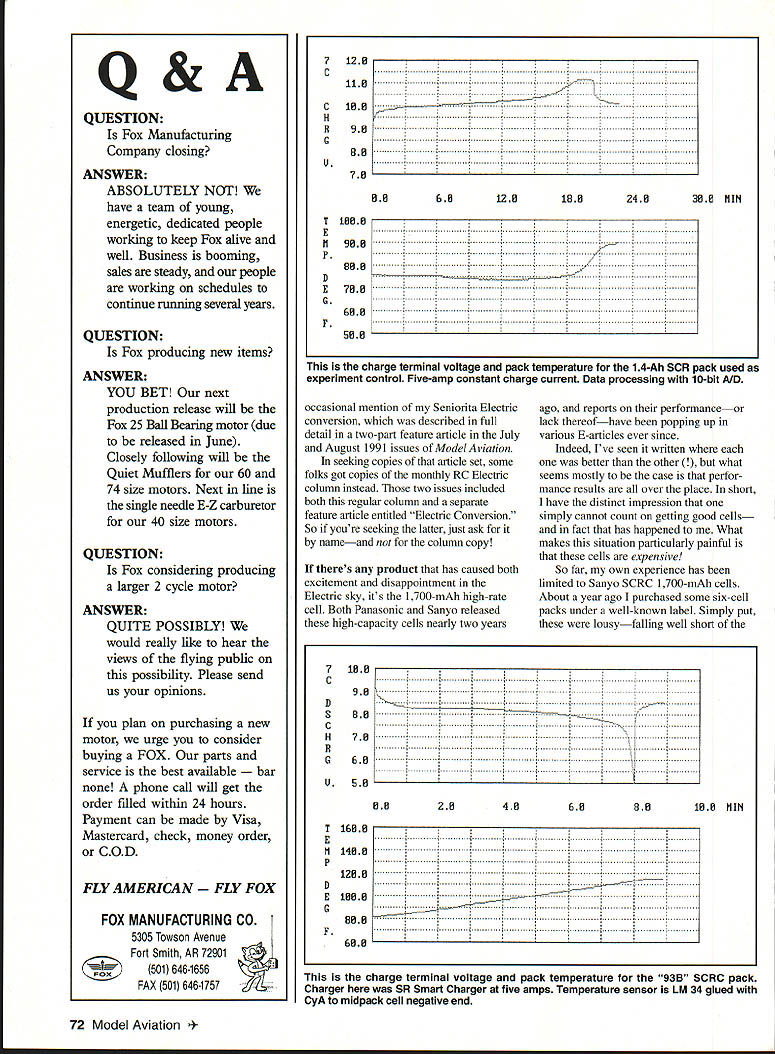
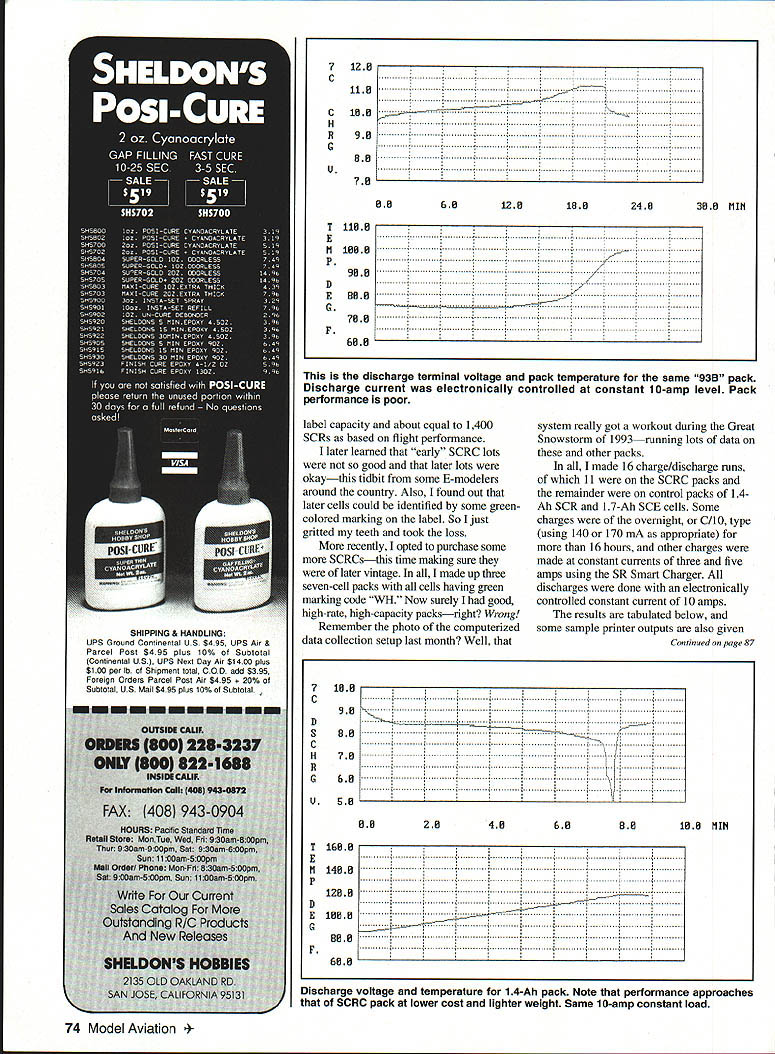
During the Great Snowstorm of 1993 I ran lots of data on these and other packs using a computerized data-collection setup. In all, I made 16 charge/discharge runs: 11 on the SCRC packs and the remainder on control packs of 1.4‑Ah SCR and 1.7‑Ah SCE cells. Some charges were overnight (C/10, using 140 or 170 mA as appropriate) for more than 16 hours, and other charges were at constant currents of 3 A and 5 A using the SR Smart Charger. All discharges were done with an electronically controlled constant current of 10 A.
The results are summarized below. The packs designated "93x" are the three new SCRC packs. "Time" is taken as the seven-volt crossing point on the computer output curves.
Battery Performance Tests
Run Pack Charge Time (min) Ah delivered 1 93A C/10 8.4 1.41 2 93A C/10 7.9 1.31 3 93A 5 A 7.5 1.25 4 93A C/10 7.9 1.31 5 93B C/10 7.9+ 1.40 6 93B C/10 8.33 1.38 7 93B 5 A 7.83 1.33 8 93C C/10 8.25 1.37 9 93C C/10 8.0 1.32 10 93C 5 A 7.66 1.28 11 93C 3 A 7.8 1.30 12 SCE C/10 7.75 1.29 13 SCE 3 A 8.46 1.41 14 SCE C/10 7.58 1.26 15 SCR C/10 7.45 1.24 16 SCR 5 A 7.83 1.39
What this comes down to is that my SCRC packs don't perform much differently from my older, lower-cost, lighter-weight SCR pack — and now I'm out more big bucks just to find that out. To add last-minute confusion, I just received the May issue of RC Report, in which John Mountjoy and Charlie Spear present curves showing the SCRC as significantly better. The assorted E-writings have presented the correct picture overall: you just can't tell what you're getting until it's too late.
I'm not a very happy modeler right now, and you can bet your last prop I won't be buying any more until this gets straightened out — if then.
Please address any correspondence directly to me (and not to AMA), and enclose a SASE with any correspondence for which you'd like a reply. See ya at KRC!
Transcribed from original scans by AI. Minor OCR errors may remain.

