


Radio Control: Electrics
Bob Kopski 25 West End Drive, Lansdale, PA 19446
This Month's Topics:
- Meet Announcement
- A Premonition?
- Computerized Data Acquisition
- "Charge Cord" Followup
- REVOLT!
1) Meet Announcement
FLASH! This is a late-breaking addition to the '93 KRC Electric Fly—for early arrivals. There will be a "night fly," hosted by SEFLI (the Silent Electric Flyers of Long Island) in cooperation with KRC on Friday, September 17, beginning at dark. SEFLI's Larry Sribnick (of SR Batteries) will coordinate. Light up your electrics any way you can (no fire, please) and join in this "pre-event" event. References: "Nytiques," in this column, December 1988, and "Illuminous," May 1989.
The Dallas Electric Aircraft Fliers' (DEAF) Seventh Annual Electric Fly-In will be held October 2–3 in the Dallas area, according to meet CD Frank Korman. This will be two days of fun flying, competitive events, and AMA events, plus a Texas barbecue or Tex‑Mex supper if interest warrants. There will be plenty of prizes and awards to go around.
In addition, this meet is combined with the Gulf States Electric Fly-In, October 23–24 in New Orleans, as announced in this column last month. The meet combination forms the Astro Flight Southern Electric Championships, with special awards to the top point-getters. You can get full info from Frank Korman, 5834 Goodwin, Dallas, TX 75206-6106; Tel.: (214) 821-0393 after 5 p.m. and on weekends.
Note: The previous story in no way affects the upcoming '93 KRC Electric Fly. That's at an entirely different and borrowed (non-KRC) field many miles away.
2) A Premonition?
The April '93 column included a comment on page 164: "Enough fields have been lost to noise—and that often means lost model flying of any kind—you know, guilt by association."
Now I don't know if it's coincidence or premonition, but it's happened to me and many of my electric-flying club friends, and it also affects my club (KRC). For many years my club used a relatively noise-safe industrial-site field, but the company/owner failed financially and we lost use of that location. For about a year we had also been developing and using an additional site, so the loss of the original was not the end of the world. But activity increased at the other location until the neighborhood reacted to the "wet" noise saturation of this otherwise peaceful country setting.
To be candid, I don't blame the nearby residents—who needs it, anyway? Unfortunately, the loss of that field has dramatically curtailed flying: there is no flying of any kind after 7:30 p.m. For practical purposes it's summer, and we've mostly lost evening flying.
During the winter we developed an ambitious plan involving a lot of test flying to gather performance data; info I fully intended to share in upcoming columns. I have several new product and flight-test reports—there's telemetry I talked about in a previous column, and some new speed-control circuit ideas that could possibly represent a mini-breakthrough. I wanted to try them out and share the results, but we've lost enough flight time that the best will take vastly longer—maybe a year. So—lose, lose.
Because of "wet" power noise, KRC is now seeking another field. Success could take a long time; very little land left resembles open ground—housing right up against fields will surely kill "wet" flying. "Wet" seems associated with quiet flying; I can see the not-too-distant day when there will be no "wet" flying anywhere around here—county after county. Does that mean no flying of any kind? I know guilt by association; I'm extremely upset about the association aspect. I personally enjoyed wet-power RC for over a quarter century, and I have many friends who still prefer it. I haven't "touched the stuff" for nearly 15 years.
For me, there is only electric: the quiet power for the future of modeldom, but we have to survive now to get there later. What's needed locally, and in many other places, is an electric-exclusive club, or club affiliate, to help preserve a field. I've never heard of field loss due to quiet! So much for the soapbox this month.
3) Computerized Data Acquisition
The July column included a photo of my computerized data-collection system, and the August column (not yet out as I write this) will have printed output from it. The photo caught readers' interest, and several called or wrote seeking information on the setup. Here it is for everyone.
The technical design details were supplied by my friend Phil Thayer of Flightec (the speed-control company). About a year ago I expressed interest in such an item to Phil, and it turned out he had already done the same thing. Phil graciously supplied his schematic and certain critical items (microprocessor, EEPROM, and software); I got the other parts and assembled it on Radio Shack holeboard. It worked right off the bench.
The "box" is a battery-powered four-channel 10-bit A/D with a 5.0-volt reference and an RS-232 link to the PC serial port. The software is written in BASIC and is easily modified to do a variety of tasks, including graphic data on up to four parameters at a time. Phil used it to plot motor rpm, voltage, current, and thrust simultaneously. The display graphs are easily scaled for vertical (volts) and horizontal (time) axes. The design works great, and I have lots of ideas for future modeling applications and column content.
More recently, Phil/Flightec plans to make this product and suitable software available. He tells me he will have it running on a laptop at this year's KRC. Many technically inclined readers would enjoy this item in their electric pursuits.
4) "Charge Cord" Followup
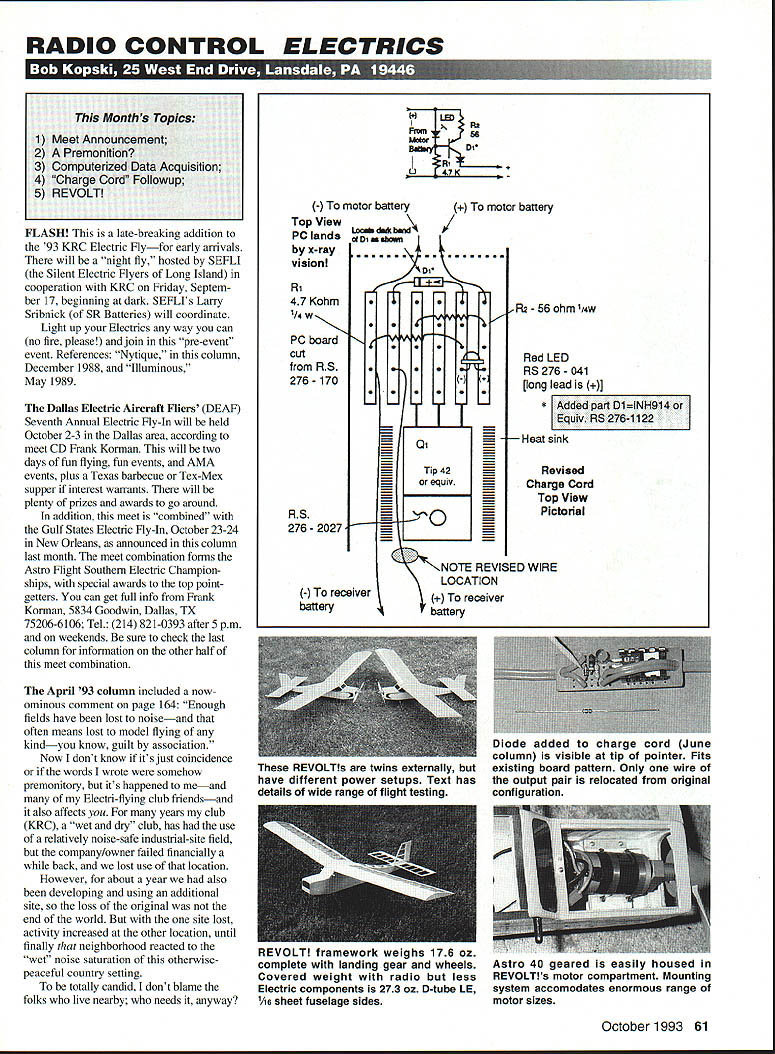
The June column discussed the how-to for one of my most-used electric accessories: my "charge cord." This simple electronic assembly allows charging of the radio battery with leftover charge from the motor battery.
I presently have three of these cords in routine use, and I just got parts to make several more. Right now I have 11 fully equipped, operational electrics, which would ordinarily be a radio-charging nightmare, but the charge cord makes for sweet dreams!
I've made a minor design improvement that costs only a few pennies and takes a few minutes to incorporate in existing assemblies. I'm presenting this now for those who might routinely hook up the charge cord and forget it for extended periods (i.e., many days)—something I do often.
As described previously, the charge cord uses leftover motor-battery charge to supply a regulated charge current to the receiver battery. It will "run" as long as there is charge available, i.e., until the motor battery runs down. Beyond that point, however, I discovered a tiny current (about 600 microamperes) will begin to drain from the receiver battery, so a charged 250 mA pack would itself drain in about 17 days.
While I've never had problems, this counterproductive condition could be trouble. The cure is a simple diode added in the positive output wire. This diode eliminates the drain condition. The retrofit is very easy and makes use of existing holes and lands on the circuit-board assembly. I suggest you incorporate this upgrade—I've added it to all my charge cords.
5) REVOLT!
The September issue included a description and flight information on my then-unnamed new electric. Well, it's no longer nameless—it's REVOLT! I've built and flown two more and have a few more under construction.
These latest planes are basically identical to the prototype, with only minor structural tweaks. I've added more depth to the nose section because the prototype proved to be a whelming success.
REVOLT! was originally intended to be flown over a range of power systems, from geared cobalt 05s and 15s up to direct-drive 25s and 40s. Associated batteries would range from seven to 18 cells, with room left to shift packs to aid center of gravity (CG) location.
First flights were made with a geared 05 on seven cells; this was the worst-case condition, so I started there. The plane flew great—leaping off the grass runway and proceeding upward in adverse weather—and it immediately drew favorable comment from the flight line.
So impressive was the handling that I immediately added another seven cells in parallel (a weight hit). While the overweight variation required a longer takeoff run, it also flew very well and drew favorable reaction for its extended flight time.
I tried power systems across the intended range, and in every case REVOLT! flew well. Then I tested outside the intended range: a direct-drive Thrustmaster and a geared Master Airscrew (economy motors), flown with one seven-cell pack and then two in parallel. REVOLT! continued to perform, delighting the flight line—people were requesting plans.
I then moved upward in power. Geared cobalt 25s and 40s are larger and wouldn't fit the original nose, so I modified the nose on the latest REVOLT!s. I've flown several flights with a geared 40 on 21 cells—nearly six pounds all-up, almost twice the weight of the lightest systems. Results: REVOLT! flies absolutely great this way, too. My last flight was more than 19 minutes long and included taxi, takeoff, many touch-and-goes, loops, cruising, bursts of high-rate climb, and some power-off glide time.
One photo shows a pair of REVOLT!s with similar appearance but many internal differences:
- Model A: Master Airscrew 2.5:1, seven 1.2 Ah cells, 11 x 6 prop; weight 53 ounces.
- Model B: Geared Astro Cobalt 40, twenty-one 1.4 Ah cells, 11 x 8 prop; weight 95 ounces.
Both models use Jomar SM4, ACE guidance, and have 600-square-inch wings using a 12.5% high-lift flat-bottom airfoil. REVOLT! really is impressive.
REVOLT! has lots of vintage design influence. It is an easy, stable flyer, well suited as a trainer with most of the power systems tried. Deliberate stalls are gentle and shallow; deliberate left and right spirals smooth out when sticks are released; and power-off flight has a remarkable low-sink glide.
I could generalize that REVOLT! is everything except aerobatic—intended, not accidental. Part of the original intent was in-flight experiments and data accumulation. I’ve got lots of ideas, plans, and three REVOLT!s—so you’ll be seeing more of this in future columns.
REVOLT! challenges conventional wisdom about electric and power-system selection and offers an opportunity to adjust our electric "perspective." It’s a frontal assault on the "which motor, which plane" syndrome and mocks contemporary motor-nomenclature nonsense. Whether truly unique or not, the design and results speak for themselves.
I've always believed in "build light everywhere, and strong where needed," and REVOLT! demonstrates that philosophy. The light aspect lets it fly well on lower-power installations, and the strong part permits carrying the heaviest setups.
The toughest part of the design was the landing gear: it must be light for the low-power end and strong for the heaviest installations. I compromised with double 1/8-inch-wire struts. It could be made lighter for the low end and stronger at the other extreme—an argument for customized landing gear across the power-system range. Maybe I'll try that sometime.
Please include a SASE with any correspondence for which you'd like a reply.
Happy, Quiet, Safe Electric Landings, Everyone!
RC Electrics / Kopski
Transcribed from original scans by AI. Minor OCR errors may remain.

