
Radio Control: Giant Scale
Bob Beckman
LET'S share the wealth. For a column like this to be of any real value it has to contain a lot of how-to information, not just who flew what, where, and when. We'll try to pass on all the where-to-get-it and how-to-do-it data we can lay hands on, but we've got to get most of that data from you.
Even long-time, very experienced modelers are finding that they have to come up with new materials and new methods when building the big birds. Personally, I think that is Giant Scale's greatest appeal at this time. New techniques and variations on old standbys are being generated at a great rate. MA wants to help spread that wealth around.
When you work out the solution to a building or operating problem, tell me about it. Pictures and sketches, where appropriate, would be welcome. Welcome enough that you'll be paid for any we use. Pictures must be black-and-white glossy prints, at least 4 x 5". 5 x 7" would be better. Unfortunately, Polaroid prints are seldom usable. If you can do a finished, inked sketch, fine. If not, send me a rough sketch and description and I'll try to convert it to finished form. If you have trouble getting B&W prints, I can make them if you want to risk your negatives in the mail. Please include a SASE so I can return them.
Don't make the mistake of underestimating your ideas and methods. Sometimes the thing that seems simple or obvious to you can be the long-sought answer to a lot of other people's problems.
Federal Standard Color Info
All U.S. military aircraft and many civilian planes are, or were, painted in colors specified by a Federal Standard number. For example, the yellow used on the upper wing surface of most Navy 1930s biplanes was FS15102. Included in the specifications of any military aircraft will be color specs in terms of an FS number.
These FS color numbers are often overlooked when researching data on a scale subject, but if you have the numbers you can get 3 x 5" color chips for a whopping big 15¢ apiece. And for a whole $3.50 you can get a book of 1/2 x 1" chips of every FS color, listed by FS number. The color chip you get today matches the color used 40 and 50 years ago, because the actual color specifications to which the chips are made are in terms of the wavelengths of colored light and the years haven't changed that.
To get these goodies, write to:
- GSA, Specification Activities, Washington Navy Yard Bldg. 197, Washington, D.C. 20407.
Ask for:
- FS 595 Color Books — $3.50
- 3 x 5" chips by # (e.g., FS15102) — 15¢ each
Laminated Ply Trailing Edge
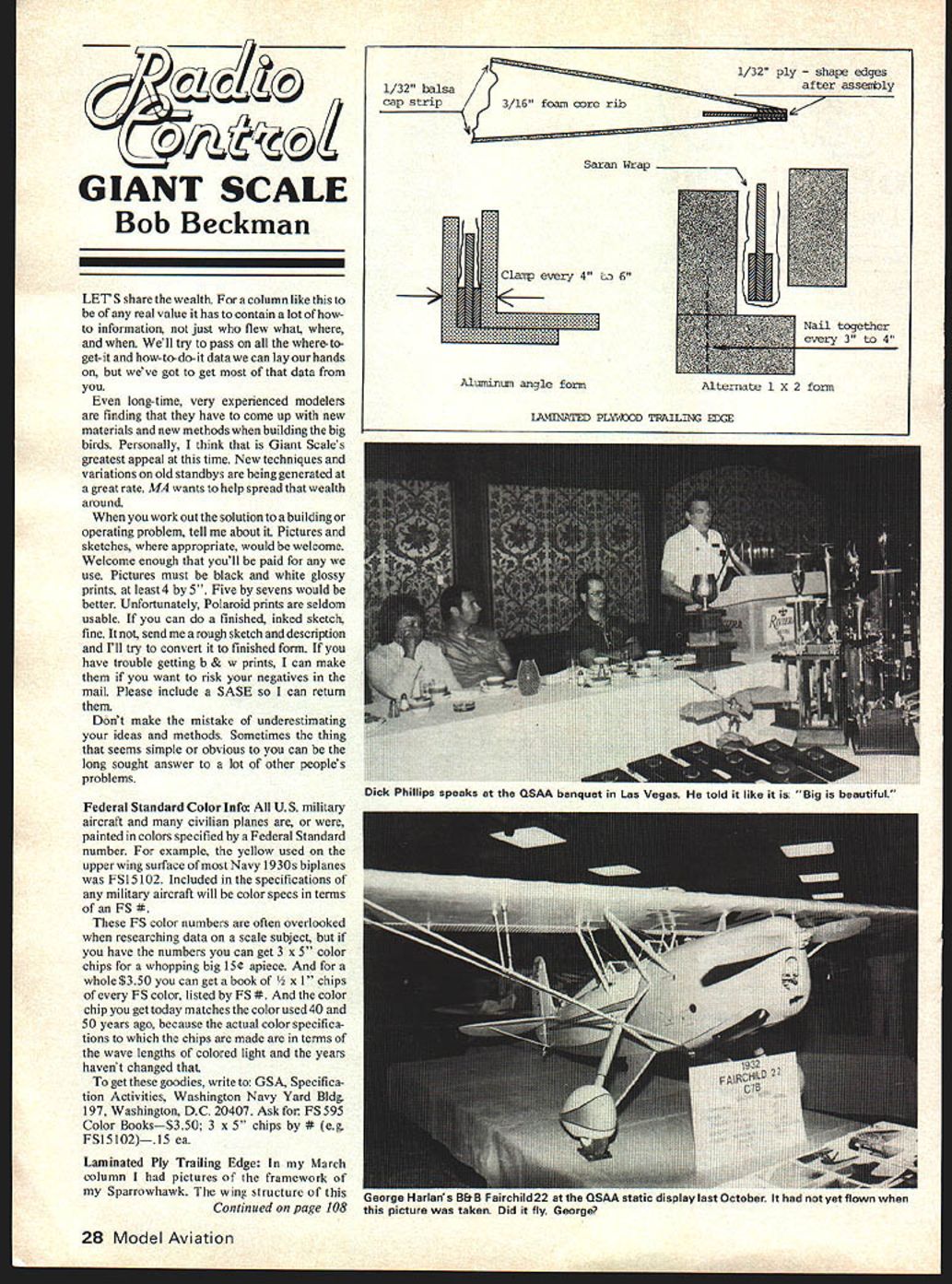
In my March column I had pictures of the framework of my Sparrowhawk. The wing structure of this ship features a trailing edge made from laminated 1/32" plywood. Several people who have seen the trailing edge have asked "Why?" and "How?"
The "Why" is the need for a rigid trailing edge on a fabric-covered wing. The usual triangular trailing edge stock doesn't look very scale-like and is seldom really straight.
My solution results in a rigid trailing edge that is absolutely straight. The sketches show the structure of the wing at the trailing edge and the way the edge is fabricated. I used aluminum angle stock for the form, but an adequate form could be made from 1 x 2 lumber. Use slow-curing (e.g., 30-minute) epoxy so you have plenty of time to line everything up.
Safety
Safety is in the eye of the beholder. One day last summer I was at the club field with a friend I've been teaching to fly. As we were getting my student's Kavalier ready, another friend and his student arrived and set up near us in the pits. Along with a couple of spectators we all were soon into a general discussion and the subject of giant-scale airplanes came up.
I was just about to mention the big bird I was building when this other fellow launched into a diatribe about how dangerous the big airplanes were. According to him, a gasoline-fueled model was a flying bomb and any crash, which was certain to happen, would automatically result in an explosion and fire. That, of course, was assuming that the fool operating the engine managed to start the engine and get airborne without burning up on the ground, along with half the other airplanes and people in the pits.
Realizing that his mind was closed, I resisted the impulse to point out that I had been flying gasoline-fueled RC models not only before he started modeling, but before he was born. I have never had a fire in the pits, and never had a crash burst into flames. (And I certainly had my share of crashes.) It was obvious, however, that this fellow had made up his mind and didn't want to be confused by facts.
We soon had the Kavalier going and my student, on a buddy box, taxied out to the flight line. As he had been taught, he stopped, checked the operation of all controls, and automatically checked for traffic in the air before moving onto the runway. He then took off and we proceeded to work on landing which he had not yet done. A few minutes later I was flying and demonstrating a landing. I was on final about 20 feet up and approaching the end of the runway when our "friend" taxied out of the pits and, without pausing, out to the middle of the runway and took off. I aborted the landing and made a sharp, climbing turn to avoid him. When it became obvious that the other plane was going to stay right over the field we decided to put off our landing practice and my student took over for practice figure-eights and procedure turns while I kept an eye on things.
The next thing I know this guy and his student have moved up the flight line and are right next to us. With no one else flying and plenty of room along the line, he moves up practically shoulder to shoulder with me. His student, on his left, had their transmitter. I had my transmitter, and my student on my right was using the buddy box. I don't like transmitter antennas that close, but every time I moved to my right they came right along.
After a bit this "instructor" announces that they are landing, and with the plane on final, he takes the transmitter from his student. Now we are shoulder to shoulder with the antennas about two feet apart. I started pushing my student to the right and got just enough clearance to move out of the way as their plane veered toward us and crashed right between me and the safety expert. All this time he's hollering "I haven't got it."
The point is that it isn't things, whether they are big, small, or in between, that are dangerous. It's the way people operate them that can be dangerous.
Big Birds and Air Shows
In going over the newsletter of the AMA-sanctioned Air Show Teams I noticed that many of the teams have, or are planning to have, Giant Scale models as part of their presentation. Those who have already used them all report a high level of spectator interest and acceptance.
The big birds do have a lot of appeal to the uninitiated. The size makes it easier for most people to accept the idea that these are aircraft and not toys. Being scale or very scale-like makes it possible for more people to recognize and relate to the model. This has always been part of any scale model, but again the sheer size makes it easier.
The size of the big birds doesn't restrict their utility, either. Any space adequate for 60- and most 40-powered models can be used safely by many Giant Scale planes. And their usually lower flight speeds make it easier for the spectators to see and appreciate what is happening.
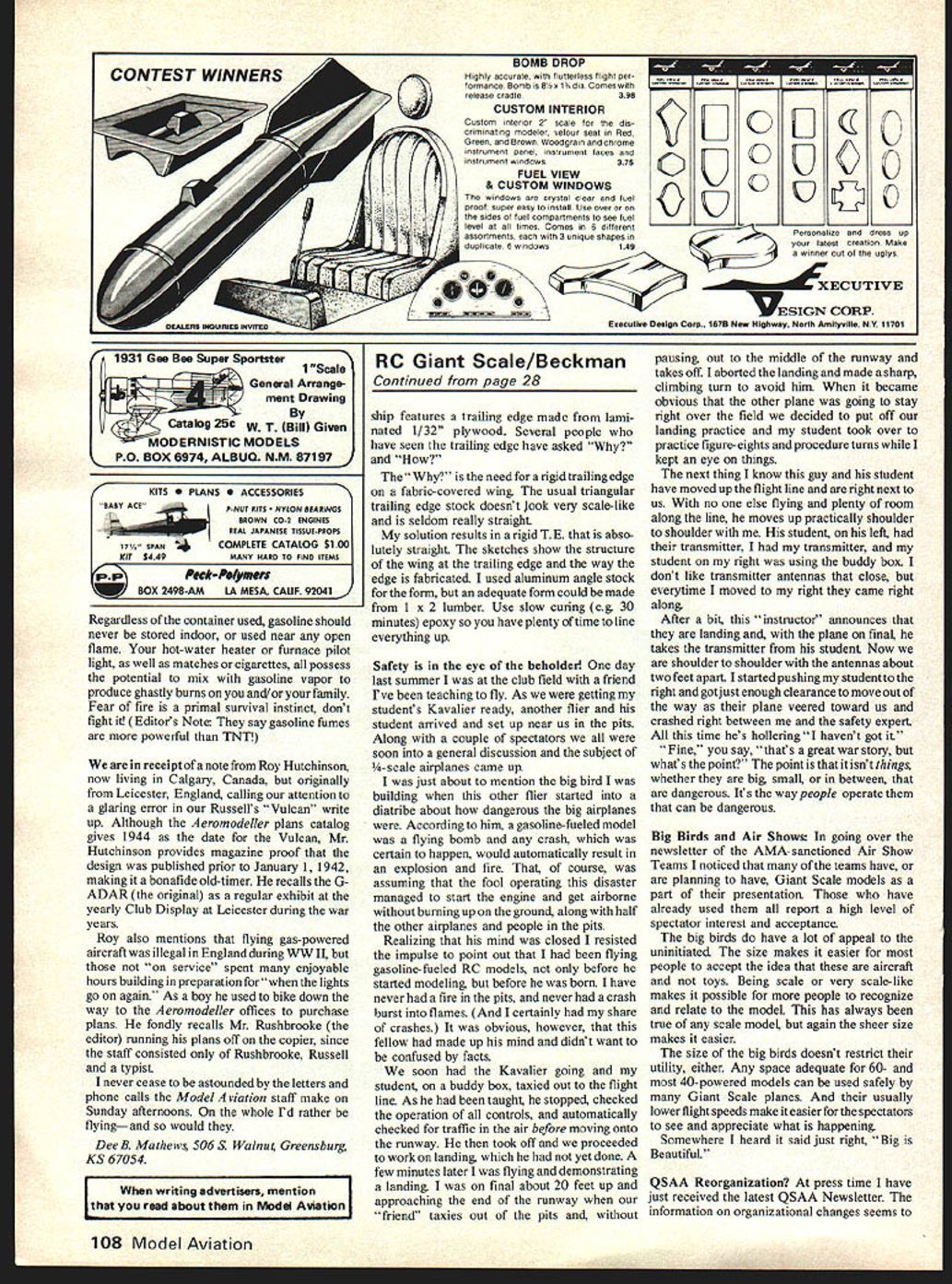
Somewhere I heard it said just right, "Big is Beautiful."
QSAA Reorganization?
At press time I have just received the latest QSAA Newsletter. The information on organizational changes seems to produce more questions than answers. I would like to hear your comments, and I'll have more next month.
Bob Beckman 8248 Holly Grove Ct., Manassas, VA 22110
Regarding vibration problems, I cannot see that a 1/4-scale aircraft, if flown in anything resembling scale-type flight and comparative stresses, can't be controlled with normal servos delivering somewhere around 20 oz.-in. I believe that since 1/8" dowel is as stiff as wire but much lighter and without RF associations, it can be used quite successfully for control pushrods, provided it is supported at 8" to 10" intervals by carefully aligned nylon or comparable "slick" guides to prevent lateral movement. This type of connection also minimizes weight in all respects and tends to dampen vibration better than using a heavier unsupported pushrod.
Bob Munn's accomplishments with friction-free lightweight pushrods provide ideas that will be helpful on all sizes of scale planes. His use of standard servos on planes up to nine-foot span would indicate that we have power to spare. The only exception may be a servo driving large-area flaps down to a 45° angle which may require some extra energy, particularly when there are friction losses in linkage.
Scale Details
Inquiries regarding the gathering of information needed to finish a scale kit are constantly reaching our mailbox. It isn't easy to inform someone that he should have started with a good scale drawing and a stack of sharp photos before he bought the kit; a more proper sequence. Questions of this nature usually arise because the kit buyer is new to scale, has purchased kits in the past for trainer-type models and found the box to contain all that was needed. Even though some scale kits do include a three-view drawing, additional information to build a model of a specific aircraft is most often required. Kit information may be sufficient to build a model with the general outlines and colors of an aircraft type. When a builder is dissatisfied with the ordinary, perhaps because he has seen well finished models or photos of them, there comes an awareness of lacking information.
We have been asked for a list of purchased scale goodies from which to select parts that can be assembled with a kit, making modeling an assembly task rather than a building job. Actually, the Sig and Ace catalogs contain a large portion of the available items on the market, so a list, of sorts, already exists. It is regrettable that the builder who wants a top-quality model of a specific airplane will not find many items that are usable in their original, as-purchased condition. Everything depends upon the degree of authenticity that is desired, and Sport Scale modelers have a definite advantage in being willing to accept ready-made parts that are not necessarily perfect for their application.
Choosing a model subject on the basis of available data and usable purchased parts would be the surest course of action. Preferred scale drawings should have sufficient detail to remove doubts about such items as control surface hinge point locations and landing gear motion, if retractable. Determine whether commercial retract mechanisms can be employed. Wheels that swing through an arc greater than 90° may require machining of parts that is beyond the modeler's capacity, or a change in design that reduces scale accuracy. A decision must be made as to whether loss of accuracy is acceptable, as it may be in Sport Scale.
A modeler searching for the ultimate in every detail will find that quality suffers when compromises must be made in shape, form, or structure to accommodate use of ready-made parts. Hinges, as an example, are available in a profusion of shapes and sizes. Possibly a way can be found to use them, but true scale hinging usually has pivot centers in such position that a sacrifice in scale appearance or operation is inevitable.
Wheels and tires are an eyesore on too many otherwise excellent scale planes. Too large or too small, with the wrong proportion of hub to tire size, is a conspicuous error and tread pattern also contributes to lack of authenticity. Reliable scale data in the form of drawings and clear photos, on hand before starting construction, will warn that wheels can be a problem, even though we have a large number from which to select. We have rejected some attractive prototypes because authentic wheels are not available. If exact-diameter wheels can't be found, it is best to err on the large side.
Research is regarded by many as a boring ancillary to the art of scale modeling. Others dislike the writing of begging letters to possible data sources. Too many of us live in relative isolation from fellow modelers who may come forth with helpful information about our choice of subject. Groups and clubs that specialize in scale can assist one another. As a research aid, the National Association of Scale Modelers (NASA) has compiled a Scale Data Source List for its members. The list narrows down the number of places one would need to write for specific information. Some information can be found in columns such as ours, but the data becomes lost to future reference unless the reader clips the item. Membership dues in NASA are $5.00 annually. Address inquiries to Robert Underwood, 4109 Concord Oaks Drive, St. Louis, MO 63128. The list contains government agencies and commercial sources for drawings, photographs and some museum aircraft for personal viewing and study.
What may be the largest collection of aircraft photo negatives is in the possession of Peter Bowers. Peter has not been able to answer inquiries because of the time required to operate his own photo business, but prints from his several hundred thousand negatives can be obtained through Castle Graphics, P.O. Box A D., Greenbank, WA 98253. Prices are $2.50 for 8 x 10 or $1.75 for 5 x 7, single-weight glossy black-and-white, with $1.00 additional for first-class postage. Like most photo sources it will be necessary to be quite specific when inquiring.
To be of value, photos should not be halftone magazine or book types. A magnifying glass used to check detail can be a big help.
Transcribed from original scans by AI. Minor OCR errors may remain.

