
Radio Control: Giant Scale
John A. de Vries
Colonel, USAF, Ret. 4610 Moffat Ln. Colorado Springs, CO 80915
Welcome back
WELCOME BACK! It's great to be writing once again. After a month off to make space for extended Nationals coverage, Giant Scale continues to proliferate. I'm glad that you're a part of it!
In the interim, I observed a seemingly minor incident that draws an important moral. Our RC club had scheduled a fun fly, but the wind and weather were against us and the event was called off at the last minute. As always, several fliers decided to challenge the elements and fly anyway. Zack Fassman had his Giant Extra 230 assembled and ready to go. Like many of us, he made a thorough check of the model and was satisfied that it was ready for flight. With a helper he cranked up the Super Tigre 3000 and soon had it purring like a kitten.
One might expect that the next thing to do would be to taxi the model to the runway. But no! With the engine singing at full bore, Zack began walking away from the flight line. As he walked, he exercised all of the model's controls. His helper signaled that things were working properly. By the time Zack's stroll ended, he was more than 100 yards from the model. Of course, this was a good range check for his radio. Although he'd flown the Extra many times before—it had always performed perfectly—he made sure that the radio functioned properly. His subsequent flight into the teeth of a gale was a most anticlimactic success: rolls, loops and knife-edge flight—it was a symphony of positive radio control.
The moral of the story: for the investment of three minutes to do a radio range check, Zack was sure his model was ready to fly. When was the last time you range-checked your Giant model?
Covering materials
In the continuing saga of unusual model covering materials, I received some interesting stiffish Dacron from J. Robert Droege, AMA 1722, of Potomac, MD. It's called mainsail Dacron. The material can be applied to a solid understructure to simulate metal covering and is available in several weights. According to Bob, it takes dope well and is easy to apply. The only caution is to make sure that the Dacron isn't creased. He says the mainsail Dacron is available from sailmakers' supply houses.
New drawings and kits
A bunch of new Giant Scale drawings and kits have appeared on the market recently. Among them are several from the prolific drawing pen of "Doc" Pepino (Scale Plans & Photo Service, 3209 Madison Ave., Greensboro, NC 27403). They include:
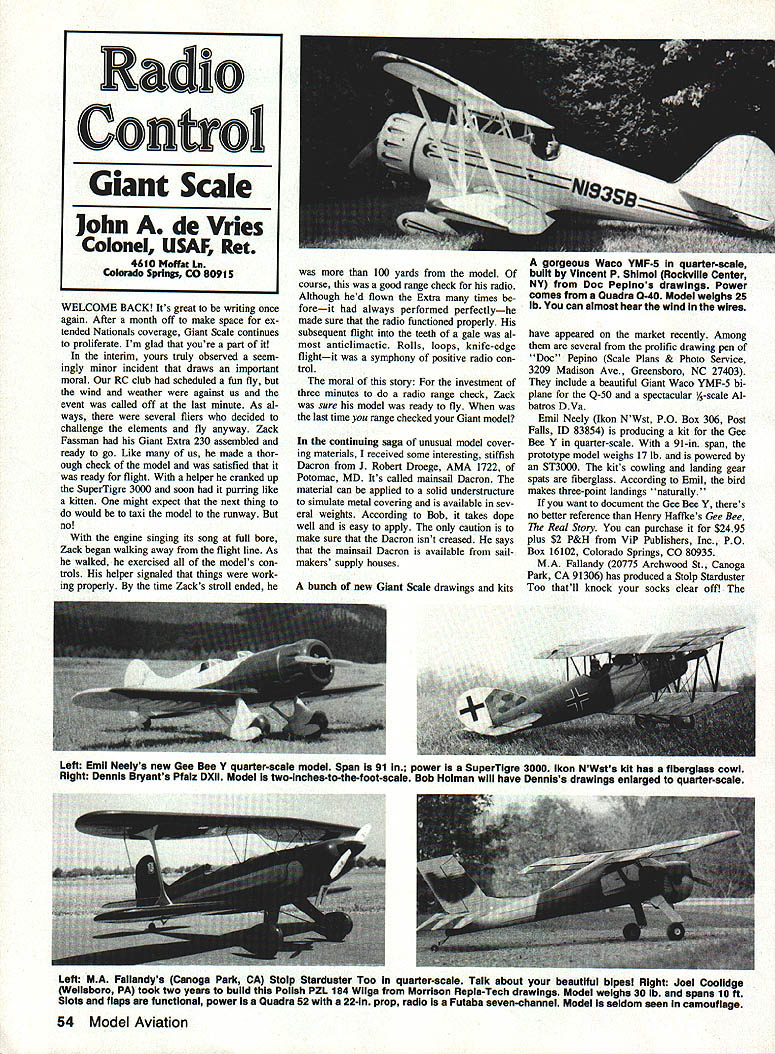
- a beautiful Giant Waco YMF-5 biplane
- a spectacular 1/5-scale Albatros D.Va
Emil Neely (Ikon NWst, P.O. Box 306, Post Falls, ID 83854) is producing a kit of the Gee Bee Y quarter-scale. The 91-inch span prototype model weighs 17 lb and is powered by a ST3000. The kit's cowling and landing gear spats are fiberglass. According to Emil, the bird makes three-point landings "naturally."
If you want to document the Gee Bee Y, there's no better reference than Henry Haffke's Gee Bee: The Real Story. You can purchase it for $24.95 plus $2 P&H from ViP Publishers, Inc., P.O. Box 16102, Colorado Springs, CO 80935.
M.A. Fallandy (20775 Archwood St., Canoga Park, CA 91306) has produced a Stolp Starduster Too that'll knock your socks clear off!
Composites and building materials
I received a press release from Aerospace Composite Products recently—all about their RC building materials. 'Twas frosting on the cake, because I already use them. The foam wings for my Pacific C-1 are reinforced by their No-Fray carbon fiber tape epoxied to stiff balsa spars. The epoxy is their Epoxy Laminating Resin. The wing is almost stiff enough to stop a jeep out of the mud!
Sending a big SASE to P.O. Box 16621, Irvine, CA 92714 should produce a copy of their catalog—which includes such goodies as Kevlar vinyl-coated Kev-Cord, used for control cables that won't stretch. Great stuff!
Preseason inspection and maintenance
Building season is upon us in most parts of the country. It's a good time to give your 1990 Giant a complete inspection and put it in shape for the '91 flying season before you embark on your winter construction project.
A general cleaning is a good idea, but you should look deeper than that. Ask yourself:
- Is there some hidden, hard-to-find damage that you may have overlooked (slightly bent wing or stabilizer spars, overly spread landing gear struts, weakened fuselage longerons, cracked paint that may indicate damaged sheeting underneath)?
- Have you drained and flushed your tank and fuel lines, cleaned the carb, and lubricated the muffler's innards to prevent rusting when it isn't fired up regularly?
- Does your radio have a gold sticker and have you set up a charging program for your transmitter and receiver batteries?
- Did you check the controls, including pushrods, rod ends, and the control cables for fraying?
- Have you inspected the wing mounting area for weak wood or stripped bolts?
With the inspection conscientiously completed, it's time to cover the model so that it's protected from the balsa dust from this year's modeling project! Have you chosen your next project? After all, it's the Christmas hunting season!
Keep the big 'uns flying!
Transcribed from original scans by AI. Minor OCR errors may remain.

