
Radio Control: Giant Scale
John A. de Vries
Colonel, USAF, Ret. 4610 Moffat Ln. Colorado Springs, CO 80915
HERESY, heresy, heresy! We're going to talk heresy this month. And Bob Benjamin's the cause. On a toasty day last September Bob called to say that he was passing through Colorado Springs en route to the Scale Masters Final in Texas. He figured that we'd get together for lunch and a spot of hangar flying before he resumed his drive. Bob, of course, is the artist who does those great covers for Model Builder magazine. I'd met him at the ROC's flying field up in Washington state awhile back. He's a master model builder-flier, a very talented guy.
In any event, Bob showed up, and after lunch we retired to his RV to talk scale models. As most of you already know, Bob qualified for the Masters with an electric airplane, and he was the first person to do it. His red Porterfield monoplane, a simple, stable Scale subject, showed its master class (it staticked 93 in Dallas and scored 51 out of 76 birds).
Electric Power: Heresy (Number One and Two)
As we talked, Bob convinced me that with today's technology giant-scale electric airplanes are eminently feasible. That's heresy number one, because big birds are supposed to be powered by converted gasoline-burning chain saw engines or, at the least, by monstrous glow hummers.
With a bit more conversation, Mr. Benjamin made the point that scale models don't have to be built like fragile indoor ships nor be covered with microfilm (heresy number two). Some care has to be taken, of course, not to load a giant electric with fiberglass and foam, but competition models can be built by the average modeler.
Time passed more quickly than either of us hoped and Bob had to get back on the road. After bidding him farewell, it was we who committed heresy number three. I went home and dug out the Graupner electric motor I'd acquired some time ago and began dreaming up a smaller version of the Pacific C-1, probably 1½ in. to the foot scale. It won't be a giant (hence the heresy) but it may lead to a true electric giant design around here (and that's what's called rationalization).
Electric birds do have some very desirable traits:
- The field box only needs to contain a battery charger, a second set of flight batteries, and a propeller or two.
- Electric motors are quiet and clean.
- Starting isn't a problem, and with proper motor control the power curve is absolutely smooth.
- With the correct complement of cells, ten-minute flights are possible.
I'm not going to sell Quadras and big four-strokers, but I am going to give electric a try.
Repairing a Wreck: Converting During Repair
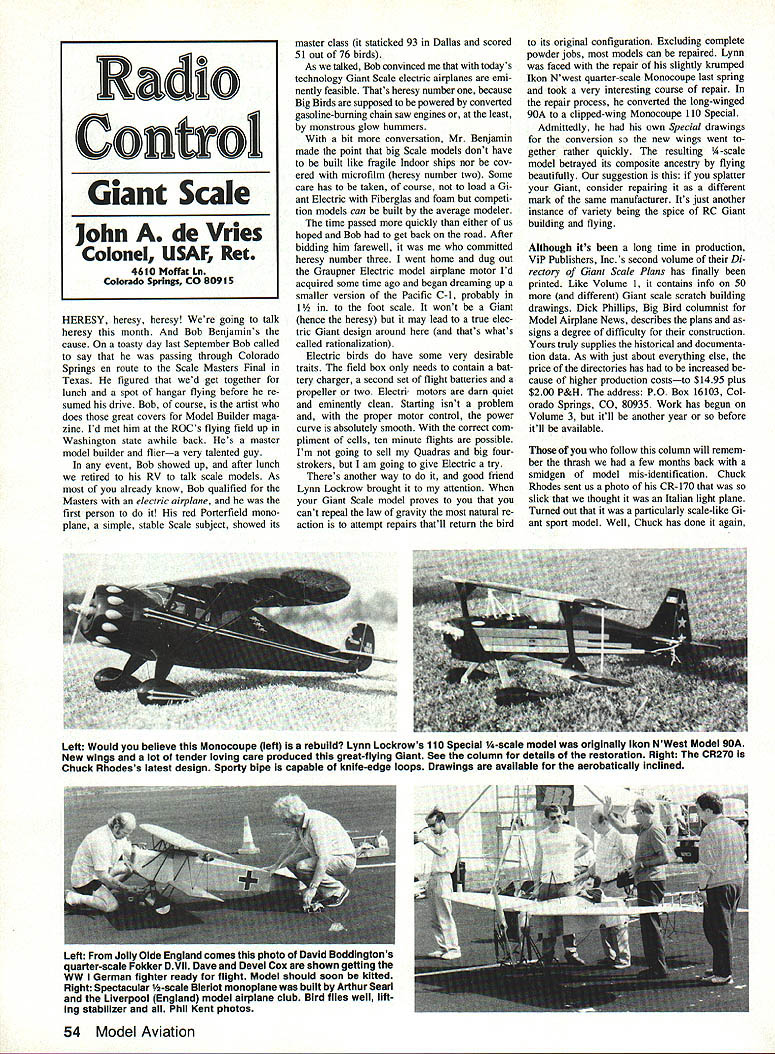
There's another way to do it, and good friend Lynn Lockrow brought it to my attention. When your giant-scale model proves to you that you can't repeal the law of gravity, the most natural reaction is to attempt repairs that will return the bird to its original configuration. Excluding complete power jobs, most models can be repaired. Lynn was faced with the repair of his slightly crumpled Ikon N'West quarter-scale Monocoupe last spring and took a very interesting course of repair. In the repair process he converted the long-winged 90A to a clipped-wing Monocoupe 110 Special.
Admittedly, he had his own Special drawings of the conversion, so the new wings went together rather quickly. The resulting 1/4-scale model betrayed its composite ancestry by flying beautifully. Our suggestion is this: if you splatter your giant, consider repairing it as a different mark of the same manufacturer. It's just another instance of variety being the spice of RC giant building and flying.
Directory of Giant Scale Plans
Although it's been a long time in production, VIP Publishers, Inc.'s second volume of their Directory of Giant Scale Plans has finally been printed. Like Volume 1, it contains info on 50 more (and different) giant-scale scratch-building drawings. Dick Phillips, Big Bird columnist for Model Airplane News, describes the plans and assigns a degree of difficulty for their construction. Yours truly supplies historical documentation data.
As with just about everything else, the price of the directories has increased because of higher production costs—to $14.95 plus $2.00 P&H. The address: P.O. Box 16103, Colorado Springs, CO 80935. Work has begun on Volume 3, but it will be another year or so before it'll be available.
Recent Models and Misidentifications
Those of you who follow this column will remember the kerfuffle we had a few months back with a smidgen of model misidentification. Chuck Rhodes sent us a photo of his CR-170 that was so slick that we thought it was an Italian light plane. Well, Chuck has done it again. The CR-270 is a sporty biplane capable of knife-edge loops. Drawings are available for the aerobatically inclined.
Personal Standards and Modeling Techniques
In putting together this column every month, I've set a sort of personal standard concerning its content. Although it's patently impossible to build the model from every drawing I tout, try every modeling technique I pass on to you, or employ all the commercial products I describe, I usually have some solid background or experience with the items that are noted on these pages. One gains a pretty solid modeling background in 56 years of effort in the balsa-wood forest. From five-cent Comet kits to scratch-built giants, the modeling state-of-the-art has experienced quantum improvements that boggle the mind. Fiberglass-covered foam wings are light-years away from 1/16 wing ribs and Japanese tissue.
All of this song and dance is to introduce a modeling technique that I have yet to try. A company known as Composite Structures Technology is heavily involved with vacuum bagging. It's the technique wherein a model structure (usually wing panels) is covered with fiberglass cloth and resin, then placed inside a plastic bag. The air is removed from the bag, pressing the covering onto the structure for a solid, complete bonding. An advantage of the technique is that it squeezes out excess epoxy or other resin coating (which lightens the finished piece) and smoothes the fiberglass cloth or other space-age covering material; it takes just a bit of sanding, and friends who have used the technique tell me that the bagging method minimizes weight and produces a part with maximum strength.
If you are interested in this very modern covering approach, CST will send you a free catalog that is replete with all the equipment to bag model parts. Contact:
- Composite Structures Technology
- P.O. Box 615
- Lancaster, CA 93539
As I said, I haven't tried it; my friends recommend it, and I hope to try it myself given an appropriate model.
IMAA Festival 1991
We'll wind things up this month with the news of the impending 1991 IMAA Festival—the biggie for us giant-scale builders and fliers. This year's do will be held at North Lake Park, Irving, Texas, from the 20th through the 23rd of June. Should be a good 'un!
Transcribed from original scans by AI. Minor OCR errors may remain.

