
Radio Control: Giant Scale
John A. de Vries Colonel, USAF, Ret. 4610 Moffat Ln. Colorado Springs, CO 80915
Ah, the good old days. Would you believe that in the 1930s and 1940s you could buy a model airplane kit for a nickel? A tube of glue went for the same price. If you really wanted to splurge, you might plunk down a dime and get a rubber-powered kit that produced an 18‑in. wingspan scale flier. If you really wanted to go first class, fifty cents would get you a Cleveland Dwarf (1/2‑inch scale) kit. That was two weeks' allowance for some kids—a young fortune!
As time passed and gas engines came into vogue, you might save up your pennies and invest $16.50 in an Ohlsson .23 to power your all-balsa Jim Walker control-line Fireball kit that cost all of $10. With the advent of radio control, the engine of choice was the K&B Greenhead .45 that set you back a staggering $27.95 at the hobby shop. It was just the engine to power your $24.95 scale Spitfire kit in the mid‑sixties.
The point I'm making: scale modeling has become more expensive over the years—in spades! When the Giant Scale movement began in 1976 with Dick Phillips' first columns in Radio Control Modeler, you could acquire a Quadra engine for $85 to $120, depending on where you bought it. Since then, Giant Scale prices have burst through the ceiling. Today, engines are blasting past the $500 level, and model kits run from $200 to $700. The $1,000 RC model seems to be the norm when radio costs are considered. Retracts selling at $200–$300 aren't unknown for Giant warbird builders, and $50–$60 for a pair of scale wheels doesn't jar the finer sensibilities of the Giant Scale builder.
Fortunately, most of the beautiful birds that show up on Giant Scale flight lines are plans-built, with their inherently lower costs. We trade our sweat equity for fancy prefabricated bits and pieces that would run up the cost of our models.
Cost-saving techniques
To keep costs as low as possible, here are a few dollar‑saving techniques you might consider:
- Engines: Although gas prices have risen substantially at the local service station, they’re still considerably cheaper than glow fuel. A gas burner will save you money, particularly over the long run.
- Lumber: Most plans-built and scratch-built Giant Scale models specify spruce or other hardwoods as the primary construction material. Precut strips are relatively expensive, but if you have a halfway decent table saw you can rip your own from sheet lumber at a lower overall cost. If you don't have a local source for spruce, consider sending for the catalog put out by Aircraft Spruce & Specialty Co., Fullerton, California.
- Foam: Although some Giant builders deplore its use, foam is an inexpensive substitute in many model-building applications. Foam wings are a tad heavier than built-up ribs and spars, but when cost is considered—don't insist on expensive balsa sheeting—they're a reasonable tradeoff. Foam blocks can be substituted for formed wing tips and fleshing out fuselage contours. Choose blue or green foam—you'll be pleasantly surprised to find modeling adhesives, even cyanoacrylates, won't dissolve it. Thin poster board or very thin ply will add strength to foam wings while keeping costs within reason.
- Alternative materials: Often inexpensive mahogany door paneling may be substituted for costly plywood in some Giant Scale applications. Some modelers use wing ribs as formers. Since there isn't much stress on wing ribs, other modelers save a buck using foam core board, though you're generally better off choosing commercially available products.
- Hardware and accessories: For control systems and big-bird safety considerations, you can save a bunch by making your own wheels and other accessories. It may take a bit of digging to find unusual sources for wheels. For example, rollers from a local hangar queen ready-to-cover Ryan B-5 came from a K-Mart scooter. Look around a little and you can keep the cost of a plans-built Giant model at a reasonable level. With a little trade-off of time and a bit of research you'll be pleasantly surprised at how little a Giant will cost.
Finally, if you're willing to make parts yourself rather than relying on prefabricated bits and pieces, you're well ahead in the cost department.
Solution needed
Steve Pelles 3408 Constitution Ave. Colorado Springs, CO 80909
Steve has a problem. Not content to bolt together the Sig Morrisey Bravo kit as it comes out of the box, he wants to convert it to the Morrisey OM‑1, a single-seater. The OM‑1 was the ancestor of the Bravo but had an open cockpit. Steve has a drawing of the bird from an old issue of Kitplanes magazine but needs more documentation. Drop him a line if you have any OM‑1 data.
A model builder's modeler
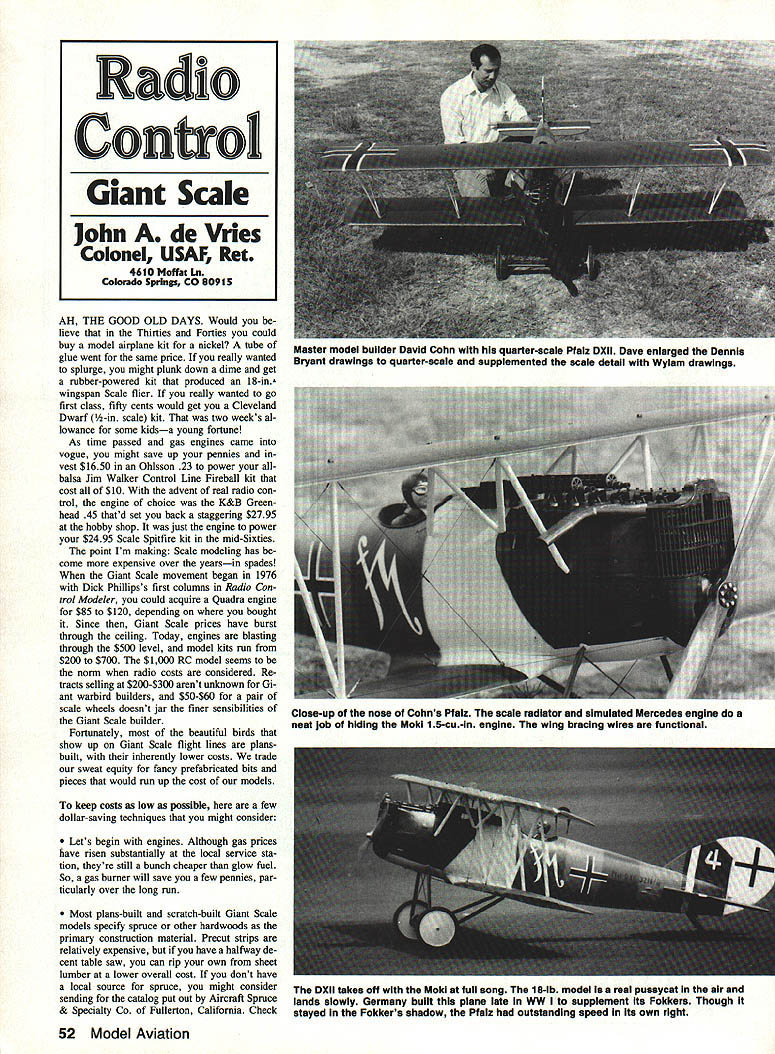
David Cohn (Torrance, California) sent me some photos. I've included three that I'm sure will convince you of his excellence.
Dave enlarged Dennis Bryant's Pfalz D.XII drawings to quarter scale and built the model. He used Wylam drawings for details lacking in the construction plans. His model weighs a reasonable 18 lb. and is powered by a Moki 1.5‑cu‑in. engine. He notes that it was difficult to find an engine that fit within the weird shape of the prototype's nose. The bird flies well and lands very s‑l‑o‑w‑l‑y.
Computer stuff
John R. Lane (J&L Sales, 20163 Woodbend, Northville, MI 48167) has come up with a computer software product that might be of interest to Giant Scale fliers, particularly beginners. It's called the Primary R/C Flight Trainer and it runs on Commodore 64, 128 and Amiga home computers equipped with joysticks. The program is contained on a single 5‑1/4‑in. disk.
According to John, the program "teaches the rudiments of RC flying, from the point of view of both proper flying field procedures and basic maneuvers." I haven't had a chance to check out the disk (my machine is an IBM‑compatible), but the program seems like a good idea.
Flying season and preflight checklist
Flying season is fast approaching, even if it hasn't arrived in your part of the country. We hope your project's coming along nicely and will be ready to take to the wing when the weather allows.
Before you shove the throttle forward for that first test flight of your new giant, break out your checklist and make sure the bird will be safe to fly. Recheck the following:
- Proper center-of-gravity (C.G.) location.
- Long-range and short-range radio range checks.
- Direction of movement of all control surfaces, particularly the ailerons (triple-check).
- Designed range of control surface movements.
- Wheels track straight ahead.
- Engine is putting out its rated power.
You can't be too careful if you want to be assured of a great-flying model. It's worth the extra time and effort.
Lots of luck with your new giant!
Transcribed from original scans by AI. Minor OCR errors may remain.

