
Radio Control: Giant Scale
John A. de Vries Colonel, USAF, Ret. 4610 Moffat Ln. Colorado Springs, CO 80915
To Each His Own
Give five skilled RC model builders a set of enlarged three-view drawings, and you'd expect to see some differences in their finished models. That's what happened when some of our club members decided to construct propeller-driven versions of the Grumman F9F, an early Navy jet fighter. What stunned us, though, was just how wide the disparities were. Although all five birds shared the same hot-wired foam wings, fuselages were built in totally different ways.
- The first modeler adopted Jack Stafford's box-jig method to build his Grumman fuselage. Taking a long, thin, stiff cardboard box that had originally held an automotive part, he laid out a centerline on the box cover, drew perpendicular lines across it to locate the formers, and cut a series of slots into which the formers fit. The inexpensive makeshift jig held the formers while he planked the fuselage top. When things were dry, he simply popped the fuselage away from the box and planked its underside.
- The second modeler opted for the crutch technique. Tracing the top view of the fuselage onto a sheet of balsa, he glued on the formers and proceeded to plank. He chose a common reference line for the crutch and the split formers. After the upper fuselage was completed, he simply flipped the crutch, added the lower formers, and planked the underside.
- Modeler number three purchased a piece of one-inch aluminum tubing the length of the fuselage and marked it with the former locations. Using a reference line common to the fuselage side and plan views, he drilled a hole almost an inch in diameter in each former; this ensured a good friction fit. For convenience, he set up a pair of brackets at the ends of the tubing, which allowed the assembly to be rotated. Since the fuselage was perfectly aligned, he was able to plank the whole works simply by rotating it between the holding brackets. He then withdrew the aluminum tube.
- The fourth modeler chose a more complex method. Using the enlarged three-view, he drew a box that could be contained within the former outlines and transferred the rectangular box cross sections to the former outlines. After building the sturdy balsa box, he added the top, side, and bottom former sections in their proper positions and then planked the whole works.
- Our last modeler used the master-stringer technique, which is similar to the crutch method. He built two master stringers representing the plan view and two more outlining the side view. All the formers were notched to accept the four master stringers (each about 1/2 in. deep) and glued in place. When he began to plank, he had a stabilized set of formers to work with.
Five modelers used the same drawing but opted for entirely different construction methods. All produced dead-straight assemblies. The point of this discussion: if you scratch-build—and most Giant Scale builders do—you aren't limited to the technique employed by the designer. If a different construction method works better for you, adapt the drawings you're working from. It may take a bit more time, but if you're comfortable with a particular building technique, that's the way to go.
Seaplane redux
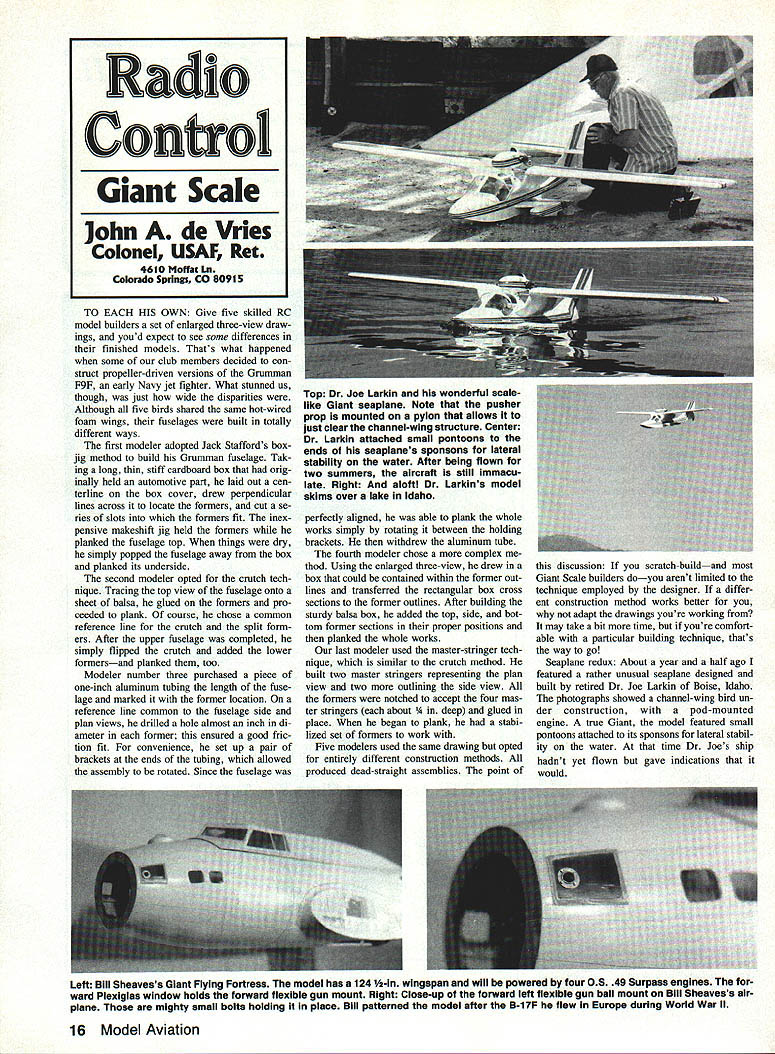
About a year and a half ago I featured a rather unusual seaplane designed and built by retired Dr. Joe Larkin of Boise, Idaho. The photographs showed a channel-wing bird under construction, with a pod-mounted engine. A true Giant, the model featured small pontoons attached to its sponsons for lateral stability on the water. At that time Dr. Joe's ship hadn't yet flown but gave indications that it would.
In a recent letter Dr. Joe included some toothsome photographs of the completed model. The plane flies stable as a rock both in the air and on the water. Dr. Larkin has flown it the past two summers; it's still in immaculate condition.
Doc Pepino — A-scale Bell P-39
Doc Pepino has taken the drawing board once again to come up with a definitive A-scale Bell P-39. The wingspan is 80 in., which makes it an IMAA-legal prospect. A prototype model is being built. The model will be powered by a water-cooled Quadra installed in scale location behind the pilot in the middle fuselage; the propeller will be driven by a simple steel extension shaft. Custom Robart retracts are being considered.
Giant Scale Reno Air Races
The February 1991 column discussed at length the drawings for the Giant Scale Reno Air Races that have been proposed in California by R/C Unlimited Racing, Inc. This inspired three letters, all of which showed interest in the races.
Of these, a most interesting epistle came from Tony Carvalho of Arkansas City, KS. Both Tony and I realize that the organizers have their hands full putting together the first big race. Nevertheless, Tony suggested that adding another class to the competition might someday be considered. Mr. Carvalho would like to see a Golden Age class add some variety to all those Reno warbird models that'll be zipping around the Giant Scale course.
Of course, there's no lack of suitable Giant drawings for Golden Age racers. Examples include:
- Henry Haffke's quarter-scale Gee Bees.
- Wendell Hostetler's Roscoe Turner Pose Special.
- Art Chester's Jeep and a beautiful Wedell-Williams racer.
- Don Neill's Hall Bulldog, a Wedell, and the definitive Folkerts SK-4.
- The Granger Williams Gee Bee Z and R.
- Jim Thompson's drawings for Benny Howard's Ike and Tony LeVier's Schee-feldt Firecracker.
If and when the class is introduced, there's a host of great Golden Age large-scale drawings available.
Still on the subject of the Giant Scale Reno races, I've heard that Bob Heitkamp, up in Juneau, Alaska, is gluing together a big Sea Fury for the competition. Ivan Munnighoff, here in Colorado Springs, is designing and building a sleek model of the Stiletto, a much-modified P-51 Mustang. The underflush radiators were remounted in the wings to reduce parasitic drag. Both models sound like winners.
Bill Sheaves's Giant B-17F
I'm going to tease you a bit with news about Bill Sheaves's Giant B-17F this month. You'll recall that Bill's building a 124½-in.-span Flying Fortress from the original USAAF tech orders. Previous columns have featured his intricately designed electrically driven scale landing gear mechanisms and noted that he'd completed the basic model structure. Next month's column will feature Bill's work on what may be the definitive B-17 model.
Here I'll dwell on just a small part of his current efforts—the mounts for the free-firing (flexible) nose guns. In the prototype, these guns were set into ball joints and manned by the navigator and bombardier. Mr. Sheaves has machined miniature ball mountings in the nose of his model to fit the scale machine guns. But wait until you see how Bill's provided for disassembling his big Fortress and how he's hinged the split landing flaps for Fowler-like action. The man's a genius!
Jennings Products — awards and shirts
A small plug for friend Jim Jennings down in Hendersonville, Tennessee. Jim produces a rather extensive line of awards and trophies specially aimed at model airplane competitions. Great artwork and quality products. If you're looking for reasonably priced engraved or silk-screened awards for your fly-in, contact Jim at Jennings Products, 202 Hollow Lane, P.O. Box 1121, Hendersonville, TN 37075. Sporty silk-screened sweatshirts and T-shirts are available from Jim, too.
Next month
The ultimate Flying Fortress.
Transcribed from original scans by AI. Minor OCR errors may remain.

