
Radio Control: Giant Scale
John A. de Vries 4610 Moffat Lane Colorado Springs, CO 80915
Bill Sheaves' 1/6-scale B-17F
The ultimate giant RC model for many people is the Boeing B-17 Flying Fortress. It's also number one with raw beginners to the RC hobby—an idea that often dies aborning when the realities of the hobby are explained. However, there are many giant builders with the smarts and experience to build and fly a four-engined Fortress. Well up on the list of these competent modelers you'll find my friend Bill Sheaves.
Bill's building a 1/6-scale B-17F with a 124-1/2 in. wingspan that will be powered by four .48 Surpass engines. He's duplicating, in model form, the bird he flew over Europe during World War II. His documentation is the USAAF technical orders for the prototype. It's going to be precision giant scale in every sense.
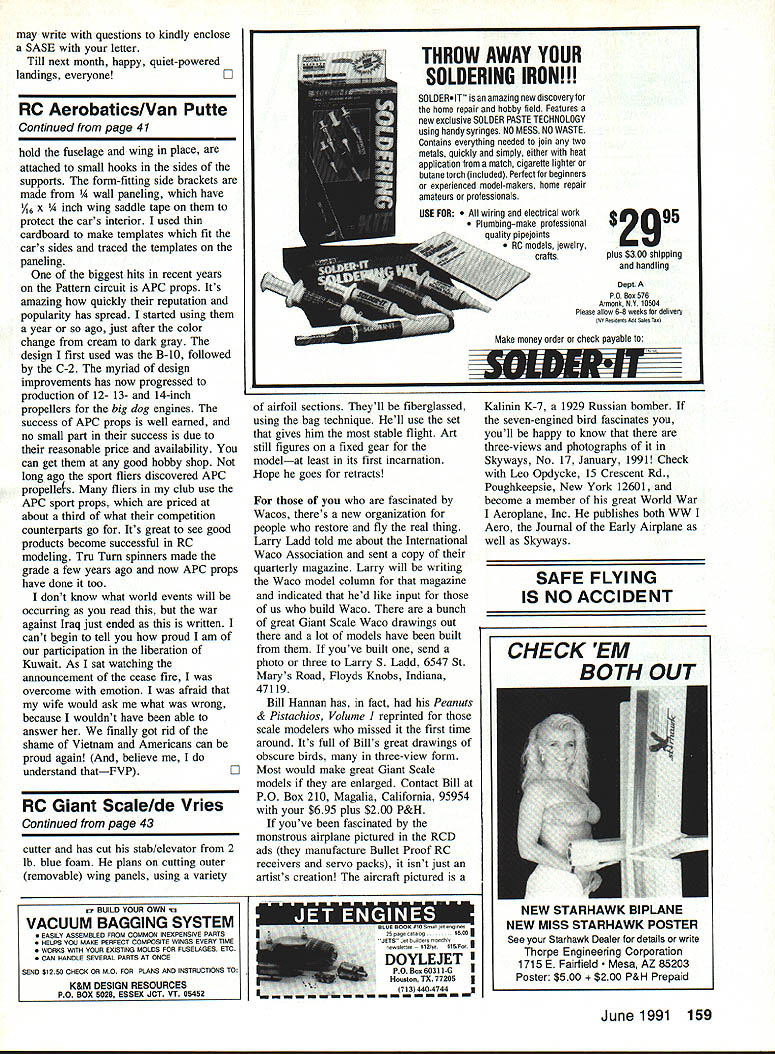
Among his other talents, Bill is a machinist. Thus, the retractable main landing gear in the B-17 is dead-on scale. The struts are oleos and all of the linkage is functional. The gear is retracted by miniature geared electric motors. The same is true for the tailwheel; it has an oleo as well.
Scale armament, glazing and bomb bay
We noted in last month's column that the scale machine guns in the nose of Bill's model are mounted in metal ball swivels. The turrets in the Fortress will "track" and elevate via radio control. The upper turret and ball turret will feature strobes to simulate machine-gun fire. "The tail guns will only elevate and depress," Bill says—almost apologetically. Waist guns won't be animated, either.
He's molded all of the clear parts for the model—including the clear, pointed bombardier's nose, the radio man's gun window, and the turrets. He's molded the windows in the nose of the model to fit its contours—they aren't just bits of clear, flat plastic. The bomb-bay doors, however, will open and close in flight by radio control.
Wing, tail and flap mounting
A 10-foot-plus Fortress is a bear to transport. The wing panels will detach, of course. The horizontal stabilizers and elevators will also be removable. This latter feature is mind-boggling. Bill has installed wire spars in both stabilizers. Within the fuselage he's mounted two drilled metal blocks to which the stab spars fit. He's also drilled and tapped the bottom of the metal blocks for Allen-head bolts. The bolts retain the spars, of course.
The neat part of the stab mount is that Bill has installed plastic tubes in the fuselage that line up with the tapped holes in the mounting blocks beneath the fuselage. Thus, he has to drop the Allen heads into the tubes and tighten them with a wrench. The mounting-bolt holes are "invisible" because of their small size but may be covered by tiny "scale" panels for full-scale appearance.
The flaps on the B-17 are of the split trailing-edge variety. They differ slightly from the pure form of split flaps in that they move slightly to the rear and down when deployed. They work that way on Bill's bird as well. They're hinged on a trio of twin music-wire struts that duplicate the prototype's flap action.
Scale details and systems
There are a host of niceties built into the model. For example, Bill is using flexible metal tubing to lead the exhaust from the engines to the scale exhaust pipes/mufflers. The B-17 had turbos, and that's where Bill is directing his four-stroke glow-engine fumes.
There are servos sprinkled around the model with what appears to be wild abandon. Most of them are positioned near where they operate. Bill's going into the R.F. trap business in a big way, what with all of the servo leads in the bird.
Radio systems and throttle control
As noted in earlier descriptions of this model, there will be two complete radio systems required to fly it. Nine or ten channels will be involved. The first transmitter will handle flight controls, engines and retracts. The second transmitter will operate all of the scale features. He intends to use the throttle on transmitter number two to control the wing flaps; he'll be able to choose any degree of flap extension in a proportional manner.
The pièce de résistance in Bill's Fortress is the way he's going to control the four throttles. There's a throttle servo in each wing that is the primary control of the two Surpass engines in that panel. However, he's also installed what he calls a "differential servo" in each wing panel as well. The differential servos will be cross-linked to the rudder servo and the outboard engines' throttles (outboards only). That will permit true prototype taxiing—selecting right rudder, for example, will rev up the left outboard engine for sharper turns on the ground.
Weight and schedule
As this is written, Bill optimistically believes that he'll bring the model in at about 30 lb. He just might do it! The completely planked and fiberglassed fuselage, with massive fin attached, weighs only eight lb. We'll see when he hits the fall 1991 projected completion date.
Other projects and news
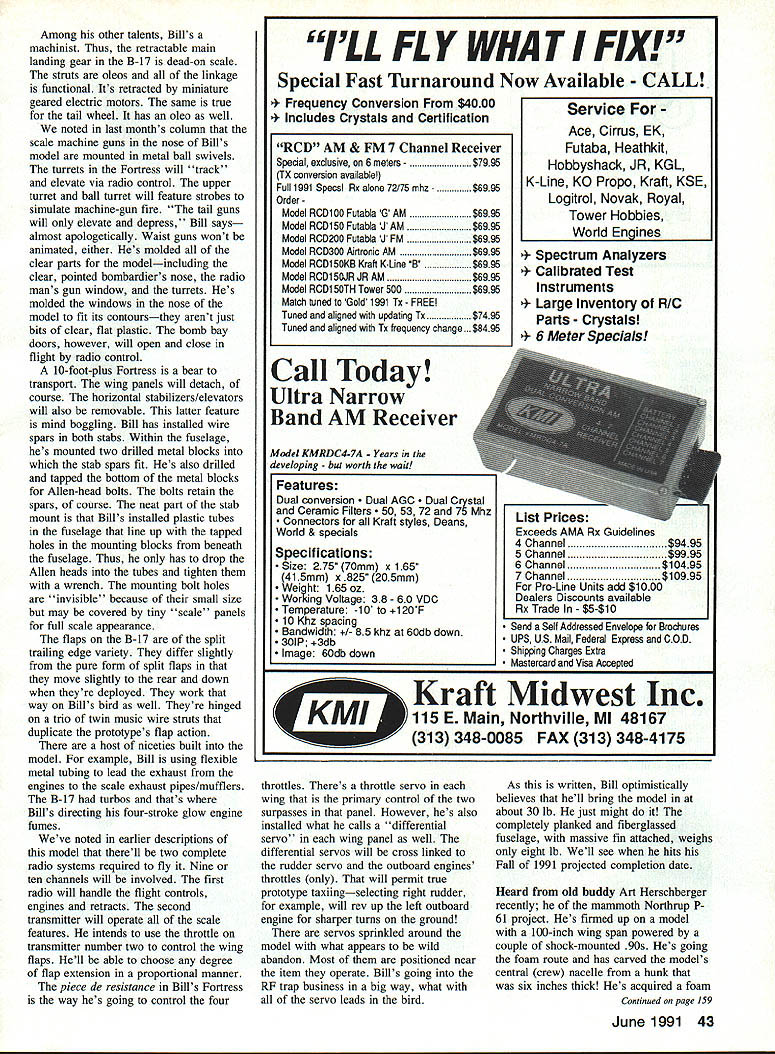
Heard from old buddy Art Herschberger recently; he of the mammoth Northrop P-61 project. He's firmed up on a model with a 100-inch wingspan powered by a couple of shock-mounted .90s. He's going to fly the foam nacelle that came from the central (crew) nacelle of the real ship. It was six inches thick! He's acquired a set of foam airfoil sections. They'll be fiberglassed, using the bag technique. He'll use the set that gives him the most stable flight. Art still figures on fixed gear for the model—at least in its first incarnation. Hope he goes for retracts!
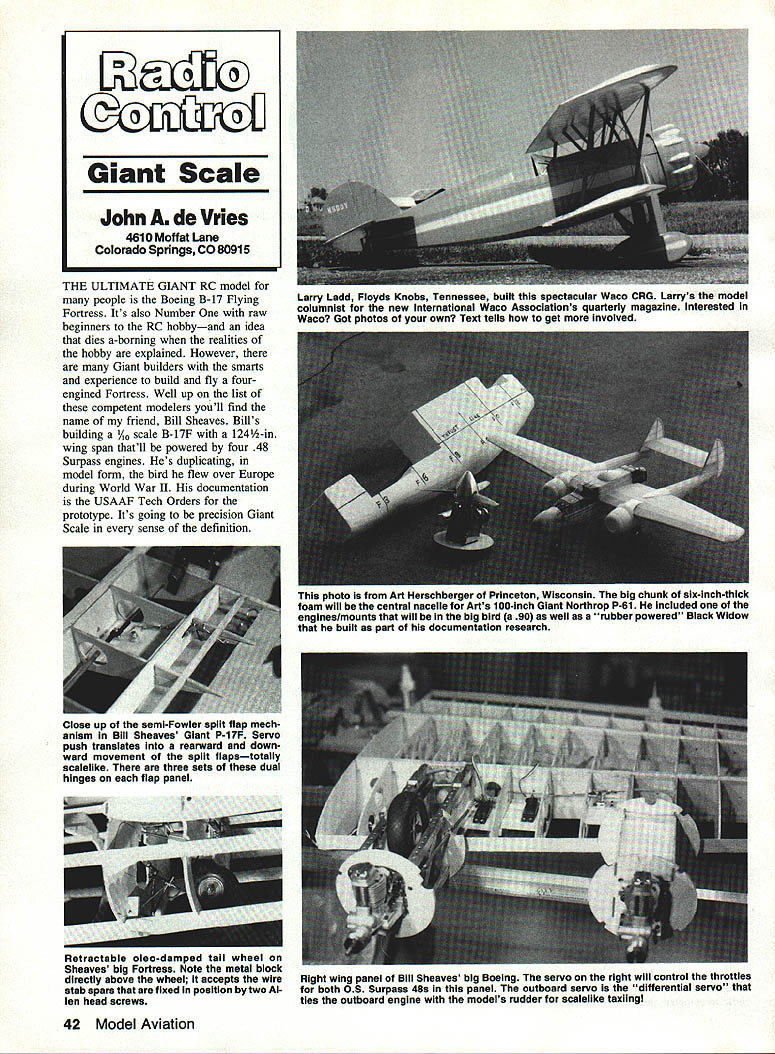
For those fascinated by Wacos, there's a new organization for people who restore and fly the real thing. Larry Ladd told me about the International Waco Association and sent a copy of their quarterly magazine. Larry will be writing the Waco model column for that magazine and indicated that he'd like input from those of us who build Waco. There are a bunch of great giant-scale Waco drawings out there and many models have been built from them. If you've built one, send a photo or three to Larry S. Ladd, 6547 St. Mary's Road, Floyds Knobs, Indiana 47119.
Bill Hannan has had his Peanuts & Pistachios, Volume I reprinted for those scale modelers who missed it the first time around. It's full of Bill's great drawings of obscure birds, many in three-view form. Most would make great giant-scale models if enlarged. Contact Bill at P.O. Box 210, Magalia, California 95954 with $6.95 plus $2.00 P&H.
If you've been fascinated by the monstrous airplane pictured in the RCD ads (they manufacture Bullet Proof RC receivers and servo packs), it isn't just an artist's creation. The aircraft pictured is a Kalinin K-7, a 1929 Russian bomber. If the seven-engined bird fascinates you, you'll be happy to know that there are three views and photographs of it in Skyways No. 17, January 1991. Check with Leo Opdycke, 15 Crescent Rd., Poughkeepsie, New York 12601, and become a member of World War I Aeroplane, Inc. He publishes both WW I Aero, the Journal of the Early Airplane, as well as Skyways.
Transcribed from original scans by AI. Minor OCR errors may remain.

