
Radio Control: Giant Scale
John A. de Vries 4610 Moffat Lane Colorado Springs, CO 80915
Trend to Larger Giants
There’s a new trend among Giant builders. For a while, 1/4-scale seemed to be the norm — models one quarter the size of their prototypes were the de facto standard and a host of plans and kits appeared in that size. The first inkling of the new trend came when Scale-Master’s Canadian Bob Nelitz produced his big 1/3-scale Cub. His superb drawings of the 14-footer attracted lots of attention, and many modelers duplicated the large J-3.
Commercially, the new era gained momentum when Sig announced their 1/3-scale Spacewalker kit. It was followed by Balsa USA’s moderately priced 1/3-scale J-3 Cub kit and their one-third-size Super Stearman. Big is not only better — it’s getting bigger — yet large, good-flying scale R/C models can still be built well within the 55-pound weight limit.
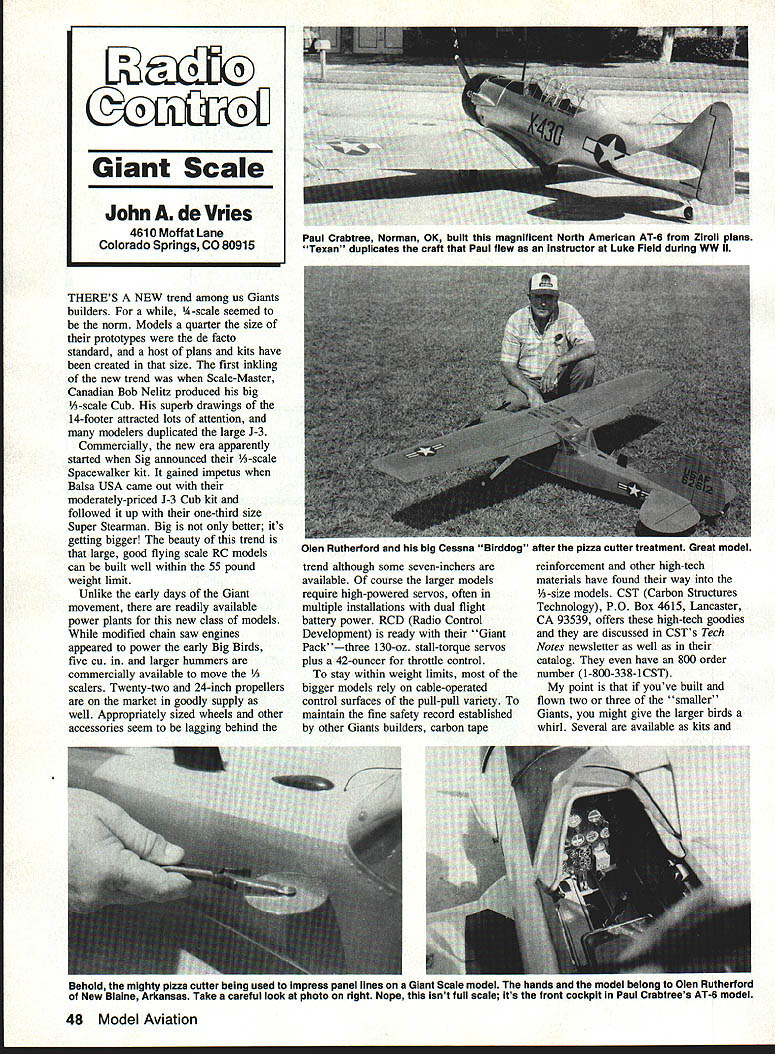
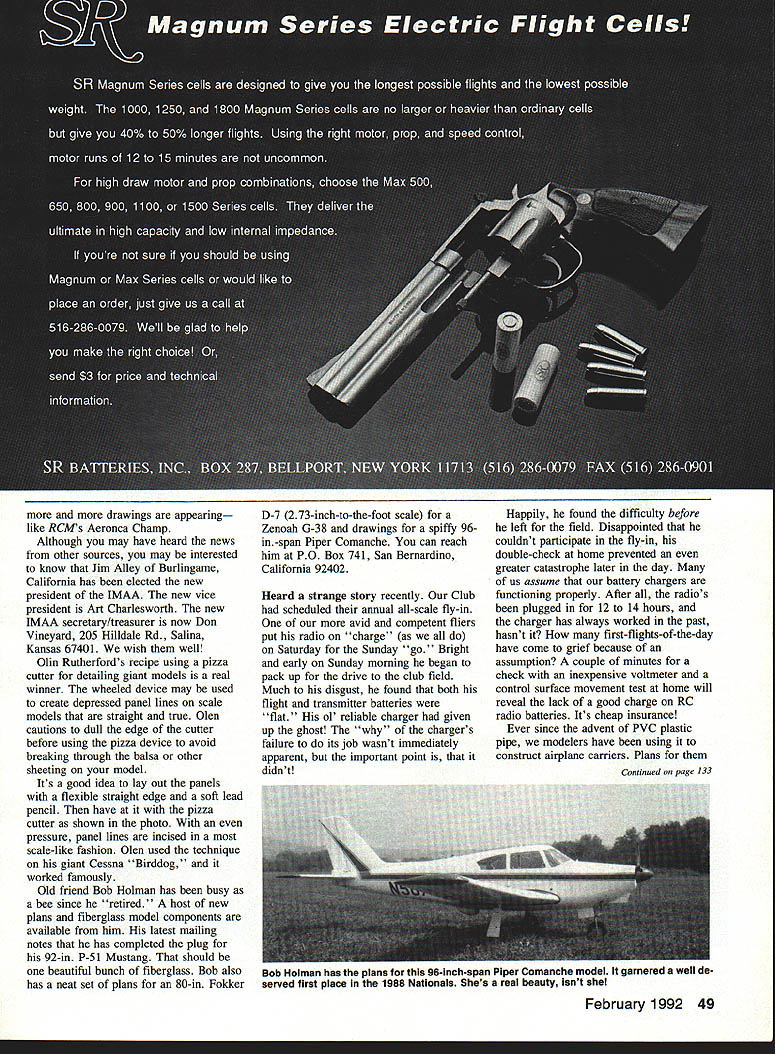
More and more drawings are appearing, including RCM’s Aeronca Champ and other large-scale plans. Examples in the field include Paul Crabtree’s magnificent North American AT-6 built from Ziroli plans and Olen Rutherford’s big Cessna “Bird Dog.”
Powerplants, Propellers and Accessories
Unlike the early days of the Giant movement, there are now readily available powerplants for this class of models.
- Commercial five-cu.-in. and larger “hummers” are now available for 1/3-scale models. Modified chainsaw engines were used in the early Big Birds.
- Propellers in 20-, 22- and 24-inch sizes are in good supply.
- Appropriately sized wheels and other accessories lag somewhat, though some 7-inch wheels are available.
- Larger models require high-powered servos, often multiple installations, and dual flight battery power.
RCD (Radio Control Development) offers a "Giant Pack" — three 130-oz. stall-torque servos plus a 42-ouncer for throttle control.
Control Systems and Construction Techniques
- To stay within weight limits, most of the bigger models rely on cable-operated control surfaces (pull-pull variety).
- To maintain safety, carbon-tape reinforcement and other high-tech materials have been incorporated into 1/3-size models.
High-Tech Supplies
CST (Carbon Structures Technology) supplies carbon tape and other reinforcement products. Contact:
- CST, P.O. Box 4615, Lancaster, CA 93539
- Order line: 1-800-338-1CST
Try a Larger Giant
If you’ve built and flown two or three of the “smaller” Giants, consider trying a larger bird — you’ll find plans and kits becoming increasingly available and support hardware improving.
IMAA Officers
Although you may have heard from other sources, here’s the update on IMAA officers:
- President: Jim Alley, Burlingame, CA
- Vice-President: Art Charlesworth
- Secretary/Treasurer: Don Vineyard, 205 Hilldale Rd., Salina, KS 67401
We wish them well.
Pizza-Cutter Technique for Panel Lines
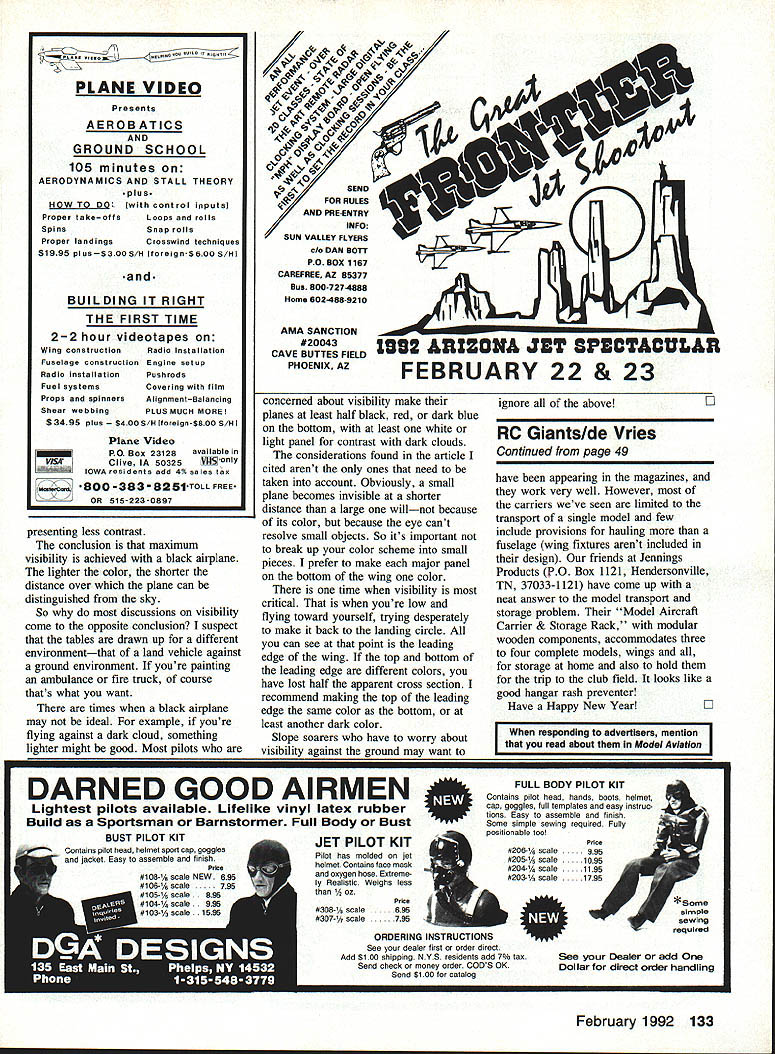
Olen Rutherford’s recipe for detailing giant models using a pizza cutter is a real winner. The wheeled device creates depressed, straight and true panel lines on scale models.
Steps:
- Lay out the panel lines with a flexible straight edge and a soft-lead pencil.
- Dull the edge of the pizza cutter slightly to avoid cutting through balsa or sheeting.
- Roll the cutter with even pressure along the penciled line to incise a depressed panel line.
Olen used this technique on his giant Cessna Bird Dog and it worked famously. The method is simple and effective for large-scale models.
Bob Holman: Plans and Fiberglass Components
Bob Holman has been busy since retiring. Recent items from his mailing:
- Completed plug for a 92-in. P-51 Mustang (suitable for fiberglass components).
- Plans for an 80-in. Fokker D-VII (2.73-inch-to-the-foot scale) sized for a Zenoah G-38.
- Drawings for a 96-in.-span Piper Comanche.
Contact: P.O. Box 741, San Bernardino, CA 92402.
Battery Charger Warning — Check Before You Go
A cautionary tale from a club member: he plugged his radio batteries in to charge overnight for a Sunday fly-in, only to find both flight and transmitter batteries flat the next morning because his charger had failed. Fortunately he discovered the problem before leaving home.
Lessons:
- Don’t assume a charger has done its job just because it’s been plugged in for many hours.
- Before leaving for the field, perform a quick check:
- Use an inexpensive voltmeter to confirm battery voltage.
- Perform a control-surface movement test to ensure servos and batteries will power up.
- These few minutes can prevent first-flight disasters and save your model.
Model Transport and Storage
PVC pipe carriers have been popular for transporting models, but many are limited to carrying a single fuselage and exclude wing fixtures.
Jennings Products offers a solution:
- "Model Aircraft Carrier & Storage Rack" with modular wooden components that accommodate three to four complete models, wings and all, for home storage and transport.
- Contact: Jennings Products, P.O. Box 1121, Hendersonville, TN 37073-1121
This unit looks like a good hangar rash preventer.
Visibility and Color Considerations
There’s a common misconception about aircraft color and visibility. Tests show that maximum visibility against the sky is achieved with a black airplane — darker colors present greater contrast against a bright sky, while lighter colors present less contrast.
Considerations:
- Many visibility tables assume a ground environment (for vehicles like ambulances), which leads to different conclusions.
- If you’re flying against a dark cloud, a lighter color may provide better contrast. Many pilots compromise by making the bottom at least half black, red or dark blue and including one white or light panel for contrast with dark clouds.
- Avoid breaking up the color scheme into many small pieces; large, solid panels are easier to resolve at distance.
- Critical phase: when flying low and toward yourself, you may only see the leading edge of the wing. If the top and bottom of the leading edge are different colors, you effectively lose half the apparent cross section. Make the top of the leading edge the same color as the bottom, or at least another dark color.
- Slope soarers who worry about visibility against the ground may need different schemes.
Closing
Have a Happy New Year — and happy building and flying.
Transcribed from original scans by AI. Minor OCR errors may remain.

