
Radio Control: Giant Scale
John A. de Vries 4610 Moffat Lane Colorado Springs, CO 80915
I'm going to suggest something you may never have tried. It will cost a buck or two—but not more than a good giant servo—and you may even get lucky and get it for free. Take an airplane ride. Not a jet airliner hopping from Point A to Point B, but a ride in a single-engined Cessna, Beechcraft or similar. Ideally the full-scale craft will have a bit of aerobatic capability, but that isn't strictly necessary. Just you and a pilot, with all the sky to maneuver in, is the way to go.
The reason? To experience first-hand what your Giant Scale model "sees" when you tool it around the club field. You'll gain a new perspective on what flying really means and an appreciation for what G forces do to an airplane's structure as it's maneuvered.
Actually feeling the slip that glues you to the seat when rudder and aileron controls are crossed will demonstrate what happens to your big bird when similar pressures are applied. It will convince you that you must coordinate rudder and aileron to smooth out turns. Once a turn is established, let the rudder return to neutral.
If your pilot permits you to handle the controls, push in a bit of rudder and feel the resulting skid. The first time you'll likely feel uncomfortable, but you'll experience what happens to your model if you're inclined to over-control the tail surfaces.
Probably the most valuable demonstration is a stall. The aircraft slows, often in a slight climb, then begins to shake. After a full aerodynamic stall the nose drops and the view that was half ground and half sky becomes mostly earth-colored. The next time you fly RC you can look for the symptoms of a stall and avoid them until your model is just off the ground and ready to land. You'll keep the nose down on final.
An hour or two in a full-scale aircraft will open your eyes to how they work and leave you with a new appreciation for the forces your model contends with and for how smooth your control inputs should be.
Giant Scale Designs
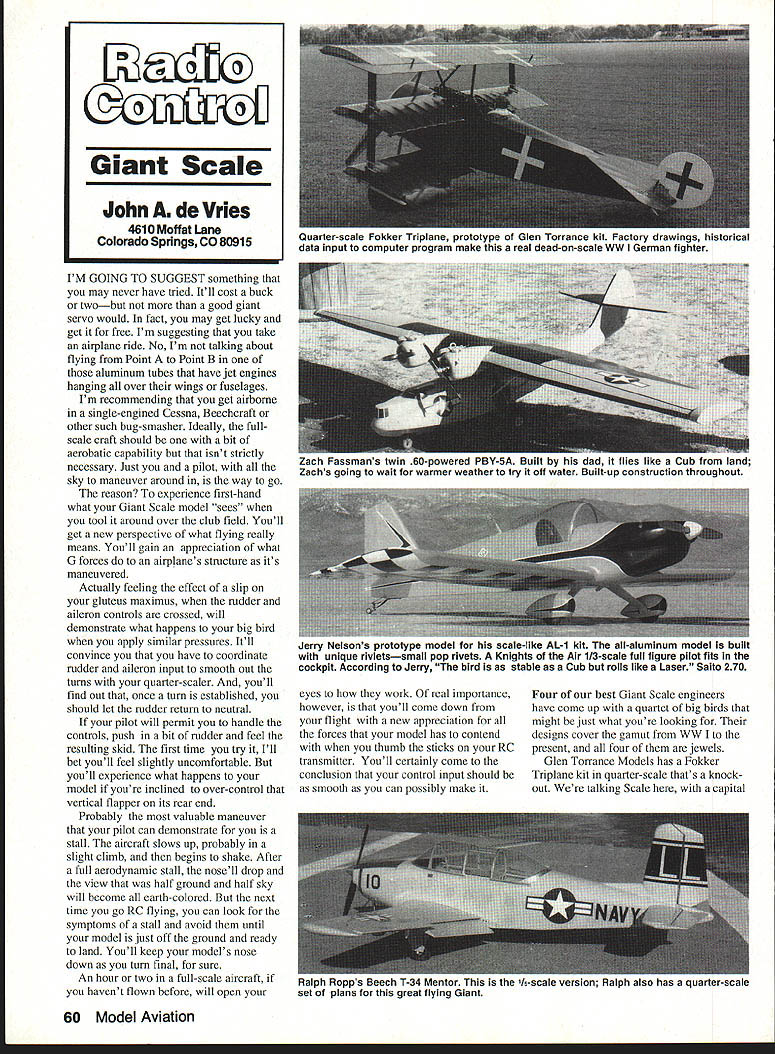
Four of our best Giant Scale designers have produced a quartet of big birds that cover the gamut from WW I to modern homebuilt types. All four are noteworthy.
- Glen Torrance Models — Fokker Triplane (1/4 scale)
A knockout scale model produced from factory drawings and historical data. Already flown at Top Gun ’91 and campaigned in World Scale competition. The kit contains materials to duplicate the model, including authentic Fokker camouflage color chips. Span: almost 71 inches. Recommended power: Quadra 35, ST 2000 or OS .160 twin. Contact: Glen Torrance Models, 2881 Vail Valley Court, Snellville, GA 30278. Phone: 404-985-4543. Fax: 404-985-4544.
- Ralph Ropps — Beech T-34 Mentor (1/5 and 1/4 scale)
By the time this appears, Ralph will have both a 1/5-scale (82 in. span) and a 1/4-scale (98 in. span) T-34 available, with drawings, bills of material, and likely canopies, fiberglass cowls, and tail cones. Short kits of formers and wing ribs will be offered. The smaller T-34 recommends a Super Tigre 2500; the larger model requires more power. Ralph also offers a 1/4-scale Spitfire Mk IX (110 in. span, for a Sachs 5.8) with fiberglass parts for a 35–40 lb. example. Contact: Ralph Ropps, P.O. Box 608, Rocklin, CA 95677. Phone: 916-782-6616.
- Dry Ridge Models — Spacewalker Speedwing (Emil Agosta)
A beautiful quarter-scale Speedwing with wheel pants and a 78 in. wingspan. Rolled drawings and decals available for $30. Power range: O.S. .60 to YS-120. Contact: Dry Ridge Models, 59 McCurry Road, Weaverville, NC 28787.
- Jerry Nelson — AL-1 (scale-like RV-4)
An all-aluminum, scale-like model based on the RV-4. Jerry plans a limited run of complete kits. Span: 97½ inches. Weight: about 28 lb. Prototype powered by a Saito 270 and has flown. For complete specifications, send a large SASE. Contact: Ted Nelson Company, P.O. Box 20637, Reno, NV 89510.
EVEN FURTHER OUT!
The seven-times enlargement of Frank Ehling's AMA Cub design was built by Ken Chadwick of Wichita, Kansas. It debuted at a Jumbo fly-in at Lake Afton, Kansas. The model is two-channel radio control and, yes, rubber powered. Wild and crazy—but it looks like a lot of fun. At the time of the first photos it had not yet flown; I understand it has since flown. One wonders if the rubber winder needs to be scaled to match—and who was strong enough to turn it, or brave enough to hold it!
Ken developed the enlarged logo and trim via computer, and it looks very much like the classic Ehling design—only larger. It gives a sort of reverse Gulliver feeling.
AN EAGLE 1.5?
Brian Ulwin of Corvallis, Oregon sent photos and drawings of modifications he made to a Goldberg Eagle. He changed the stock kit airfoil to one with a raised entry section and reports a dramatic improvement: rock-steady, very predictable handling; outside loops possible at full throttle; incredibly short takeoffs; and low-speed flybys that left spectators wondering how it could still be flying. One experienced flier said he'd build another trainer if it would fly like Brian's.
A slight modification to the airfoil can greatly increase flying fun—it's worth considering. Brian also noted similar benefits when he used a raised-entry wing on a scale J-3 Cub.
As I've said before, true full-scale aircraft generally do not use flat-bottom wing sections; they use Clark Y or E-series airfoils. I have no vendetta against flat-bottomed airfoils, but I now know there are often better choices.
IMPATIENT!
Although you're reading this late in February, the column was written just before Christmas. If you live in the sun belt you may not know what cabin fever is all about. The rest of us can only build, repair, and impatiently wait for spring so we can get out to the flying field and do lots of flying for fun. We are ready any time!
Weather's getting better. Let's go to the field!
Notes and Resources
- For 2 to 6 cu. in. big-bird powerplants, neoprene is often used in engine mounts to soak up vibrations. Extra strips can be ordered to modify mount stiffness to suit your Giant Scale installation.
- Scale video: Dick Hansen's Scale Video #12 features the QSAA Fly-In, the '91 Scale Masters meet, and George Vogelsang's Sopwith Pup demonstration. Price: $19.95. Contact: Hansen Scale Video, 10807 SE Stacy Ct., Portland, OR 97266. Phone: 503-653-2578. Dick accepts VISA and MasterCard.
- Publications: Bill Hannan's new book, Stick & Tissue International, is packed with scale drawings that can be enlarged and includes some unusual giant models. Send an SASE to Hannan's Runway, P.O. Box 210, Magalia, CA 95954 for details. Bill and Joan Hannan also carry two volumes of Paul Matt's precision drawings; each 8½ x 11 in. softbound book contains 61 Matt drawings—102 in all—and they are valuable resources for any scale builder.
- Flying schools: Many local flying schools offer introductory rides at minimal cost—the idea is to entice new students. These sampled rides are a good, low-cost way to get the full-scale experience.
Transcribed from original scans by AI. Minor OCR errors may remain.

