
Radio Control: Giant Scale
Bob Beckman
Kioritz engine
Elsewhere in this issue is the first part of the report on the engine testing which Kirby Crawford and I have done. One of the engines tested was the Kioritz, and you'll find detailed specs and performance data listed in the report. Right now I'd like to make some general comments about the engine.
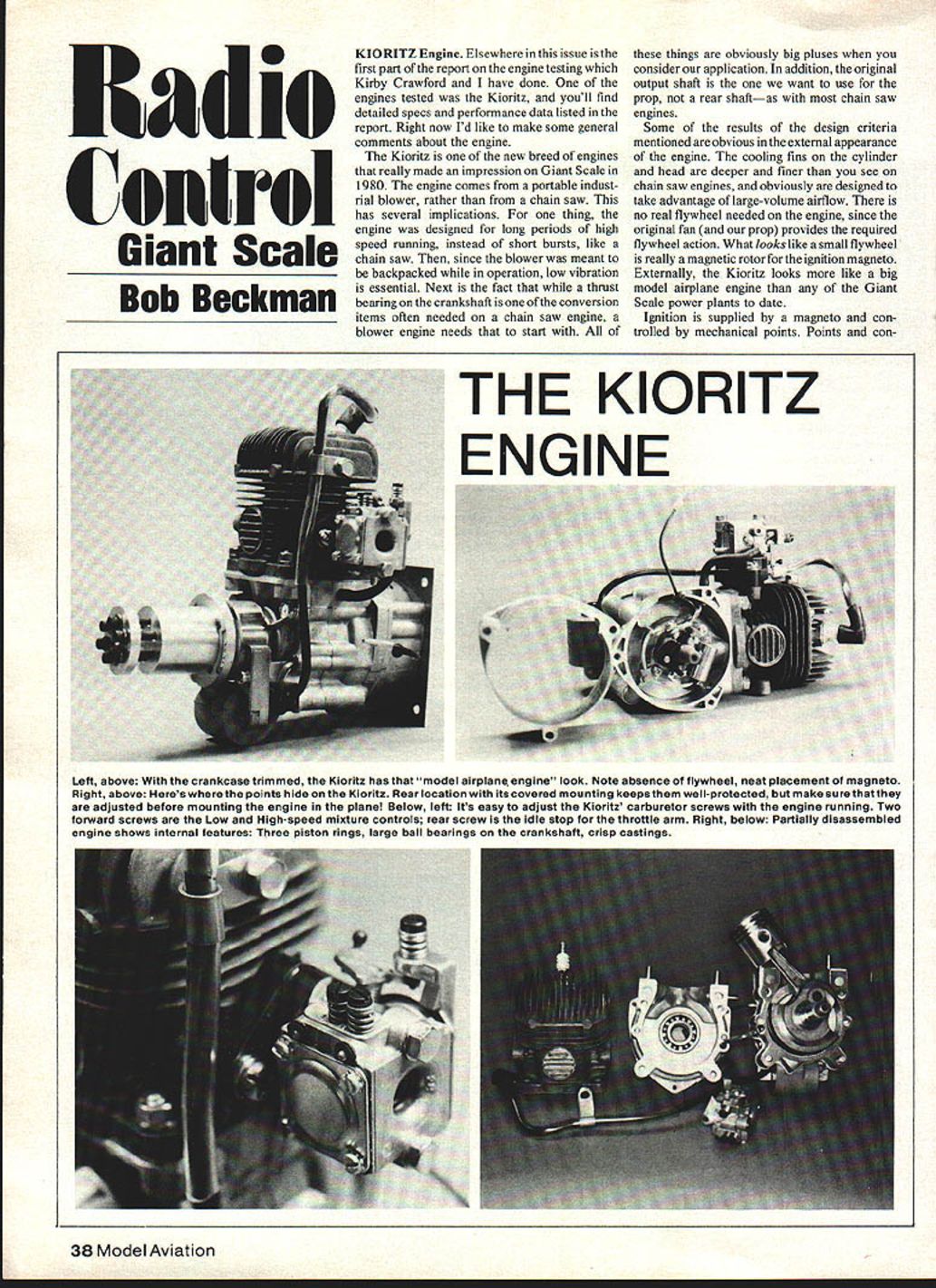
The Kioritz is one of the new breed of engines that really made an impression on Giant Scale in 1980. The engine comes from a portable industrial blower rather than from a chain saw, and that origin has several implications. For one thing, the engine was designed for long periods of high-speed running, instead of short bursts like a chain saw. Because the blower was meant to be backpacked while in operation, low vibration is essential. A thrust bearing on the crankshaft, which is often needed when converting a chain saw engine, is part of the blower design already. All of these things are obvious pluses for our application. In addition, the original output shaft is the one we want to use for the prop, not a rear shaft as with most chain saw engines.
Some results of those design criteria are obvious in the engine's external appearance. The cooling fins on the cylinder and head are deeper and finer than you see on chain saw engines, designed to take advantage of large-volume airflow. There is no real flywheel needed, since the original fan (and our prop) provides the required flywheel action. What looks like a small flywheel is really a magnetic rotor for the ignition magneto. Externally, the Kioritz looks more like a big model airplane engine than any of the Giant Scale power plants to date.
Ignition is supplied by a magneto and controlled by mechanical points. The condensers are in a sealed compartment at the rear of the engine. This keeps them well protected from dirt and fuel, but it does mean that they cannot be adjusted with the engine mounted in a plane.
The carburetor is one of the Walbro diaphragm-pump models. I was surprised to find that this is the original carb. Most fan engines have carburetors unsuitable for our use and must be replaced with Walbros or Tillitsons. One unfortunate result in this case is that the carb does not have a built-in choke, since the choke function was incorporated in a rather bulky air cleaner. The carb is essentially the same as the one used on the Quadra, and I have heard that Dario Brisighella has an add-on choke fitting for the Quadra which may fit the Kioritz.
There is another feature shared by the Kioritz and the Quadra. Most of the engines we use employ reed valves, but the Kioritz uses direct piston porting (old-time modelers call it "three-port" or "side-port" intake). The carb is mounted on the side of the cylinder opposite the exhaust. As the piston approaches top dead center, it opens a port in the cylinder wall and the crankcase vacuum draws in the fresh charge of fuel and air. As the piston moves down, it closes the side port and forces the fresh charge through Schnuerle-type front and rear bypasses into the combustion chamber. I don't pretend to be an expert on engine theory, but as an old electronics man I'm a firm believer in the fewer moving parts the better.
On disassembly, the quality of the engine becomes apparent:
- Crisp, clean die castings
- Chromed cylinder
- Precise machining
- Double-counterweighted crankshaft with large ball bearings front and rear
- Forged steel conrod
One significant internal feature is visible with the engine assembled. Looking into the exhaust port and turning the engine over reveals three rings on the piston. Each ring is pinned so that it overlaps the gap on the adjacent ring(s). This gives a better compression seal, especially when the engine is hot. Many single-ring engines are easy to start cold but become difficult once warmed up because differential expansion degrades the piston-to-cylinder seal.
John Gibbs does several things to the engine to prepare it for aircraft use:
- Remove portions of the forward crankcase casting used for mounting blower components — the machining is done neatly.
- Add a point-grounding "kill wire."
- Fit an aluminum mounting plate.
- Install a six-bolt prop hub.
The standard hub is 1-1/4 in. long, but any length from 1-1/8 in. to 2 in. is available on special order. John's hub and prop washer have a 1/4-in. diameter projection instead of a hole in the center. The projection on the hub helps locate the prop, but once the six bolt holes are properly drilled it's not strictly necessary. The projection on the washer can be used as a jig to drill the bolt holes in the prop; turn the washer around when you mount the prop and you will find the center drilled and tapped for spinner mounting.
The Kioritz is available from: Gibbs Hobby & Research 6195 Hillfield St. NW North Canton, OH 44720 Retail price as of January 1, 1981: $189.95. John says there will be no increase unless his cost for the engine itself increases.
P-40 plans
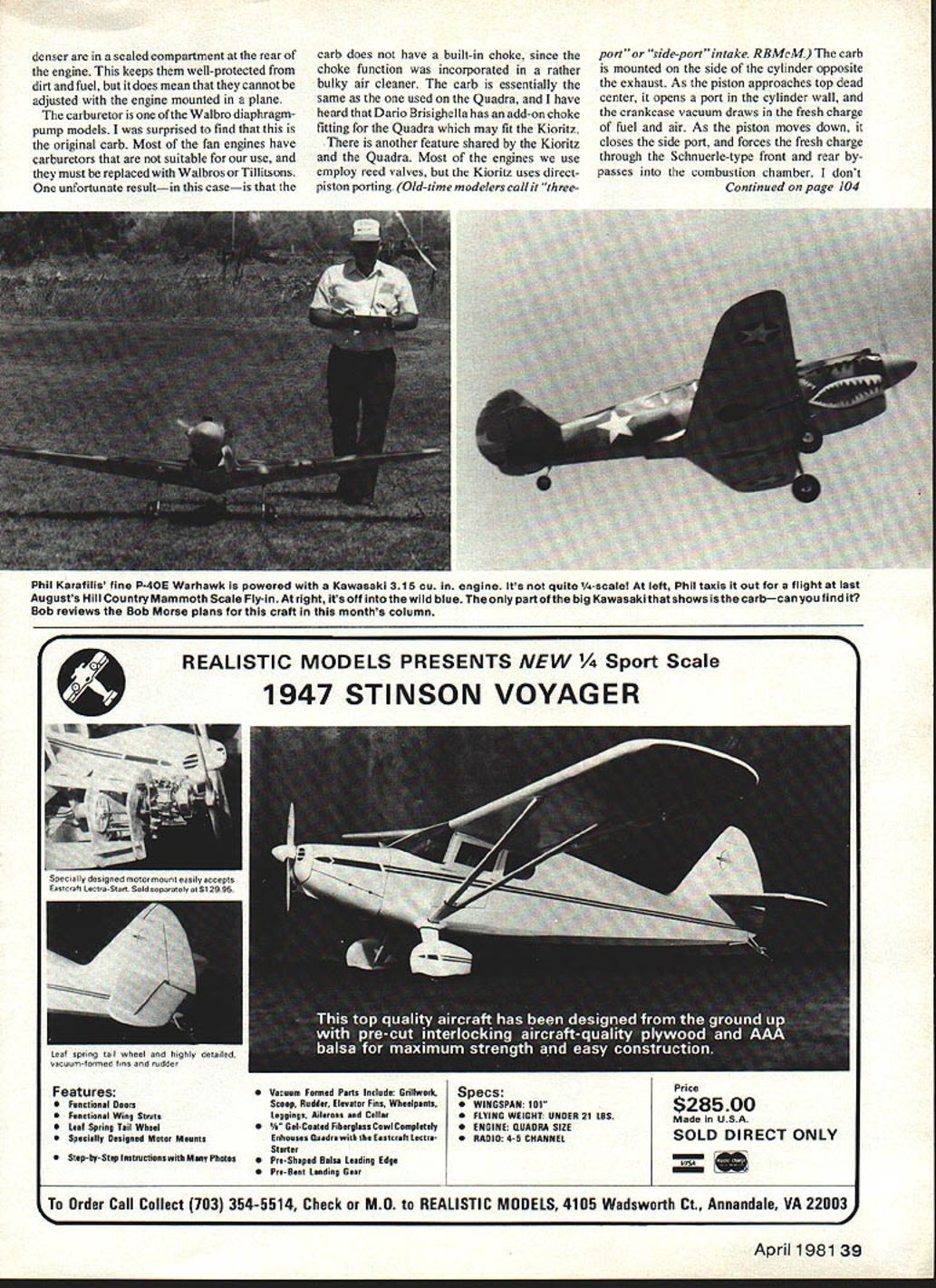
I have already reported on several plans by Bob Morse, and there are more to come. Bob is very prolific. This month's Morse plan is a little different, however: all of Bob's other offerings are his own designs, but the P-40 was designed and built by Phil Karafilis. Bob said the airplane was just so pretty that he had to get it into print and work up the plan drawings. It was a good collaboration, and hopefully there will be more such in the future.
The plans are typical of Bob's work: clean, neat drawings; lots of detail; innovative solutions for the inevitable problems; and practical structure. I do have one complaint. In all his plans Bob uses a simple construction technique that builds in the CB Associates' hinges for the control surfaces, especially the rudder and elevators. In previous plans this has been clearly detailed, but in this case someone unfamiliar with the technique might have trouble interpreting it. On the other hand, this is not a beginner's airplane.
This is a big model, and it is not quarter-scale. It works out to 21.6% of full size — a little under one-fifth scale — yet the wingspan is 8 ft. and the fuselage measures just over 7 ft. from the c.g. of the rudder to the tip of the spinner. With a little over 12 sq. ft. of wing area and a flying weight of 35 lbs., the wing loading works out to 46 oz./sq. ft. It's a tremendous flier, but like the original, it's no Piper Cub.
Plan details:
- Sheets: three sheets, 42 in. wide and seven to nine feet long, plus a smaller sheet with landing gear details
- Landing gear: rugged, functional unit suitable for many Giant Scale designs; some machine work required but nothing difficult
- Flap system: Phil included flaps; because the projected flying weight is over 30 lbs., direct servo operation seemed impractical, so a pneumatic/hydraulic system was incorporated — the plans provide enough information to duplicate this successful installation
- Fuselage jig: plans suggest a jig made from a length of 2 by 8 lumber with 1/4-in. plywood bulkhead supports; Phil built his original without a jig, but it's a good investment
I have seen Phil's plane fly and can vouch for its airworthiness. Unfortunately I also witnessed its last flight: Phil had just completed a rolling pass when he lost control and the plane spun in. It was several weeks before the cause was traced to a cracked crystal in the transmitter.
I can certainly recommend these plans, but not as a first model. Price: $29.95 plus $2.00 postage and handling. Available from: Bob Morse 3352 Prune Ridge Ave. Santa Clara, CA 95051
Bob Beckman 8248 Holly Grove Court Manassas, VA 22110
Transcribed from original scans by AI. Minor OCR errors may remain.

