
Radio Control: Giant Scale
Bob Beckman
Roper Engines
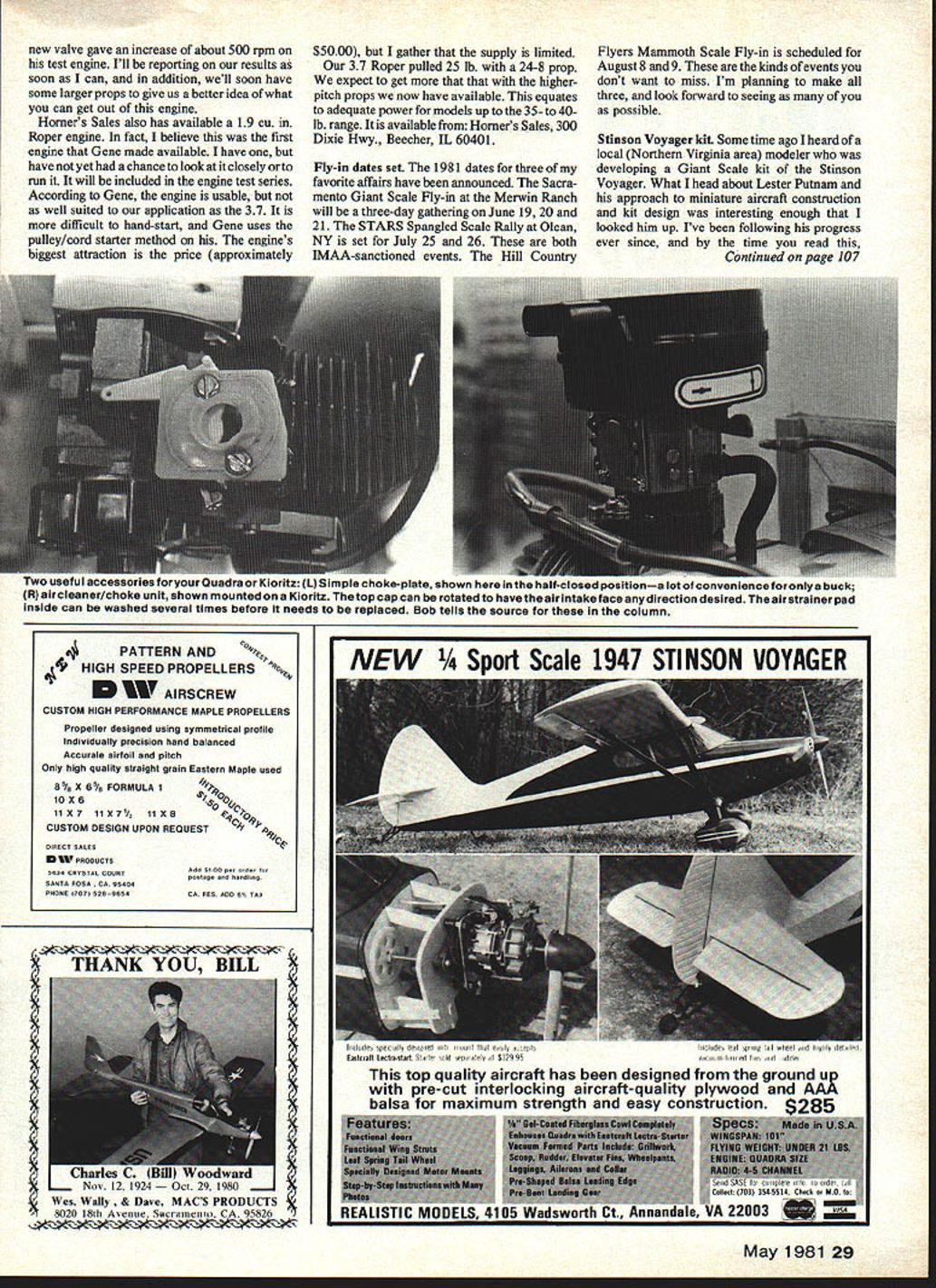
One of the engines covered in our first engine report last month was the 3.7 cu. in. Roper. One of the most impressive things about this engine is its large displacement-to-physical-size ratio. The engine requires very little more space than a Quadra, yet it has almost twice the displacement.
The Roper is made in the U.S.A., and its principal use is in a chainsaw sold by Sears. It has the typical chainsaw appearance and characteristics, including the shaft extension that comes out of what, to us, is the rear of the engine. This is actually the shaft which drives the chain in the usual application. These shaft extensions can be good news and bad news. They can complicate mounting; one answer is to simply cut a hole in the firewall and let the shaft stick through. That's not as bad as it sounds, since gasoline burners aren't as messy as glow engines. The other solution is to build or buy a mount that holds the engine far enough in front of the firewall to clear the shaft. The good news about that shaft is that it is a natural for coupling to an on-board starter system.
Our test engine had electronic ignition—standard on current engines (there are some earlier versions that use points). The ignition system is quite effective, and we had no problems hand-starting the engine. One reason for this is that Gene Homer, who converts and markets the engine, puts a high-quality ball bearing on the prop end of the shaft. This virtually eliminates the play (bearing slop) in the front shaft and allows the magneto to be set very close to the flywheel magnets. The closer the magneto pole pieces are to the flywheel magnets as they go by, the hotter the spark produced, and the easier it is for the engine to fire.
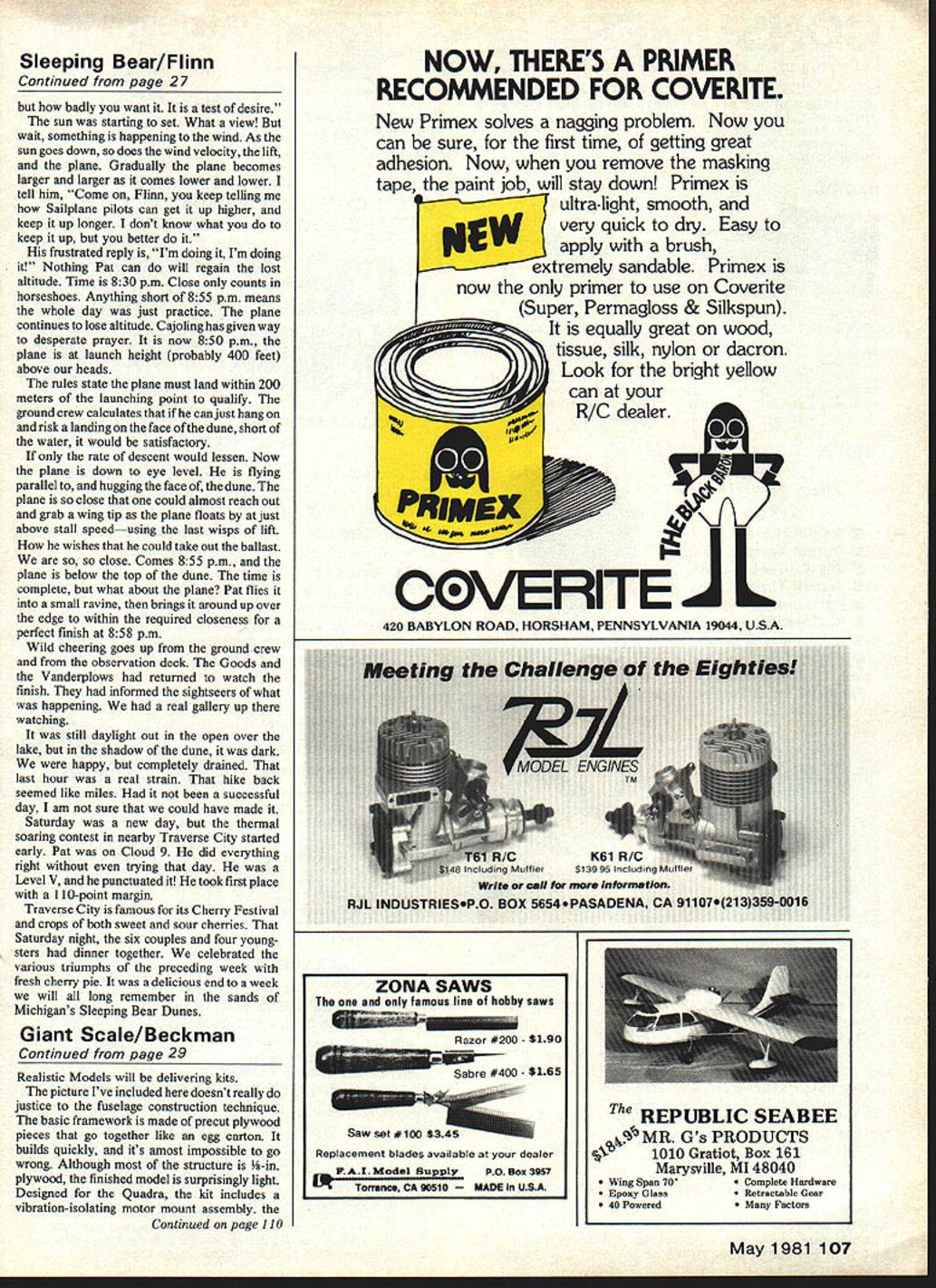
Performance figures were given in the report last month, and more will be forthcoming as we get more running time on the engine. One item of interest is a new reed valve assembly that we have not yet had a chance to run. Gene says that the new valve gave an increase of about 500 rpm on his test engine. I'll be reporting on our results as soon as I can, and in addition we'll soon have some larger props to give us a better idea of what you can get out of this engine.
Homer's Sales also has available a 1.9 cu. in. Roper engine. In fact, I believe this was the first engine that Gene made available. I have one but have not yet had a chance to look at it closely or to run it; it will be included in the engine test series. According to Gene, the engine is usable but not as well suited to our application as the 3.7. It is more difficult to hand-start, and Gene uses the pulley/cord starter method on his. The engine's biggest attraction is the price (approximately $50.00), but the supply appears to be limited.
Our 3.7 Roper pulled 25 lb. with a 24x8 prop. We expect to get more than that with the higher-pitch props we now have available. This equates to adequate power for models up to the 35- to 40-lb. range. It is available from:
- Homer's Sales, 300 Dixie Hwy., Beecher, IL 60401.
Fly-in dates set
The 1981 dates for three of my favorite affairs have been announced:
- Sacramento Giant Scale Fly-in at the Merwin Ranch — June 19–21 (three-day gathering).
- STARS Spangled Scale Rally at Olean, NY — July 25–26 (IMAA-sanctioned).
- Hill Country Flyers Mammoth Scale Fly-in — August 8–9.
These are the kinds of events you don't want to miss. I'm planning to make all three and look forward to seeing as many of you as possible.
Stinson Voyager kit
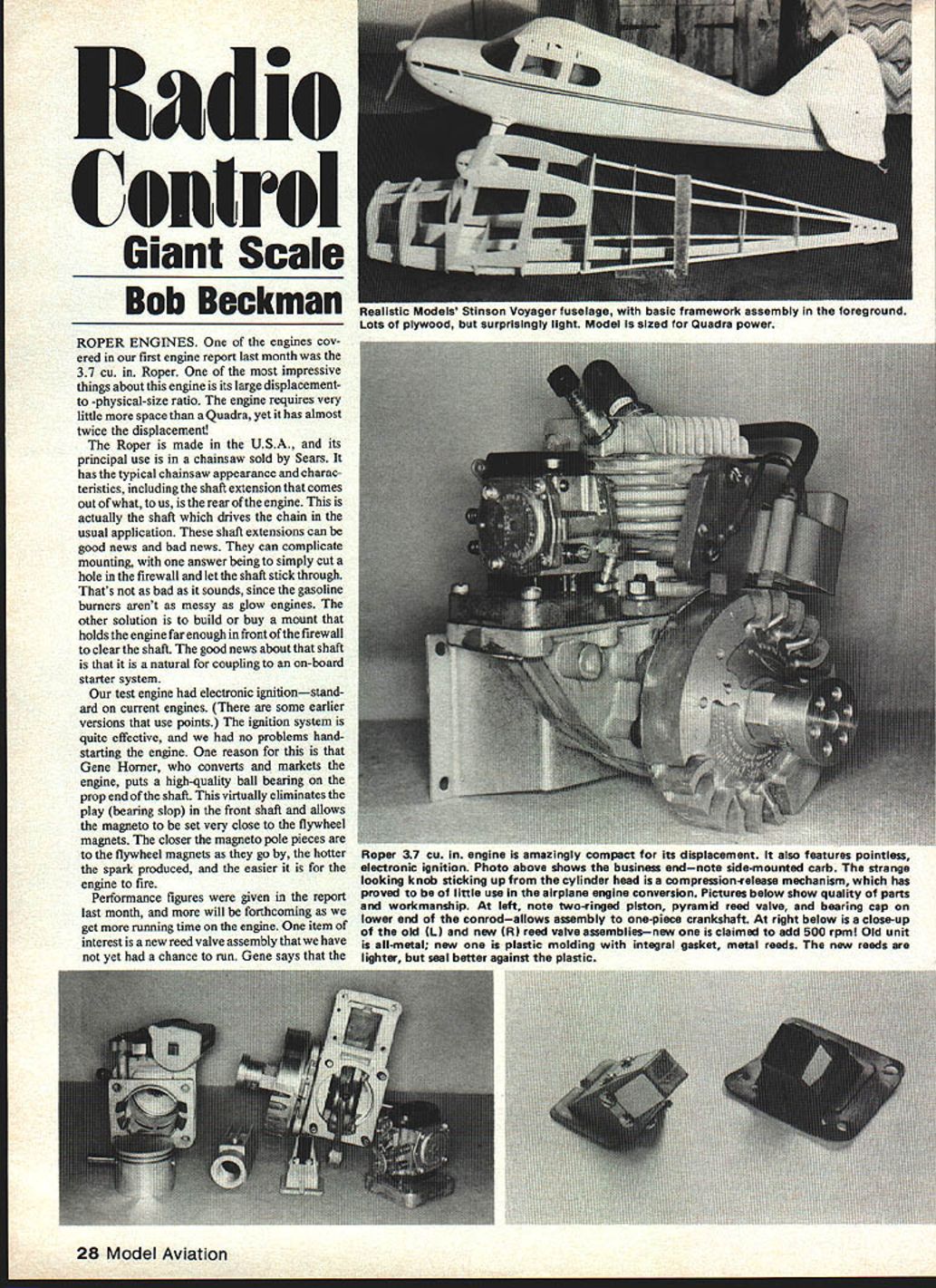
Some time ago I heard of a local (Northern Virginia area) modeler who was developing a Giant Scale kit of the Stinson Voyager. What I had heard about Lester Putnam and his approach to miniature aircraft construction and kit design was interesting enough that I looked him up. I've been following his progress ever since, and by the time you read this, Realistic Models will be delivering kits.
The picture I've included here doesn't really do justice to the fuselage construction technique. The basic framework is made of precut plywood pieces that go together like an egg carton. It builds quickly, and it's almost impossible to go wrong. Although the structure is 5/16-in. plywood, the finished model is surprisingly light. Designed for the Quadra, the kit includes a vibration-isolating motor mount assembly, the fiberglass cowl, and vacuum-formed control surfaces, wheel pants, and other accessories that are beautifully done.
Les' prototype has flown, with no more than the usual new-plane teething troubles. The lessons learned have already been cranked into the kit. There will be a half-dozen of them around here in the spring, including the one I'm going to build. I'll let you know how it goes.
Quadra (Kioritz) chokes
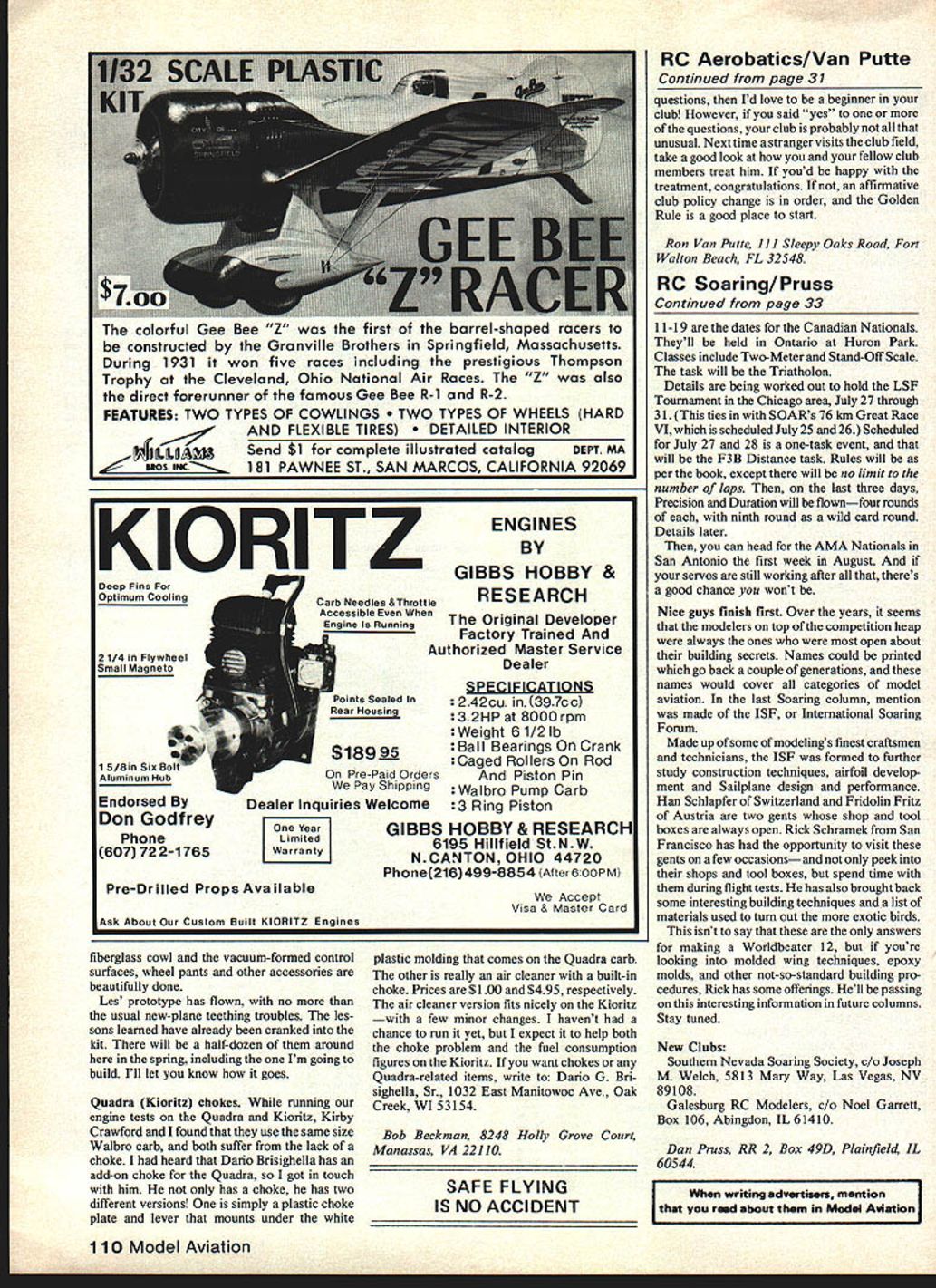
While running our engine tests on the Quadra and Kioritz, Kirby Crawford and I found that they use the same size Walbro carb and both suffer from the lack of a choke. I had heard that Dario Brisighella has an add-on choke for the Quadra, so I got in touch with him. He not only has a choke, he has two different versions:
- A plastic choke plate and lever that mounts under the white plastic molding that comes on the Quadra carb — $1.00.
- An air cleaner with a built-in choke — $4.95.
The air cleaner version fits nicely on the Kioritz—with a few minor changes. I haven't had a chance to run it yet, but I expect it to help both the choke problem and the fuel consumption figures on the Kioritz. If you want chokes or any Quadra-related items, write to:
- Dario G. Brisighella, Sr., 1032 East Manitowoc Ave., Oak Creek, WI 53154.
Bob Beckman 8248 Holly Grove Court Manassas, VA 22110
SAFE FLYING IS NO ACCIDENT
Transcribed from original scans by AI. Minor OCR errors may remain.

