
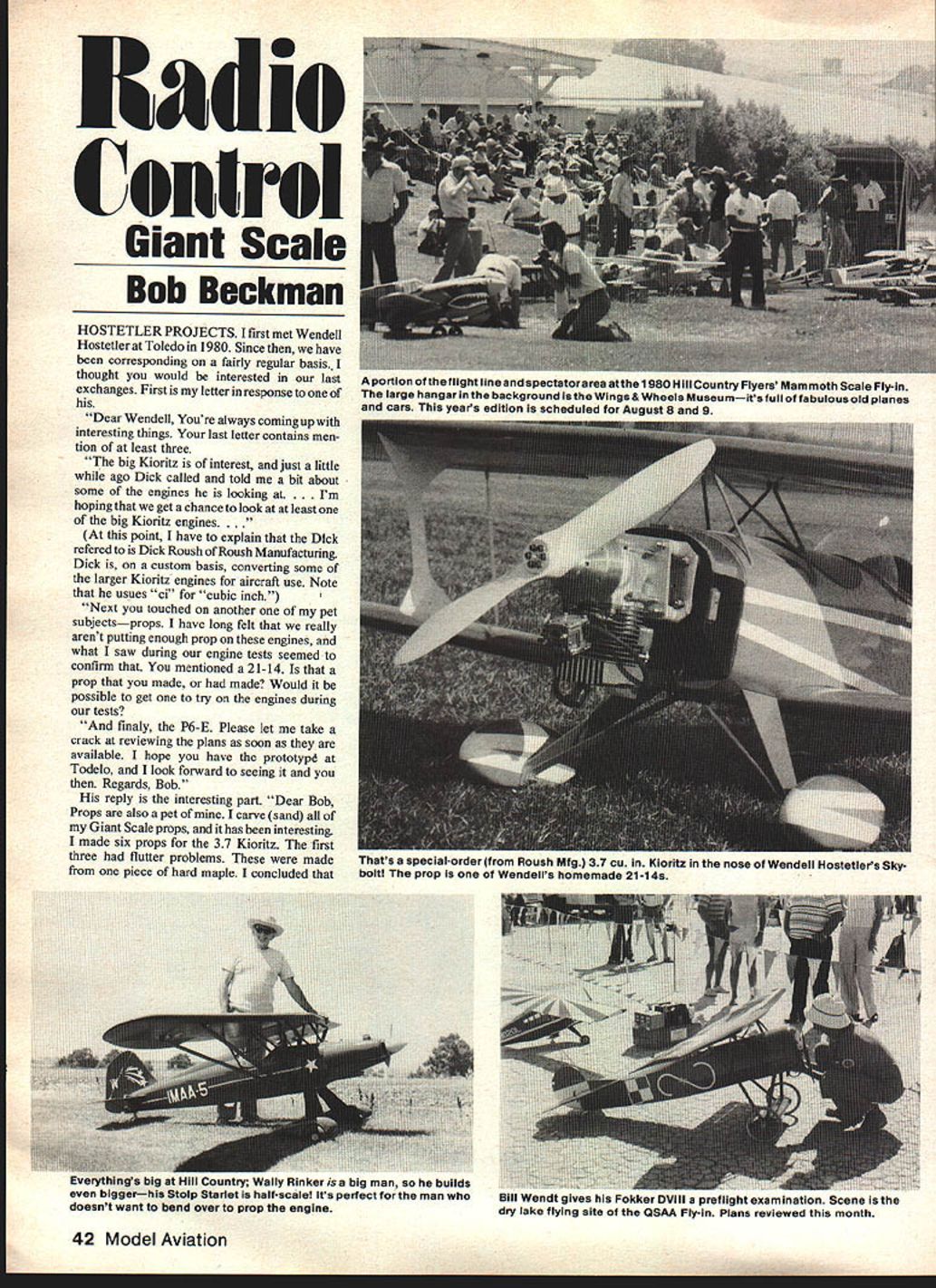
Radio Control: Giant Scale
Bob Beckman
Hostetler Projects
I first met Wendell Hostetler at Toledo in 1980. Since then, we have been corresponding on a fairly regular basis. I thought you would be interested in our last exchanges. First is my letter in response to one of his.
"Dear Wendell, You're always coming up with interesting things. Your last letter contains mention of at least three.
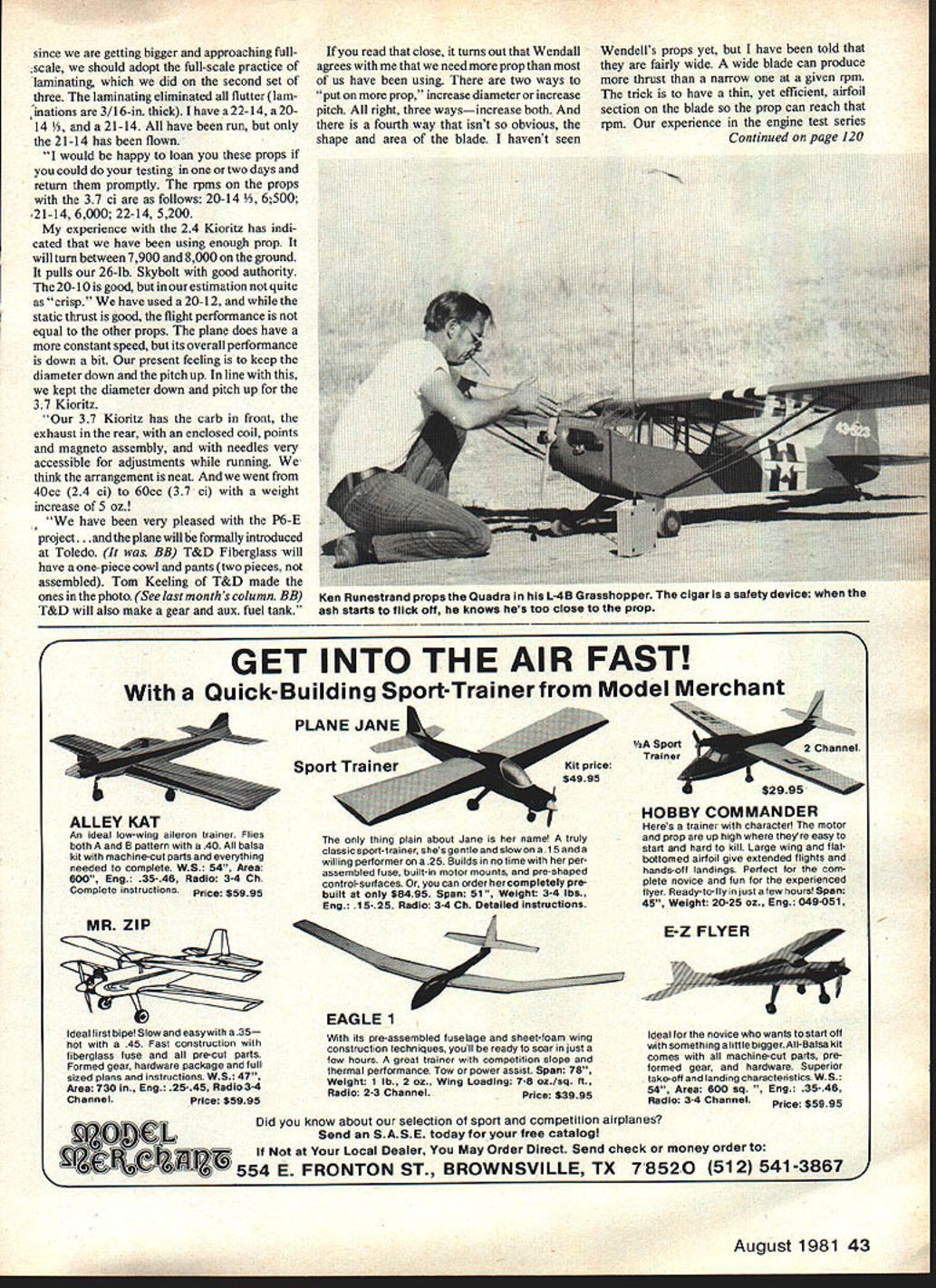
"The big Kioritz is of interest, and just a little while ago Dick called and told me a bit about some of the engines he is looking at . . . . I'm hoping that we get a chance to look at at least one of the big Kioritz engines. . . ."
(At this point, I have to explain that the Dick referred to is Dick Roush of Roush Manufacturing. Dick is, on a custom basis, converting some of the larger Kioritz engines for aircraft use. Note that he uses "ci" for "cubic inch.")
"Next you touched on another one of my pet subjects—props. I have long felt that we really aren't putting enough prop on these engines, and what I saw during our engine tests seemed to confirm that. You mentioned a 21-14. Is that a prop that you made, or had made? Would it be possible to get one to try on the engines during our tests?"
"And finally, the P6-E. Please let me take a crack at reviewing the plans as soon as they are available. I hope you have the prototype at Toledo, and I look forward to seeing it and you then. Regards, Bob."
His reply is the interesting part.
"Dear Bob, Props are also a pet of mine. I carve (sand) all of my Giant Scale props, and it has been interesting. I made six props for the 3.7 Kioritz. The first three had flutter problems. These were made from one piece of hard maple. I concluded that since we are getting bigger and approaching full-scale, we should adopt the full-scale practice of laminating, which we did on the second set of three. The laminating eliminated all flutter (laminations are 3/16-in. thick). I have a 22-14, a 20-14½, and a 21-14. All have been run, but only the 21-14 has been flown.
I would be happy to loan you these props if you could do your testing in one or two days and return them promptly. The rpms on the props with the 3.7 ci are as follows: 20-14½, 6,500; 21-14, 6,000; 22-14, 5,200.
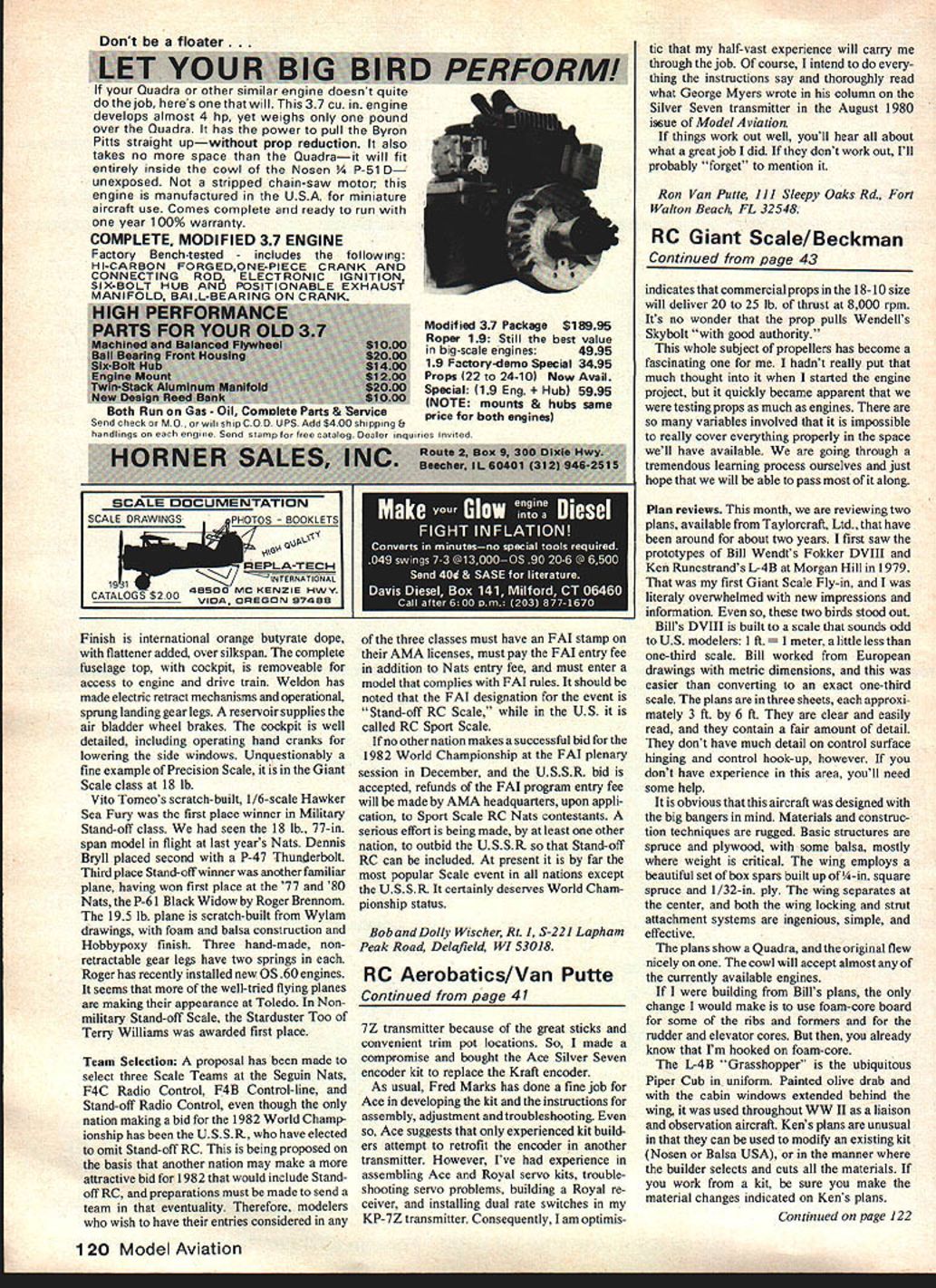
My experience with the 2.4 Kioritz has indicated that we have been using enough prop. It will turn between 7,900 and 8,000 on the ground. It pulls our 26-lb. Skybolt with good authority. The 20-10 is good, but in our estimation not quite as "crisp." We have used a 20-12, and while the static thrust is good, the flight performance is not equal to the other props. The plane does have a more constant speed, but its overall performance is down a bit. Our present feeling is to keep the diameter down and the pitch up. In line with this, we kept the diameter down and pitch up for the 3.7 Kioritz.
Our 3.7 Kioritz has the carb in front, the exhaust in the rear, with an enclosed coil, points and magneto assembly, and with needles very accessible for adjustments while running. We think the arrangement is neat. And we went from 40cc (2.4 ci) to 60cc (3.7 ci) with a weight increase of 5 oz.!
We have been very pleased with the P6-E project... and the plane will be formally introduced at Toledo. (It was. BB) T&D Fiberglass will have a one-piece cowl and pants (two pieces, not assembled). Tom Keeling of T&D made the ones in the photo. (See last month's column. BB) T&D will also make a gear and aux. fuel tank."
If you read that closely, it turns out that Wendell agrees with me that we need more prop than most of us have been using. There are two ways to "put on more prop": increase diameter or increase pitch. All right, three ways — increase both. And there is a fourth way that isn't so obvious: the shape and area of the blade. I haven't seen Wendell's props yet, but I have been told that they are fairly wide. A wide blade can produce more thrust than a narrow one at a given rpm. The trick is to have a thin, yet efficient, airfoil section on the blade so the prop can reach that rpm. Our experience in the engine test series indicates that commercial props in the 18-10 size will deliver 20 to 25 lb. of thrust at 8,000 rpm. It's no wonder that the prop pulls Wendell's Skybolt "with good authority."
This whole subject of propellers has become a fascinating one for me. I hadn't really put that much thought into it when I started the engine project, but it quickly became apparent that we were testing props as much as engines. There are so many variables involved that it is impossible to really cover everything properly in the space we'll have available. We are going through a tremendous learning process ourselves and just hope that we will be able to pass most of it along.
Plan reviews
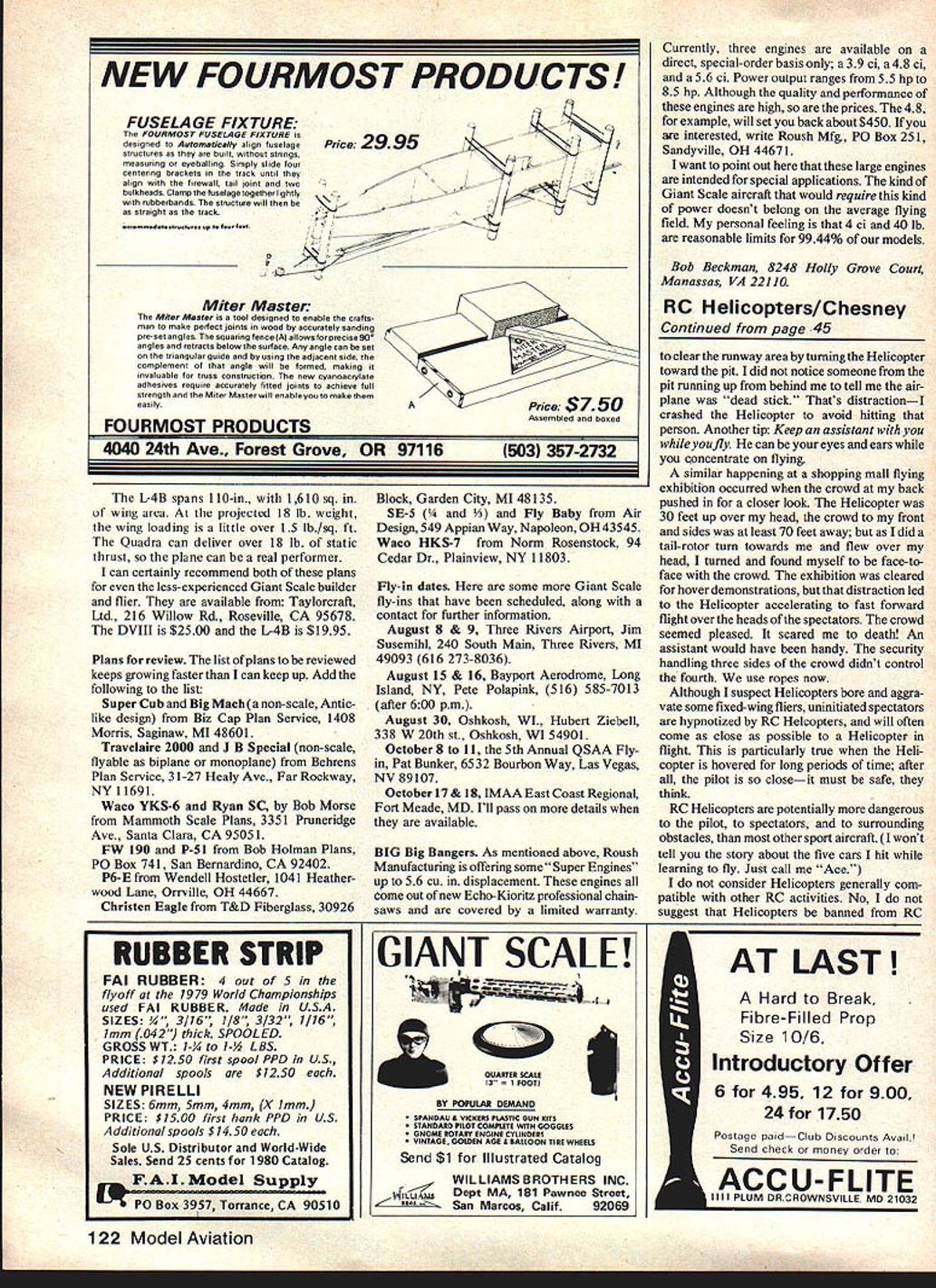
This month, we are reviewing two plans, available from Taylorcraft, Ltd., that have been around for about two years. I first saw the prototypes of Bill Wendt's Fokker DVIIf and Ken Ruenstrand's L-4B at Morgan Hill in 1979. That was my first Giant Scale Fly-In, and I was literally overwhelmed with new impressions and information. Even so, these two birds stood out.
Bill's DVIIf is built to a scale that sounds odd to U.S. modelers: 1 ft. = 1 meter, a little less than one-third scale. Bill worked from European drawings with metric dimensions, and this was easier than converting to an exact one-third scale. The plans are in three sheets, each approximately 3 ft. by 6 ft. They are clear and easily read, and they contain a fair amount of detail. They don't have much detail on control surface hinging and control hookup, however. If you don't have experience in this area, you'll need some help.
It is obvious that this aircraft was designed with the big bangers in mind. Materials and construction techniques are rugged. Basic structures are spruce and plywood, with some balsa, mostly where weight is critical. The wing employs a beautiful set of box spars built up of 1/8-in. square spruce and 1/32-in. ply. The wing spars are at the center, and both the wing locking and strut attachment systems are ingenious, simple, and effective.
The plans show a Quadra, and the original flew nicely on one. The cowl will accept almost any of the currently available engines.
If I were building from Bill's plans, the only change I would make is to use foam-core board for some of the ribs and formers and for the rudder and elevator cores. But then, you already know that I'm hooked on foam-core.
The L-4B "Grasshopper" is the ubiquitous Piper Cub in uniform. Painted olive drab and with the cabin windows extended behind the wing, it was used throughout WWII as a liaison and observation aircraft. Ken's plans are unusual in that they can be used to modify an existing kit (the Nosen or Balsa USA), or in the manner where the builder selects and cuts all the materials. If you work from a kit, be sure you make the material changes indicated on Ken's plans.
The L-4B spans 110 in., with 1,610 sq. in. of wing area. At the projected 18 lb. weight, the wing loading is a little over 1.5 lb./sq. ft. The Quadra can deliver over 18 lb. of static thrust, so the plane can be a real performer.
I can certainly recommend both of these plans for even the less-experienced Giant Scale builder and flier. They are available from: Taylorcraft, Ltd., 216 Willow Rd., Roseville, CA 95678. The DVIIf is $25.00 and the L-4B is $19.95.
Plans for review
Add the following to the list:
- Super Cub and Big Mach (a non-scale, Antic-like design) — Biz Cap Plan Service, 1408 Morris, Saginaw, MI 48601.
- Travelair 2000 and J B Special (non-scale, flyable as biplane or monoplane) — Behrens Plan Service, 31-27 Healy Ave., Far Rockaway, NY 11691.
- Waco YKS-6 and Ryan SC, by Bob Morse — Mammoth Scale Plans, 3351 Pruneridge Ave., Santa Clara, CA 95051.
- FW 190 and P-51 — Bob Holman Plans, PO Box 741, San Bernardino, CA 92402.
- P6-E — Wendell Hostetler, 1041 Heatherwood Lane, Orrville, OH 44667.
- Christen Eagle — T&D Fiberglass, 30926 Block, Garden City, MI 48135.
- SE-5 (3/4 and 1 1/2) and Fly Baby — Air Design, 549 Appian Way, Napoleon, OH 43545.
- Waco HKS-7 — Norm Rosenstock, 94 Cedar Dr., Plainview, NY 11803.
Fly-in dates
Here are some more Giant Scale fly-ins that have been scheduled, along with a contact for further information.
- August 8 & 9 — Three Rivers Airport. Contact: Jim Sumerhell, 240 South Main, Three Rivers, MI 49093. (616) 273-8036.
- August 15 & 16 — Bayport Aerodrome, Long Island, NY. Contact: Pete Polanik. (516) 585-7013 (after 6:00 p.m.).
- August 30 — Oshkosh, WI. Contact: Hubert Ziebel, 338 W 20th St., Oshkosh, WI 54901.
- October 8–11 — 5th Annual OSAA Fly-in, Las Vegas, NV. Contact: Pat Bunker, 6532 Bourbon Way, Las Vegas, NV 89107.
- October 17 & 18 — IMAA East Coast Regional, Fort Meade, MD. (More details to be announced.)
BIG Big Bangers
As mentioned above, Roush Manufacturing is offering some "Super Engines" up to 5.6 cu. in. displacement. These engines all come out of the Echo-Kioritz professional chainsaws and are covered by a limited warranty.
Currently, three engines are available on a direct, special-order basis only: a 3.9 ci, a 4.8 ci, and a 5.6 ci. Power output ranges from 5.5 hp to 8.5 hp. Although the quality and performance of these engines are high, so are the prices. The 4.8, for example, will set you back about $450. If you are interested, write Roush Mfg., PO Box 251, Sandyville, OH 44671.
I want to point out here that these large engines are intended for special applications. The kind of Giant Scale aircraft that would require this kind of power doesn't belong on the average flying field. My personal feeling is that 4 ci and 40 lb. are reasonable limits for 99.44% of our models.
Bob Beckman 8248 Holly Grove Court Manassas, VA 22110
Transcribed from original scans by AI. Minor OCR errors may remain.

