
Radio Control: Giant Scale
Bob Beckman
Wood suppliers and materials
All kinds of suppliers of wood for Giant Scale construction are coming out of (you guessed it) the woodworks. We've all been talking about using spruce, bass, pine, etc., in place of balsa, especially in high-stress areas, but until recently you pretty much had to cut your own, at least in the longer sizes. Now I'm hearing from people all over the country who are making various types and sizes of wood available.
Aircraft-grade clear white pine
- Supplier: Air Design
- Address: 549 Appian Ave., Napoleon, OH 43545
- Product: Aircraft-grade clear white pine in the usual cross-section sizes, lengths up to 72 in.
- Notes: Pine bends and carves more easily than spruce. It doesn't have quite the same strength as spruce but is adequate for many applications. Contact Air Design for prices and availability.
Basswood
- Supplier: G. McGinnis
- Address: 144 Murray Ave., Goshen, NY 10924
- Product: Basswood in usual sizes and lengths up to 72 in.
- Example prices: 1/8 in. sq. × 36 in. — $0.20; 1/2 in. × 3/4 in. × 72 in. — $1.35
- Notes: Fine, straight grain similar to white pine; bends and carves nicely; a little heavier than pine or spruce but acceptable for Giant Scale.
Redwood and spruce in 5-ft. lengths
- Supplier: Schmidt Custom Kits
- Address: 11948 Franklin Blvd., Elk Grove, CA 95624
- Product: Semi-kits plus spruce and redwood in 5-ft. lengths
- Example prices: 3/16 in. sq. redwood — $0.40, spruce — $0.55; 1/2 in. × 1/4 in. redwood — $1.00, spruce — $2.15
- Notes: Redwood is lighter and usable but tends to splinter more and is not quite as strong as spruce. More common on the West Coast.
Aircraft-grade spruce (72 in. lengths)
- Supplier: Midwest Products Co.
- Address: P.O. Box 564, Hobart, IN 46342
- Product: Aircraft-grade spruce cut in sizes from 3/16 in. × 1/8 in. ($1.20) to 3/8 in. × 1-1/2 in. ($4.30) in 72 in. lengths
- Notes: Their Micro Cut Balsa methods are now applied to spruce. Check local hobby shops or write for information.
I'm sure there are other suppliers beyond those I have information on. Choice of wood will often come down to availability and personal preference. I use spruce myself — I cut my own. I bought a saw at the local lumberyard and built tools and a small deck on the back of the house to justify the saw; now my wife sits on the deck and suns while I work in the basement.
Onboard starters
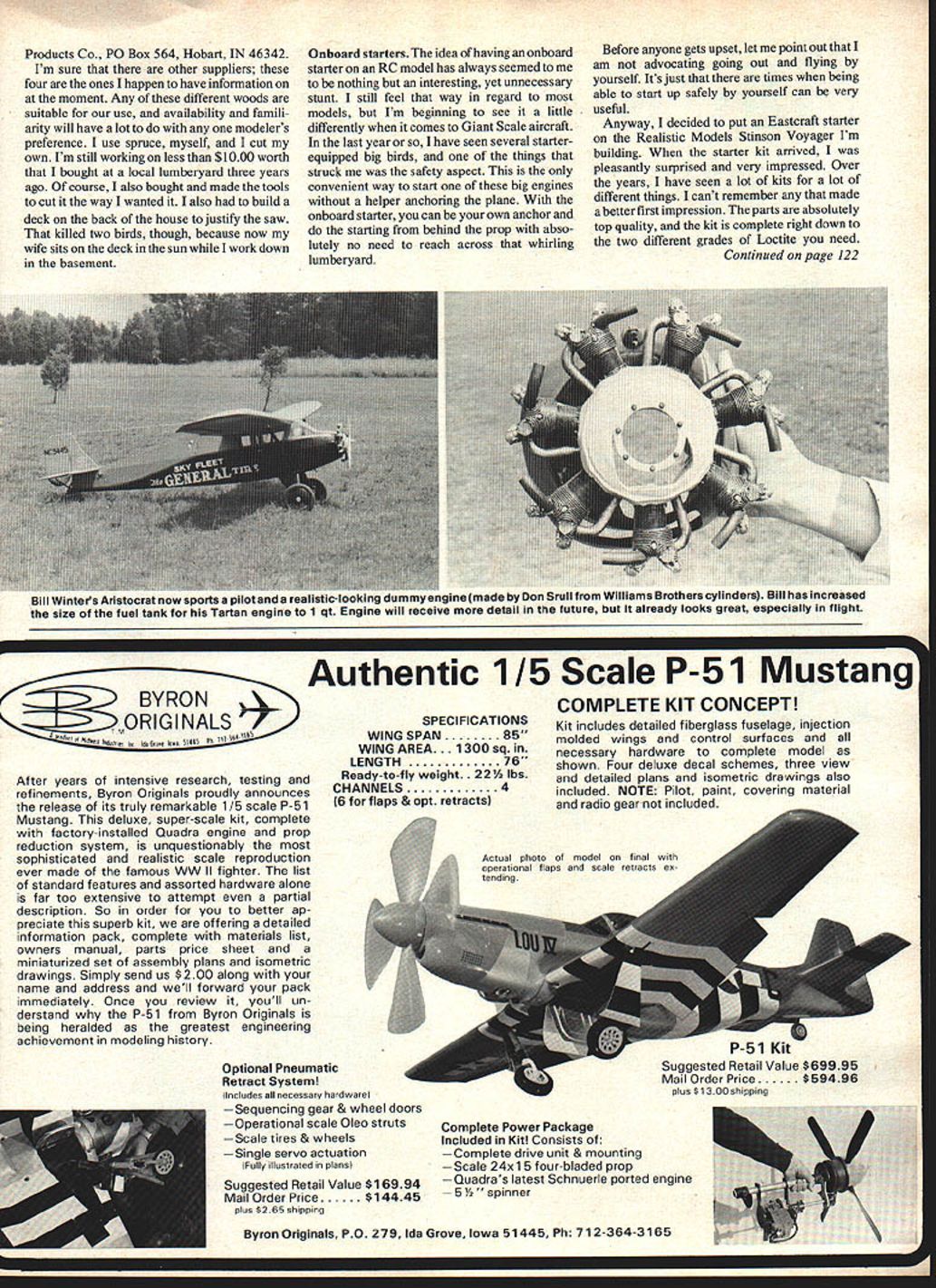
The idea of having an onboard starter on an RC model has often seemed like a gimmick — interesting but unnecessary. For Giant Scale aircraft I'm coming to appreciate the safety advantage: a convenient, safer way to start big engines. With a helper anchoring the plane, an onboard starter can be used from behind the prop with no need to reach across a whirling propeller. There are many stories of inadvertent engine starts with onboard starters; in every case I know the cause was carelessness built up by years of operating glow-ignition engines.
I installed an Eastcraft starter on the Realistic Models Stinson Voyager I'm building. The kit made a very good first impression: top-quality parts and complete contents, including two different grades of Loctite. Installation went quickly, partly because the Voyager motor mount was designed to accept the starter. The instructions should make installation fairly simple in most aircraft.
Important safety measures
- Install an ignition "kill" switch in the aircraft and use it. A radio-controlled ignition switch is a good idea, but you should also have a separate switch that kills the engine regardless of the radio state.
- Develop the habit of turning that switch off every time you shut down the engine and checking it before you turn the engine over.
- Be aware that self-contained magneto ignition systems can allow an engine to start from a casual flip of the prop or from trying the starter, so preventative habits and hardware are essential.
I maintain that tools and equipment are not inherently unsafe — it's what people do with them that can be unsafe.
Add-on chokes
Several engines used in Giant Scale do not have built-in chokes. A number of add-on choke units are available for the Walbro carburetor used on many engines.
- Quadra USA
- Address: 1032 East Manitowoc Ave., Oak Creek, WI 53154
- Products:
- Combination air cleaner and choke — $4.95. Intended for the Quadra carb, will fit a Kioritz with slight modification. Bulky and needs a large cowl to enclose; the air filter is a useful addition.
- Choke plate and linkage that fits under the plastic fitting on the carb — $1.00. Simple and effective.
- Gardner-Burrell
- Address: 6005 Cliff Drive, Fort Smith, AR 72903
- Product: Ram-induction fitting with built-in choke — $14.95. Manufacturer claims a 200 rpm increase due to the ram air intake (I haven't tested this yet).
- Vortac Mfg. Co.
- Product: Choke unit available in model shops — $5.98. Designed to be operated manually from the front through the air intake in the cowl; can also be set up for servo operation or manual cockpit control.
All of these choke assemblies fill a need on engines without chokes. Choking with your finger is awkward and dangerous, and can be almost impossible on a cowled engine.
Plan reviews
Bob Morse continues to be prolific with excellent Giant Scale plans. The four latest designs:
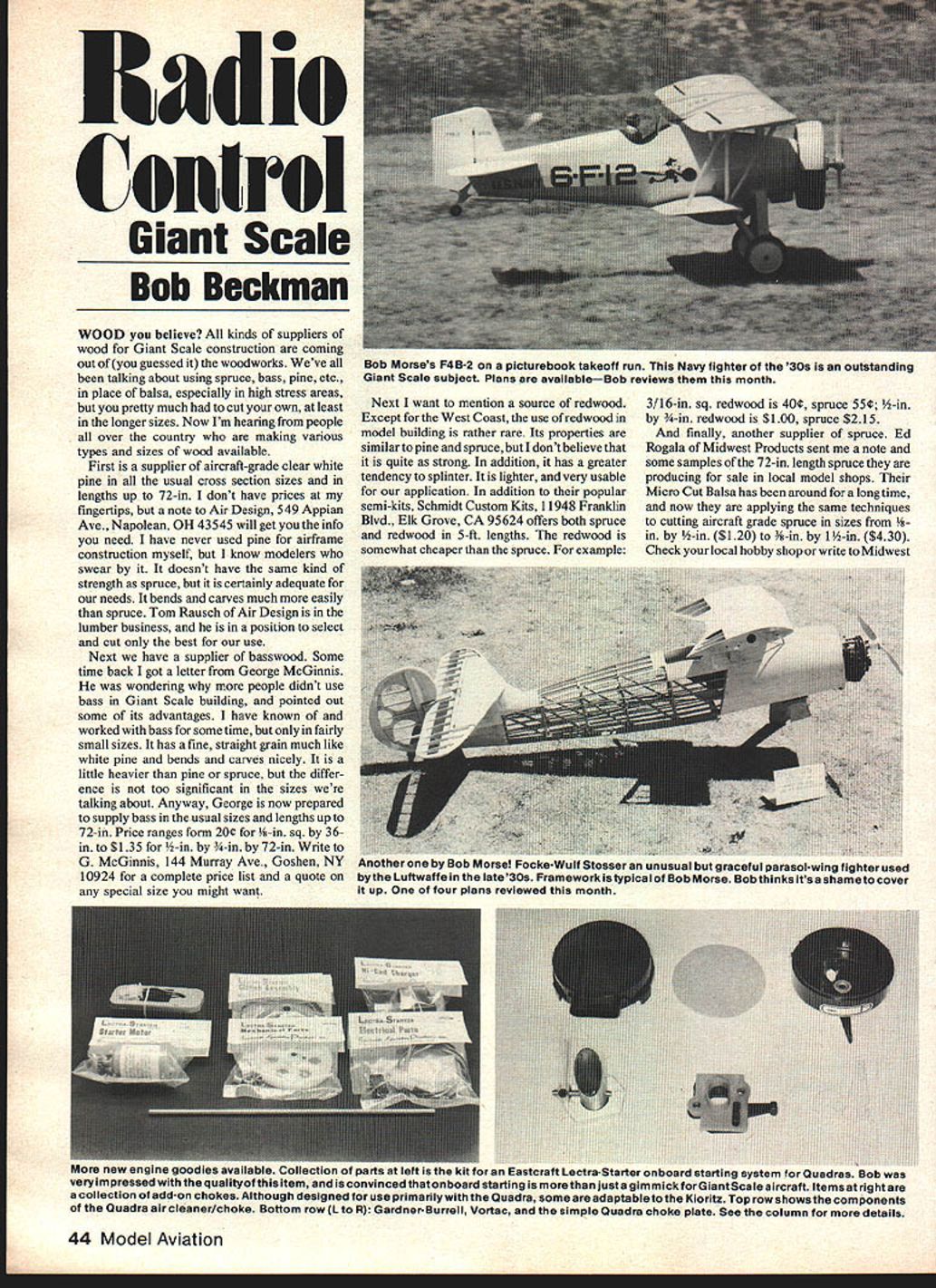
F4B-2 / P12-C
- Span: 90 in.
- Wing area: 2,118 sq. in.
- Weight: 23 lb.
- Wing loading: 25 oz./sq. ft.
- Notes: I believe this was the first Kawasaki 2.2-powered model; the match-up is excellent. Plans include a simple and effective jig for constructing the cabane struts. I've seen the prototype fly many times.
Focke Wulf FW56 Stosser
- Span: 102.5 in.
- Length: 75 in.
- Wing area: 1,300 sq. in.
- Weight: 22 lb.
- Notes: A parasol with beautiful fuselage lines, an elliptical wing planform, and an unusual tail assembly. Bob's wing construction method simplifies building the elliptical wing; the same cabane jigging method is used.
WACO YKS-6 (cabin biplane)
- Upper wing span: 99.38 in.
- Total wing area: 2,414 sq. in.
- Weight: 29.3 lb.
- Wing loading: 28 oz./sq. ft.
- Notes: Designed for either the Quadra or the Kawasaki 2.2.
Ryan S-C
- Span: 112 in.
- Length: 75 in.
- Area: 1,700 sq. in.
- Weight: 24 lb.
- Wing loading: 32 oz./sq. ft.
- Notes: Low-wing, side-by-side cabin monoplane. Uses a full-monocoque fuselage shell technique adapted from smaller-scale models, producing a good representation of the original. With the Kawasaki 2.2 it should fly very much like the original.
Bob's plans include detailed construction information: how to install hinges, control systems, strut fittings; he provides part numbers and sources. Not all good plans include this level of detail.
Ordering information
- Supplier: Mammoth Scale Plans
- Address: 3351 Pruneridge Ave., Santa Clara, CA 95051
- Notes: Plans are sent rolled, not folded.
- Prices (including postage): Ryan S-C — $26.00; the other three — $23.50 each.
IMAA Fly-in
The International Miniature Aircraft Association (IMAA) Fly-in, held the last weekend in September, is shaping up as a combined fun-fly and trade show. Indoor and outdoor booths are being reserved by many manufacturers; this could become the Toledo show of Giant Scale.
- Location: "Tom" Sawyer State Park, Louisville, KY
- Contact: Don Godfrey, 254 Washington St., Binghamton, NY 13901
Bob Beckman 8248 Holly Grove Court Manassas, VA 22110
Transcribed from original scans by AI. Minor OCR errors may remain.

