
Radio Control: Giant Scale
Bob Beckman
Big Ball Joints
In my Toledo report a couple months ago I mentioned the large-size fittings that are starting to show up. Here are details and example applications of two different ball joints that I saw there.
- B & B Specialties — open ball joint
- Apparently from Germany (marked Schulter), originally made for helicopter linkages.
- Steel ball: 3/16-in. diameter with a 1/16-in. hex key socket in the end.
- Shank: 2.5 mm × 0.45 metric thread with a matching lock nut.
- Plastic socket accepts a 5-1/2-in. long mild steel rod with a 4-40 thread.
- Du-Bro — new large-scale closed-style ball joint
- Steel ball: 0.210-in. diameter with a 1/4-in. hex section below the ball, then a 4-40 shank.
- Plastic socket supplied with a 1-in. long 4-40 stud and a brass coupler sized to be soldered to 3/32-in. music wire.
The assembled links both move more freely, without slop, and you don’t have to worry about them coming apart. In fact, they are rather difficult to take apart! Dave Gray of Du-Bro told me they plan to make available a removal tool, as they have for their small ball joints.
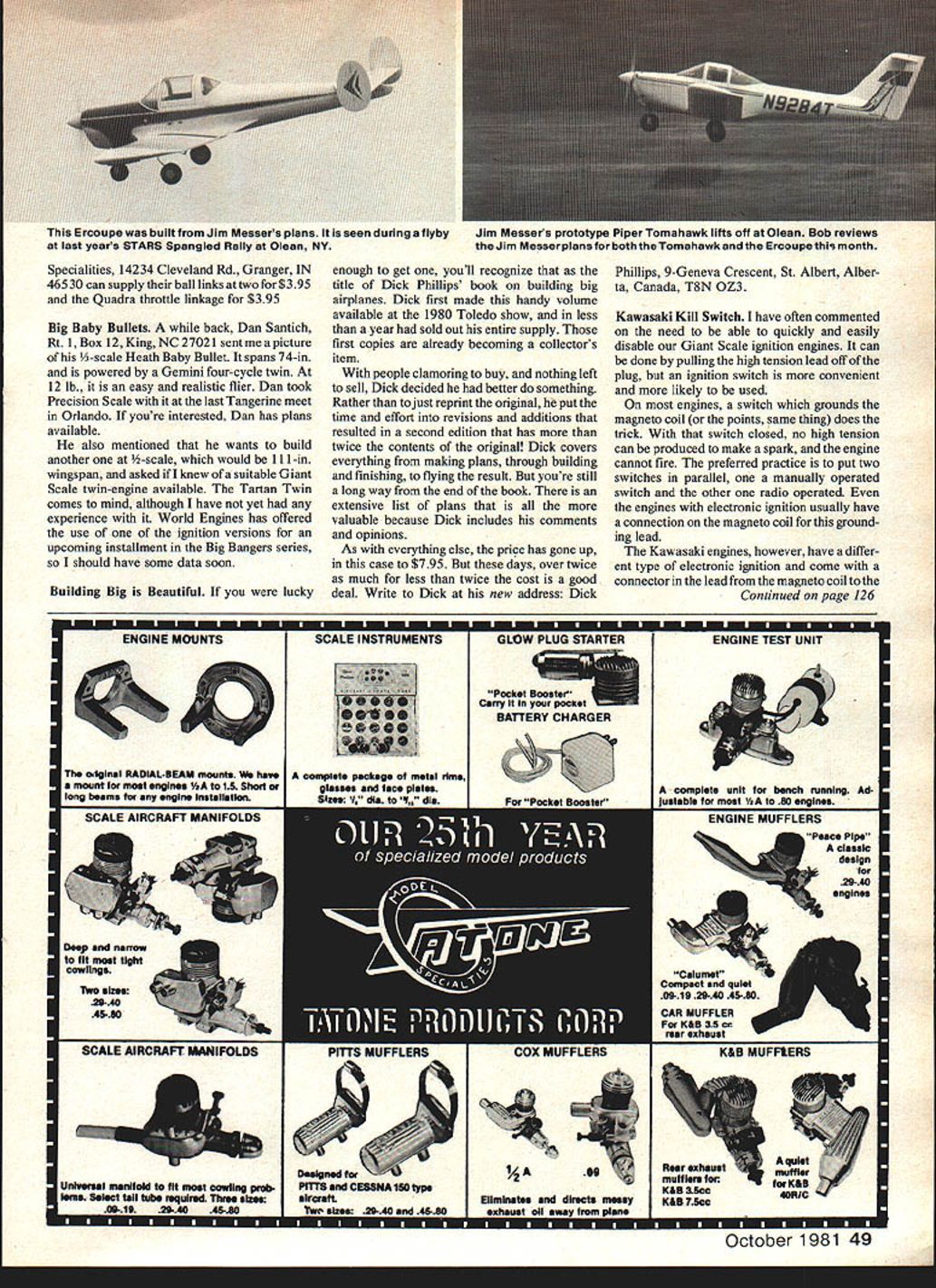
One picture this month shows an application of the Du-Bro unit to the elevator horn in my Realistic Models Stinson Voyager. The horn is a piece of 3/16-in. brass rod with a 6-32 thread cut into one end; the threaded end goes into the structure linking the elevators. The other end is drilled and tapped to accept the 4-40 shank of the ball. A 4-40 stud links the socket to an aluminum-tube pushrod that goes to a cable-driven bellcrank just forward of the fin. Since the horn will be inaccessible inside the fin, I’m not concerned about being able to take the joint apart.
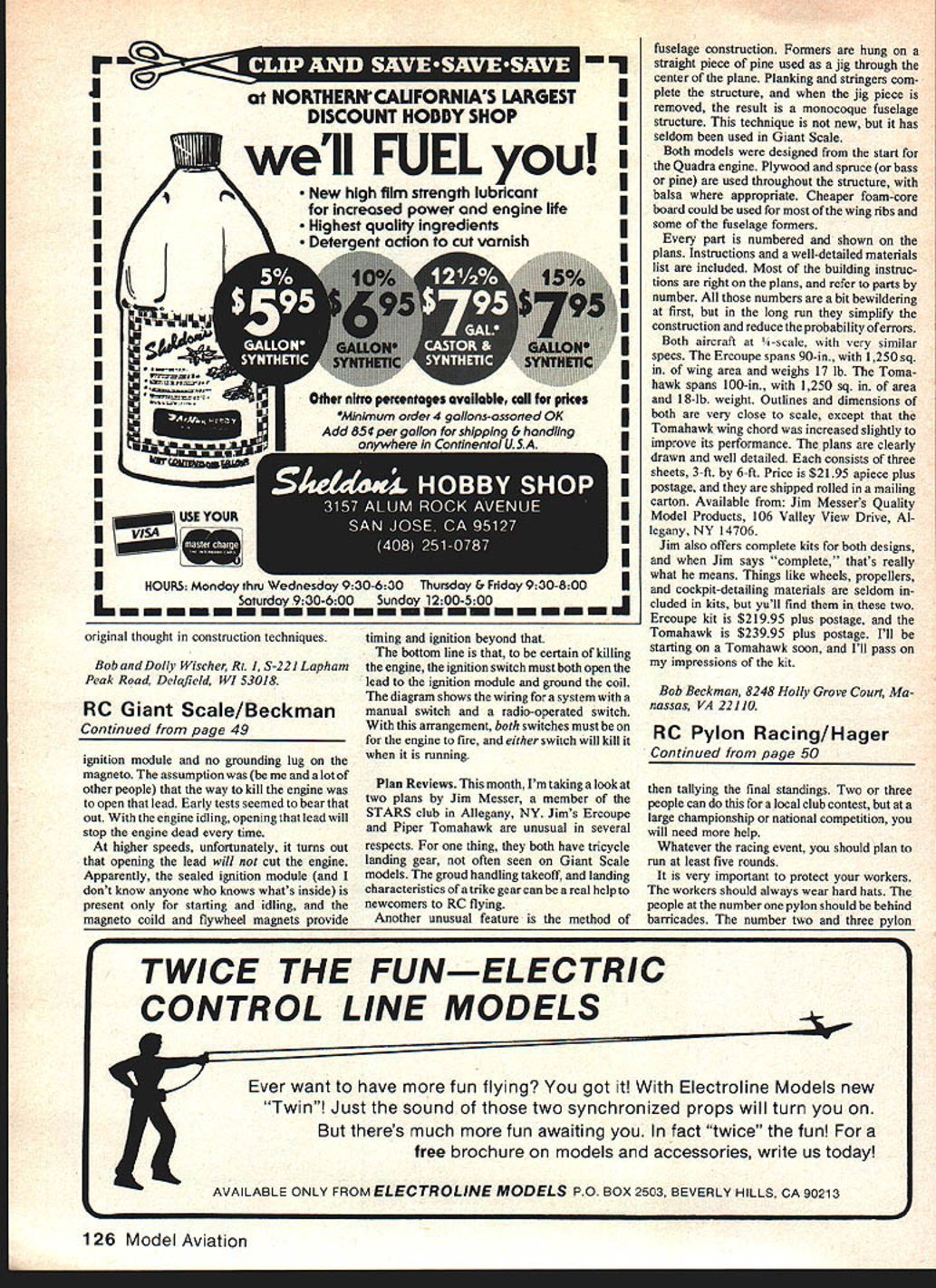
One application of the B & B link is their Quadra throttle linkage: two ball links, a preformed pushrod, a bellcrank, and hardware are included in the neat solution to the right-angle throttle linkage problem. Another B & B ball link, or one of the smaller Du-Bro units, is handy for linking the bellcrank to the servo pushrod. Both of these new items can be very useful in Giant Scale aircraft.
- Du-Bro 4-40 Ball Link: available in hobby shops for $1.25.
- B & B Specialties: ball links — two for $3.95; Quadra throttle linkage $3.95.
- B & B Specialties, 14234 Cleveland Rd., Granger, IN 46530.
Big Baby Bullets Back
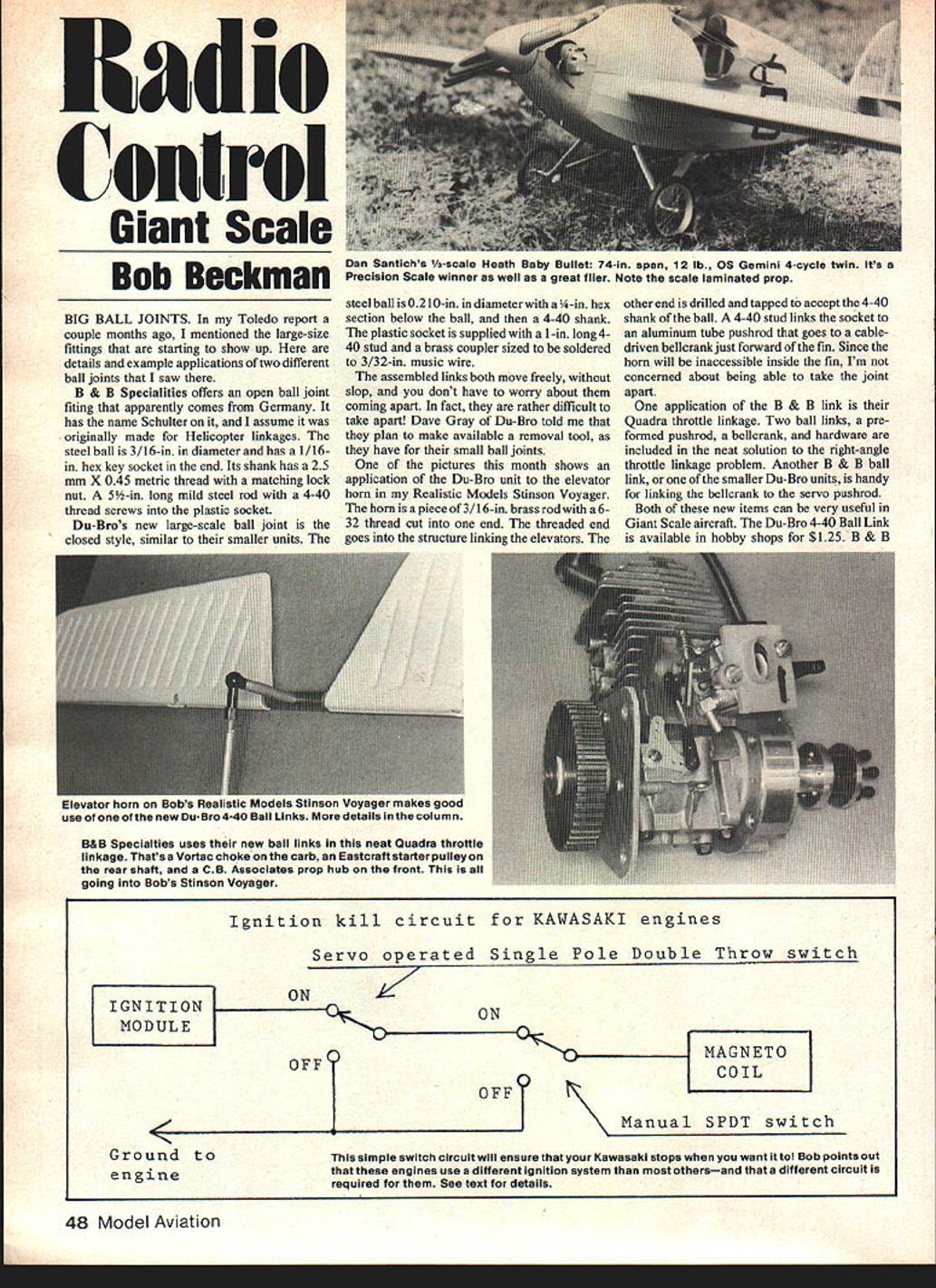
Dan Santich, Rt. 1, Box 12, King, N.C. 27021, sent a picture of a 1/2-scale Heath Baby Bullet: 74-in. span, 12 lb., OS Gemini 4-cycle twin. It’s a Precision Scale winner as well as a great flier. Note the scale laminated prop. If you’re interested, Dan has plans available.
He also mentioned he wants to build another 3/4-scale version, which would be 111-in. wingspan. I asked if he knew a suitable Giant Scale twin-engine; the Tartan Twin comes to mind, although I have yet to have any experience with it. World Engines has offered to use ignition versions. In the upcoming installment of the Big Bangers series I should have some data soon.
Building Big Is Beautiful
If you were lucky enough to get one, you'll recognize that as the title of Dick Phillips' book on building big airplanes. Dick first made this handy volume available at the 1980 Toledo show, and in less than a year had sold out his entire supply. Those first copies are already becoming a collector’s item.
With people clamoring to buy and nothing left to sell, Dick decided he had better do something. Rather than just reprint the original, he put the time and effort into revisions and additions that resulted in a second edition that has more than twice the contents of the original! Dick covers everything from making plans through building and finishing to flying the result. There is also an extensive list of plans, made more valuable because Dick includes his comments and opinions.
Price: $7.95. Write to Dick at:
- Dick Phillips, 9 Geneva Crescent, St. Albert, Alberta, Canada, T8N 0Z3.
Kawasaki Kill Switch
I have often commented on the need to be able to quickly and easily disable our Giant Scale ignition engines. It can be done by pulling the high-tension lead off the plug, but an ignition switch is more convenient and more likely to be used.
On most engines, a switch which grounds the magneto coil (or the points—same thing) does the trick. With that switch closed, no high tension can be produced to make a spark, and the engine cannot fire. The preferred practice is to put two switches in parallel: one manually operated switch and one radio-operated. Even engines with electronic ignition usually have a connection on the magneto coil for this grounding lead.
The Kawasaki engines, however, have a different type of electronic ignition. They come with a connector in the lead from the magneto coil to the ignition module and no grounding lug on the magneto. The assumption was (me and a lot of other people) that the way to kill the engine was to open that lead. Early tests seemed to bear that out: with the engine idling, opening that lead will stop the engine dead every time.
At higher speeds, unfortunately, opening the lead will not cut the engine. Apparently the sealed ignition module (and I don't know anyone who knows what's inside) is present only for starting and idling, and the magneto coil and flywheel magnets provide timing and ignition beyond that.
The bottom line is that, to be certain of killing the engine, the ignition switch must both open the lead to the ignition module and ground the coil. The wiring diagram (not shown here) presents a system with a manual switch and a radio-operated switch. With this arrangement, both switches must be on for the engine to fire, and either switch will kill it when it is running.
Plan Reviews
This month I'm taking a look at two plans by Jim Messer, a member of the STARS club in Allegany, NY. Jim's Ercoupe and Piper Tomahawk are unusual in several respects.
- Tricycle landing gear: not often seen on Giant Scale models. The ground handling, takeoff, and landing characteristics of trike gear can be a real help to newcomers to RC flying.
- Fuselage construction: formers are hung on a straight piece of pine used as a jig through the center of the plane. Planking and stringers complete the structure, and when the jig piece is removed, the result is a monocoque fuselage. This technique is not new, but it has seldom been used in Giant Scale.
Both models were designed from the start for the Quadra engine. Plywood and spruce (or bass or pine) are used throughout the structure, with balsa where appropriate. Cheaper foam-core board could be used for most of the wing ribs and some of the fuselage formers.
Every part is numbered and shown on the plans. Instructions and a well-detailed materials list are included. Most of the building instructions are right on the plans and refer to parts by number. All those numbers are a bit bewildering at first, but in the long run they simplify construction and reduce the probability of errors.
Both aircraft are 3/4-scale, with very similar specs:
- Ercoupe: 90 in. span, 1,250 sq. in. wing area, 17 lb.
- Tomahawk: 100 in. span, 1,250 sq. in. wing area, 18 lb.
Outlines and dimensions of both are very close to scale, except that the Tomahawk wing chord was increased slightly to improve performance. The plans are clearly drawn and well detailed. Each consists of three sheets, 3 ft. by 6 ft. Price: $21.95 apiece plus postage; shipped rolled in a mailing carton.
Available from:
- Jim Messer's Quality Model Products, 106 Valley View Drive, Allegany, NY 14706.
Jim also offers complete kits for both designs, and when Jim says "complete," that's really what he means. Things like wheels, propellers, and cockpit-detailing materials—seldom included in kits—are included in these two.
- Ercoupe kit: $219.95 plus postage.
- Tomahawk kit: $239.95 plus postage.
I'll be starting on a Tomahawk soon and will pass on my impressions of the kit.
Bob Beckman 8248 Holly Grove Court Manassas, VA 22110
Transcribed from original scans by AI. Minor OCR errors may remain.

