
Radio Control: Giant Scale
Bob Beckman
The Voyager Voyages
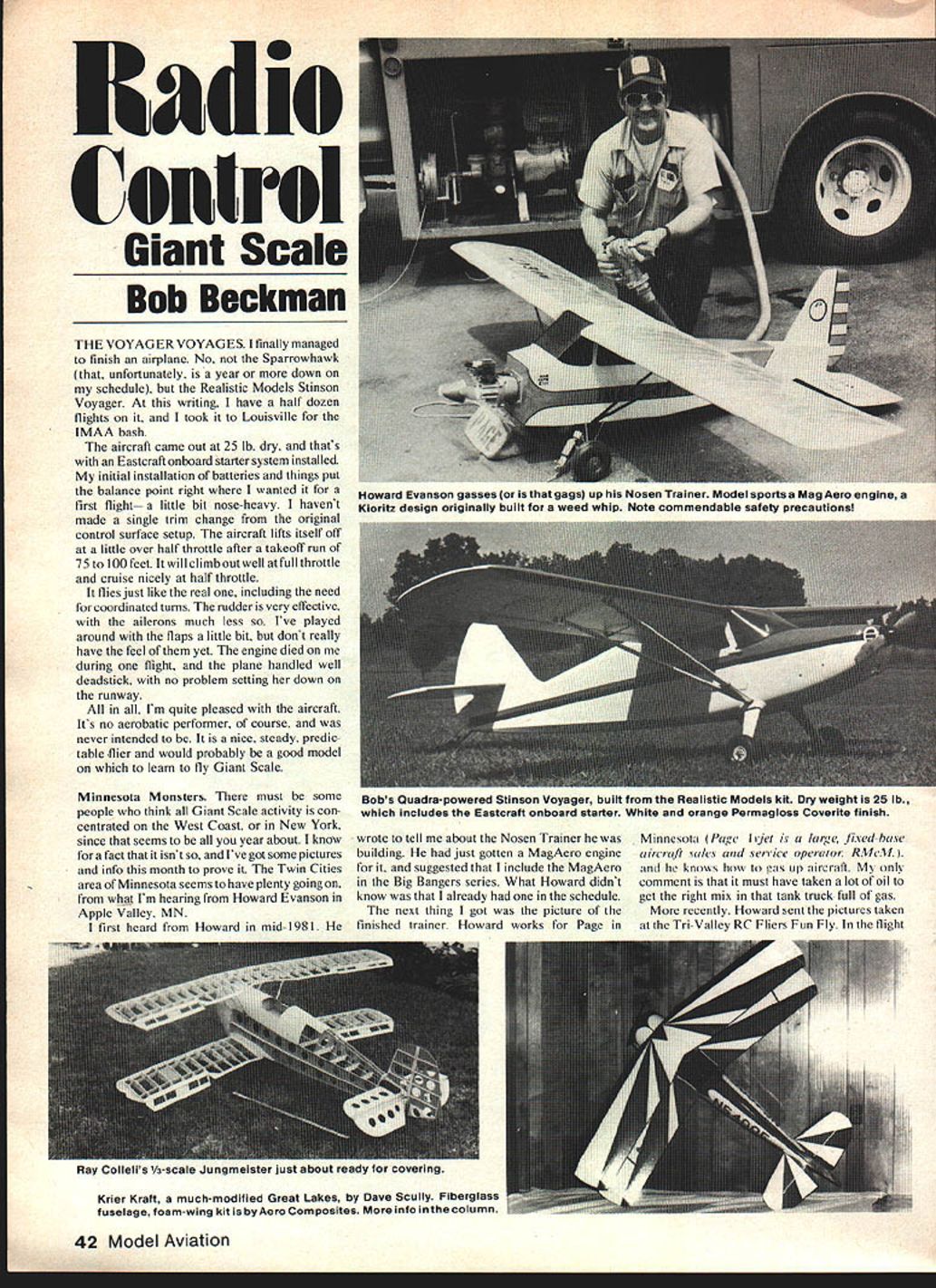
I finally managed to finish an airplane — not the Sparrowhawk (that's still a year or more down my schedule), but the Realistic Models Stinson Voyager. At this writing I have a half dozen flights on it, and I took it to Louisville for the IMAA bash.
The aircraft came out at about 25 lb. dry, and that's with an Eastcraft onboard starter system installed. My initial installation of batteries and things put the balance point right where I wanted it for a first flight — a little bit nose-heavy. I haven't made a single trim change from the original control-surface setup. The aircraft lifts itself off at a little over half throttle after a takeoff run of 75 to 100 feet. It will climb out well at full throttle and cruise nicely at half throttle.
It flies just like the real one, including the need for coordinated turns. The rudder is very effective; the ailerons are much less so. I've played around with the flaps a little, but don't really have the feel of them yet. The engine died on me during one flight, and the plane handled a deadstick well, with no problem setting her down on the runway.
All in all, I'm quite pleased with the aircraft. It's no acrobatic performer — it was never intended to be — but it's a nice, steady, predictable flier and would probably be a good model on which to learn to fly Giant Scale.
Minnesota Monsters
There must be some people who think all Giant Scale activity is concentrated on the West Coast or in New York, since that's what you hear about most. It's not so — the Twin Cities area of Minnesota has plenty going on, from what I'm hearing from Howard Evanson in Apple Valley, MN.
I first heard from Howard in mid-1981. He wrote to tell me about the Nosen Trainer he was building. He had just gotten a MagAero engine for it and suggested I include the MagAero in the Big Bangers series. What Howard didn't know was that I already had one in the schedule.
Howard later sent a picture of the finished trainer. He works for Page in Minnesota (Page is a large fixed-base aircraft sales and service operator), and he certainly knows how to gas up aircraft. My only comment is that it must have taken a lot of oil to get the right mix in that tank-truck full of gas.
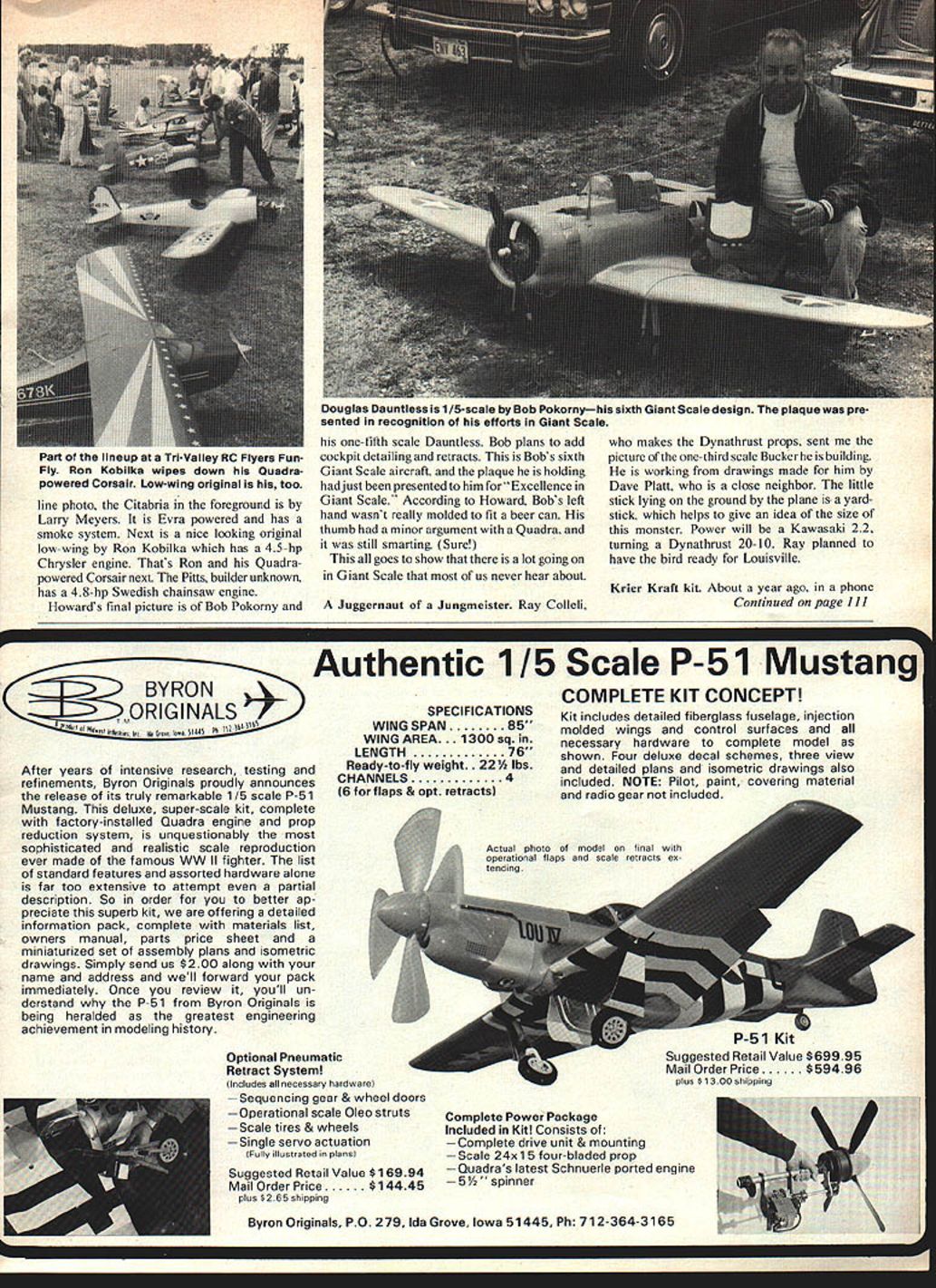
More recently, Howard sent pictures taken at the Tri-Valley RC Fliers Fun Fly, including Bob's one-fifth-scale Dauntless. Bob plans to add cockpit detailing and retractable gear. This is Bob's sixth Giant Scale aircraft, and the plaque he is holding had just been presented to him for "Excellence in Giant Scale." According to Howard, Bob's left hand wasn't really molded to fit a beer can — his thumb had a minor argument with a Quadra, and it was still smarting. This all goes to show there is a lot going on in Giant Scale that most of us never hear about.
A juggernaut Jungmeister — Ray Colleli, who makes the Dynathrust props — sent me the picture of the one-third-scale Bucker he is building. He is working from drawings made for him by his neighbor Dave Platt. The little stick lying on the ground by the plane is a yardstick, which helps give an idea of the size of this monster. Power will be a Kawasaki 22 turning a Dynathrust 20-10. Ray planned to have the bird ready for Louisville.
Krier Kraft kit
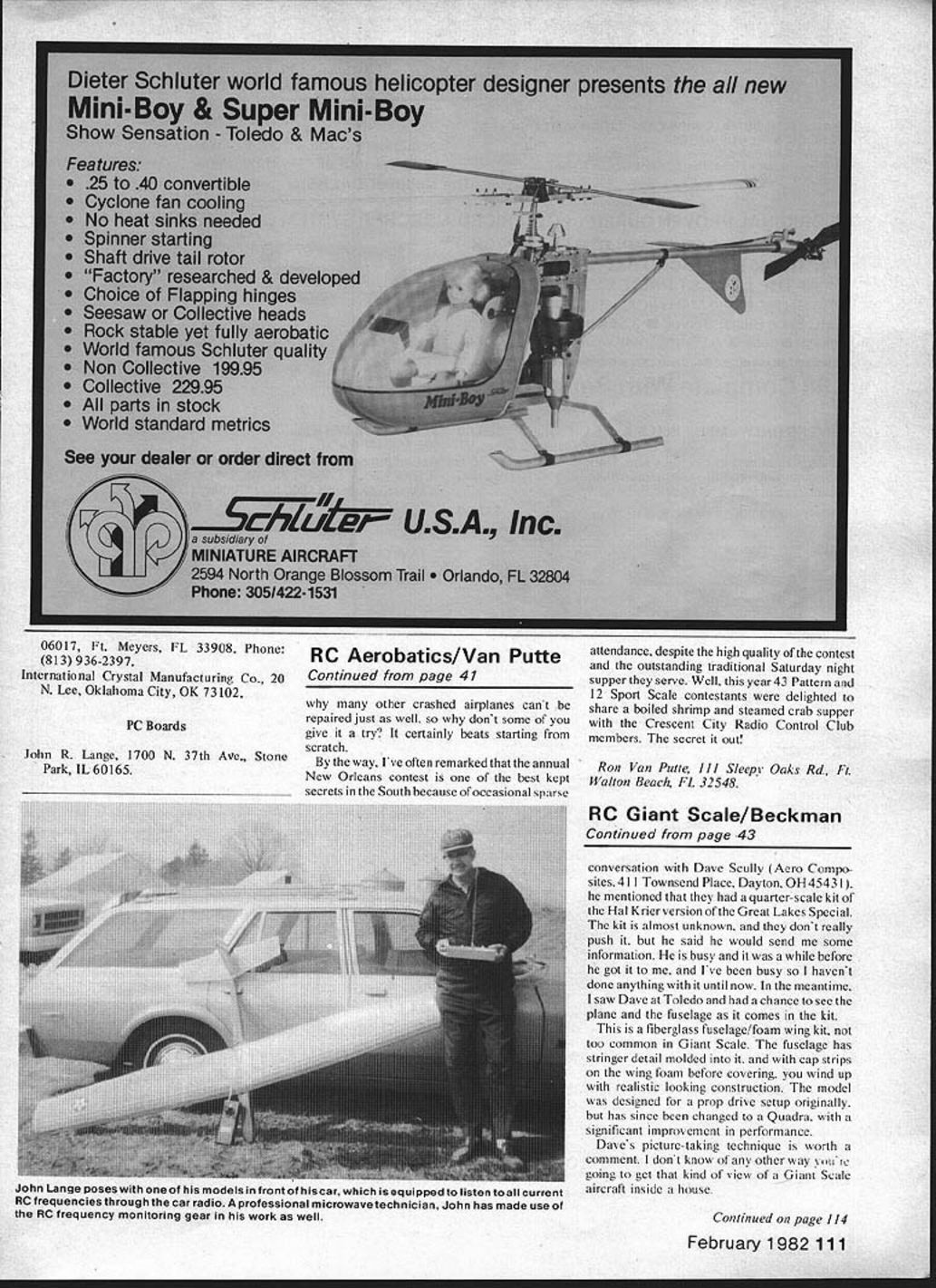
About a year ago, in a phone conversation with Dave Scully (Aero Composites, 411 Townsend Place, Dayton, OH 45431), he mentioned they had a quarter-scale kit of the Hal Krier version of the Great Lakes Special. The kit is almost unknown, and they don't really push it, but he said he would send me some information. It was a while before I received it, and I've been busy, so I hadn't done anything with it until now. In the meantime I saw Dave at Toledo and had a chance to see the plane and the fuselage as it comes in the kit.
This is a fiberglass fuselage/foam wing kit — not too common in Giant Scale. The fuselage has stringer detail molded into it, and with cap strips on the wing foam before covering you wind up with realistic-looking construction. The model was designed for a prop-drive setup originally, but has since been changed to a Quadra with a significant improvement in performance.
Dave's picture-taking technique is worth a comment. I don't know of any other way you're going to get that kind of view of a Giant Scale aircraft inside a house.
Ft. Meade Monster Rally
The first major Giant Scale fly-in in my part of the country (the Washington, D.C. area) was held October 17–18 at Ft. George G. Meade, MD. Twenty-six participants registered to fly, and counting units under construction there were 47 aircraft present.
For a "First Annual" that is a pretty good turnout. Beautiful weather and a great flying site greeted the participants and spectators on Saturday. Sunday was cloudy and cool with some rain in the morning, but flying went on until 4 p.m. I'll have pictures and more comments in future columns.
Godfrey Stearman plans
There are a lot of Giant Scale plans available now, and more coming along all the time. One of the first, and still one of the best, is the quarter-scale Super Stearman by Don Godfrey. Originally powered with the Quadra, it is a design that can accept and benefit from the larger, more powerful engines now available. I've seen versions with Kawasakis, Kioritzes, Ropers, and one-of-a-kind engine conversions of more than four cu. in.
The plans consist of two sheets, 3 ft. by about 9 ft., and a 23-page booklet. All parts are clearly drawn, and an experienced modeler should have no problems. A few areas that might be confusing are covered in the instruction booklet. Construction is, for the most part, typical model practice beefed up with spruce and plywood as appropriate. I have heard from some builders that the structure tends to be heavy in the tail section, but I can't account for that by looking at the plans. Don does go overboard a bit with gussets in the rudder and elevator, but as long as they aren't rock-hard balsa or plywood, they should add more strength than weight.
This design is at least three years old now and, understandably, doesn't take advantage of some of the hardware items that have become available since. For example, the plans call for large Klett hinges on all of the control surfaces. Since even the largest of these hinges was never designed for Giant Scale, large numbers of hinges are specified — five or more for the rudder alone. I would tend to use the CB hinges built for Giant Scale and use fewer of them.
If you decide to build a Super Stearman, you've just got to put a smoke system on it. With enough power in the nose and an effective smoker, this aircraft is always a show stopper. Plans, cowl, and wheelpants are available from: Don Godfrey, 254 Washington St., Binghamton, NY 13901. My records show the plans priced at $24.95, but I don't know if that includes postage.
Ziroli Corsair plans
Nick Ziroli has been producing outstanding model designs for quite a few years. He was one of the first to turn his talents toward Giant Scale, and he is now doing a fine Giant Scale column in Flying Models. I have seen several of his designs in action; the Corsair is the only plan I've had a chance to examine in detail.
The scale employed is 2 3/4 in. to the foot — a little smaller than 1/5-scale — but the Corsair was a big aircraft and the model is definitely in the Giant class. Wingspan comes out to 93 in., and there is plenty of room in the cowl for a Quadra. The plans also show a prop-drive installation, but I would prefer a gasoline burner. I've seen several fly well with Quadras, and with a Kioritz or Kawasaki it is a real performer.
Nick's Corsair is built like a rubber-powered scale model, with formers hung on a crutch and then stringers added to form what amounts to a monocoque fuselage structure. "Hold on," you say, "this is Giant Scale we're talking about, not some delicate little rubber job." Real airplanes are built by hanging formers on a jig and then adding stringers and an outer skin. The only difference in the three cases is size and materials used. The monocoque structure has one of the highest strength-to-weight ratios attainable.
The plans give you the option of fabric covering over stringers, or sheeting the entire fuselage with balsa. In the latter case, half the stringers are omitted. The sheeting will make for a more realistic-looking model but at the cost of a little more weight and a small fortune in balsa. An interesting possibility would be to cover the stringers with aluminum — used aluminum litho plates are cheap or even free.
One unusual feature of this bird is its folding/removable wings. The center section is built into the fuselage, and the outer panels can be folded or removed at the same point as on the original aircraft. Some simple aluminum parts and four screws for each wing are all it takes.
The date on the drawings is 1-79, so there are some hardware items now available that can be used to good advantage even though they don't appear on these plans. About the only complaint I've heard about the model relates to the landing gear. The 7/32-in. wire called out is a little light for the job, but it was the largest available at the time. Now you can get 1/4-in. wire, and some people are using 5/16-in. automobile trunk-lid springs.
The plans are $25.00, postage paid. Cowl, canopy, and spinner are also available. Write to: Nick Ziroli, 29 Edgar Drive, Smithtown, NY 11787.
Anniversary
Next month I start my third year of doing this column. My, how time flies when you're having fun. I've had a ball these last two years, and even though it has cut into my own building and flying, the chance to get out and see the rest of you doing our thing has more than made up for that.
I hope that I've been able to give you at least some of what you want to see. Keep the letters coming so I'll know if I'm on target.
Bob Beckman 8248 Holly Grove Ct. Manassas, VA 22110
Transcribed from original scans by AI. Minor OCR errors may remain.

