
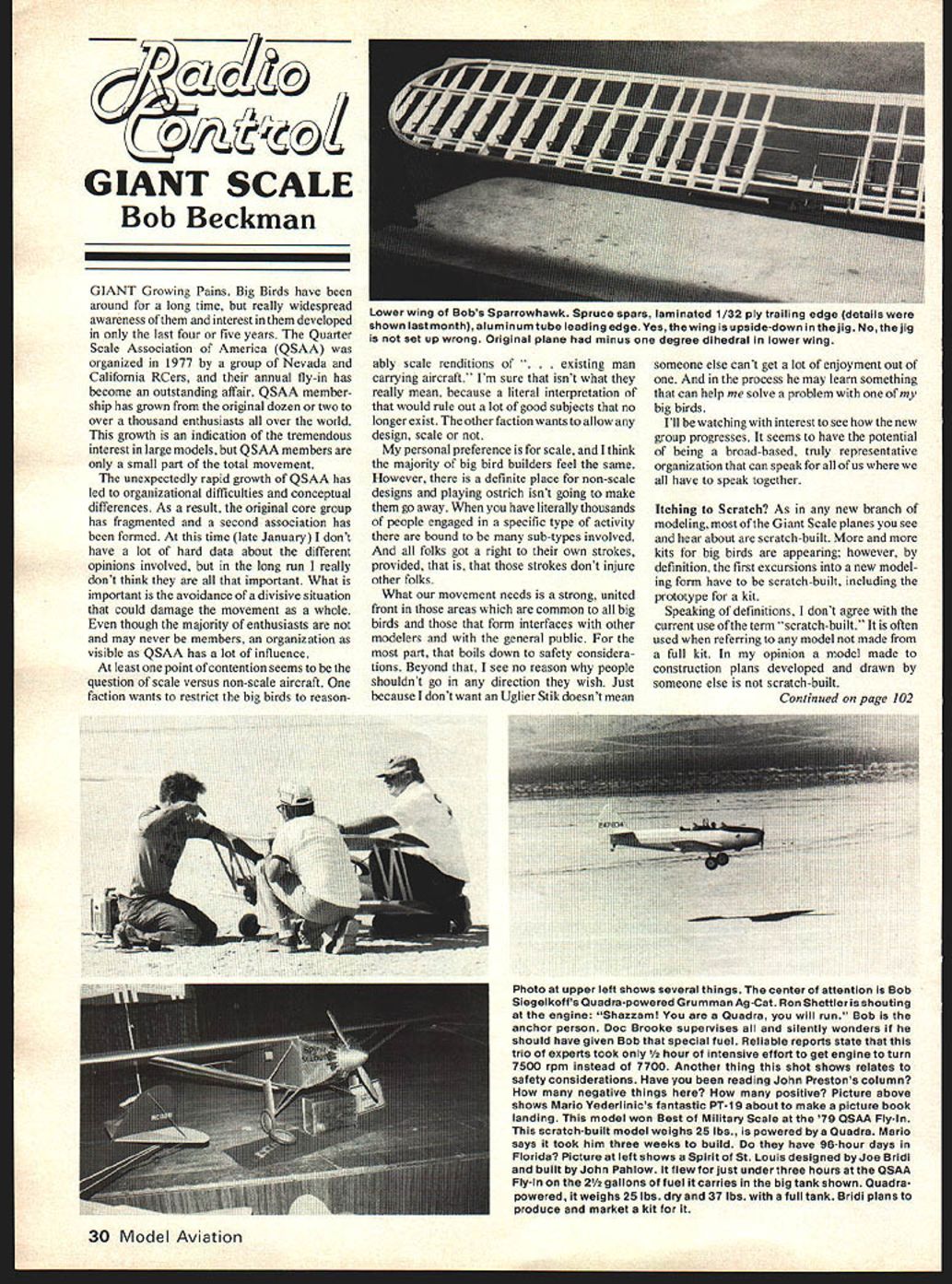
Radio Control: Giant Scale
Bob Beckman
Giant Growing Pains
Big birds have been around for a long time, but really widespread awareness of them and interest in them developed only in the last four or five years. The Quarter Scale Association of America (QSAA) was organized in 1977 by a group of Nevada and California RCers, and their annual fly-in has become an outstanding affair. QSAA membership has grown from the original dozen or two to over a thousand enthusiasts all over the world. This growth is an indication of the tremendous interest in large models, but QSAA members are only a small part of the total movement.
The unexpectedly rapid growth of QSAA has led to organizational difficulties and conceptual differences. As a result, the original core group has fragmented and a second association has been formed. At this time (late January) I don't have a lot of hard data about the different opinions involved, but in the long run I really don't think they are all that important. What is important is the avoidance of a divisive situation that could damage the movement as a whole. Even though the majority of enthusiasts are not and may never be members, an organization as visible as QSAA has a lot of influence.
At least one point of contention seems to be the question of scale versus non-scale aircraft. One faction wants to restrict the big birds to reasonably scale renditions of existing man-carrying aircraft. I'm sure that isn't what they really mean, because a literal interpretation would rule out a lot of good subjects that no longer exist. The other faction wants to allow any design, scale or not.
My personal preference is for scale, and I think the majority of big-bird builders feel the same. However, there is a definite place for non-scale designs and playing ostrich isn't going to make them go away. When you have literally thousands of people engaged in a specific type of activity there are bound to be many sub-types involved. And everyone has a right to their own strokes, provided, that is, those strokes don't injure others.
What our movement needs is a strong, united front in those areas which are common to all big birds and those that form interfaces with other modelers and with the general public. For the most part, that boils down to safety considerations. Beyond that, I see no reason why people shouldn't go in any direction they wish. Just because I don't want an Ugly Stik doesn't mean someone else can't get a lot of enjoyment out of one. In the process he may learn something that can help me solve a problem with one of my big birds.
I'll be watching with interest to see how the new group progresses. It seems to have the potential of being a broad-based, truly representative organization that can speak for all of us where we all have to speak together.
Itching to Scratch?
As in any new branch of modeling, most of the Giant Scale planes you see and hear about are scratch-built. More and more kits for big birds are appearing; however, by definition, the first excursions into a new modeling form have to be scratch-built, including the prototype for a kit.
Speaking of definitions, I don't agree with the current use of the term "scratch-built." It is often used when referring to any model not made from a full kit. In my opinion a model made to construction plans developed and drawn by someone else is not scratch-built.
I don't mean to disparage the plan-built model, or the kit-built. Over the years I've certainly built plenty of both. It's just that I feel the term "scratch-built" should really mean starting from scratch with nothing but the desired flight characteristics in mind and, in the case of a scale model, the necessary information about the original airplane.
When built from a kit, the finished model is usually identified with the kit manufacturer; we talk about Nosen P-51s and Bird Reavers. I think plan-built airplanes should give the same kind of credit (and publicity) to the person who put the time and effort into designing them. Two examples that come to mind are Bob Morse's fine Cessna 180 and Don Godfrey's outstanding Super Stearman.
There are many Giant Scale plans available, some of which are advertised in one or more of the model magazines. For those of you who are interested in plan-building, I intend to review some plans I can get hold of and pass on my comments and opinions. If you have plans available, send me a list of what you have, prices, how to get them, etc., and a copy of at least one of your offerings (which will be returned). I'll give as objective a report as I possibly can.
Plan-building is the logical step between kit-building and scratch-building. If you've got that down, you'll find the hardest part is getting started—finding that first set of plans and the data on which to base your model.
Transcribed from original scans by AI. Minor OCR errors may remain.

