


Radio Control: Giant Scale
Bob Beckman
SAFETY INSPECTION CHECK LIST
I have often commented that the Giant Scale movement has been intensely safety-conscious right from the beginning. This is not because BIG is automatically dangerous, but because our birds are truly miniature aircraft, not just large models. Anyone who has had anything to do with full-scale flying—military, civil, or private—naturally treats Giant Scale operations in the same manner. The popularity and appeal of Giant Scale is due largely to the fact that these mammoth miniatures fly like—and must be operated like—the real thing.
The pre-flight check has been a part of aviation since before Wilbur told Orville to twang the wires. Unfortunately, it has been abbreviated to the point of invisibility in a lot of RC activities. I've been as guilty as anyone in this respect. I can remember whole seasons of operating models with nothing but casual inspections once the initial spring check-out was complete. (I've known people who didn't bother with the spring check-out!) I find it impossible to be that casual about Giant Scale activities.
The check list presented here has been around from the beginning of Giant Scale. In this, or a very similar form, it has been used at every fly-in I have attended in the last three years. As far as I know, it was first developed by Lee Taylor and the very active Giant Scale group in the Sacramento area. It has been used by QSAA at their Las Vegas fly-ins and was part of IMAA procedures from the start. Most people who have been to one or more fly-ins in the last couple of years are familiar with the check list and its use. It is presented here for the benefit of newcomers to Giant Scale.
A quick look at the list should make its purpose obvious: to detect potential failures before they occur—either on the ground or in the air. No one is interested in testing your pride and joy to destruction, and the people doing the inspections will be modelers who appreciate the fragility and the strength of our creations. I know of a case at a 1981 fly-in where a participant with a beautifully detailed model objected to the idea of someone pulling on his control-surface hinges. When told that without the inspection he couldn't fly, he reluctantly agreed. The inspector found an aileron hinge completely free on one side. It turned out the modeler didn't know what "pinning the hinges" meant; he was last seen looking for a drill and some toothpicks.
We should all be using this or a similar check list every time we go out to fly. Don't wait until you've driven hundreds of miles to a big bash just to find out something has deteriorated. Our birds are probably going to go in sooner or later, but it makes sense to do everything you can to make it later than you think. Take every opportunity to have someone else run through the list on your aircraft—an outside opinion never hurts.
RC Giant Scale Aircraft Safety Inspection Check List
- Overall appearance — obvious flaws affecting safety
- Engine, propeller security; mounts — wiggle
- Propeller — cracks or damage
- Cowling — condition and security
- Left wing panel — cracks, loose covering
- Left wing strut (if applicable) — security and condition
- Left wing aileron hinge security — pull; control horn solidity — wiggle
- Left wing — check for obvious warps
- Left wing root attachment — security; lack of play
- Fuselage — general condition
- Tail group — security, cracks, looseness; guy wires and attaching hardware
- Elevator — condition, cracks, looseness; hinges — pull
- Elevator control horns — solidity — wiggle
- Elevator control system rigidity — gently try to move elevator manually against the control system to detect dangerous softness or slop
- Rudder — condition, cracks, looseness; hinges — pull
- Rudder control horns — solidity — wiggle
- Rudder/tailwheel control system — check for softness or slop
- Right wing panel — cracks, loose covering
- Right wing strut (if applicable) — security and condition
- Right wing aileron hinge security — pull; control horn solidity — wiggle
- Right wing — check for obvious warps
- Right wing root attachment — security; lack of play
- Landing gear, wheels — security and general condition
- IF FEASIBLE: turn radio on — check control surface movement for proper direction. Perform this check immediately before flight. DO NOT NEGLECT THIS CHECK.
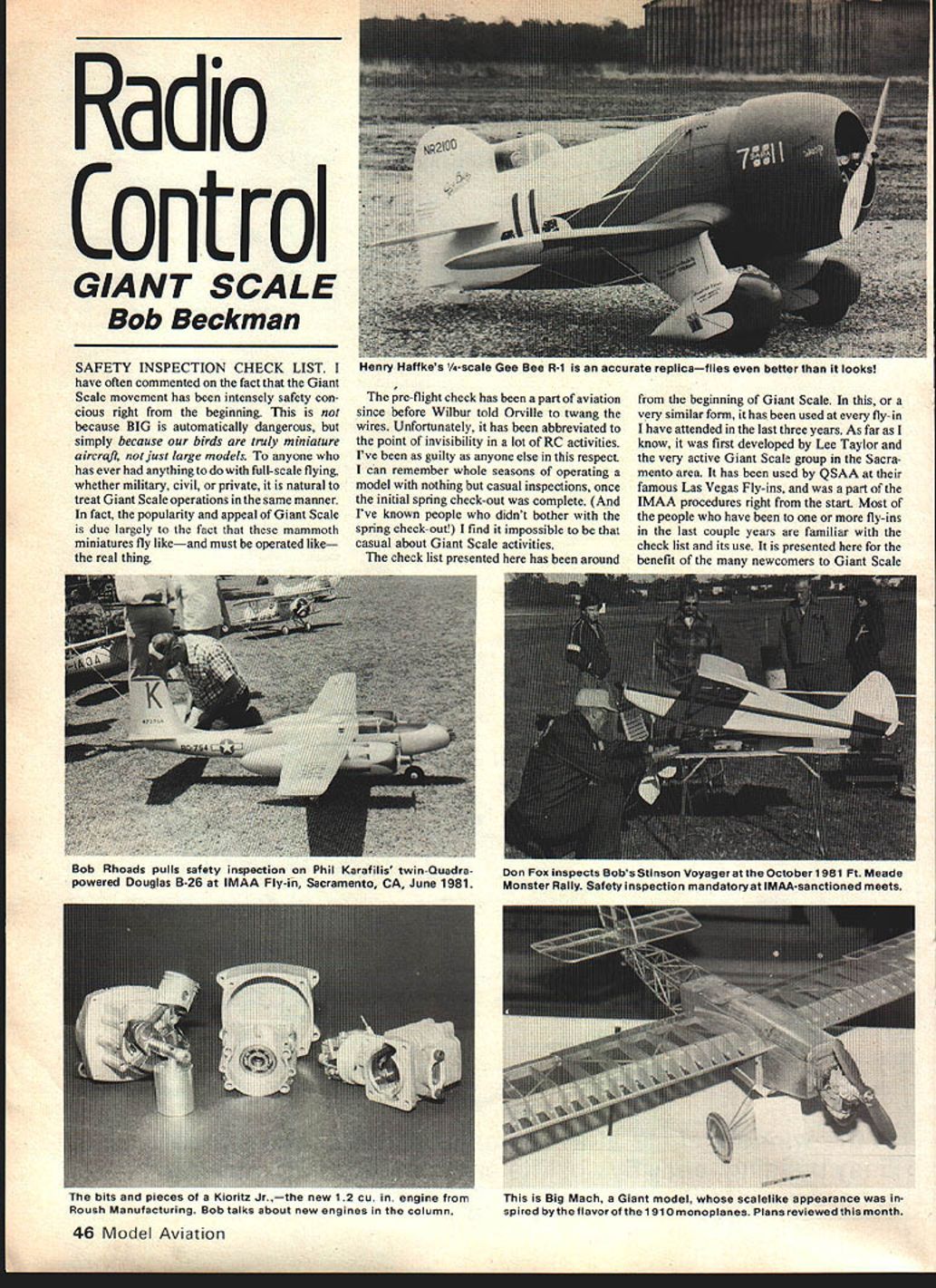
Gee Bee R-1
Henry Haffke sent a picture of his quarter-scale R-1 racer. The model is accurately scaled with no changes to areas, airfoil, or moment arms. Naturally, many said it would never fly, but like the original it proved them wrong. At last year's Bealeton meet it was a show-stopper. It was only one point behind the leader after static judging and then posted the highest flight score.
Power is a Webra .91 with a Martin Industries carb and a Rev-Up 16-4½ prop. Span is 75 in., dry weight 14 lb. The model is built up of balsa and ply, with a plastic cowl and wheel pants. Finish is white Permagloss with red Permagloss trim; the only paint is on the plastic parts.
New engines coming
Remember when there were only three or four really big (2 cu. in. and up) power plants advertised, and the Quadra was about the only gasoline engine you might see in a shop? In the past year we've put more than a dozen engines through the Big Banger test program, and more are on the way. New engines are popping up everywhere. Some are in the larger categories (4 cu. in. and up), and we are starting to interface with the powered-hangglider people where engines from 4 cu. in. on up are being used.
Many new units are in what I consider a more reasonable range for our use—2 to 4 cu. in. Engines are being introduced with physical dimensions close to the Quadra and about the same weight, but with half again or twice the displacement. Aircraft that were marginal with a Quadra may get a new lease on life with these engines.
The IMAA field in Sacramento now sees three times as many big airplanes as it had two years ago. The trend seems toward larger, but not necessarily heavier, models—better finished, cleaner, and often more scale. As with everything else, you pay for what you get. There aren't many of the new engines under $150, and most are more expensive.
Another installment in the Big Banger series is in preparation. Once we get a break in the weather so we can make test runs, we'll have data on four new engines, with four more already in sight.
Monster Mooney
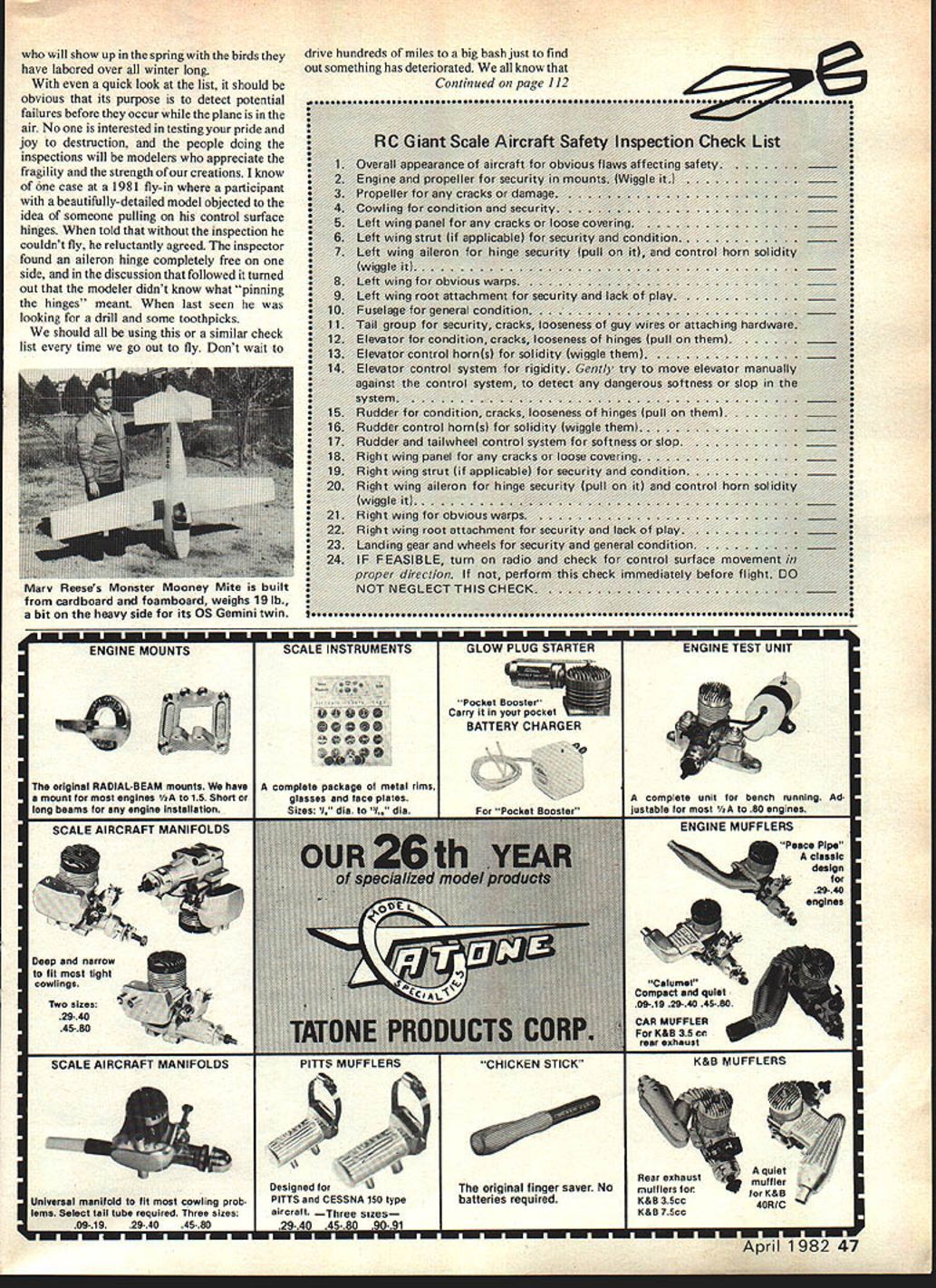
Marv Reese of Wichita, KS sent a picture of his Mooney Mite, which uses "a new method of construction: cardboard for the fuselage inner structure, then sliding on foamboard formers for the shape, then stringers, then topped with balsa sheeting." The model in the picture is "entirely of cardboard and foamboard," so I assume the outer covering is foamboard rather than balsa. It flies well, but at 19 lb. is underpowered with a Gemini engine. His second one is under construction, 15% smaller and with balsa sheeting. He is enthusiastic about the construction method because "the fuse is straight for a change... light... strong... and cheap."
Marv mentioned their Jumbo Fun-Fly scheduled for May 1–2, 1982 at Beech Field, Wichita, KS. The flyer says, "This is not a contest! You don't even have to fly if you don't want to. This is a show and tell... a bull session about big aircraft... a totally unscheduled fun-fly..." Their definition of Jumbo: biplanes must have at least 60 in. wingspan, monoplanes 80 in., ducted fans must have minimum fuselage length of 72 in. A list of probable participants includes a cardboard Quickie 2000, an electric-powered 9-ft. Cub, and several ducted fans. For more information write: Marv Reese, 9050 Harvest Ct., Wichita, KS 67212. It would be polite to include a SASE.
Lead time
This is a good time to point out the lead time required to get an announcement like Marv's into my column. At the time I was writing this it was around the first of January. It will appear in the April issue, which you should see early in March. That is barely in time for people to make plans to attend a May 1st affair. I got Marv's letter in mid-December, which gave me time to plan for its inclusion in this column.
What it boils down to is you have to get the word to me at least five months before your scheduled date; six months would be better. I know that sounds unreasonable, but those are the facts of life in magazine publishing.
Plan review
This month I'm taking a look at some plans from BIZCAP Plan Service, 1408 Morris, Saginaw, MI 48601. At the 1980 Toledo show, Tom Keeling (T & D Fiberglass) had a Quadra-powered Antic-line model called Big Mach hanging in his booth. When asked about it, he told me it was by L. A. Bissonette and that plans were available. A few months later I got a set of plans from Mr. Bissonette (BIZCAP), including a flyer listing more plans such as 1/6- and 1/4-scale Piper PA-18 Super Cubs.
Now, 25 years ago I was flying 8-ft. and 9-ft. RC models loosely based on the Piper SuperCruiser and flying a full-scale SuperCruiser every chance I got. At that time the term Super Cub referred to the clipped-wing J-3's used for acrobatics. In recent years I've heard people talk about Super Cub models that looked like SuperCruisers to me. I mentioned this to Bissonette and he wrote back saying the model was intended to be a SuperCruiser; he had made provisions in the plans for both extended and clipped wings. His PA-18 plans are scale-ish and well thought out.
BIZCAP's quarter-scale PA-18 spans 106 in., is 68 in. long, and weighs about 18 lb. with a Quadra. Performance should be good using an 18-8 or 20-6 prop. The drawings are on two sheets (36 in. by about 7 ft.) plus a smaller sheet with some parts outlines. The plans are well drawn and detailed; the airfoil is a narrow section that looks true to scale rather than the fatter section usually seen on models. The external appearance should be very scale-like, particularly the wing with its rolled plywood leading edge and cable aileron drive.
It's not a project for the newcomer. The plans assume techniques and skills beyond the beginner: some welding and/or brazing (especially for the landing gear), many struts and fittings of steel or brass, and working without balsa. An experienced builder of smaller models should have no trouble once accustomed to these materials.
The Big Mach (short for Big Machine) is billed as a 1/4-scale trainer. Construction is relatively simple, and the materials called out are comparatively inexpensive if you know where to get them. Big Mach spans 8 ft.; the one-piece wing makes field assembly simple but may complicate transportation. The fuselage is just under 6 ft. long and is an uncovered framework from the cockpit back—careful work on gussets and crosspieces and a little dark wood stain can make a real showpiece.
Both plans are available from BIZCAP. Big Mach is listed at $16.50.
Transcribed from original scans by AI. Minor OCR errors may remain.

