
Radio Control: Giant Scale
By Bob Beckman
Isolated servo batteries
Anyone getting into Giant Scale soon learns the need for heavy-duty servos that have the power to move large control surfaces. That power requires high current flow from the battery, which in turn means higher-capacity packs. A 500 mAh battery that will power servos in a standard RC model for several flights might not make it through the first flight of a Giant Scale aircraft. Big 1200 mAh (1.2 Ah) batteries are what you usually see in the big birds, and a wise modeler keeps a close eye on their condition.
When high current is being drawn, the battery's output voltage is dragged down. The less charge the battery contains, the greater the voltage change. Eventually the battery could reach the point where its output voltage drops so low it can't force enough current through a motor to make it turn over — the same sickening "click" you get from a car with a dead battery. With servos you'll usually not reach that point because long before then the receiver will have given up and you'll be looking at a pile of splinters.
Receivers tolerate gradual changes in supply voltage; they are designed to operate over the normal discharge range of batteries. Many receivers will operate on three cells, while the usual four-cell pack provides margin for both servos and receiver in standard-size models. In Giant Scale aircraft, with larger control surfaces and much heavier servo loading, that margin can get very thin.
A larger battery helps on a long-term basis by providing the capacity needed and reducing discharge rate, but instantaneous problems can still occur. The highest current drain happens when a servo first starts up. In addition to the load on the control surface, the servo motor takes a lot of current to get running. Once the motor starts turning, the current drops to the level required to move the control. That initial surge is very short but can be very high — larger servos can be on the order of two amperes. Although brief, the surge can drag the battery voltage down by a volt, producing a high-amplitude negative spike on the supply line.
Receivers can shrug off gradual DC supply changes, but a fast spike can mimic the signals the receiver is meant to receive. A spike caused by one servo starting may be interpreted as a command, starting another servo and causing another spike, and so on. The result can be servos chattering back and forth, driving to their limits while legitimate signals are blocked. Radio designers know about this and have implemented measures in some receivers and decoders to minimize such interactions.
Many receivers in use today were designed before we started using large servos. They perform well with smaller servos but can be marginal in Giant Scale applications. The problem may not show up until the battery reaches an otherwise acceptable discharge level, or it may appear only under flight loads that draw a bit more current. In short, it's one of those faults that can happen when everything else seems perfect.
There is work being done to address this. Bill Hershberger, for example, has done design work to prevent interaction between servos, decoders, and receivers. Newer receivers are coming that will be immune, or at least much less susceptible, to this problem.
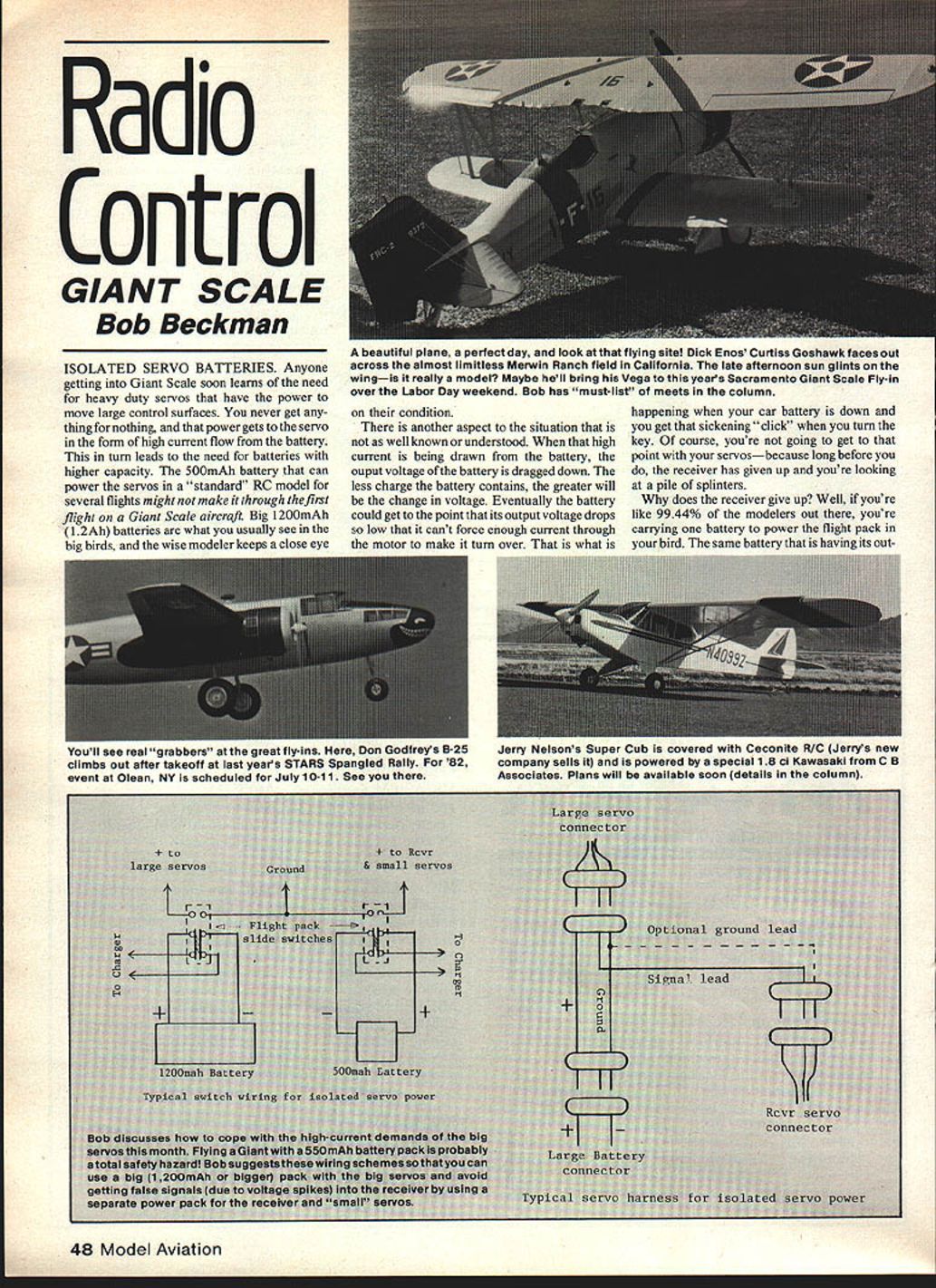
If you can't or don't want to replace your gear, there is a fairly simple and inexpensive way to avoid the problem. The interaction is caused by glitches on the power supply line. If you provide a separate power source for the receiver, the glitches won't enter the receiver via the supply. Practically, this means carrying a second battery and connecting the system so the receiver has its own supply. The second battery doesn't have to be large; a standard 500 mAh flight battery will do, and it can also power smaller servos used for light loads such as throttle.
Disadvantages:
- You may need an extra switch (and must remember to turn both on) or a good-quality three-pole switch.
- You will need special cables that are a bit more complex than a simple Y-harness.
- You have another battery to keep charged.
In my opinion the advantages far outweigh these disadvantages.
An example is my Stinson Voyager installation: I'm using three 500 mAh batteries — one for the two 20H aileron servos, one for the 20H elevator and rudder servos, and a third powering the receiver and the bantam-size flap, throttle and ignition servos. I do not recommend this exact arrangement for everyone; not all 500 mAh batteries can handle the peak currents involved. In future installations I plan to use 1.2 Ah packs in place of the first two small batteries. The receiver I used had given good service in small models, but when I first drove the 20H servos from it I had trouble. With only one large servo and several small ones everything was fine with fresh batteries; add another large servo or let the batteries weaken a bit and everything started jittering and range dropped drastically. With the split-battery arrangement the system has been solid as a rock.
I also use long servo cables in that plane. The aileron servos are at the end of about five feet of cable. I use three-conductor shielded cable with the shield grounded at the receiver end only. So far I have seen no indication of problems despite many dire predictions.
Ceconite covering
Ceconite has become the most widely used fabric for full-scale aircraft. Several fabrics similar to Ceconite have been used for Giant Scale applications, but none match all of its features. One of the most important advantages of genuine Ceconite is its controlled shrinkage with heat. The amount of shrinkage is proportional to the heat applied, with a maximum of 10% at 400°F. However, the shrinking process doesn't start until about 200°F, so you don't have to worry about unwanted shrinkage on a hot day. This controlled behavior is one reason Ceconite is FAA approved.
Genuine Ceconite fabric is now available under the name Ceconite R/C. This is the lightweight grade used for control surfaces on full-scale aircraft. Its closer weave is a good quarter-scale approximation of the standard grade used for most purposes, making it an extremely realistic fabric for Giant Scale models. The material is available from Jerry Nelson & Company: 3510 San Mateo Avenue, Reno, NV 89509.
Jerry Nelson is not new to modeling. He has been an active competitor and innovator for many years. I first met Jerry about 25 years ago when he was in his early teens. He went on to help establish some of today's popular RC activities and has been associated with the business side of the hobby all his adult life. He is now concentrating on Giant Scale and supplying related needs.
For use with Ceconite R/C, Jerry offers an adhesive and a unique water-based filler. These products are used on full-scale aircraft and carry FAA approval. He will also be offering aircraft-quality fiberglass cloth, drawn from full-scale use. All of this underscores how much our Giant Scale birds resemble "real" aircraft.
Jerry will have additional offerings for Giant Scalers, starting with plans for a 1/4-scale Super Cub and a 1/3-scale Corby Starlet C1-1.
Fly-in dates
- April 16–18 — Arkansas Jumbo Fun Fly, Petit Jean Mountain State Park, Morrilton, AR. Sponsored by Budweiser and intended to become a major annual event. Details: Wendel and Glenda Roberts, #9 Timber Valley Cove, Little Rock, AR 72204. Phone (501) 224-4278.
- July 1–5 — Bawlf, Alberta, Canada. Organized by Dick Phillips ("Big is Beautiful"). For more info write: Dick Phillips, 9 Geneva Crescent, St. Albert, Alberta, Canada T8N 0Z3. Note: use a U.S. stamp with the price marked on it — C.O.D. will not be accepted by the Canadian postal system.
- July 10–11 — STARS Spangled Scale Rally, Olean, NY. The STARS annual scale rally is open to any scale RC model, and over the years it has become the most prestigious Giant Scale ...
Transcribed from original scans by AI. Minor OCR errors may remain.

