

Radio Control: Giant Scale
By Bob Beckman
Letter (excerpt) from Dr. Cyrus J. Stow
"Dear Bob: If a fellow modeler wishes to fly an RC aircraft that weighs nearly as much as a full-grown adult human being (see your June MA issue regarding that model B-29), I don't wish to stop his endeavor. However, I believe very strongly that model aircraft controlled merely by glitch-vulnerable radios and which fly faster than I am permitted by law to drive my own automobile on public highways, and which also weigh more than five baseball bats or as much as a typical standard-size Chevrolet spare tire and rim, have no rational basis in our model aircraft activities whatsoever—these monsters are too dangerous and present an unacceptable risk to everyone within their potential flying range.
'Being hit with one baseball bat is dangerous enough, my friend, but can you imagine the damage that some flying object 10 or more times a baseball bat's weight can do to either a human skull or human vertebrae? Should just one innocent spectator at some flying meet become permanently paralyzed upon being struck by one of these over-sized "giant scale" monsters, is that an outcome we can accept in the pursuit of fun? Personally, I think any flying RC model in excess of 10 pounds is just too deadly to permit: we all owe something to the well-being and safety of other human beings.
Sincerely, Cy' (Dr. Cyrus J. Stow, 2195 Rockdale Drive, Conyers, GA 30207.)"
Response and overview
Cy's attitude, new to many of you, has been running ever since I became interested in Giant Scale. Almost invariably people who feel the way he does have two things in common: they have not intended to build or fly Giant Scale aircraft and they know little or nothing about actual Giant Scale practices and operations. They seem to extrapolate what they have seen on familiar, normal-size models on the basis of size and weight and arrive at tremendously increased risks by comparison. I would agree we would not operate Giant Scale aircraft in the manner normal RC models would—to do so would be like driving a car down the wrong side of a busy highway.
Right from the start, organized Giant Scale activities have been highly safety conscious. A few months ago I published a Safety Checklist that has regular use by Giant Scalers. In some five years I know of no other non-competitive modeling activity with such stringent safety standards; few competitive events can match. We recognize models as the interface between modeling and full-scale aircraft and maintain and operate them like real airplanes. In fact, Giant Scale's safety record has been good. The AMA recently was able to remove the previous 40-pound weight limit with regard to insurance coverage. I know of no injury sustained by a spectator or flier, no matter how you count being bitten by one's own prop, during organized Giant Scale activity.
Let's consider the risks Dr. Stow is concerned about. He doesn't have an apparent background in weights of things like baseball bats or automobile wheels. I accept the analogies, but I doubt very much he would really be able to tell the difference between being hit by a baseball bat traveling 60 miles per hour and five of the same at lower speed, or the chance of a Chevrolet wheel or tire suddenly appearing and striking down a remote spectator. The latter is so remote that I seldom worry about it.
Risk analysis
Risk is composed of two factors that, for this discussion, I will label "seriousness" and "probability." The amount of risk in any situation can be considered as the product of the two factors. An event with serious consequences and high probability represents a high risk. Infinitely serious consequences with zero probability, and 100% probability with no serious consequences both work out to zero risk. In the real world we are always somewhere in between these extremes.
The consequences of any model striking someone are extremely serious, and the injury aspect is only part of the total. Granted that size, speed, weight, etc. can bear on the extent of potential injury, with any type of model you quickly get to the point where seriousness is so high that any further increments are meaningless. That means the true measure of risk is going to be in the probability aspect.
If we leave the model on the ground and don't even fire up the engine we can reduce the probability to very nearly zero. You never hear anyone suggest that solution for the models he is interested in building and flying. Let's face it: we're all in this hobby to operate—and/or watch the operation of—miniature aircraft, whatever their size, and it is the way in which we operate which determines that probability factor.
If we break things down a little further, we can say the risk hinges on two probabilities:
- the probability of the aircraft crashing, and
- if it does, the probability that people or property will be involved.
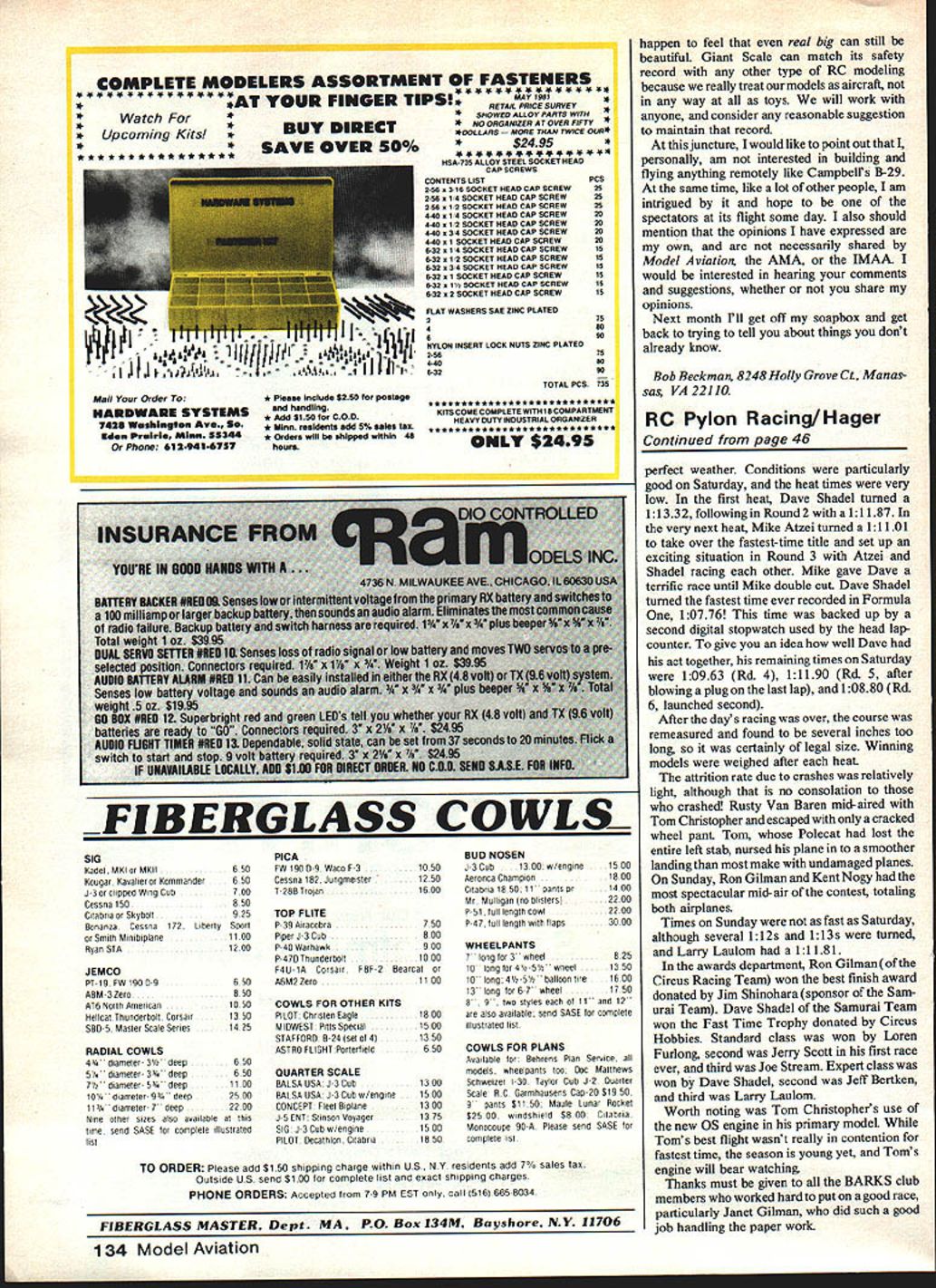
If we go out by ourselves to the middle of a desert to do our flying, we can reduce the second probability to almost zero, and we have already accepted the risk to ourselves. This is not a bad idea for the initial flight of state-of-the-art projects like Bob Campbell's B-29. In fact, every such project that I know of has been handled exactly that way. I don't necessarily mean a literal desert, just some facility with space enough to allow plenty of leeway for the uncertainties of an untested airplane.
Examples of test flights and safety precautions
Here are some examples I witnessed or know of during the past year or so:
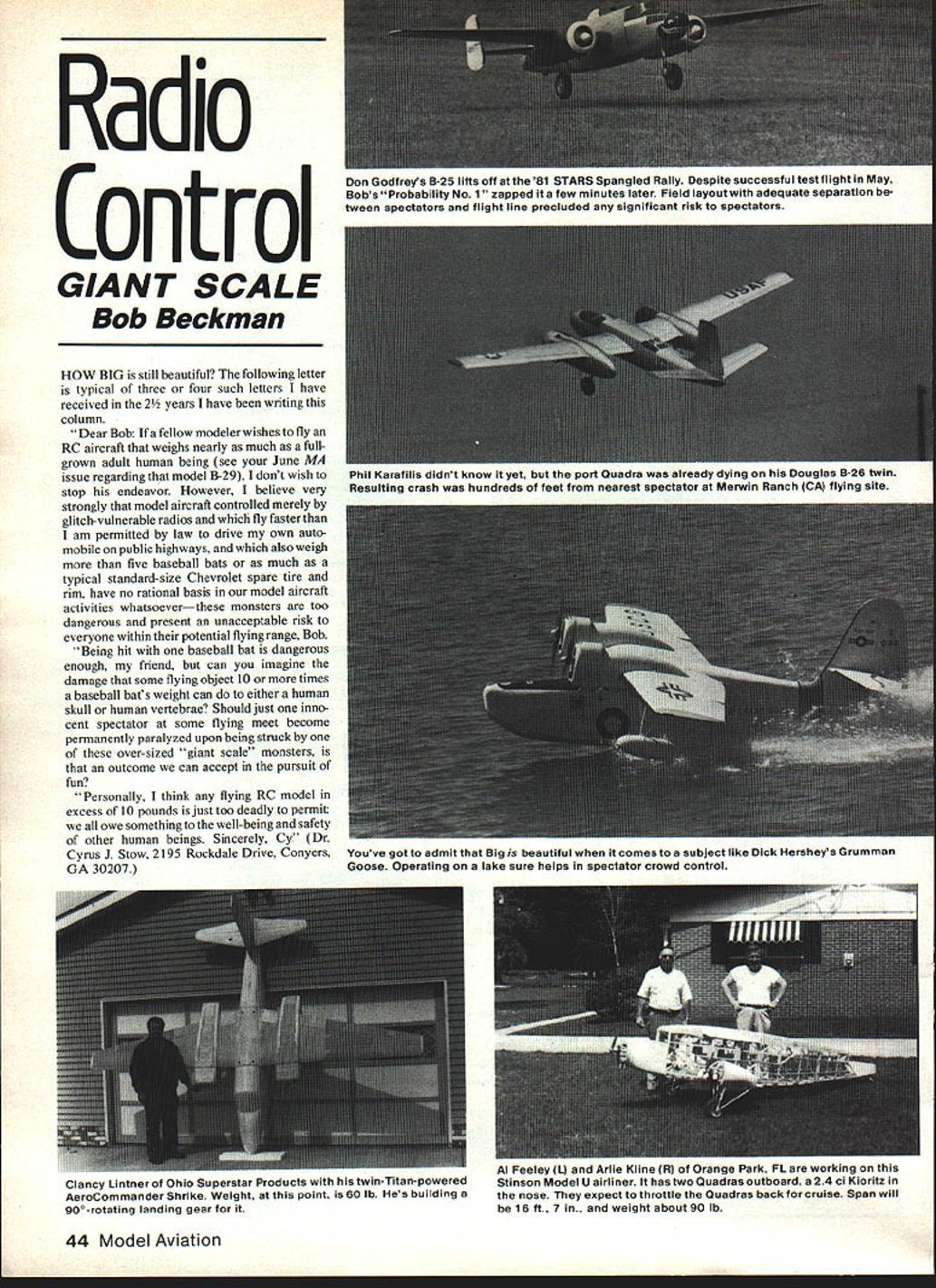
- In May of 1981, Don Godfrey test flew his B-25 at an inactive airport near Scranton. The test flights were successful, and at no time was there any significant risk to the small number of people present.
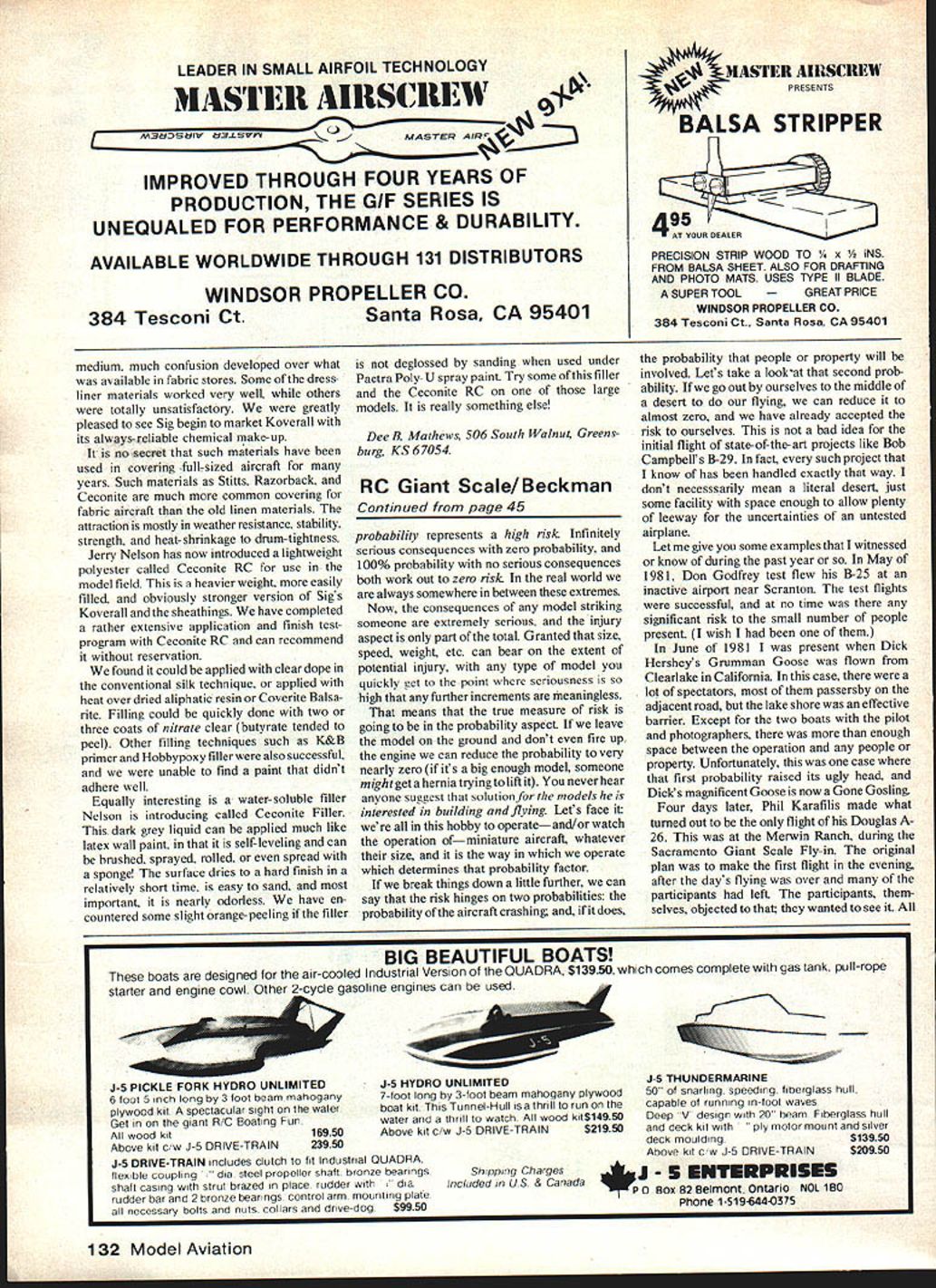
- In June of 1981 I was present when Dick Hershey's Grumman Goose was flown from Clearlake, California. In this case there were a lot of spectators, most of them passersby on the adjacent road, but the lake shore was an effective barrier. Except for the two boats with the pilot and photographers, there was more than enough space between the operation and any people or property. Unfortunately, this was one case where the aircraft was lost—the Goose is now a "Gone Gosling."
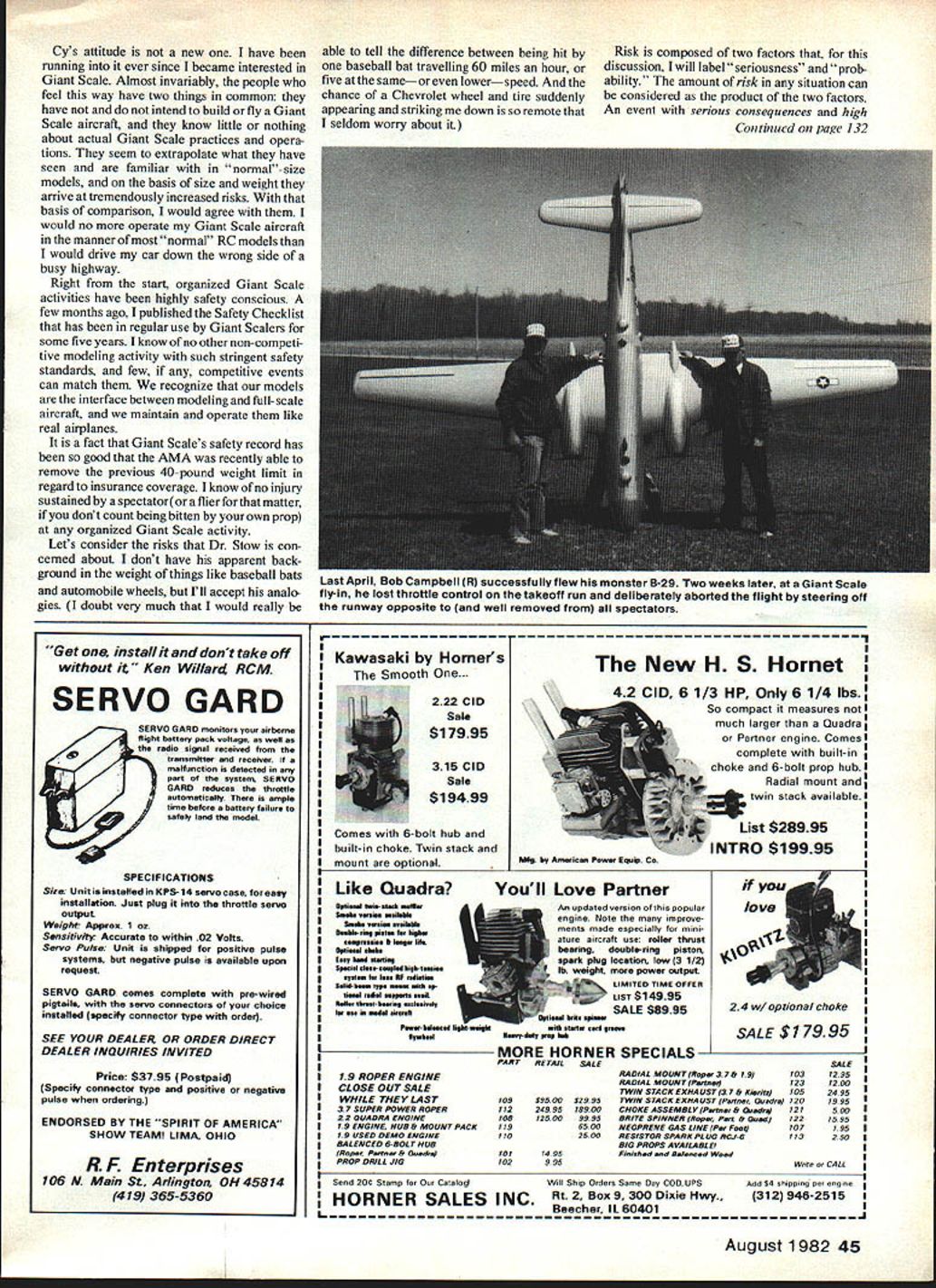
- Four days later, Phil Karafilis made what turned out to be the only flight of his Douglas A-26 at the Merwin Ranch during the Sacramento Giant Scale Fly-In. The original plan was to make the first flight in the evening, after the day's flying was over and many participants had left. The participants themselves, however, wanted to see it. All other flying was suspended at noon, and the flight line was cleared. (That flight line is 300 feet from the pits and spectators, with a half mile or more of clear, flat field out in front.) Phil experienced an engine failure just after liftoff, but probability of people being involved had been cut down to almost zero, so the overall risk was low.
- On April 18, 1982, Bob Campbell flew his B-29 for the first time. This flight was at a full-scale airport, with few people present and far from other activities. Those first flights were completely successful, and with the second probability kept low, the risk was minimal.
These are just illustrations of the kind of care typical Giant Scalers have exhibited with projects that prompt the concerns like Dr. Stow's letter.
Crowd control and safety rules
Once the first testing is successful, owners will want other people to see their creations, and many people will want to see them. After all, our hobby is really a spectator sport. This means the second of our two probabilities has increased, but the first one is much lower. We can never get the probability of a crash down to zero, so it behooves us to keep probability No. 2 as low as we can, and that boils down to crowd control.
The AMA has lifted its 40-pound limitation for insurance purposes (as opposed to any competition rules). It did, however, include a condition: any aircraft over 20 pounds must abide by the rules for Air Show Team operations. What this boils down to is that you must establish a flight line, and all flight operations must stay on one side of that line and all spectators on the other. This is a good step toward the crowd control we need, but most Giant Scale operations go a bit further and specify a minimum distance (usually 100 ft.) between the spectators and the flight line.
Some outstanding examples of safe, well-controlled operations are the fly-ins at the Merwin Ranch in California and the STARS Spangled Rally in Ocean, NY. In both cases, the flight line is some 300 ft. from the pit and spectator areas, and the separation is enforced.
There are many otherwise good flying sites that just do not have the space to have that much separation. In my opinion, it is not needed for the average Giant Scale aircraft. What is that average? Off the top of my head:
- single-engine,
- weighs 25 to 27 pounds,
- has a wing loading three-quarters to one-half that of the "normal" sport and pattern models,
- flies more slowly than they do, and
- is much more stable.
Such aircraft can be operated just as safely as any "normal" model, and on the basis of my observations they usually are operated more safely.
I think a reasonable minimum separation of flight line and spectators for any RC model would be 50 to 75 ft. By "any" I mean all models from 1/4A up to Giant Scale, with an upper weight limit of 30 to 40 pounds. Beyond that weight limit, whatever it is, the minimum separation should be increased to keep the risk down by keeping probability No. 2 low. I think the people who build the larger, and especially multi-engine, aircraft will agree with that. Those with whom I have talked won't even consider flying their creations unless they have conditions roughly similar to what I am describing.
Closing thoughts
Some of the people decrying Giant Scale aircraft as dangerous monsters seem to be using the same arguments that were heard about half a century ago when an effort was made to legally ban those abominations that used gasoline engines instead of honest rubberbands. We aren't unfeeling ogres who ignore the rights and safety of other people! We are simply modelers who happen to feel that even real big can still be beautiful. Giant Scale can match its safety record with any other type of RC modeling because we really treat our models as aircraft, not in any way at all as toys. We will work with anyone and consider any reasonable suggestion to maintain that record.
At this juncture, I would like to point out that I, personally, am not interested in building and flying anything remotely like Campbell's B-29. At the same time, like a lot of other people, I am intrigued by it and hope to be one of the spectators at its flight some day. I also should mention that the opinions I have expressed are my own, and are not necessarily shared by Model Aviation, the AMA, or the IMAA. I would be interested in hearing your comments and suggestions, whether or not you share my opinions.
Next month I'll get off my soapbox and get back to trying to tell you about things you don't already know.
Bob Beckman 8248 Holly Grove Ct. Manassas, VA 22110
Transcribed from original scans by AI. Minor OCR errors may remain.

