
Radio Control: Giant Scale
Bob Beckman
REDUCING THE RISK
I'm not going to devote this whole column to the subject, but from time to time I plan to talk about what we can do to reduce the risk of injury—to ourselves as well as others—when operating our Giant Scale aircraft. Last month I defined "risk" as the product of "seriousness" and "probability," and expressed my opinion that the seriousness of any RC model striking someone is high enough that increments due to the size or weight of the model have little meaning. Since seriousness can't be reduced, if we are going to reduce the risk it has to be by reducing the probability.
The probability of injuring someone else has two factors: the probability of the plane crashing or otherwise operating out of control (Probability No. 1), and the probability that, if it happens, the plane will strike someone (Probability No. 2). For now, let's talk about Probability No. 1.
Once an aircraft has been checked out and is past its initial test flights, one of the most common causes of control failure seems to be battery failure. I'm not talking about the battery not being charged properly—that's operator error—I'm talking about catastrophic failure in flight when all previous indications have been normal. Although I don't think this happens as often as people say, it can and does happen. (I also take it with a grain of salt when someone flies a plane into the ground and hollers "interference.") The point is that the probability of battery failure causing a crash can be reduced, thereby reducing the risk involved in flying our big birds—or any RC aircraft.
Full-scale practice commonly employs redundancy to reduce the probability of failure of vital functions: two and sometimes three identical or similar systems are installed so that failure of one system does not result in loss of the function. A prime example in reciprocating-engine planes is the installation of two magnetos; either one can run the engine. The same principle can be and has been used in some RC models—and this is an area where our Giant Scale birds have a real advantage. You never get anything for nothing, and one of the ways you pay for redundancy is in weight. Larger airframes have a larger load capacity and can handle extra weight in safety.
One example of redundancy is the dual-battery system first developed, I believe, by George Steiner in California. This involves carrying two batteries that are connected to the radio through a circuit which can detect a failure in one battery and switch to the other. In addition to the weight, you pay for the extra battery and the switcher, but the cost is small in terms of the reduction in Probability No. 1.
Bob Siegelkoff of C.B. Associates has for several years been using another form of redundancy that, in my opinion, is even better. It's also more expensive, but that's often the way. Bob doubles up on everything—two batteries, two switches, two receivers, and two servos on every control surface. The receivers are tuned to the same frequency and respond to the same transmitted signal. The flight-control servos are linked mechanically so that each servo contributes to driving the control surface, but either servo could stop in any position and the other could bring the control surface back to neutral. The throttle servo is on one receiver and the ignition switch is on the other so at least some engine control is maintained.
Neither of these redundancy schemes guarantees complete control at all times, but they do significantly reduce Probability No. 1, which in turn reduces the risk involved in pursuing our hobby. Let's face it—the only way RCers are going to reduce the risk to zero is to take up needlepoint instead, and the probability of sticking a needle in my thumb is too high for me to go that route.
Bob Beckman 8248 Holly Grove Ct., Manassas, VA 22110
Sig Cubs
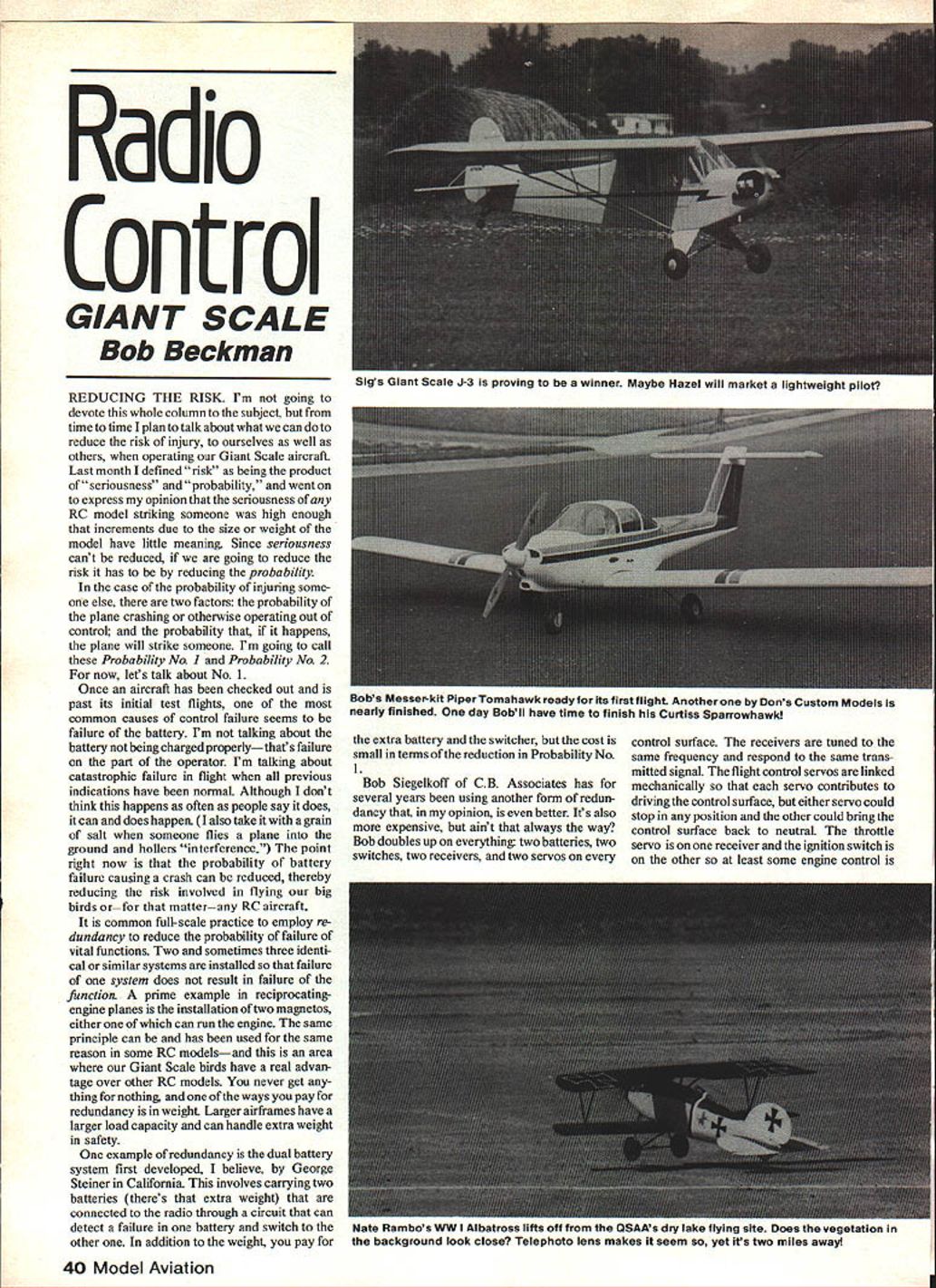
Sig's two Giant Scale Piper Cub kits, the J-3 and the clipped-wing version, have been available for only a few months now, and I'm hearing good things about them already. I watched Maxey Hester fly the prototype of the clipped-wing model back in 1979 at the QSAA Las Vegas bash. It looked pretty good then, but they spent a couple more years on it before they felt it was really ready.
I haven't actually seen the kits yet, but I recommend them. Over the years I've built a lot of Sig kits, and I've never gotten a bad one. In fact, I've never gotten one that wasn't downright outstanding. I still remember the Liberty Sport I built in 1974 as being my most pleasurable modeling experience in almost 50 years of balsa hacking. There is no reason to think Sig's Giant Scale efforts would be any different.
QSAA Fly-in
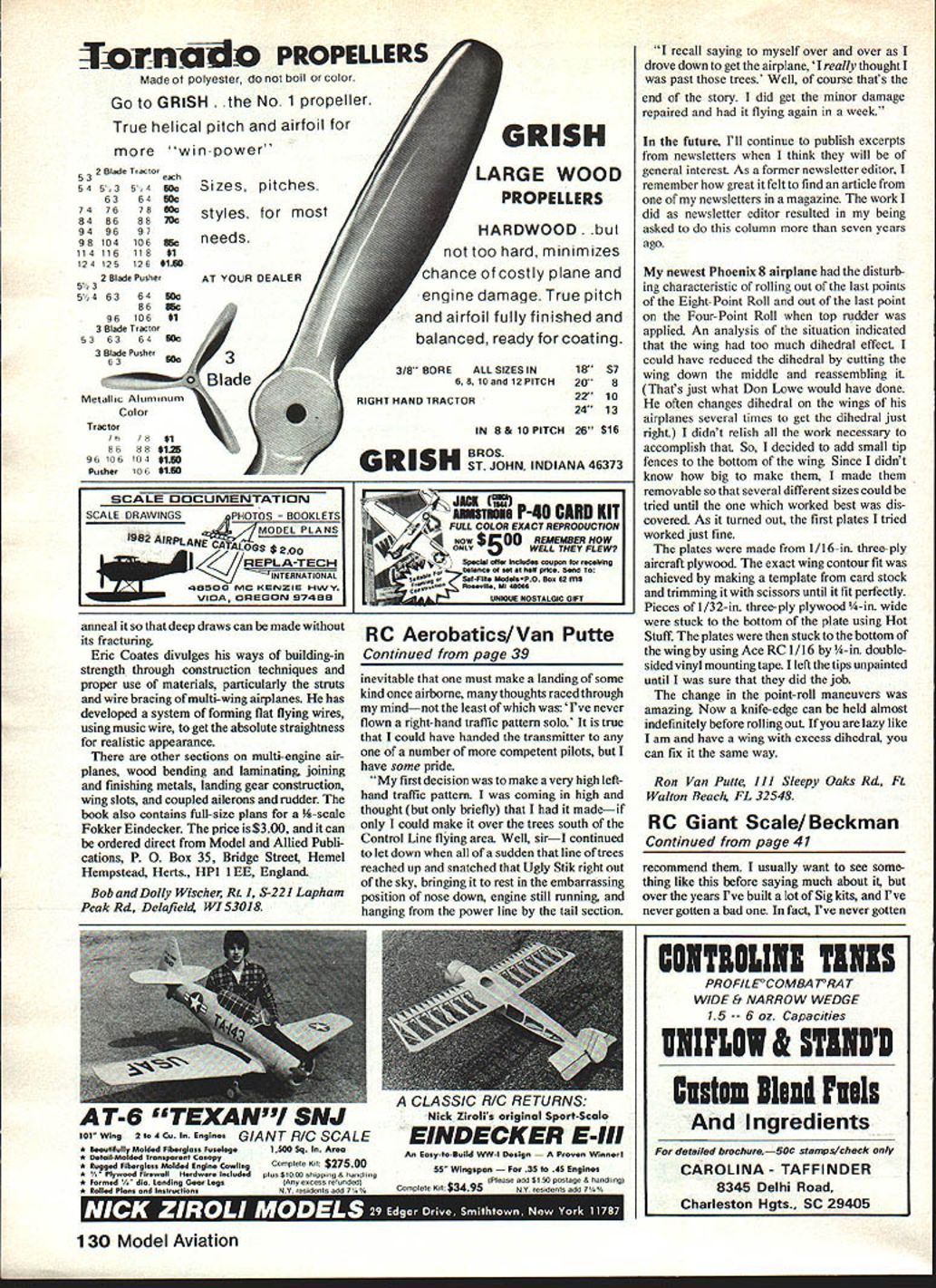
Speaking of QSAA, their 6th Annual Fly-in is set for October 28–31. Headquarters is the Showboat again, but the flying is moved back to the dry lake. Despite the dust, that's one of the finest big-bird flying sites around. Registration deadline is September 27, and only the first 200 airplanes will be accepted. Room reservations at the Showboat must be made before September 20. For more information write to:
Pat Bunker 6532 Bourbon Way Las Vegas, NV 89107
IMAA Fun-Fly Festival
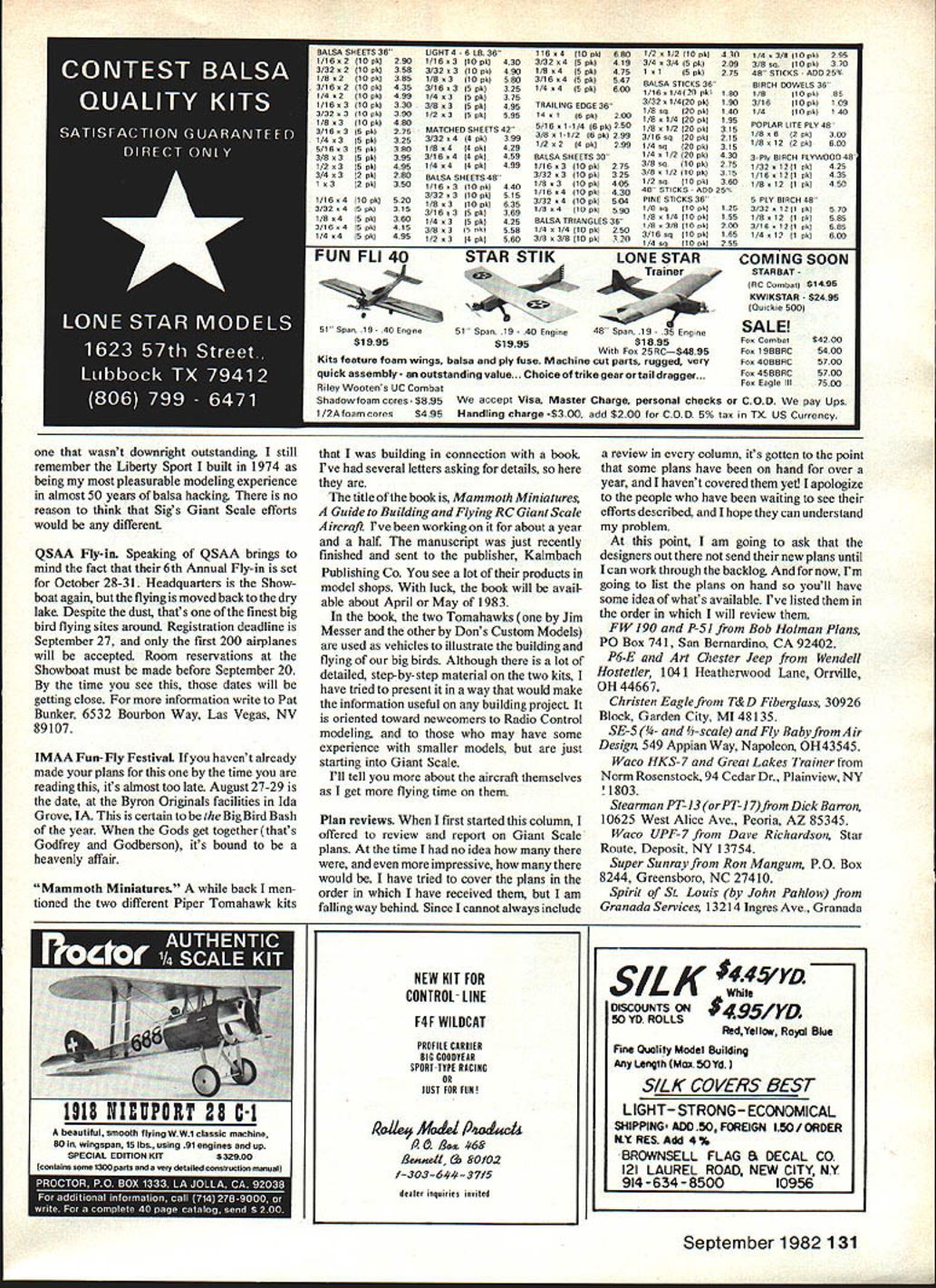
If you haven't already made your plans, it's almost too late. August 27–29 is the date, at the Byron Originals facilities in Ida Grove, IA. This is certain to be the Big Bird Bash of the year. When the Gods get together (that's Godfrey and Godberson), it's bound to be a heavenly affair.
"Mammoth Miniatures"
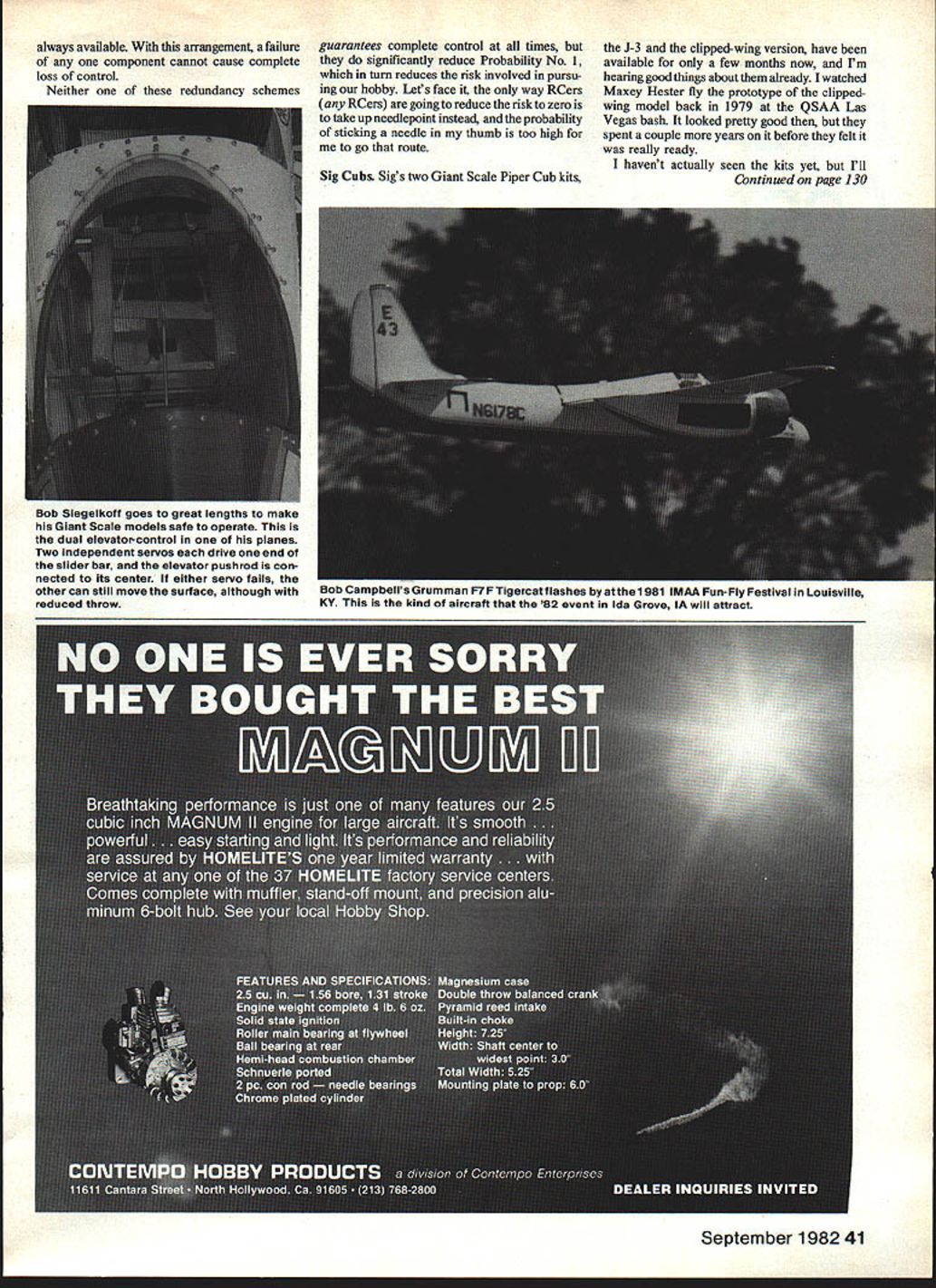
A while back I mentioned the two different Piper Tomahawk kits that I was building in connection with a book. I've had several letters asking for details, so here they are.
The title of the book is Mammoth Miniatures: A Guide to Building and Flying RC Giant Scale Aircraft. I've been working on it for about a year and a half. The manuscript was recently finished and sent to the publisher, Kalmbach Publishing Co. With luck, the book will be available about April or May of 1983.
In the book, the two Tomahawks (one by Jim Messer and the other by Don's Custom Models) are used as vehicles to illustrate the building and flying of our big birds. Although there is a lot of detailed, step-by-step material on the two kits, I have tried to present it in a way that would make the information useful on any building project. It is directed toward newcomers to radio control modeling, and to those who may have some experience with smaller models but are just starting into Giant Scale.
I'll tell you more about the aircraft themselves as I get more flying time on them.
Plan reviews
When I first started this column, I offered to review and report on Giant Scale plans. At the time I had no idea how many there were, and even more impressive, how many there would be. I have tried to cover the plans in the order in which I have received them, but I am falling way behind. Since I cannot always include a review in every column, some plans have been on hand for over a year without being covered. I apologize to the people who have been waiting to see their efforts described, and I hope they can understand my problem.
At this point, I am going to ask that designers not send new plans until I can work through the backlog. For now, here are the plans on hand, listed in the order in which I will review them:
- FW 190 and P-51 from Bob Holman Plans, P.O. Box 741, San Bernardino, CA 92402.
- P6-E and Art Chester Jeep from Wendell Hostetter, 1041 Heatherwood Lane, Orrville, OH 44667.
- Christen Eagle from T & D Fiberglass, 30926 Block, Garden City, MI 48135.
- SE5 (7/8- and 1/2-scale) and Fly Baby from Air Design, 549 Appian Way, Napoleon, OH 43545.
- Waco HKS-7 and Great Lakes Trainer from Norm Rosenstock, 94 Cedar Dr., Plainview, NY 11803.
- Stearman PT-13 (or PT-17) from Dick Barron, 10625 West Alice Ave., Peoria, AZ 85345.
- Waco UPF-7 from Dave Richardson, Star Route, Deposit, NY 13754.
- Super Sunray from Ron Mangum, P.O. Box 8244, Greensboro, NC 27410.
- Spirit of St. Louis (by John Pahlow) from Granada Services, 13214 Ingres Ave., Granada
Transcribed from original scans by AI. Minor OCR errors may remain.

