
Radio Control: Giant Scale
Bob Beckman
Sopwith Triplane
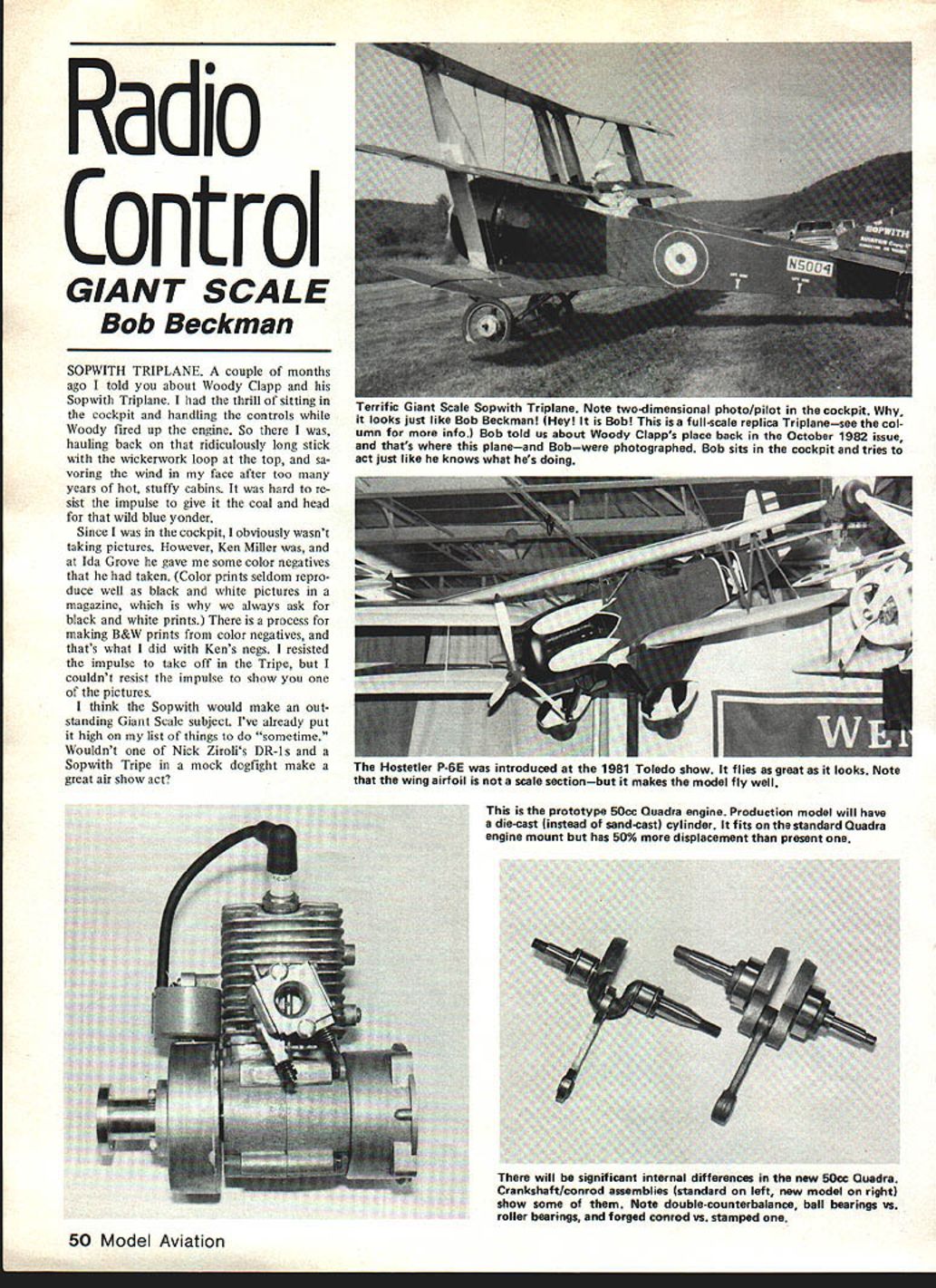
A couple of months ago I told you about Woody Clapp and his Sopwith Triplane. I had the thrill of sitting in the cockpit and handling the controls while Woody fired up the engine. So there I was, hauling back on that ridiculously long stick with the wickerwork loop at the top, and savoring the wind in my face after too many years of hot, stuffy cabins. It was hard to resist the impulse to give it the coal and head for that wild blue yonder.
Since I was in the cockpit, I obviously wasn't taking pictures. However, Ken Miller was, and at Ida Grove he gave me some color negatives that he had taken. (Color prints seldom reproduce well as black and white pictures in a magazine, which is why we always ask for black and white prints.) There is a process for making B&W prints from color negatives, and that's what I did with Ken's negs. I resisted the impulse to take off in the Triplane, but I couldn't resist the impulse to show you one of the pictures.
I think the Sopwith would make an outstanding Giant Scale subject. I've already put it high on my list of things to do "sometime." Wouldn't one of Nick Ziroli's DR-1s and a Sopwith Triplane in a mock dogfight make a great air show act?
New Quadra
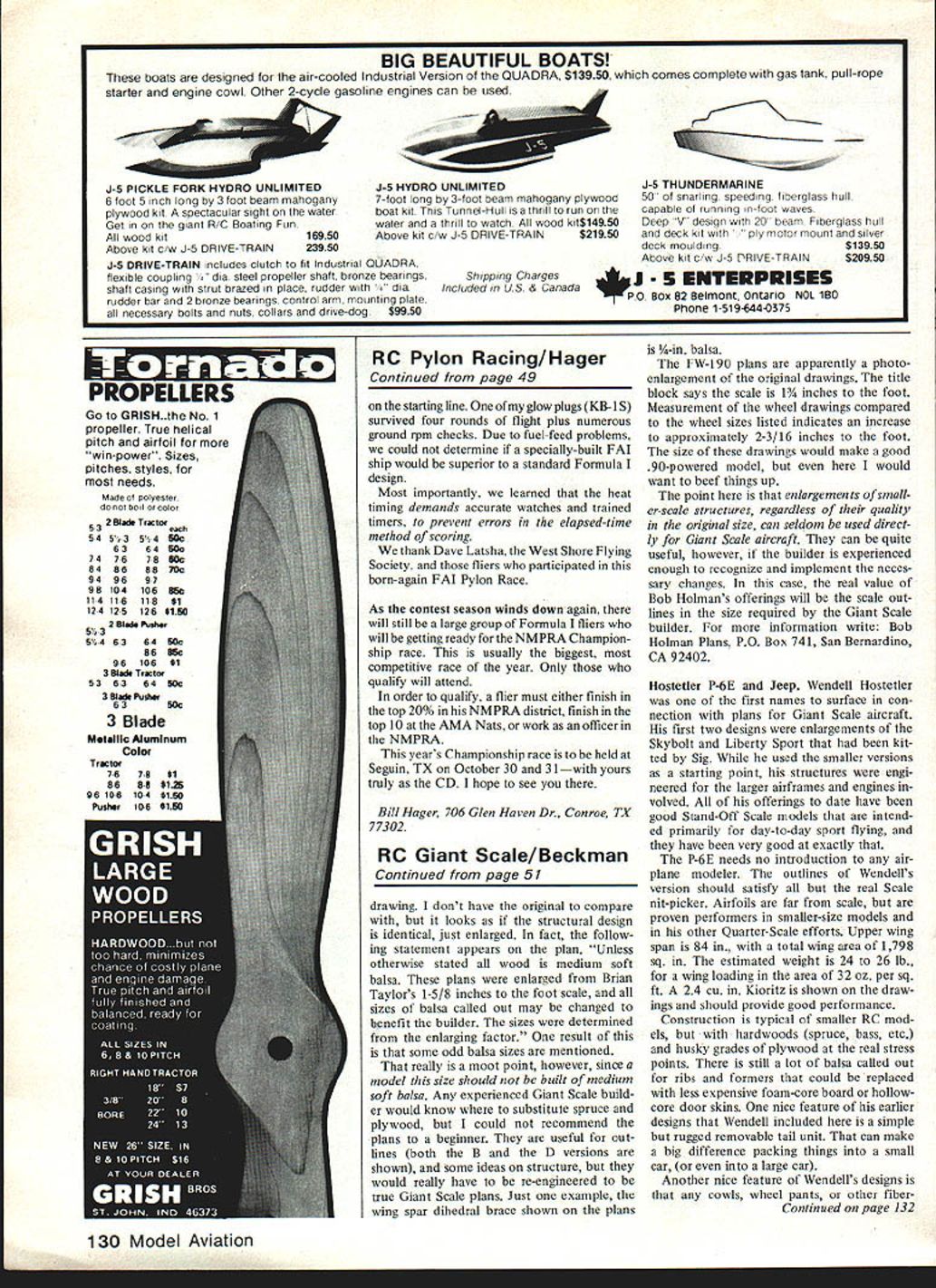
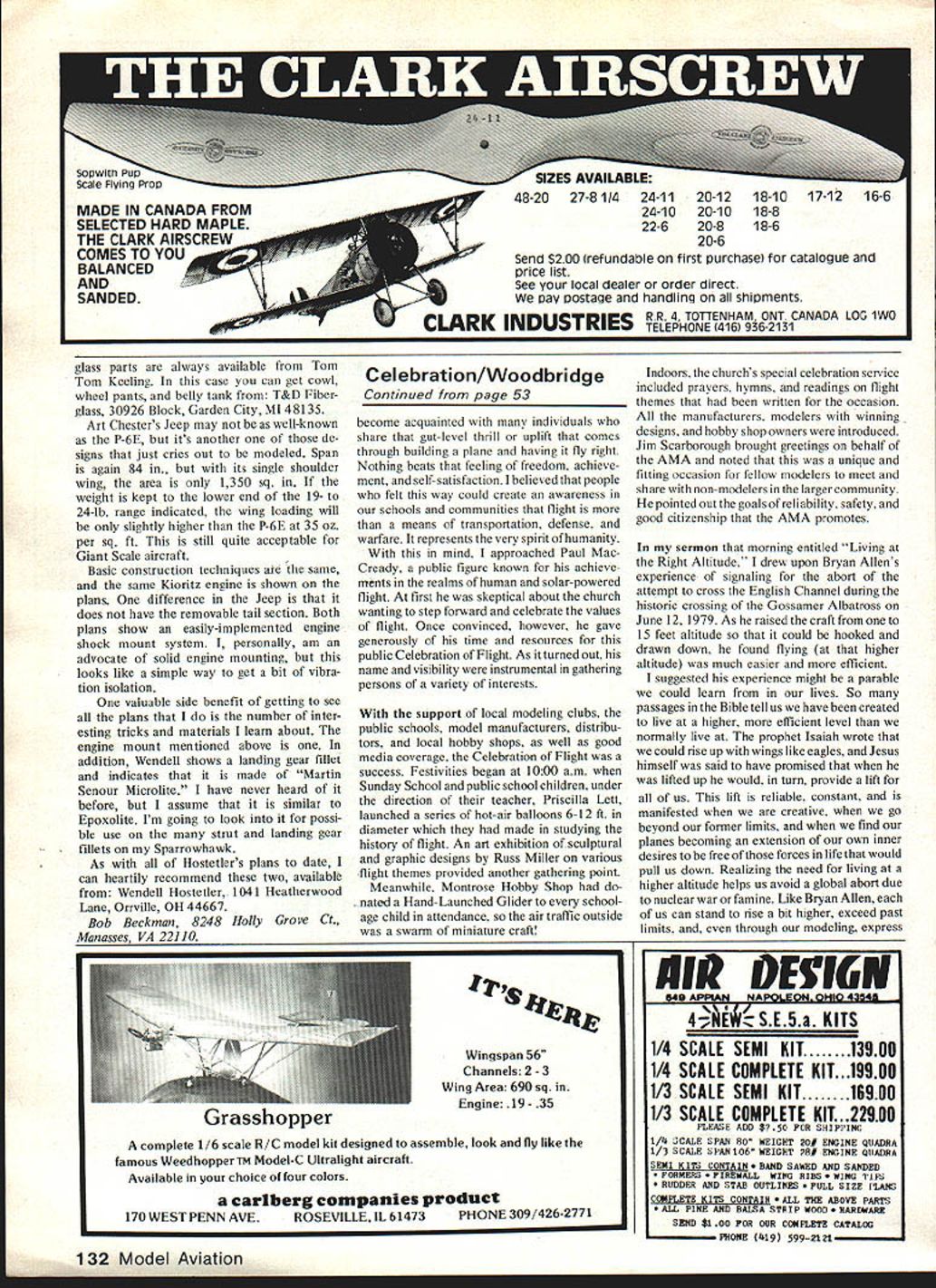
I just got back from a very pleasant and interesting trip to the Quadra factory in Canada. I'll be telling you more about that trip in the near future, but for now I thought you would be interested in the current status of the new 50cc (3 cu. in.) engine.
We've all been waiting for this one, and some overly optimistic estimates of when it would be available have a lot of people wondering if it really exists. Well, it is not yet in production, but it's getting close. The day I was there, the first die-cast cylinder out of the mold was delivered to the engineering department. It is my understanding that this is the last part needed to start production.
Now don't get excited; that doesn't mean that they're ready to start cranking out engines. Engineering will have to assemble and test engines made with these final parts to make sure that everything works as it should. At this stage, the probability is high that it will all come together right. After all, they wouldn't have gone to the considerable expense of making the die if they weren't pretty sure of where they stood.
So where does that leave all of us who are waiting for the new Quadra? If all goes well with the new cylinder casting, I would guess that they will start limited production in about three months. I'm writing this in mid-September, so that means about the first of the year. It will take another two to three months to build up to real quantity production.
Keep in mind that this is my own estimate, not an official statement from Quadra. They're not going to start putting out any engines until they are sure the engines are ready. If problems show up in the new cylinder casting, all bets are off. One thing is certain: when they are ready, Quadra won't be shy about letting us know. All the magazines and their Giant Scale writers will be getting the word and passing it on.
Bob Holman Plans
Bob Holman's name is not unknown to most RC modelers, especially to those interested in Scale models. For some time, Bob has been making available quality RC Scale model plans, many of them from overseas sources. Most of his items are scaled two inches to the foot or smaller, but he has started enlarging some of them to Giant Scale sizes.
Bob sent me two examples of what he can provide. Both were originally Brian Taylor designs — the P-51 and the FW-190. The two plans represent two different approaches to enlargement.
The P-51 is a drafted enlargement. That is, a new pen-and-ink drawing was made, following the original, but increasing all measurements by some factor that results in a quarter-scale drawing. I don't have the original to compare with, but it looks as if the structural design is identical, just enlarged. In fact, the following statement appears on the plan: "Unless otherwise stated all wood is medium soft balsa." These plans were enlarged from Brian Taylor's 1-5/8 inches to the foot scale, and all sizes of balsa called out may be changed to benefit the builder. The sizes were determined from the enlarging factor. One result of this is that some odd balsa sizes are mentioned.
That really is a moot point, however, since a model this size should not be built entirely of soft balsa. Any experienced Giant Scale builder would know where to substitute spruce and plywood, but I could not recommend these plans to a beginner. They are useful for outlines (both the B and the D versions are shown), and the ideas on structure, but they would really have to be re-engineered to be true Giant Scale plans. Just one example: the wing spar dihedral brace shown on the plans is 3/4-in. balsa.
The FW-190 plans are apparently a photo-enlargement of the original drawings. The title block says the scale is 1-1/4 inches to the foot. Measurement of the wheel drawings compared to the wheel sizes listed indicates an increase to approximately 2-3/16 inches to the foot. The size of these drawings would make a good .90-powered model, but even here I would want to beef things up.
The point here is that enlargements of smaller-scale structures, regardless of their quality in the original size, can seldom be used directly for Giant Scale aircraft. They can be quite useful, however, if the builder is experienced enough to recognize and implement the necessary changes. In this case, the real value of Bob Holman's offerings will be the scale outlines in the sizes required by the Giant Scale builder.
For more information write: Bob Holman Plans, P.O. Box 741, San Bernardino, CA 92402.
Hostetler P-6E and Jeep
Wendell Hostetler was one of the first names to surface in connection with plans for Giant Scale aircraft. His first two designs were enlargements of the Skybolt and Liberty Sport that had been kitted by Sig. While he used the smaller versions as a starting point, his structures were engineered for the larger airframes and engines involved. All of his offerings to date have been good Stand-Off Scale models that are intended primarily for day-to-day sport flying, and they have been very good at exactly that.
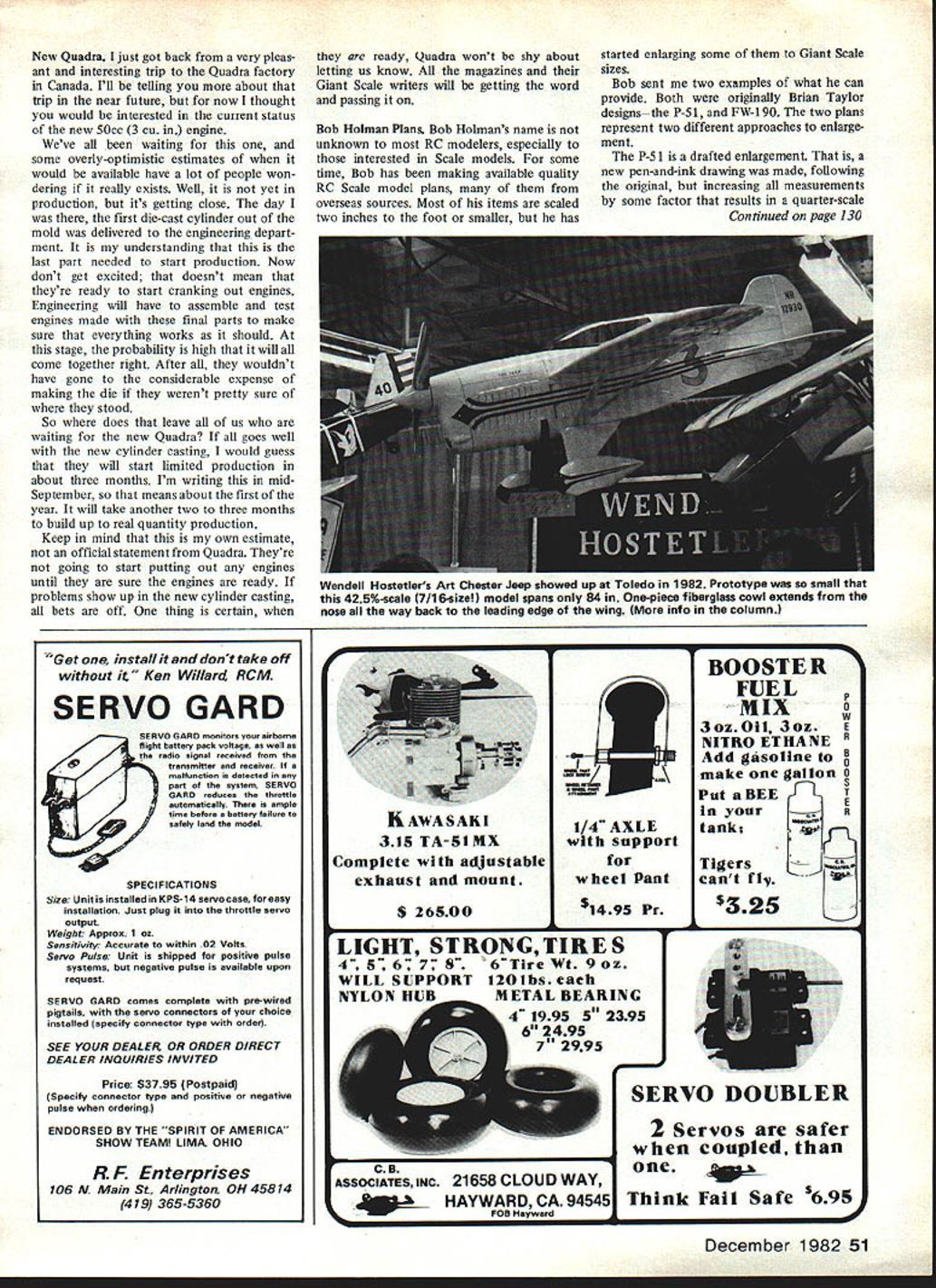
The P-6E needs no introduction to any airplane modeler. The outlines of Wendell's version should satisfy all but the real Scale nit-picker. Airfoils are far from scale, but are proven performers in smaller-size models and in his other Quarter-Scale efforts. Upper wing span is 84 in., with a total wing area of 1,798 sq. in. The estimated weight is 24 to 26 lb., for a wing loading in the area of 32 oz. per sq. ft. A 2.4 cu. in. Kioritz is shown on the drawings and should provide good performance.
Construction is typical of smaller RC models, but with hardwoods (spruce, bass, etc.) and heavy grades of plywood at the real stress points. There is still a lot of balsa called out for ribs and formers and some of the nose and other shapes. One of the major selling points for Wendell's designs is the fact that he included all the structural drawings and part patterns to make construction easier.
Another nice feature of Wendell's designs is that any cowl, wheel pants, or other fiberglass parts are always available from Tom Keeling. In this case you can get cowl, wheel pants, and belly tank from: T & D Fiberglass, 30926 Block, Garden City, MI 48135.
Art Chester's Jeep may not be as well-known as the P-6E, but it's another one of those designs that just cries out to be modeled. Span is again 84 in., but with its single shoulder wing, the area is only 1,350 sq. in. If the weight is kept to the lower end of the 19- to 24-lb. range indicated, the wing loading will be only slightly higher than the P-6E at 35 oz. per sq. ft. This is still quite acceptable for Giant Scale aircraft.
Basic construction techniques are the same, and the same Kioritz engine is shown on the plans. One difference in the Jeep is that it does not have the removable tail section. Both plans show an easily implemented engine shock mount system. I, personally, am an advocate of solid engine mounting, but this looks like a simple way to get a bit of vibration isolation.
One valuable side benefit of getting to see all the plans that I do is the number of interesting tricks and materials I learn about. The engine mount mentioned above is one. In addition, Wendell shows a landing gear fillet and indicates that it is made of "Martin Senour Microlite." I have never heard of it before, but I assume that it is similar to Epoxolite. I'm going to look into it for possible use on the many strut and landing gear fillets on my Sparrowhawk.
As with all of Hostetler's plans to date, I can heartily recommend these two, available from: Wendell Hostetler, 1041 Heatherwood Lane, Orrville, OH 44667.
Bob Beckman 8248 Holly Grove Ct., Manassas, VA 22110.
Transcribed from original scans by AI. Minor OCR errors may remain.

