
Radio Control: Giant Scale
Bob Beckman
More Monsters from Minnesota
More monsters from Minnesota. A year ago this month I showed pictures sent in by Howard "Crash" Evanson of Apple Valley, MN. There is a very active group of Giant Scalers in the area (IMAA Chapter 46), and they keep coming up with new and interesting things. Encouraged by seeing his photos in print (or maybe it was the $5.00 Model Aviation pays for each print used), Crash sent some more along.
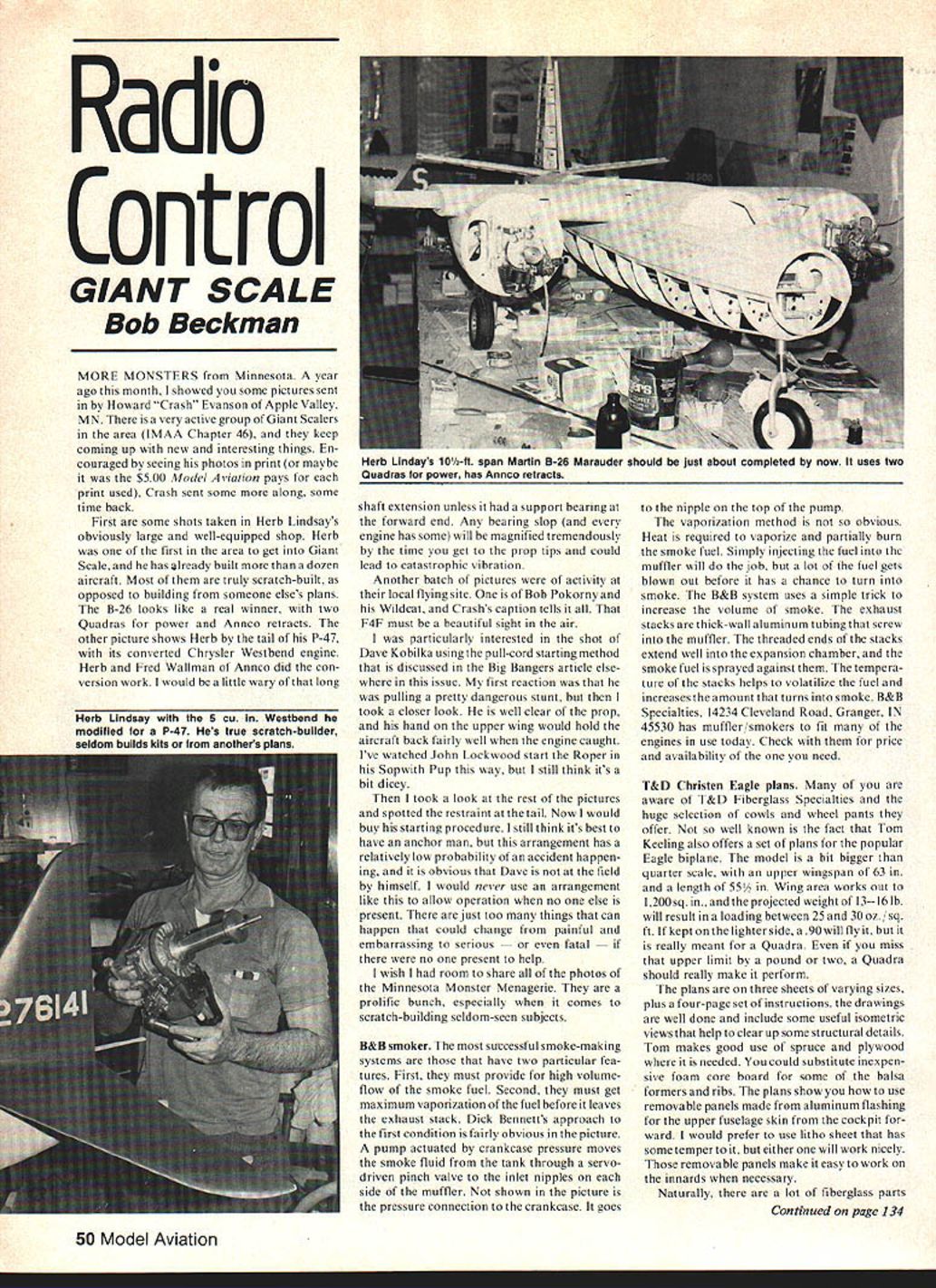
First are some shots taken in Herb Lindsay's obviously large and well-equipped shop. Herb was one of the first in the area to get into Giant Scale, and he has already built more than a dozen aircraft. Most of them are truly scratch-built, as opposed to building from someone else's plans. The B-26 looks like a real winner, with two Quadras for power and Annco retracts. Another picture shows Herb by the tail of his P-47, with its converted Chrysler Westbend engine. Herb and Fred Wallman of Annco did the conversion work. I would be a little wary of that long shaft extension unless it had a support bearing at the forward end. Any bearing slop (and every engine has some) will be magnified tremendously by the time you get to the prop tips and could lead to catastrophic vibration.
Another batch of pictures were of activity at their local flying site. One is of Bob Pokorny and his Wildcat; Crash's caption tells it all. The F4F must be a beautiful sight in the air.
I was particularly interested in the shot of Dave Kobilka using the pull-cord starting method that is discussed in the Big Bangers article elsewhere in this issue. My first reaction was that he was pulling a pretty dangerous stunt, but then I took a closer look. He is well clear of the prop, and his hand on the upper wing would hold the aircraft back fairly well when the engine caught. I've watched John Lockwood start the Roper in his Sopwith Pup this way, but I still think it's a bit dicey.
Then I took a look at the rest of the pictures and spotted the restraint at the tail. Now I would buy his starting procedure. I still think it's best to have an anchor man, but this arrangement has a relatively low probability of an accident happening, and it is obvious that Dave is not at the field by himself. I would never use an arrangement like this to allow operation when no one else is present. There are just too many things that can happen that could change from painful and embarrassing to serious—or even fatal—if there were no one present to help.
I wish I had room to share all of the photos of the Minnesota Monster Menagerie. They are a prolific bunch, especially when it comes to scratch-building seldom-seen subjects.
B&B smoker
The most successful smoke-making systems have two particular features:
- high-volume flow of the smoke fuel, and
- maximum vaporization of the fuel before it leaves the exhaust stack.
Dick Bennett's approach to the first condition is fairly obvious in the picture. A pump actuated by crankcase pressure moves the smoke fluid from the tank through a servo-driven pinch valve to the inlet nipples on each side of the muffler. The pressure connection to the crankcase goes to the nipple on the top of the pump.
The vaporization method is not so obvious. Heat is required to vaporize and partially burn the smoke fuel. Simply injecting the fuel into the muffler will do the job, but a lot of the fuel gets blown out before it has a chance to turn into smoke. The B&B system uses a simple trick to increase the volume of smoke: the exhaust stacks are thick-wall aluminum tubing that screw into the muffler. The threaded ends of the stacks extend well into the expansion chamber, and the smoke fuel is sprayed against them. The temperature of the stacks helps to volatilize the fuel and increases the amount that turns into smoke.
B&B Specialties, 14234 Cleveland Road, Granger, IN 45530 has muffler/smokers to fit many of the engines in use today. Check with them for price and availability of the one you need.
T&D Christen Eagle plans
Many of you are aware of T&D Fiberglass Specialties and the huge selection of cowlings and wheel pants they offer. Tom Keeling also offers a set of plans for the popular Christen Eagle biplane.
Model specifications:
- Upper wingspan: 63 in.
- Length: 55½ in.
- Wing area: 1,200 sq. in. (projected)
- Projected weight: 13–16 lb.
- Wing loading: about 25–30 oz./sq. ft.
If kept on the lighter side, a .90 will fly it; it is really meant for a Quadra. Even if you miss the upper weight limit by a pound or two, a Quadra should make it perform well.
The plans are on three sheets of varying sizes, plus a four-page set of instructions. The drawings are well done and include useful isometric views that help to clear up structural details. Tom makes good use of spruce and plywood where needed. You could substitute inexpensive foam core board for some of the balsa formers and ribs. The plans show how to use removable panels made from aluminum flashing for the upper fuselage skin from the cockpit forward; litho sheet with some temper would also work. Those removable panels make it easy to get at the innards when necessary.
Available parts and extras:
- Cowl, wheel pants, fairings, etc. (available from T&D)
- Pre-bent spring aluminum landing gear with all hardware
- Formed, brazed, and heat-treated cabane assembly
In short, T&D can supply many of the items that are difficult for many builders.
Plans and parts are available from T&D Fiberglass Specialties, 30925 Block, Garden City, MI 48135.
Fly Baby and SESAs
Air Design, 549 Appian, Napoleon, OH 43545 offers three sets of plans for Giant Scale aircraft:
- The Bowers Fly Baby home-built (a full-scale airplane designed by a model builder). With a 106-in. wingspan it is close to 1/3 scale. The plans give about 1,700 sq. in. of effective wing area, and at about 20 lb. it should fly like the real one on a Quadra.
- A 1/4-scale SESA: 80-in. wingspan and 15-in. chord — about 2,500 sq. in. of effective wing; a Quadra and about 20 lb. total weight should be a good combination.
- A 1/3-scale SESA: 106-in. span and 20-in. chord, with weight estimated at 25–28 lb. With all that wing, a Quadra would probably fly it, but a little more power is recommended.
Construction uses typical model techniques but calls for lots of pine (not much balsa). This is good for both strength and cost. Tom Roush of Air Design is in the lumber business and offers precut pine for Giant Scale use.
The plans are adequate for basic structure but contain little extra detail. The two pages of "Building Instructions" are very brief: experienced modelers will have no trouble building from them, but newcomers may find them insufficient.
Both SESAs have a simple and effective cabane structure using wood only—no wire or wire-bending required. The smaller model shows a non-scale semi-symmetrical airfoil (best for non-scale inverted performance). The big version has a close-to-scale undercambered airfoil; it is a bit harder to build and cover but looks better and flies more realistically.
All three plans are a good starting point for producing Giant Scale versions of the original planes, but experience (yours or someone else's) will help make the best use of them.
Spars and Gary Hutchison
The designer of the spars is Gary Hutchison, who has been using a couple of models as test beds. One model is a Two-Meter Challenger. The acid test was given on a 12-volt winch using a "zoom" launch technique. What would have destroyed most other planes of standard construction didn't even phase the Challenger.
Gary provides solutions for polyhedral sections, joiners, general building techniques (for example, small plywood plates glued to the spar webbing with the front and back rib halves glued to them), and other building questions. These construction hints and sketches accompany the spars.
Spar pricing and sizes:
- Smaller spar: $2.00/ft.; available in 4-ft., 3-ft., and 30-in. lengths.
- Larger spar: $2.15/ft.; available in 4-ft. sections only.
For further information, write: Gary Hutchison, 207 Plymouth Dr., Charlotte, MI 48813.
As mentioned above, the Fly Baby has a 106-in. wingspan and a 17-in. chord, giving about 1,700 sq. in. of effective wing area and an expected weight of about 20 lb. The 1/4-scale SESA has an 80-in. wingspan and 15-in. chord (about 2,500 sq. in. effective wing), and the 1/3-scale version measures 106-in. span and 20-in. chord with an estimated weight of 25–28 lb.
New Quadra
As of November 12, TML was scheduled to start production of the new 50cc Quadra during the first week of December. By the time you read this, they will be starting shipment, but it will take until January or February to get into full production and fill the distribution pipeline.
Bob Beckman 8248 Holly Grove Ct., Manassas, VA 22110
Transcribed from original scans by AI. Minor OCR errors may remain.

