
Radio Control GIANT SCALE
Bob Beckman
Introduction
Happy birthday to RC Giant Scale! This issue marks the beginning of my fourth year of writing the RC Giant Scale column. Back in 1978 or ’79, when I first got involved, the Giant Scale (Quarter Scale, Mammoth Scale, Le Grande Scale, whatever) movement was still in its infancy but really beginning to pick up steam. Dick Phillips had been doing his "Big is Beautiful" column in RCM for a year or so, and Ron Shettler was writing the short-lived "Mammoth Scale" for Model Builder.
The Quadra was firmly entrenched as the standard power source, but more and more new engines were starting to surface. There wasn't much in the way of Giant Scale–sized accessories, so people made their own fittings (hinges, horns, etc.) when it became obvious that most items designed for smaller models just couldn't do the job. With some notable exceptions, the hobby manufacturers had no interest in making the kinds of things we needed. Many people considered our efforts to be unnecessarily large and impractical curiosities that would soon disappear from the RC modeling scene.
Growth and IMAA
During the last three years, things have changed a lot. An amazing number of new engines are available, with more coming along all the time. Hinges, horns, wheels and other accessories in materials and sizes suitable to our application are now readily available. Kits and plans for interesting and practical miniature aircraft are plentiful, and true scratch-built creations are more common than in any other phase of RC modeling. We've come a long way, baby.
One very important factor in this growth pattern has been the International Miniature Aircraft Association. The IMAA's Second Annual Fun-Fly Festival in August 1982 ranks high as an outstanding showcase for model building of any kind. The kudos for that affair go to Byron Godberson and Don Godfrey—a couple of showmen, for sure—but there would have been no show without the vast numbers of modelers who have been turned on by this most realistic form of RC flying. The word I have is that the Third Annual is on at Ida Grove again the third week in August. If you were there last year you'll want to go again, and if you didn't make it last year you won't want to miss it this time around.
Plan reviews
This month I want to talk about plans from two designers who have quite different philosophies about Giant Scale design. Dick Barron takes the word "scale" very seriously; he's interested in scale reproduction of the basic structure of the real subject. Norm Rosenstock is interested primarily in scale appearance with function in the finished product, and he restricts himself to techniques, materials and accessories available to the average modeler. Both approaches are quite valid and have a place in Giant Scale modeling.
Dick Barron — PT-13/N2S-5 Stearman
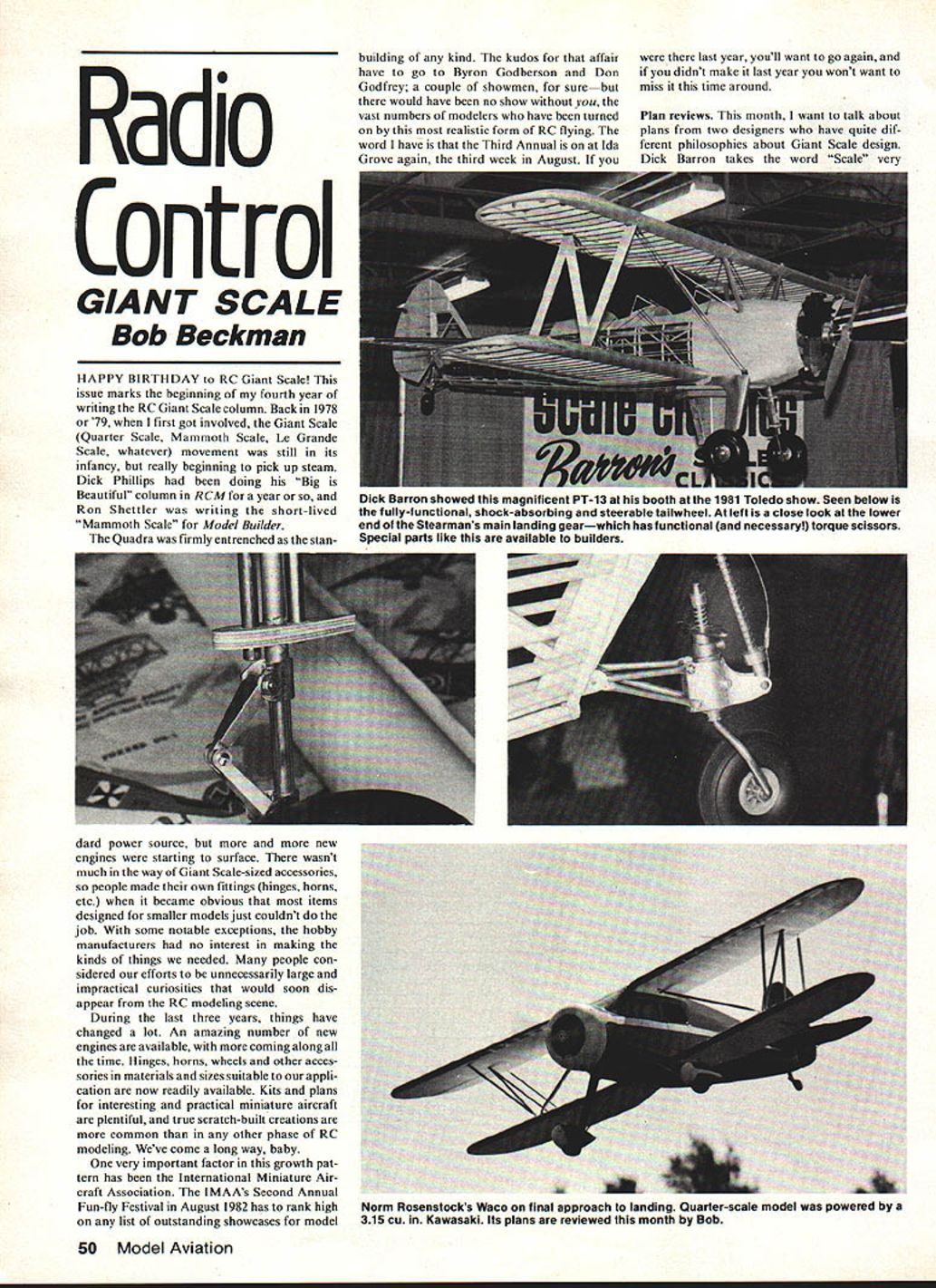
Barron's PT-13/N2S-5 Stearman from Barron's Scale Classics is a masterpiece. People often think of the PT-17; some of Dick's ads labeled the design PT-17, but the plans are for the PT-13/N2S-5. The only real difference between the PT-13, PT-17, N2S-3, -4, and -5 was the engine used. By whatever name, this is the Yellow Peril, one of the best-known aircraft ever.
- Plans: five sheets, approximately 3 ft by 5 ft.
- Drawings: superb; Barron reproduces structure as well as appearance within the limits of wood construction.
- Notable features: landing gear structure—both the main gear and the tailwheel are functional miniaturizations of the full-scale units.
- Builder level: for the person who really loves to build scale models; not intended for beginners but manageable for those with reasonable experience.
- Wingspan: 96½ in.
- Weight: keep down to about 20–22 lb for good performance.
- Power: a Quadra is shown on the plans; if you plan heavy scale detailing add the extra weight and consider a larger engine.
Some parts required will need tools and skills beyond the average modeler; Dick has made such parts available for sale. Semi-kits with precut formers, ribs, etc., are also available.
Ordering information:
- Price: $32.50 plus $2.50 postage and handling. An additional $1.00 will get a catalog of Barron Scale Classics.
- Available from: Barron's Scale Classics, 11506 Ohio Ave., Youngtown, AZ 85363.
(Note: Youngtown is correct—no 's' required.)
Norm Rosenstock — Waco HKS-7
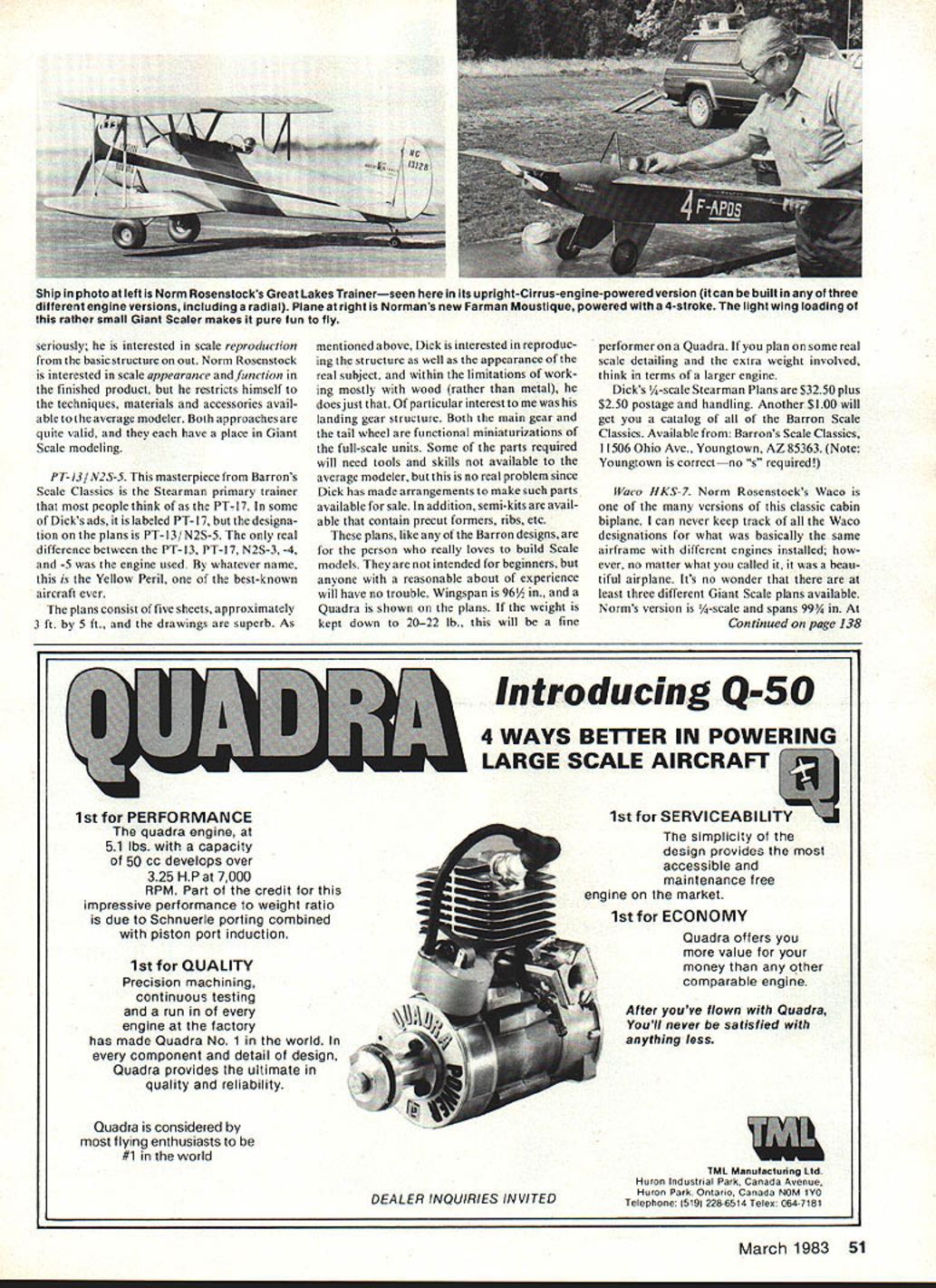
Norm Rosenstock's Waco versions of the classic cabin biplane are beautiful airplanes regardless of exact Waco designation. They are basically the same airframe with different engines installed at various times, and no matter what they are called they make lovely models.
- Scale: 1/4-scale
- Wingspan: 99¼ in.
- Weight: about 25–30 lb (too much for a Quadra).
- Power used: Norm powered his with a 3.15 cu. in. Kawasaki; it was a fine performer until it was lost in a mid-air collision.
- Plans: two sheets, approximately 40 by 72 in.; well-detailed and easy to read.
- Notes: Only one panel of each wing (upper and lower) is shown on the drawings, which can be awkward but manageable. Spars are intended to be spruce (not balsa), though the plans do not explicitly state this. Norm restricts himself to materials and fittings available to most modelers, which sometimes means departures from strict scale but yields a finished product that looks and flies like the real plane.
Price and ordering:
- Plans: $25.00 plus $2.00 postage.
- Available from: Norm Rosenstock, 94 Cedar Dr., Plainview, NY 11803.
Great Lakes Trainer (Norm Rosenstock)
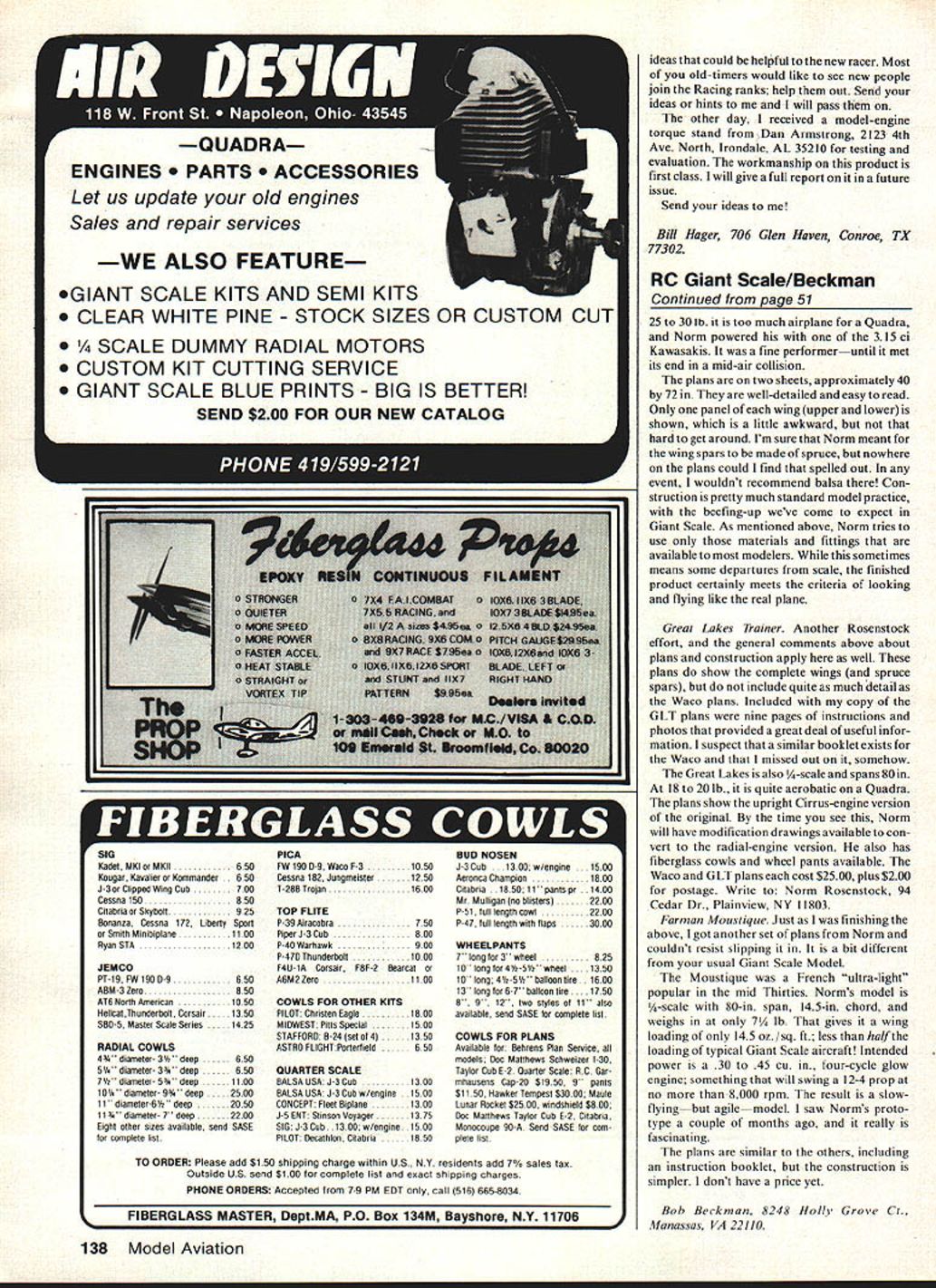
Another Rosenstock design; the general comments about plans and construction above apply here as well.
- Scale: 1/4-scale
- Wingspan: 80 in.
- Weight: 18–20 lb; quite aerobatic on a Quadra.
- Engine shown: upright Cirrus-engined version of the original.
- Plans: show complete wings (including spruce spars) and include less detail than the Waco plans, but my copy included nine pages of instructions and photos with useful information. Norm will have modification drawings available to convert to the radial-engine version. Fiberglass cowls and wheel pants are also available.
Price and ordering:
- Plans: $25.00 plus $2.00 postage.
Farman Moustique (Norm Rosenstock)
Just as I was finishing the above, I received another set of plans from Norm and couldn't resist including it. This one is a bit different from your usual Giant Scale model.
The Moustique was a French "ultra-light" popular in the mid-Thirties. Norm's model is 1/6-scale with an 80-in. span, 14.5-in. chord, and it weighs only 7½ lb. That gives a wing loading of only 4.5 oz./sq. ft., less than half the loading of typical Giant Scale aircraft. Intended power is .30 to .45 cu. in., or a four-cycle glow engine—something that will swing a 12x4 prop at no more than 8,000 rpm. The result is a slow-flying but agile model. I saw Norm's prototype a couple of months ago, and it really is fascinating.
The plans are similar to the others and include an instruction booklet, but the construction is a little different. Price was not available at the time of writing.
Contact
Bob Beckman 8248 Holly Grove Ct. Manassas, VA 22110
Transcribed from original scans by AI. Minor OCR errors may remain.

