
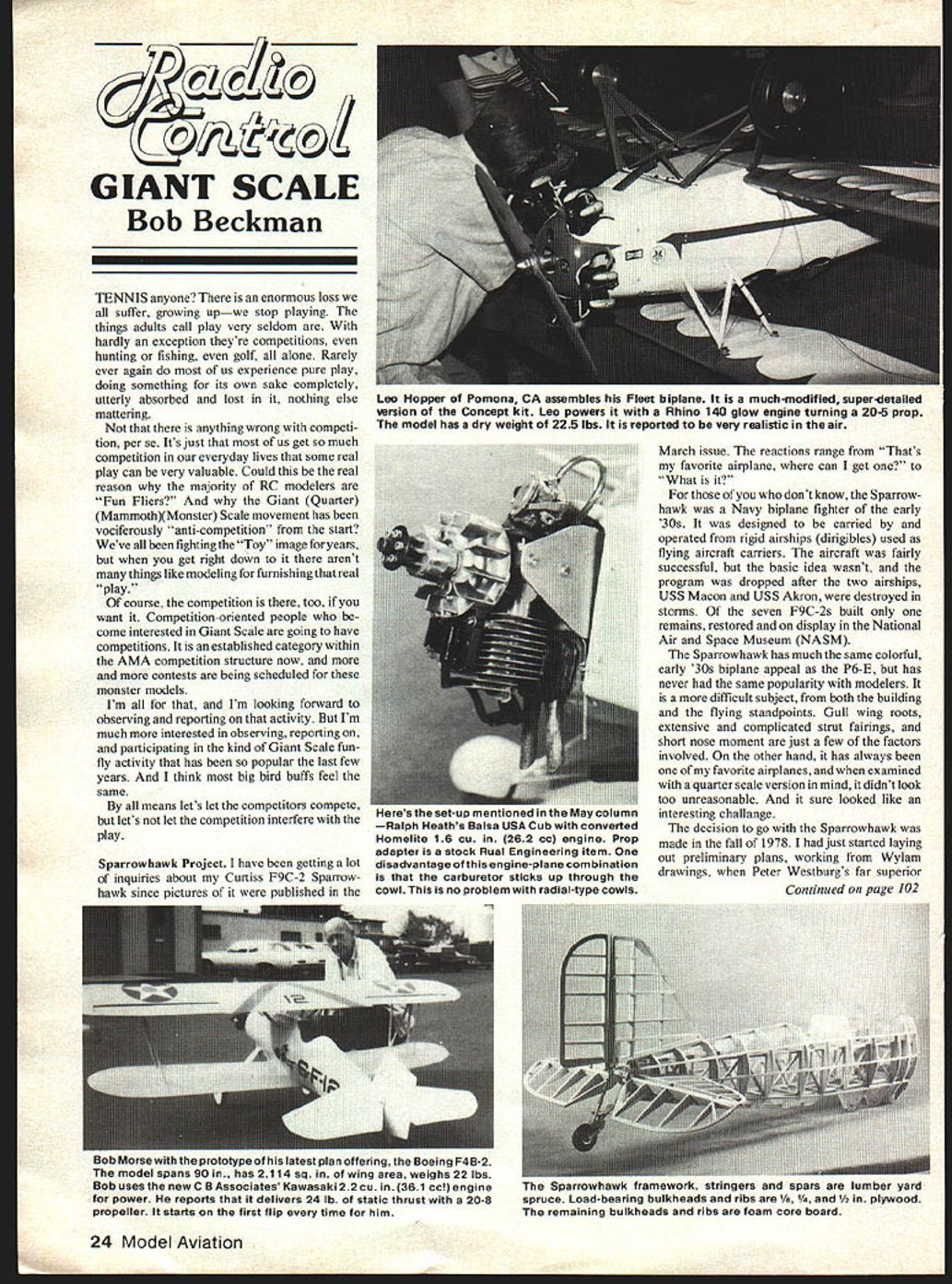
Radio Control: GIANT SCALE
Bob Beckman
TENNIS anyone? There is an enormous loss we all suffer, growing up — we stop playing. The things adults call play very seldom are. With hardly an exception they're competitions: even hunting or fishing, even golf, all alone. Rarely ever again do most of us experience pure play — doing something for its own sake, completely absorbed and lost in it, nothing else mattering.
Not that there is anything wrong with competition per se. It's just that most of us get so much competition in our everyday lives that some real play can be very valuable. Could this be the real reason why the majority of RC modelers are "fun fliers"? And why the Giant (Quarter/Mammoth/Monster) Scale movement has been vociferously anti-competition from the start? We've all been fighting the "toy" image for years, but when you get right down to it, there aren't many things like modeling that furnish that real "play."
Of course, the competition is there, too, if you want it. Competition-oriented people who become interested in Giant Scale are going to have competitions. It is an established category within the AMA competition structure now, and more and more contests are being scheduled for these monster models.
I'm all for that, and I'm looking forward to observing and reporting on that activity. But I'm much more interested in observing, reporting on, and participating in the kind of Giant Scale fun-fly activity that has been so popular the last few years. And I think most big-bird buffs feel the same.
By all means let's let the competitors compete, but let's not let the competition interfere with the play.
Sparrowhawk Project
I have been getting a lot of inquiries about my Curtiss F9C-2 Sparrowhawk since pictures of it were published in the March issue. The reactions range from "That's my favorite airplane, where can I get one?" to "What is it?"
For those of you who don't know, the Sparrowhawk was a Navy biplane fighter of the early '30s. It was designed to be carried by and operated from rigid airships (dirigibles) used as flying aircraft carriers. The aircraft was fairly successful, but the basic idea wasn't, and the program was dropped after the two airships, USS Macon and USS Akron, were destroyed in storms. Of the seven F9C-2s built only one remains, restored and on display in the National Air and Space Museum (NASM).
The Sparrowhawk has much the same colorful, early-'30s biplane appeal as the P-6E, but has never had the same popularity with modelers. It is a more difficult subject from both the building and the flying standpoints. Gull wing roots, extensive and complicated strut fairings, and a short nose moment are just a few of the factors involved. On the other hand, it has always been one of my favorite airplanes, and when examined with a quarter-scale version in mind, it didn't look too unreasonable. It sure looked like an interesting challenge.
The decision to go with the Sparrowhawk was made in the fall of 1978. I had just started laying out preliminary plans, working from Wylam drawings, when Peter Westburg's far superior drawings were published in Model Builder. I junked what I had and started over. The model is now based on the Westburg drawings with additional pictures and information from the NASM.
My original target date for finishing it was August 1979. This still looked reachable in spring 1979. I had designed and built the landing gear, converted a Homelite 1.6 cu. in. engine, obtained and learned how to cut spruce, and started to build the fuselage. At this point I decided I should be taking some pictures, so I dug out my 30‑year‑old Argus C3 and shot some black-and-white pictures in the shop. I took the film to a photographer friend for processing and he started giving me advice on taking pictures. This led to my getting interested in making good pictures, which led to SLR cameras, lenses, lights, tripods, meters, etc. And that led to wanting to process my own pictures, which led to my present Jekyll-and-Hyde basement that is sometimes a model shop, sometimes a darkroom, and in between a photo studio.
Somewhere along the line in all this I found myself doing articles for Model Aviation. After all, I had to have an excuse for — I mean "help pay for" — all the gear, didn't I? And that in turn led to my doing this column. And what about the Sparrowhawk? You guessed it: I'm almost a year behind schedule and losing ground rapidly.
I'm still making some progress, and I am going to finish it. The original Curtiss F9C first flew on February 12, 1931. Maybe I should shoot for a Golden Anniversary first flight for the model.
Plans by Bob Morse
Several Giant Scale plans by Bob Morse are available from Accounting/Clerical Services of Santa Clara, CA. I mentioned his Cessna 180 plans last month and more comments appear below. In addition, I've had a chance to review Bob's Berliner-Joyce P-16.
The P-16 was of particular interest to me because of its gulled wing roots, similar to the Curtiss Sparrowhawk. As you might expect, Bob and I have come up with completely different solutions to the same problem. Bob's wing panels fit onto 1/4 in. music-wire pins, much like current sailplane practice. The wires, two for each wing, pass through and are anchored to the fuselage. Because of the gull wings, the wires require some fancy bending, but this is no more difficult than bending up a landing gear.
At first glance either of these sets of plans might seem a little overwhelming. They are each two sheets, 40 in. wide and seven to eight ft. long. In addition to some big structural drawings, there is a lot of detailed information packed into them. It doesn't take long for things to start making sense, however, once you've taken the time to look them over properly.
The one thing that I found disappointing about both of these plans is something that applies to every big-bird plan I've seen so far. The materials used are basically the old standbys: balsa and plywood. There is some spruce used to good advantage, but nothing really new. It's not really the plan developers' fault. If they expect to sell their plans, they can't afford to go too far out with techniques unfamiliar to potential customers. Here's the area where the innovative plan builder can try new things. For example, most of the balsa wing ribs in these two big birds could be replaced by much less expensive foam-core board.
Bob's use of our traditional materials is masterful. There has been a lot of comment about how our big birds can't just be blown-up versions of smaller models, that more full-scale building techniques must be used. Here we have examples of how it's done. While the building techniques are mostly model-oriented (and therefore familiar to modelers), Bob's eye for the stress areas and his ability to combine the right structure and materials to handle them result in projects that the average modeler can tackle with confidence in the end result.
One thing that I particularly appreciate is the wealth of detail on items like:
- hinges
- tail-wheel assemblies
- control cable systems
- flying-wire fittings
Bob uses a lot of CB Associates items: hinges, motor mounts, cable pulleys, etc. Unlike some of the things that have hit the market, CB's quarter-scale accessories were designed from the ground up for use in big birds. They are rugged, they are dependable, and they work. Bob's plans show you how to use them.
The Berliner-Joyce P-16 is an intriguing airplane, and if you are a dedicated early-'30s biplane fetishist like me, it's hard to resist. But it's not a beginner's project. It would be a labor of love that could give you a stand-out airplane that isn't lost among all the Pitts, Rearwins, and Fleets.
The Cessna 180 is an easier project for the less experienced builder. Be prepared to clean up a lot of balsa shavings, though. The fuselage is basically an octagonal structure of 3/8 in. sheet balsa, carved and sanded to final shape; simple, easy, and rugged. An excellent airplane to learn the techniques for building full-size models appeared in Giant Scale Models (Vol. 1).
The following plans by Bob are available:
- Cessna 180
- Berliner-Joyce P-16
- Focke-Wulf FW 44J
- Boeing F4B-2 / P-12B
All plans are $21.50 each plus $2.00 postage. Available from: Accounting/Clerical Services 3351 Prune Ridge Ave. Santa Clara, CA 95051
Bob is presently working on plans for a 2.75 in.–1 ft. scale Curtiss P-40. The plans will be available this summer; price will be $29.50.
I can heartily recommend the two plans that I have seen and would expect the others to be of the same high caliber.
Bob Beckman 8248 Holly Grove Ct. Manassas, VA 22110
Transcribed from original scans by AI. Minor OCR errors may remain.

