
Radio Control GIANT SCALE
Bob Beckman
New Kraft Goodies
For one reason or another, it has been a long time since I got a new radio right off the shelf. A year or so ago I built a Silver Seven transmitter, but that's not quite the same thing. Anyway, when I finally got my Tomahawks finished, I wanted to get back to work on my Sparrowhawk, but realized that—thanks to the Tomahawks and the Stinson Voyager that I built in 1981—I was fresh out of suitable radios. To make a long story short, I decided to go with one of the new Kraft systems, and I thought you might be interested in my impressions.
What I wound up with was a KP-7C MKIII, with KPS-24 servos and an additional heavy-duty battery. Any new toy is fascinating, but I was particularly struck by the amount and quality of the instructions and other literature that came with the system. A lot of the information was not new to me, but if I were new to R/C it sure would be valuable. The last time I bought a new radio the instructions that came with it were minimal, to say the least.
I was particularly impressed with the installation guide book that was included. While it couldn't pretend to cover all the hints and kinks about installing radios in airplanes, it did cover the basics and would be invaluable to a newcomer. The booklet covering the radio itself was quite comprehensive and very well written. Any experienced R/Cer could have picked up the system and used it with or without this material, but the point is that even a complete tyro has a good chance of succeeding with this kind of help.
Up to now I have been using 20H servos on my Giant Scale aircraft. I had planned to go the same way with the Sparrowhawk, but decided instead to try the new KPS-24. It is a bit smaller and lighter than the 20H, but with about 20% less output power. It is rated at 45 oz.-in. torque, which should be enough, and I like the dual ball bearings and the splined output shaft. I hope they come out with some heavy-duty servo arms that will fit that splined shaft.
Speaking of the heavy-duty servo arms, I've been using them on my 20H servos, and I really like them. I did discover one minor problem with them, however. The arms on the 20Hs are held on with short 1-72 machine screws. The heavy-duty arms are thicker than the original output fittings, and only a few of the threads engage when you run the screw down. It seems secure, but even a relatively heavy shock, like nosing over on landing, can pop the arm off the output shaft. I ran a slightly longer screw through and that cured the problem.
Another new item Kraft got recently is a new 24-oz. fuel tank. The materials used are compatible with gasoline, diesel fuels as well as glow fuel. It's a nice size for Giant Scale. A Quadra will run about a half hour on that much fuel; larger engines will get about 15-minute flights.
Another Herculean Effort
Bob Campbell did a fabulous job of building and flying his twin-Quadra-powered Grumman Tigercat. Then, for an encore, he came up with his famous B-29. I have been so stunned by that one that it never even occurred to me to think about what, if anything, would be his encore to the Superfort.
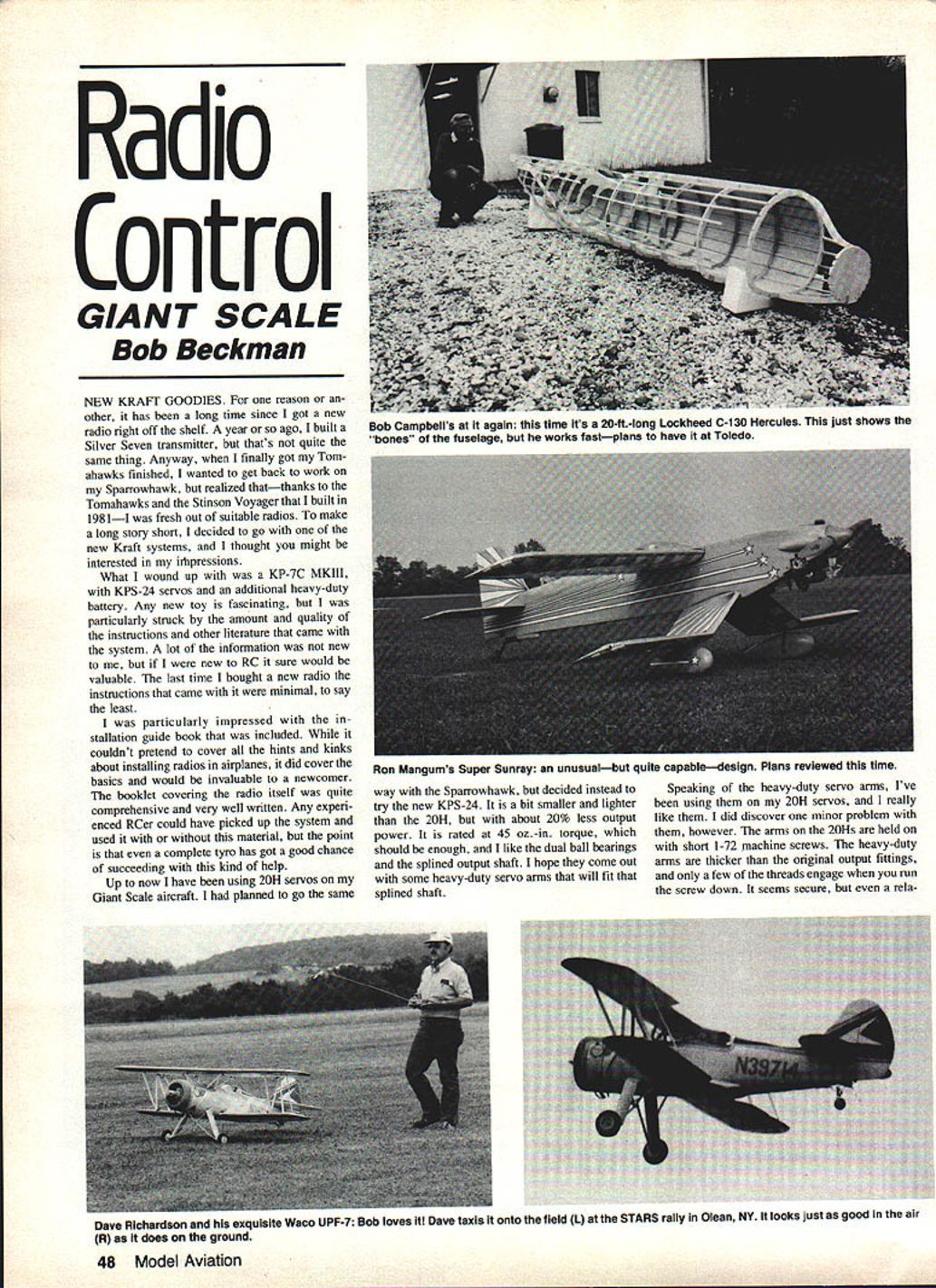
Never let it be said that Bob ever lets the balsa dust in his shop lie undisturbed for more than a week or so. His latest is a C-130 Hercules: wingspan — 20 ft.; fuselage — 14 ft. long and 2 ft. in diameter; four engines (don't know what kind yet); weight — 150 to 160 lb.
The picture was taken on December 4, 1982; by December 17 he had the fuselage finished. (I can't even write that fast, much less build that fast.) Bob expects to have the bird finished in February, with first flights in the early spring. He didn't say, but I assume he will have it at Toledo.
Hobbypoxy Scale Colors
Last June I got a letter from Bob Pettit of Pettit Paint Company, Inc., the people who make Hobbypoxy. He wrote to tell me about a project they had under way to provide paint-mixing formulas to help scale modelers reproduce accurate color schemes. Since museum-scale accuracy is not the prime concern in Giant Scale modeling, other items kept pushing this down on my list of things to tell you about. The program has been reported in detail in the Scale columns of the various magazines, so I will just outline it here.
What it boils down to is that Hobbypoxy has researched the colors used on various aircraft (let's say, for example, one of the WWII RAF colors), and in their labs they have determined the exact mixture of standard Hobbypoxy colors needed to match it. To show you how this works, here is their formula for Dark Green, one of the colors used on the upper surfaces of Hurricanes and Spitfires during the Battle of Britain:
- 6 parts H66 Dark Red
- 2 parts H33 Stinson Green
- 1 part H49 Club Yellow
- 1 part H81 Black
- 1 part H10 White
Mix that all together, and then mix 1 to 1 with Flat Hardener. One thing for sure: I would never have thought to produce a shade of green by starting with lots of dark red!
Every month or so I get another note with two or three more color formulas. So far they have all been WWII—or later—colors. If the program continues, it won't be long before almost any color you need will have been figured out for you. I assume that writing to Hobbypoxy will let you find out if they have the colors you need. If not, they will probably put them on their list for the future. I'm hoping to get them to work out the colors I need for the Sparrowhawk.
Super SunRay Plans
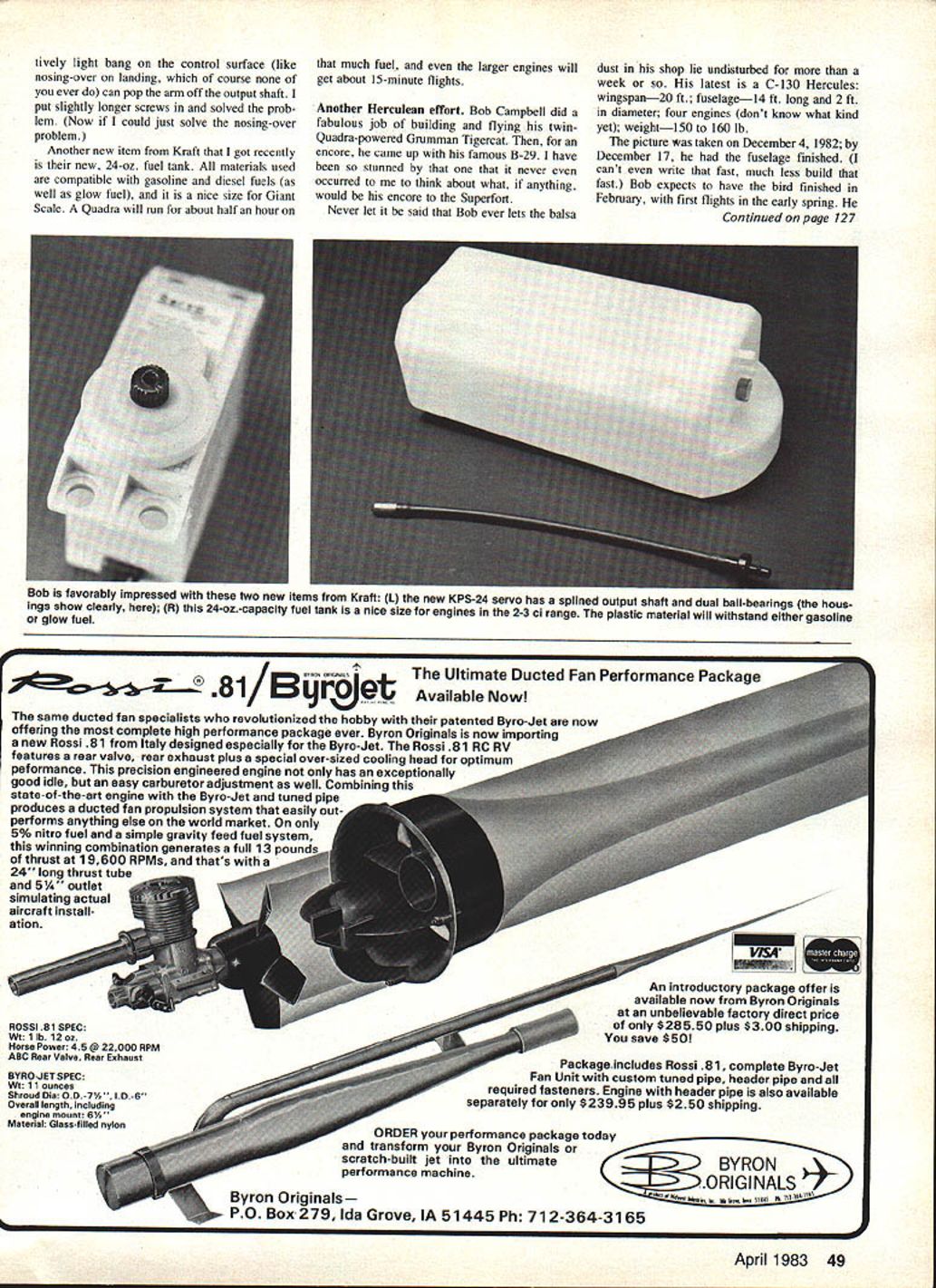
The Super SunRay is a semi-scale model patterned after a small biplane racer called the Sorceress. The original, and Ron Mangum's model, incorporate several unusual features including inverse stagger, inverted gull lower wing, and no struts of any kind. The upper wing is mounted in a shoulder position on the fuselage while the inverted gull dihedral of the lower wing provides the proper wing gap and at the same time allows the use of very short landing gear legs. All in all, an unusual, but quite practical, design.
The upper wingspan is 6 ft. 4 in., with a 14-in. chord. The lower wing is somewhat smaller. The fuselage is over 6 ft. long, but only 5-1/2 in. wide and 10-1/2 in. deep. Ron's original is powered with a Quadra and flies very well. I don't know what it weighs, but from the plans I would estimate 18 to 20 lb.
The plans were drawn by Calvin Clark and consist of two sheets, approximately 3 ft. by 7 ft. My first impression was that they didn't have much detail. There are two reasons for this: the construction is really quite simple; and Ron and Calvin must have assumed that only very experienced modelers would be using the plans. For example, there are no detailed diagrams to show the ribs and how they line up on the wings, and there is no detail shown of the landing gear mounting and radio installation. These things will bother the inexperienced builder, but they could be real stumbling blocks for the beginner.
The construction is really quite straightforward and simple, using common sport RC techniques. Except for spars of hardwood and plywood, it is all balsa, and lots of it. Some substitutions of cheaper materials could save a lot of money. For example, the 1/4-in. sheet balsa fuselage sides could be replaced with door-skin ply backed up with 1/4-in. sq. spruce longerons, and most of the bulkheads and ribs could be cut from foam core board. I don't mean this as a criticism of the plans, just as hints on how to accomplish the same thing without having to mortgage the farm.
The Super SunRay is an uncommon design, but a very good flier. You won't see many of them sitting next to you at the field. The plans are available from Ron Mangum, P.O. Box 8244, Greensboro, NC 27410.
Waco UPF-7 Plans
The UPF-7 is an open-cockpit biplane similar to, and a contemporary of, the PT-17. I have a soft spot in my heart for this aircraft because it was the first open biplane I ever flew. I got my private ticket in the late Forties at a small field near Portsmouth, VA. That field, like so many from that era, is now covered with houses. Anyway, the owner of the field had, in addition to the Aeronca Champs used for training, two airplanes that really intrigued me. One was a clipped-wing Monocoupe he was restoring, and the other was an operational UPF-7. The owner was really wrapped up in his Monocoupe, so I built a display model of it, complete with planned color scheme, and traded the model to him for check-out and flying time on the Waco. It was time and effort well spent on my part.
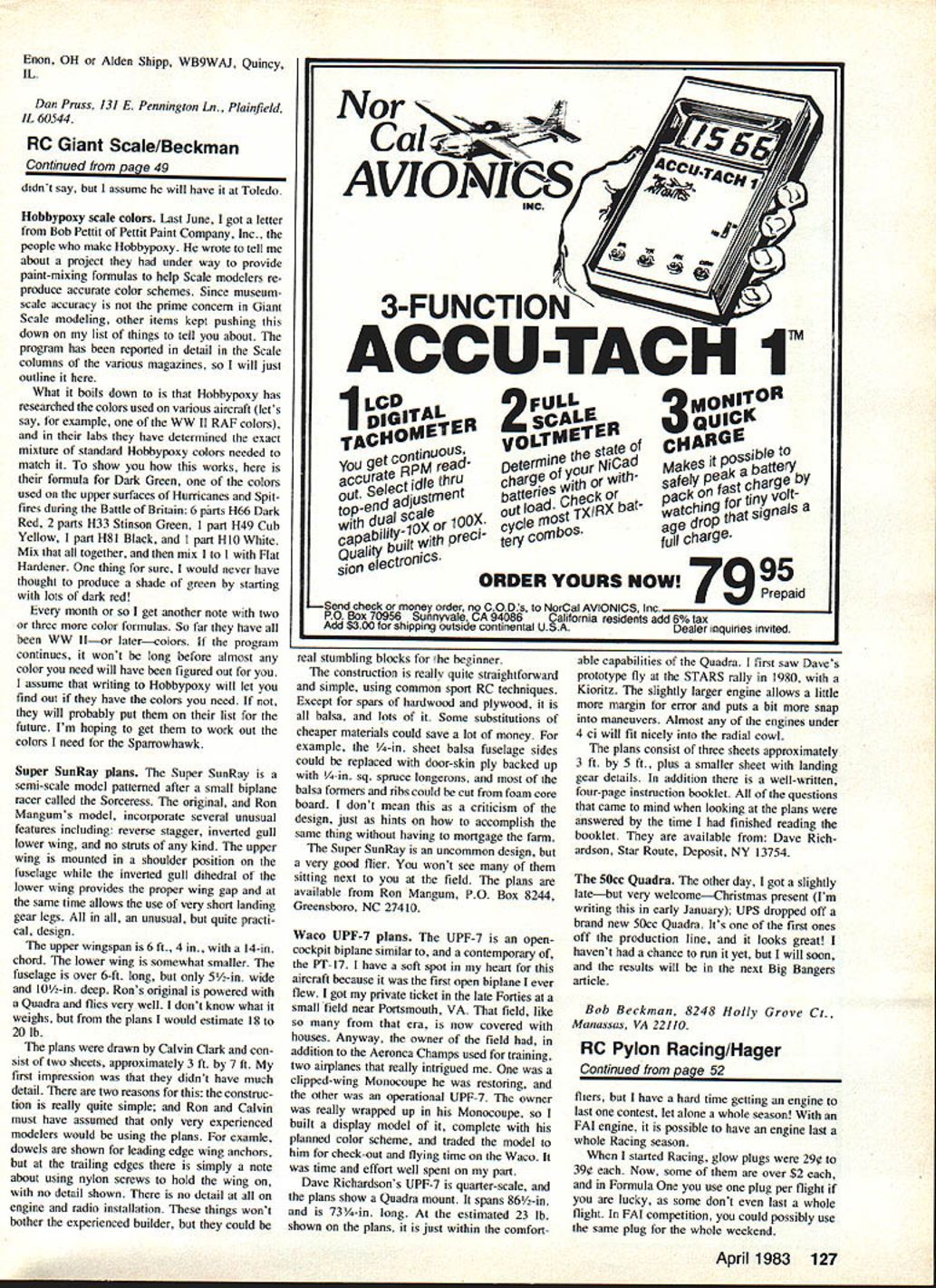
Dave Richardson's UPF-7 is quarter-scale, and the plans show a Quadra mount. It spans 86-1/2 in., and is 73-1/4 in. long. At the estimated 23 lb. shown on the plans, it is just within the comfortable capabilities of the Quadra. I first saw Dave's prototype fly at the STARS rally in 1980, with a Kioritz. The slightly larger engine allows a little more margin for error and puts a bit more snap into maneuvers. Almost any of the engines under 4 cu. in. will fit nicely into the radial cowl.
The plans consist of three sheets approximately 3 ft. by 5 ft., plus a smaller sheet with landing gear detail. In addition, there is a well-written, four-page instruction booklet. All of the questions that came to mind when looking at the plans were answered by the time I had finished reading the booklet. They are available from: Dave Richardson, Star Route, Deposit, NY 13754.
The 50cc Quadra
The other day I got a slightly late—but very welcome—Christmas present (I'm writing this in early January): UPS dropped off a brand new 50cc Quadra. It's one of the last off the production line, and it looks great! I haven't had a chance to run it yet, but I will soon, and the results will be in the next Big Bangers article.
Bob Beckman 8248 Holly Grove Ct. Manassas, VA 22110
Transcribed from original scans by AI. Minor OCR errors may remain.

