
Radio Control: GIANT SCALE
Bob Beckman
FLY-IN DATES. I say this every year, and I'm going to say it again now. If you want me to mention your fly-in date, you have to get the info to me very early. Magazine publishing being what it is, there is a minimum of three months from the time I get something to the time you see it. For example, I'm writing this in January, but it is going into the May issue, which you will see during the first part of April. That means that for a May Fly-In date I have to know in December or January. After that, there is no point in my mentioning your affair, because by the time anybody sees that month's column, it will be too late.
Marv Reese (Wichita, KS) apparently has the word, since he wrote in late December to tell me about their Second Annual JUMBO Fly-in, scheduled for May 7 and 8. I couldn't get to their first one myself, but I heard good reports about it. Their flyer really describes the Fly-In/FunFly format, and I quote in part:
- THIS IS NOT A CONTEST
- YOU DON'T EVEN HAVE TO FLY IF YOU DON'T WANT TO
- IT'S OPEN TO EVERYONE
- IT'S A SHOW AND TELL
- A GOOD BULL SESSION
- FLY IF YOU WANT TO AND WHEN YOU WANT TO, AS LONG AS YOUR FREQ IS OPEN.
For more information call:
- Jerry Carley: (316) 524-6654
- Marv Reese: (316) 721-1861
More Tomahawks.
Since publishing some pictures and comments about my Piper Tomahawks, I have been hearing from several people who have built the Jim Messer version. Everyone seems to be very pleased with the kit and the finished product. It would be hard not to be pleased with the kit. Engine, radio, covering, and paint are all you add; it is complete right down to wheels and a propeller.
The Tomahawk pictured this month is from Bill Lester of Johnson City, TN. Quadra-powered with a Top Flite 18-10, it weighs in at 18 1/2 pounds. The covering and trim are MonoKote. Bill flies from a fairly small field and would like to have flaps to help on the landings. Other than that, he says it flies like a dream.
Incidentally, this is one Giant Scale aircraft with the kind of structure that can safely use a film-type covering. A lot of them really need the extra strength of fabric covering.
Evra choke.
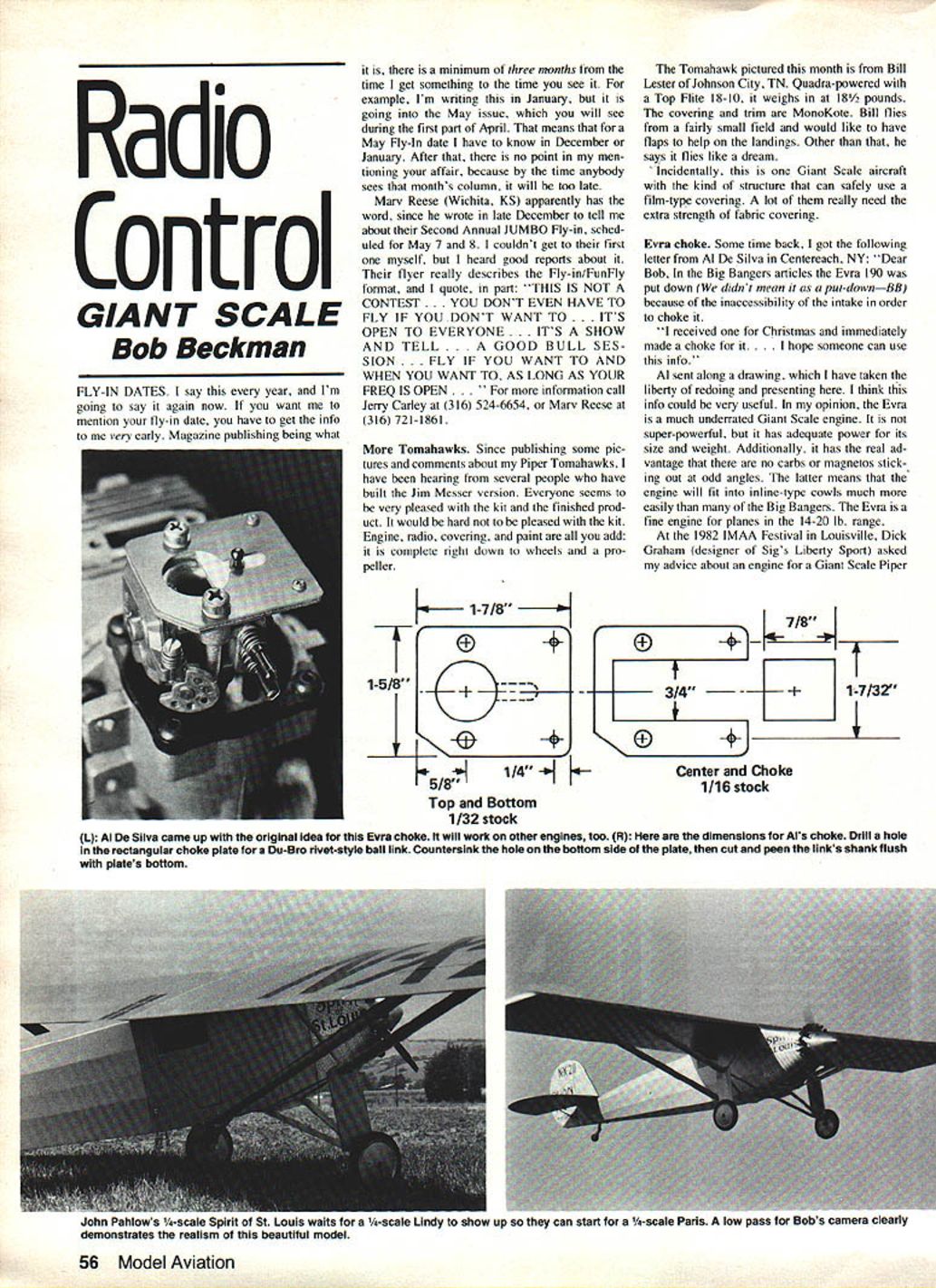
Some time back I got the following letter from Al De Silva in Centereach, NY: "Dear Bob, In the Big Bangers articles the Evra 190 was put down (We didn't mean it as a put-down—BB) because of the inaccessibility of the intake in order to choke it. I received one for Christmas and immediately made a choke for it. ... I hope someone can use this info."
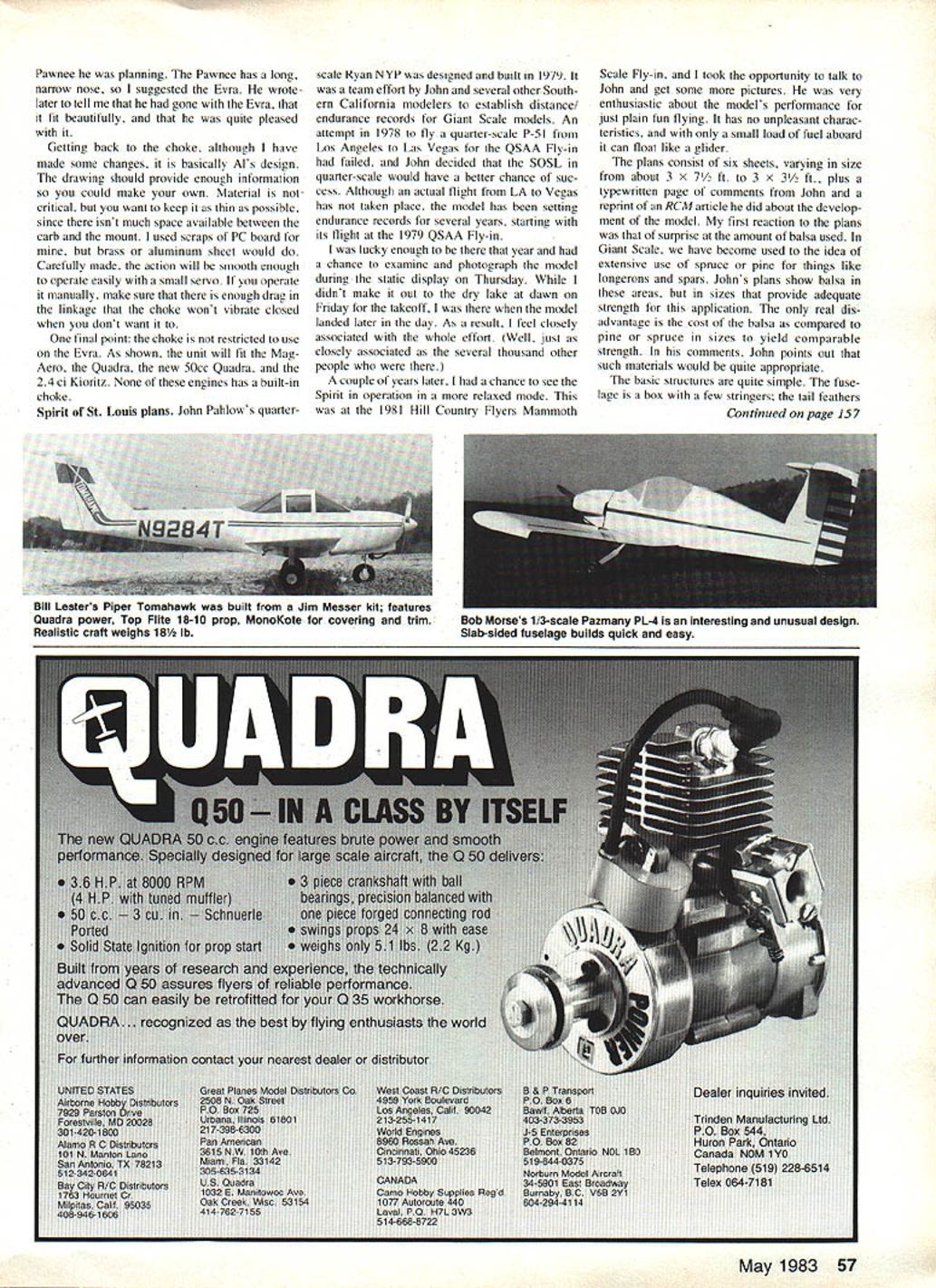
I sent along a drawing, which I have taken the liberty of redoing and presenting here. I think this info could be very useful. In my opinion, the Evra is a much underrated Giant Scale engine. It is not super-powerful, but it has adequate power for its size and weight. Additionally, it has the real advantage that there are no carbs or magnetos sticking out at odd angles. The latter means that the engine will fit into inline-type cowls much more easily than many of the "Big Bangers." The Evra is a fine engine for planes in the 14–20 lb. range.
At the 1982 IMAA Festival in Louisville, Dick Graham (designer of Sig's Liberty Sport) asked my advice about an engine for a Giant Scale Piper Pawnee he was planning. The Pawnee has a long, narrow nose, so I suggested the Evra. He wrote later to tell me that he had gone with the Evra, that it fit beautifully, and that he was quite pleased with it.
Getting back to the choke: although I have made some changes, it is basically Al's design. The drawing should provide enough information so you could make your own. Material is not critical, but you want to keep it as thin as possible, since there isn't much space available between the carb and the mount. I used scraps of PC board for mine, but brass or aluminum sheet would do. Carefully made, the action will be smooth enough to operate easily with a small servo. If you operate it manually, make sure that there is enough drag in the linkage that the choke won't vibrate closed when you don't want it to.
One final point: the choke is not restricted to use on the Evra. As shown, the unit will fit the Mag-Aero, the Quadra, the new 50cc Quadra, and the 2.4-ci Kioritz. None of these engines has a built-in choke.
Spirit of St. Louis plans
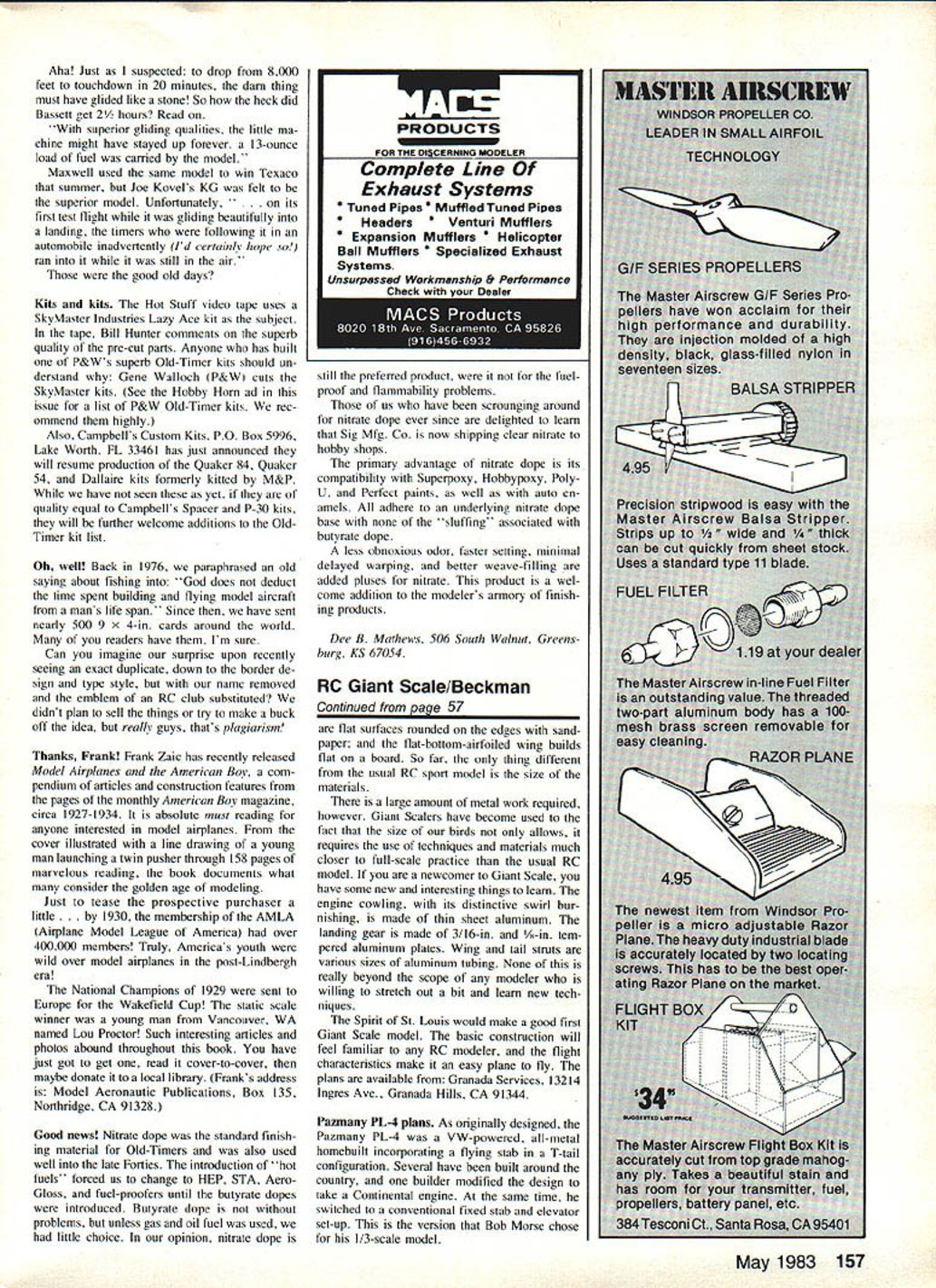
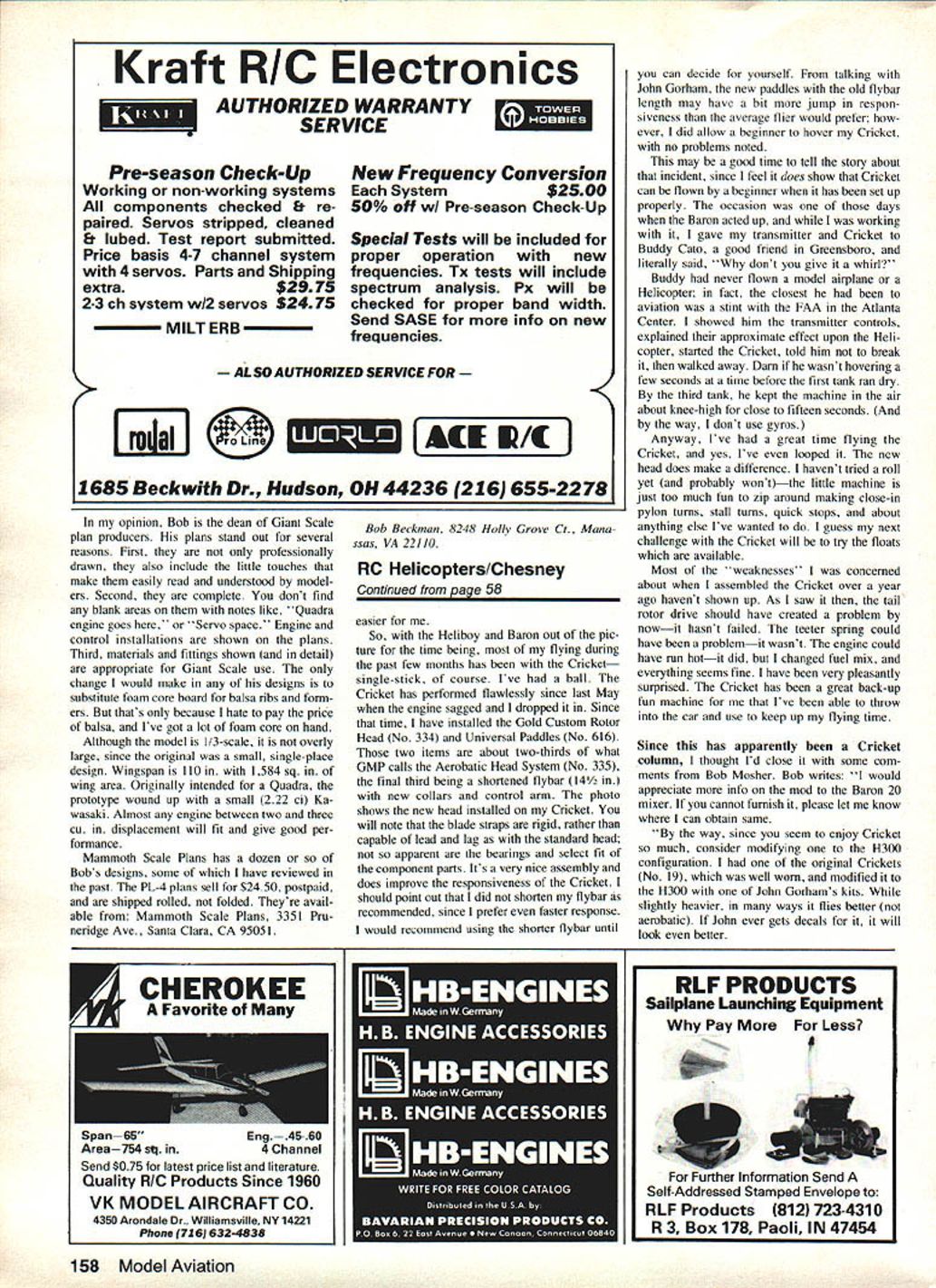
John Pahlow's quarter-scale Ryan NYP was designed and built in 1979. It was a team effort by John and several other Southern California modelers to establish distance/endurance records for Giant Scale models. An attempt in 1978 to fly a quarter-scale P-51 from Los Angeles to Las Vegas for the QSAA Fly-in had failed, and John decided that the Spirit of St. Louis in quarter-scale would have a better chance of success. Although an actual flight from LA to Vegas has not taken place, the model has been setting endurance records for several years, starting with its flight at the 1979 QSAA Fly-in.
I was lucky enough to be there that year and had a chance to examine and photograph the model during the static display on Thursday. While I didn't make it out to the dry lake at dawn on Friday for the takeoff, I was there when the model landed later in the day. As a result, I feel closely associated with the whole effort (well, just as closely associated as the several thousand other people who were there).
A couple of years later, I had a chance to see the Spirit in operation in a more relaxed mode. This was at the 1981 Hill Country Flyers Mammoth Scale Fly-in, and I took the opportunity to talk to John and get some more pictures. He was very enthusiastic about the model's performance for just plain fun flying. It has no unpleasant characteristics, and with only a small load of fuel aboard it can float like a glider.
The plans consist of six sheets, varying in size from about 3 x 7½ ft. to 3 x 3½ ft., plus a typewritten page of comments from John and a reprint of an RCM article he did about the development of the model. My first reaction to the plans was surprise at the amount of balsa used. In Giant Scale, we have become used to the idea of extensive use of spruce or pine for things like longerons and spars. John's plans show balsa in these areas, but in sizes that provide adequate strength for this application. The only real disadvantage is the cost of the balsa as compared to pine or spruce in sizes to yield comparable strength. In his comments, John points out that such materials would be quite appropriate.
The basic structures are quite simple. The fuselage is a box with a few stringers; the tail feathers are flat surfaces rounded on the edges with sandpaper; and the flat-bottom, airfoiled wing builds flat on a board. So far, the only thing different from the usual RC sport model is the size of the materials.
There is a large amount of metal work required, however. Giant scalers have become used to the fact that the size of our birds not only allows, it requires the use of techniques and materials much closer to full-scale practice than the usual RC model. If you are a newcomer to Giant Scale, you have some new and interesting things to learn. The engine cowling, with its distinctive swirl burnishing, is made of thin sheet aluminum. The landing gear is made of 3/16-in. and 1/4-in. tempered aluminum plates. Wire wheels and steerable tail struts are various sizes of aluminum tubing. None of this is really beyond the scope of any modeler who is willing to stretch out a bit and learn new techniques.
The Spirit of St. Louis would make a good first Giant Scale model. The basic construction will feel familiar to any RC modeler, and the flight characteristics make it an easy plane to fly. The plans are available from:
- Granada Services, 13214 Ingres Ave., Granada Hills, CA 91344
Pazmany PL-4 plans.
As originally designed, the Pazmany PL-4 was a VW-powered, all-metal homebuilt incorporating a flying stab in a T-tail configuration. Several have been built around the country, and one builder modified the design to take a Continental engine. At the same time he changed to a conventional fixed stab and elevator arrangement. This is the version that Bob Morse chose for his 1/3-scale model.
Radio Control: Giant Scale
In my opinion, Bob is the dean of Giant Scale plan producers. His plans stand out for several reasons. First, they are not only professionally drawn, they also include the little touches that make them easily read and understood by modelers. Second, they are complete. You don't find any blank areas on them with notes like, "Quadra engine goes here," or "Servo space." Engine and control installations are shown on the plans. Third, materials and fittings shown (and in detail) are appropriate for Giant Scale use. The only change I would make in any of his designs is to substitute foam core board for balsa ribs and formers. But that's only because I hate to pay the price of balsa, and I've got a lot of foam core on hand.
Although the model is 1/3-scale, it is not overly large, since the original was a small, single-place design. Wingspan is 110 in. with 1,584 sq. in. of wing area. Originally intended for a Quadra, the prototype wound up with a small (2.22 cu. in.) Kawasaki. Almost any engine between two and three cu. in. displacement will fit and give good performance.
Mammoth Scale Plans has a dozen or so of Bob's designs, some of which I have reviewed in the past. The PL-4 plans sell for $24.50, postpaid, and are shipped rolled, not folded. They're available from:
- Mammoth Scale Plans, 3351 Pruneridge Ave., Santa Clara, CA 95051.
Bob Beckman 8248 Holly Grove Ct., Manassas, VA 22110.
Transcribed from original scans by AI. Minor OCR errors may remain.

