
Radio Control: Giant Scale
Bob Beckman
Wingsnappers Fly-In
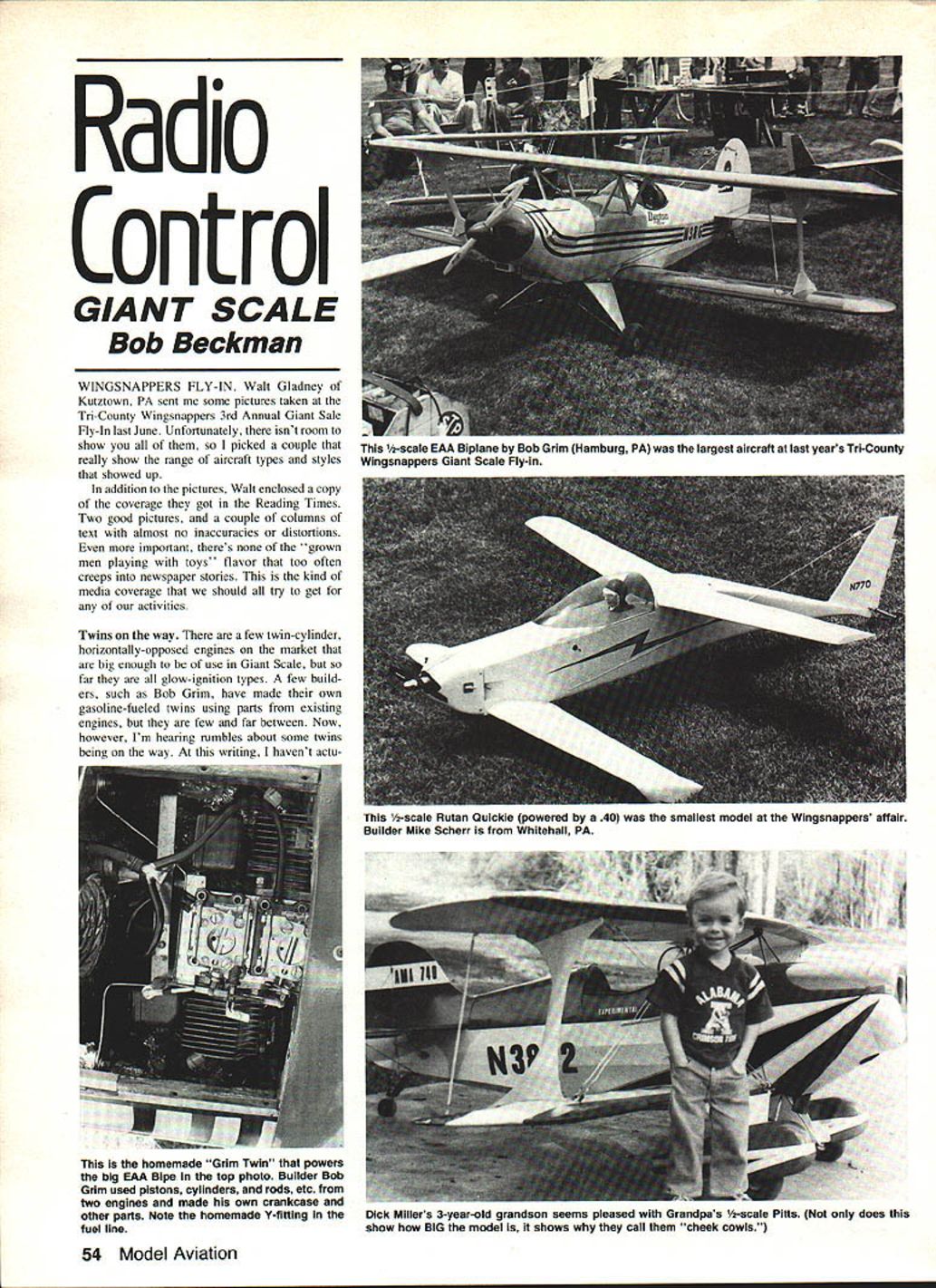
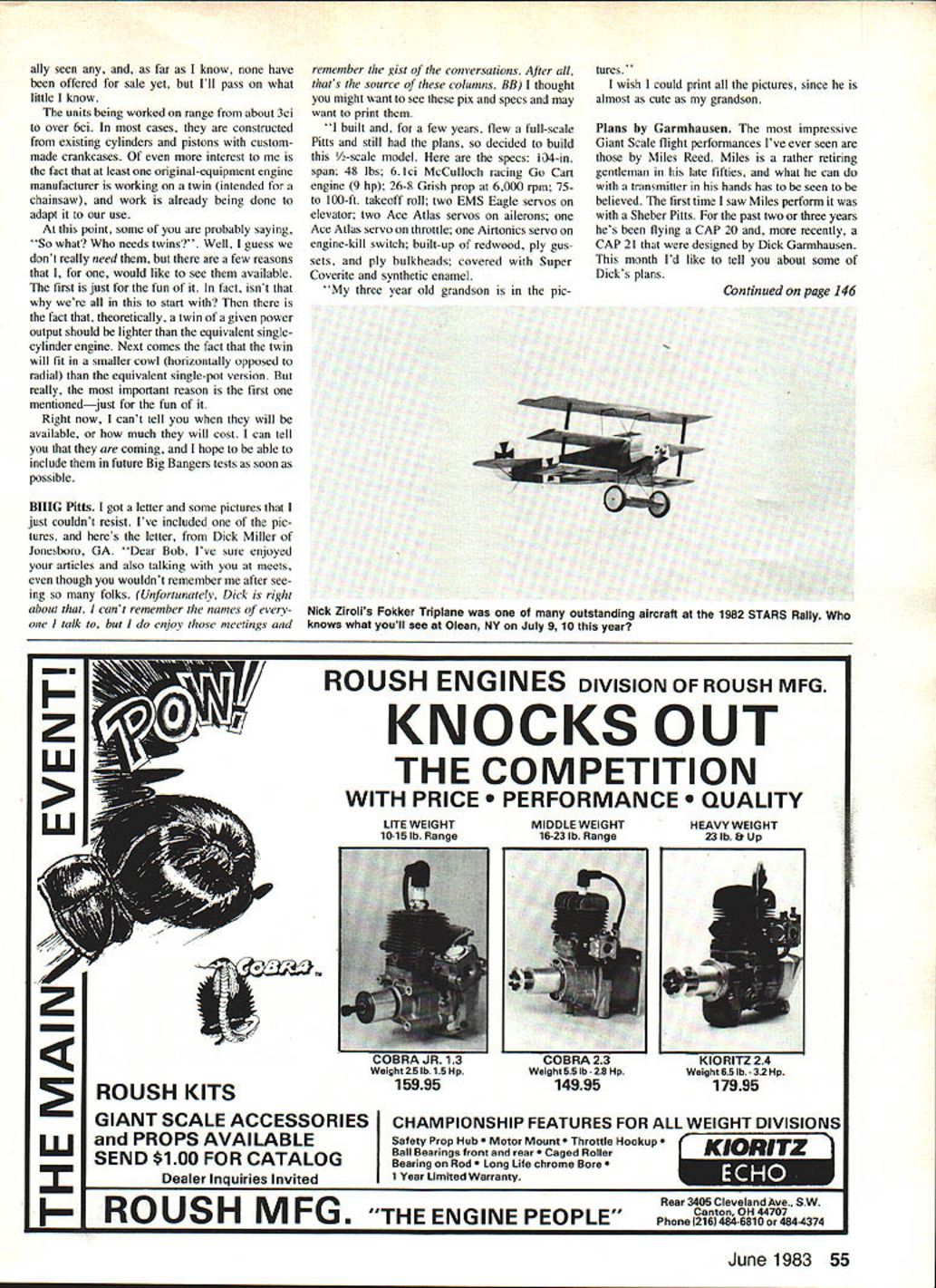
Walt Gladney of Kutztown, PA sent me some pictures taken at the Tri-County Wingsnappers 3rd Annual Giant Scale Fly-In last June. Unfortunately, there isn't room to show you all of them, so I picked a couple that really show the range of aircraft types and styles that showed up.
In addition to the pictures, Walt enclosed a copy of the coverage they got in the Reading Times. Two good pictures, and a couple of columns of text with almost no inaccuracies or distortions. Even more important, there's none of the "grown men playing with toys" flavor that too often creeps into newspaper stories. This is the kind of media coverage that we should all try to get for any of our activities.
Twins on the way
There are a few twin-cylinder, horizontally opposed engines on the market that are big enough to be of use in Giant Scale, but so far they are all glow-ignition types. A few builders, such as Bob Grim, have made their own gasoline-fueled twins using parts from existing engines, but they are few and far between. Now, however, I'm hearing rumbles about some twins being on the way. At this writing, I haven't actually seen any production units.
The units being worked on range from about 3 cu. in. to over 6 cu. in. In most cases, they are constructed from existing cylinders and pistons with custom-made crankcases. Of even more interest to me is the fact that at least one original-equipment engine manufacturer is working on a twin (intended for a chainsaw), and work is already being done there to adapt it to our use.
Now, some of you are probably saying, "So what? Who needs twins?" Well, I guess we don't really need them, but there are a few reasons that I, for one, would like to see them available. The first is just for the fun of it — in fact, isn't that why we're all in this to start with? Then there is the fact that, theoretically, a twin of a given power output should be lighter than the equivalent single-cylinder engine. Next comes the fact that the twin will fit in a smaller cowl (horizontally opposed versus radial) than the equivalent single-pot version. But really, the most important reason is the first one mentioned — just for the fun of it.
Right now, I can't tell you when they will be available, or how much they will cost. I can tell you that they are coming, and I hope to be able to include them in future Big Bangers tests as soon as possible.
BIG Pitts
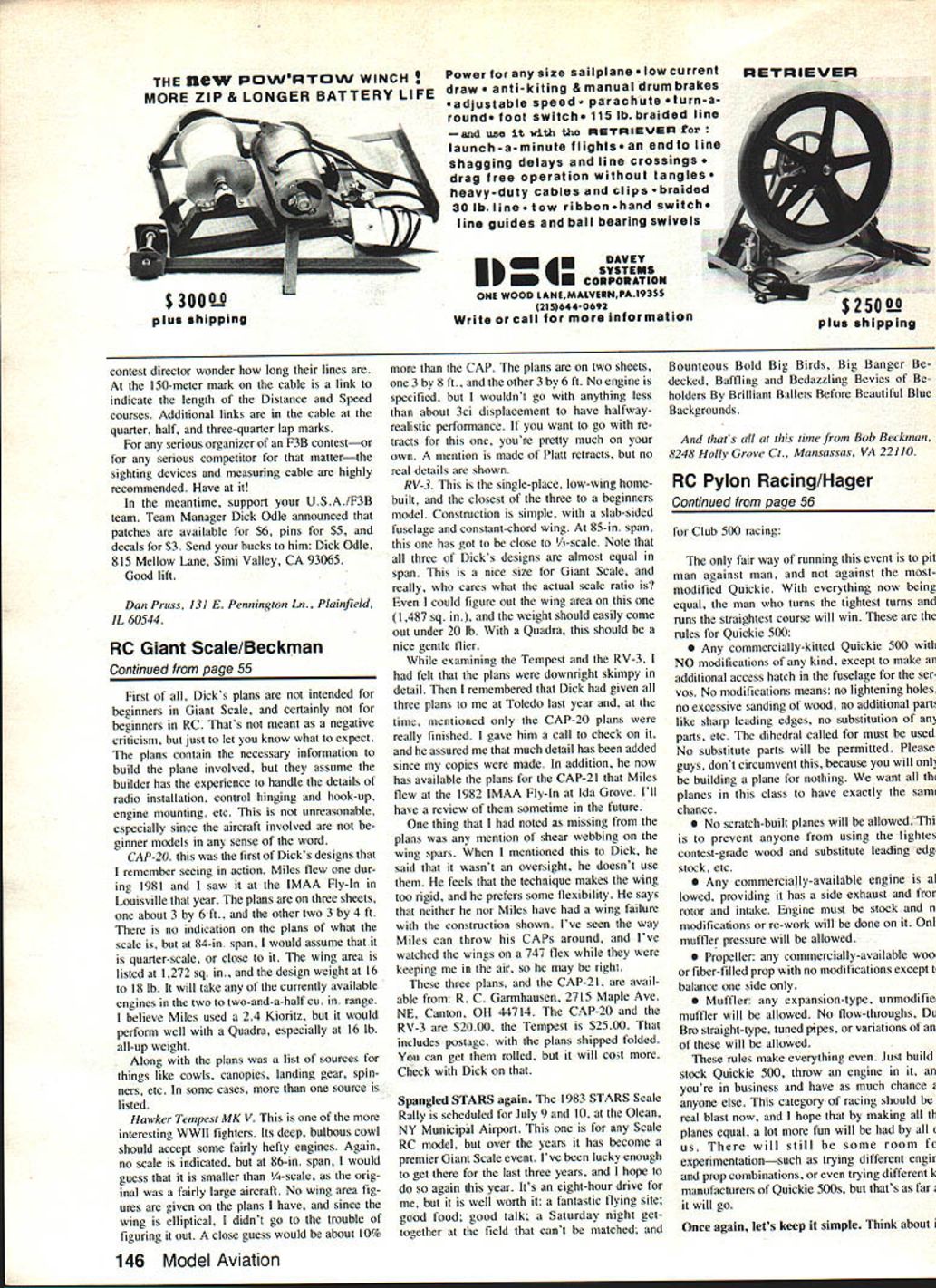
I got a letter and some pictures that I just couldn't resist. I've included one of the pictures, and here's the letter, from Dick Miller of Jonesboro, GA:
"Dear Bob, I've sure enjoyed your articles and also talking with you at meets, even though you wouldn't remember me after seeing so many folks." (Unfortunately, Dick is right about that. I can't remember the names of everyone I talk to, but I do enjoy those meetings and remember the gist of the conversations. After all, that's the source of these columns. — BB)
"I built and, for a few years, flew a full-scale Pitts and still had the plans, so decided to build this 1/2-scale model. Here are the specs:
- 104 in. span
- 48 lbs
- 6.1 cu. in. McCulloch racing go-cart engine (about 9 hp)
- 26x8 prop at 6,000 rpm
- 75 to 100 ft takeoff roll
- Two EMS Eagle servos on elevator
- Two Ace Atlas servos on ailerons
- One Ace Atlas servo on throttle
- One Airtronics servo on engine-kill switch
- Built-up of redwood, plywood gussets, and plywood bulkheads
- Covered with Super Coverite and finished with synthetic enamel
"My three-year-old grandson is in the pictures. I wish I could print all the pictures, since he is almost as cute as my grandson."
Plans by Garmhausen
The most impressive Giant Scale flight performances I've ever seen are those by Miles Reed. Miles is a rather retiring gentleman in his late fifties, and what he can do with a transmitter in his hands has to be seen to be believed. The first time I saw Miles perform it was with a Sheber Pitts. For the past two or three years he's been flying a CAP 20 and, more recently, a CAP 21 that were designed by Dick Garmhausen. This month I'd like to tell you about some of Dick's plans.
First of all, Dick's plans are not intended for beginners in Giant Scale, and certainly not for beginners in RC. That's not meant as a negative criticism, but just to let you know what to expect. The plans contain the necessary information to build the plane involved, but they assume the builder has the experience to handle the details of radio installation, control hinging and hook-up, engine mounting, etc. This is not unreasonable, especially since the aircraft involved are not beginner models in any sense of the word.
CAP-20
This was the first of Dick's designs that I remember seeing in action. Miles flew one during 1981 and I saw it at the IMAA Fly-In in Louisville that year. The plans are on three sheets, one about 3 by 6 ft., and the other two 3 by 4 ft. There is no indication on the plans of what the scale is, but at 84 in. span, I would assume that it is quarter-scale, or close to it. The wing area is listed at 1,272 sq. in., and the design weight at 16 to 18 lb. It will take any of the currently available engines in the 2 to 2.5 cu. in. range. I believe Miles used a 2.4 Kioritz, but it would perform well with a Quadra, especially at 16 lb. all-up weight.
Along with the plans was a list of sources for things like cowls, canopies, landing gear, spinners, etc. In some cases, more than one source is listed.
Hawker Tempest Mk V
This is one of the more interesting WWII fighters. Its deep, bulbous cowl should accept some fairly hefty engines. Again, no scale is indicated, but at 86 in. span, I would guess it is smaller than 1/4-scale as the original was a fairly large airplane. No wing area figure was given on the plans I have, and since the wing is elliptical, I didn't go to the trouble of figuring it out. A close guess would be about 10% more than the CAP. The plans are on two sheets, one 3 by 8 ft., and the other 3 by 6 ft. No engine is specified, but I wouldn't go with anything less than about 3 cu. in. displacement to have halfway-realistic performance. If you want to go with retracts for this one, you're pretty much on your own. A mention is made of Pfalz retracts, but no real details are shown.
RV-3
This is the single-place, low-wing homebuilt, and the closest of the three to a beginner's model. Construction is simple, with a slab-sided fuselage and constant-chord wing. At 85 in. span, this one has got to be close to 1/5-scale. Note that all three of Dick's designs are almost equal in span. This is a nice size for Giant Scale, and really, who cares what the actual scale ratio is? Even I could figure out the wing area on this one (1,487 sq. in.), and the weight should easily come out under 20 lb. With a Quadra, this should be a nice gentle flier.
While examining the Tempest and the RV-3, I had felt that the plans were downright skimpy in detail. Then I remembered that Dick had given all three plans to me at Toledo last year, and at the time mentioned only the CAP-20 plans were really finished. I gave him a call to check on it, and he assured me that much detail has been added since my copies were made. In addition, he now has available plans for the CAP-21 that Miles flew at the 1982 IMAA Fly-In at Ida Grove. I'll have a review of them sometime in the future.
One thing that I had noted as missing from the plans was any mention of shear webbing on the wing spars. When I mentioned this to Dick, he said that it wasn't an oversight; he doesn't use them. He feels that the technique makes the wing too rigid, and he prefers some flexibility. He says that neither he nor Miles have had a wing failure with the construction shown. I've seen the way Miles can throw his CAPs around, and I've watched the wings on a 747 flex wildly and still keep on flying, so he may be right.
These three plans, and the CAP-21, are available from:
- R. C. Garmhausen, 2715 Maple Ave., NE, Canton, OH 44714.
- Prices: CAP-20 and RV-3 — $20.00; Tempest — $25.00. That includes postage, and the plans ship folded. You can get them rolled, but it will cost more. Check with Dick on that.
Spangled STARS again
The 1983 STARS Scale Rally is scheduled for July 9 and 10 at the Olean, NY Municipal Airport. This one is for any scale RC modeler, but over the years it has become a premier Giant Scale event. If you're lucky enough to get there for the last three years, and I hope to, you can see some of the best flying in the country. It's an eight-hour drive for me, but it's well worth it: a fantastic flying site; plenty of good food; good talk; a Saturday night get-together at the field that can't be matched; and bounteous, bold big birds — big-banger bedecked, baffling and bedazzling bevies of beholders by brilliant ballets before beautiful blue backgrounds.
And that's all at this time from Bob Beckman, 8248 Holly Grove Ct., Manassas, VA 22110.
Transcribed from original scans by AI. Minor OCR errors may remain.

