
Radio Control: Giant Scale
Bob Beckman
When is a plan a PLAN?
When is a plan a PLAN? Over the past three years I have looked at—and reported on—a lot of Giant Scale plans. In the process I have reached some conclusions about plans in general, and those conclusions are finding their way into my reviews. In fairness to both plan users and plan producers, I think it's time I passed on those conclusions.
Philosophy of building
In my own mind, I identify three basic categories of building:
- Kit-building
- Plan-building
- Scratch-building
Most modelers seem to recognize only two categories and use the term "scratch-built" to mean anything not built from a kit. For a lot of reasons I think that catch-all term should be split in two.
One reason is that the person who designs and documents a model so others can reproduce it from his plans deserves credit. We commonly say a model was built from a Nosen kit or a Balsa U.S.A. kit, but how often do we hear that a model was made from someone's plans? Time and again I've had people tell me they scratch-built their model, yet when you ask more questions you find they used plans produced by someone else.
I'm not saying there's anything wrong with plan-building. I just think the person who did the design and the drawings should get his share of the credit. There's another reason to distinguish plan-building from scratch-building.
In RC modeling, as in any well-established construction hobby, the participant usually follows a pattern of skill development. He starts with a kit that contains all (or most) of the materials needed and, in some cases, some parts preformed or pre-assembled. Once basic construction is mastered, he usually moves on to better assembly and finishing techniques. Some people never build anything but kits, and they produce beautiful, fine-performing aircraft.
Some people, however, aren't satisfied with the kits available. Maybe they want a particular full-scale design that hasn't been kitted, or, as is often the case in Giant Scale, isn't available in the size they want. These people are ready for the next step: they find plans for the model they want and procure and process the materials required. The jump in skill level from kit-building to plan-building isn't large, but it is important. Plan-builders are more likely to substitute different materials and try new techniques. Plan-building is just a tad more creative than straight kit-building, and plan-builders can be justly proud of their efforts.
The next step, true scratch-building, is much bigger. Here the modeler becomes a designer—envisaging a final product and converting that vision into a tangible, operational reality. You might say a Scale or semi-Scale model of a real airplane already has the design done for him. True, in terms of outlines and appearance, but there's a lot of design involved in working out aerodynamics and structure for a successful miniature aircraft.
I'm not saying any one of these three methods is better than the others; over the years I've used all three myself. There can be fuzzy areas: I've seen models based on kits extensively modified toward scratch-built. Of course, a true scratch-builder wouldn't have used the other two categories in the first place.
Conclusions about plans
The majority of Giant Scale plan buyers are plan-builders—a subset made up largely of beginners and previous kit-builders of standard RC models. The relative paucity and cost of Giant Scale kits means many people looking at plans are relatively inexperienced in Giant Scale and need real guidance on materials and construction techniques. Experienced RC modelers are often not fully aware of the different requirements of larger airframes.
As a result, if you usually try to look at a set of plans with little or no background in Giant Scale, and the plan doesn't have a fair amount of detail, it won't seem very useful. Some plan-makers may feel this is fair—"the plan is for the experienced builder who will know all those things"—but the experienced builder is probably busy drawing his own plans. If you want to sell plans, direct your efforts to the only volume market there is: the relatively inexperienced builder. The experienced builder who wants your particular plane will still buy, but he is outnumbered by people who need and will appreciate a little extra help in the way of good detailing.
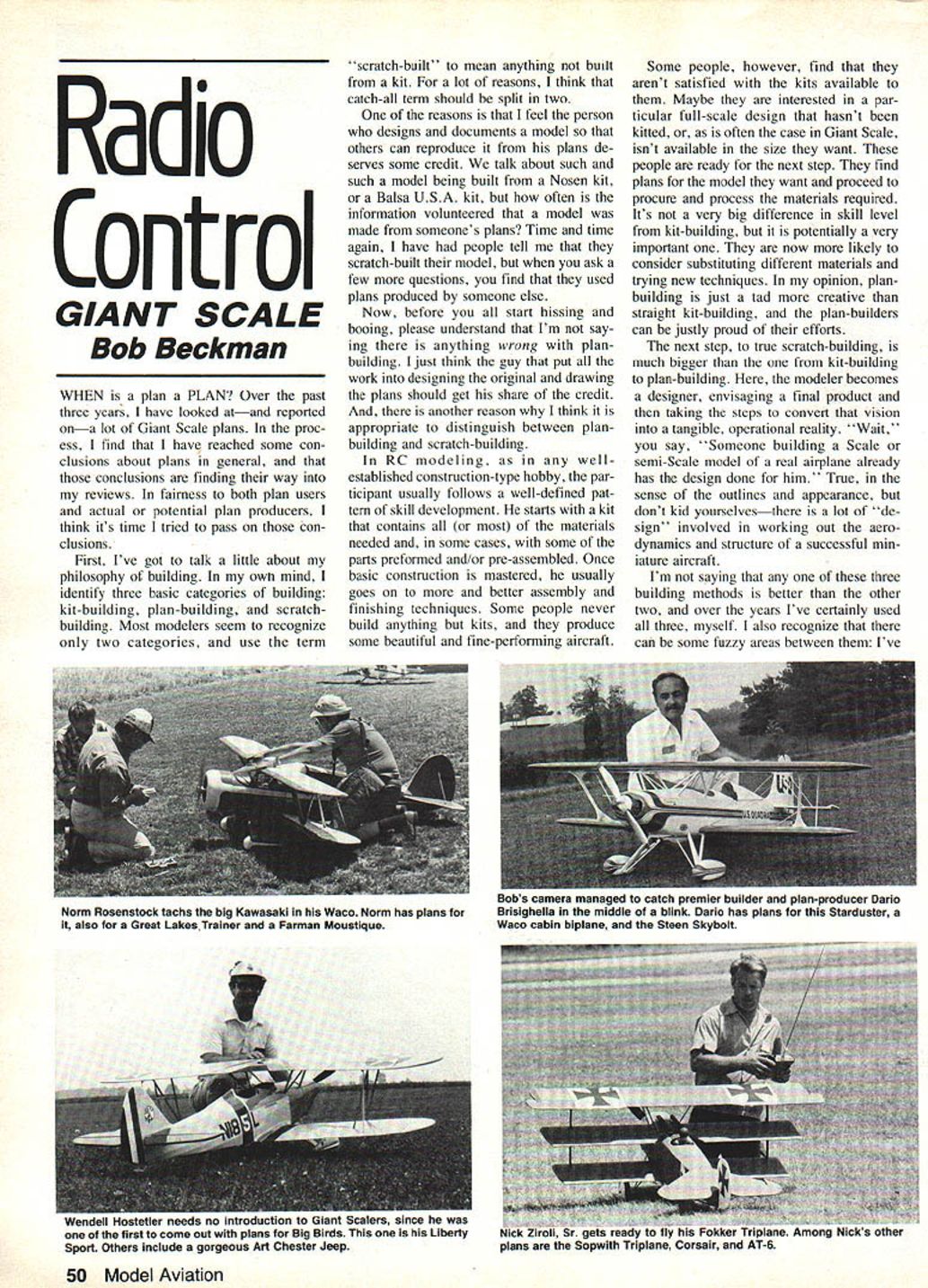
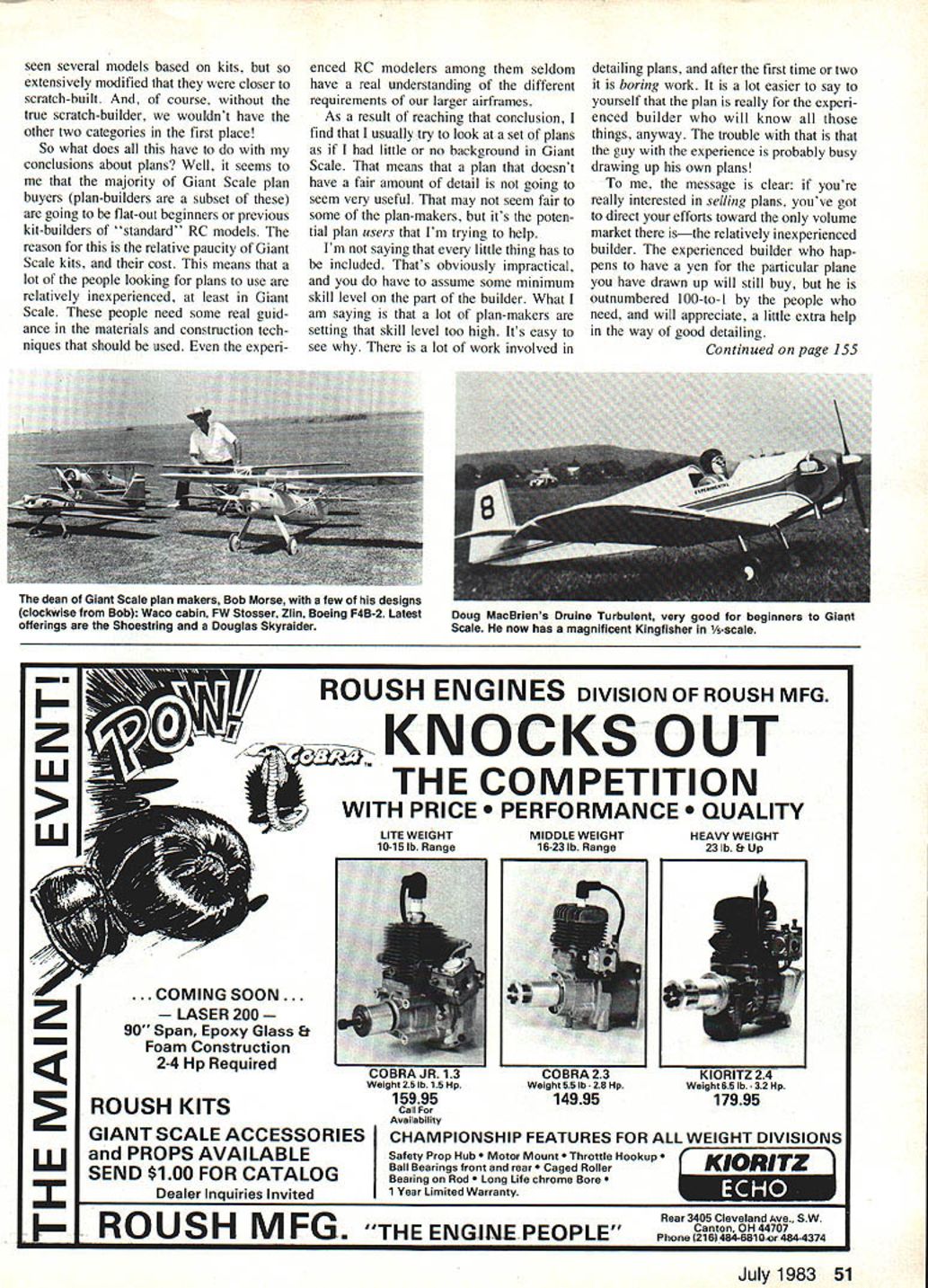
My photos this month are all of aircraft built from what I consider PLANS. The designers involved are not the only good ones, but in my opinion they are among the very best.
Getting started
I recently got a letter from an Israeli Control Line modeler who is interested in getting into Giant Scale. His problems are not that different from any other newcomer, so I thought my answer would be worth passing on.
Dear Boaz, Thank you for your letter and the photos of your CL model. If you apply that kind of workmanship to your Giant Scale efforts, you'll be a real credit to our branch of the hobby.
Answering your questions presents a bit of a problem. A proper answer to everything mentioned in your letter would be a very complete book on building Giant Scale aircraft. As it turns out, there are already some books available:
- Dick Phillips, who writes the "Big is Beautiful" column in RCM, has put together a useful book on building large models. I think the price is $10.00. Write to: Dick Phillips, 9 Geneva Crescent, St. Albert, Alberta, Canada T8N 0Z3.
- Model Airplane News recently put out a special on Giant Scale called Giant Steps. It has a lot of good information on general building techniques. You should be able to get it anywhere you can buy MAN, or write to: Model Airplane News, 837 Post Road, Darien, CT 06820.
- I have written a book titled Building and Flying Giant Scale Radio Control Aircraft. Kalmbach Publishing Co. will be bringing it out in early June. The price will be less than $15, and you will be able to buy it in most hobby stores. If you can't find it, write to me and I'll see that you get a copy.
Unfortunately, none of these has much information on converting engines. I am working on an engine book, but it will be some time before it is available. I tried to answer a couple of your engine-related questions in my letter.
The point is there are a lot of people out there with a lot of questions. Our other columnists (I think of them as "Old Dads": Dick, Al, and Don) get letters like that too, and we just can't answer them all.
Vibration and engine mounting
With these larger engines we have been giving vibration a real "fight." A number of little things have gone wrong with these larger engines and planes in use, and almost without exception the bugs were traced to vibration. About the middle of the summer (1982, B.B.) we made a concentrated effort to solve the vibration problem. We purchased and used several types of Lord mounts and installed these in various ways. We were able to reduce and almost eliminate vibration in the airframe, but at the expense of excessive vibration in the engine. Over a period of six or eight flights the engines were shaking themselves apart.
After much experimentation we reverted to a solid firewall engine mounting. The solid mounting is unquestionably the superior way to go for the larger engines. We conclude that the difference between our model applications and full-scale is that we use single-cylinder engines—"one-lungers"—and herein lies the difference. Although there is still vibration with the solid-mount system, it is tolerable, and we are enjoying good success. I have always felt that, in the long run, a solid mount with an airframe built to absorb the vibration is superior to any attempt at shock-mounting.
Wendell has come up with useful experience on the subject and put his finger on what I think is the key point: we're using one-lungers. A simultaneous-firing opposed twin might be a different matter.
Machined parts and fabrication
Our Giant Scale models are much like full-scale aircraft. They not only fly like real airplanes; in many ways they can and should be built like real airplanes. This is particularly true of high-stress areas like landing gear, strut fittings, engine mounts, exhaust systems, etc. Some items are available commercially, but they are not always suitable for a particular scale subject. Sometimes an item will be too large to fit into the available space, or it will be visible and just too non-scale to be acceptable.
In such cases the best (and often only) solution is to make a reduced-size version of the original fitting or structure using materials strong enough to take the stresses involved. That usually means metalworking of some sort. Most modelers can handle tasks like bending landing gear from 5/16-in. wire, even though they seldom have to because such items are readily available. But what about the 1/4- or 5/16-in. wire needed for Giant Scale? Or cast, forged, welded, or machined parts needed for true, operational replicas of the real thing?
Few of us have the skills or equipment for this kind of work. We depend on such items being included in kits or being available for models built from plans. If you want to design and build from scratch, you sometimes have to give up projects because you can't make the parts you need.
I recently got a note from Bob Demitz of St. Louis that bears on this subject. He included a flyer from an outfit called Mason Machine in Phoenix, AZ. They do custom fabricating in quantities of one to several (most machine shops don't want to talk about anything less than hundreds) and it sounds as if they have the experience and equipment to do almost anything we might need. I have no direct experience with their work, but Bob says he has been using them and that the work is good and the price right. If you need something like this, it can't hurt to check them out:
- Mason Machine, 3439 W. Michigan Ave., Phoenix, AZ 85023.
Quantico Scale Rally
The Fifth Annual Scale Rally at the Marine Air Museum, Quantico, VA is scheduled for July 9 and 10, 1983. The event is sponsored by the United States Marine Corps and the Northern Virginia RC Club. While the event is open to any Sport Scale model, it is another example of Giant Scale rapidly taking over. A special feature is the Gemeinhardt Trophy, awarded by the Marine Corps to the best model of an aircraft that was ever flown by the Marines. That turns out to be a surprisingly long list of both Navy and Army types.
For more information write to:
- Contest Director: Ed Beyerle, 200 Commander Cove, Stafford, VA 22554
- Phone: (703) 659-6469
Contact
Bob Beckman 8248 Holly Grove Ct. Manassas, VA 22110
Transcribed from original scans by AI. Minor OCR errors may remain.

