
Radio Control: Giant Scale
Bob Beckman
Timely News
Giant Scale Fly-In (Sikorsky Memorial Airport)
Last year Ray Hinds wrote to tell me about the Giant Scale Fly-In his group was planning for some time in June. He got the info to me in time to get a note into my column. Then it rained giant-sized cats and dogs on their date, and they had to reschedule. They set a new date in October, and Ray got that dope to me in time to get that into the column. Now Ray has followed up with pictures of the event and the schedule for this year.
According to Ray's note, they had 42 participants from five states and 55 aircraft. That's a pretty good turnout for a first-time affair. The Fly-In was at Sikorsky Memorial Airport, with enough runway and sky room for four flight lines—and to make up for the busted June date, the weather was warm and sunny.
In fact, the weather was so good that they decided to have their 2nd Annual in October, again. This year it will be two days, October 1 and 2. Sikorsky Memorial Airport is near Stratford, CT. For more information contact Ray Hinds, 140 Edna Ave, Bridgeport, CT 06610. Tel. (203) 334-7207.
IMAA Festival
3rd Annual IMAA Fun-Fly Festival (Ida Grove, IA)
The IMAA's 2nd Annual Fun-Fly Festival in 1982 was a tremendous success. While Ida Grove, IA may have seemed out-of-the-way to a lot of people, a large number of us found it and had a great time. The 3rd Annual is going to be in Ida Grove, too—and again with the help of the Byron Originals people. This year there will be some additions and subtractions compared to last year.
- A day has been added: it will be a four-day affair from Thursday, August 18 through Sunday, August 21.
- A second flying area will reduce waiting time for those who want to fly.
- Other additions include daily seminars, a Swap 'n Fly shop, and even more manufacturers' displays.
Since it will already be July when you see this (even though I'm writing it in early April), it may be too late to register as a participant. You can still come out and have a good time, though. You don't have to be an IMAA member to enjoy the biggest and best of the RC hobby.
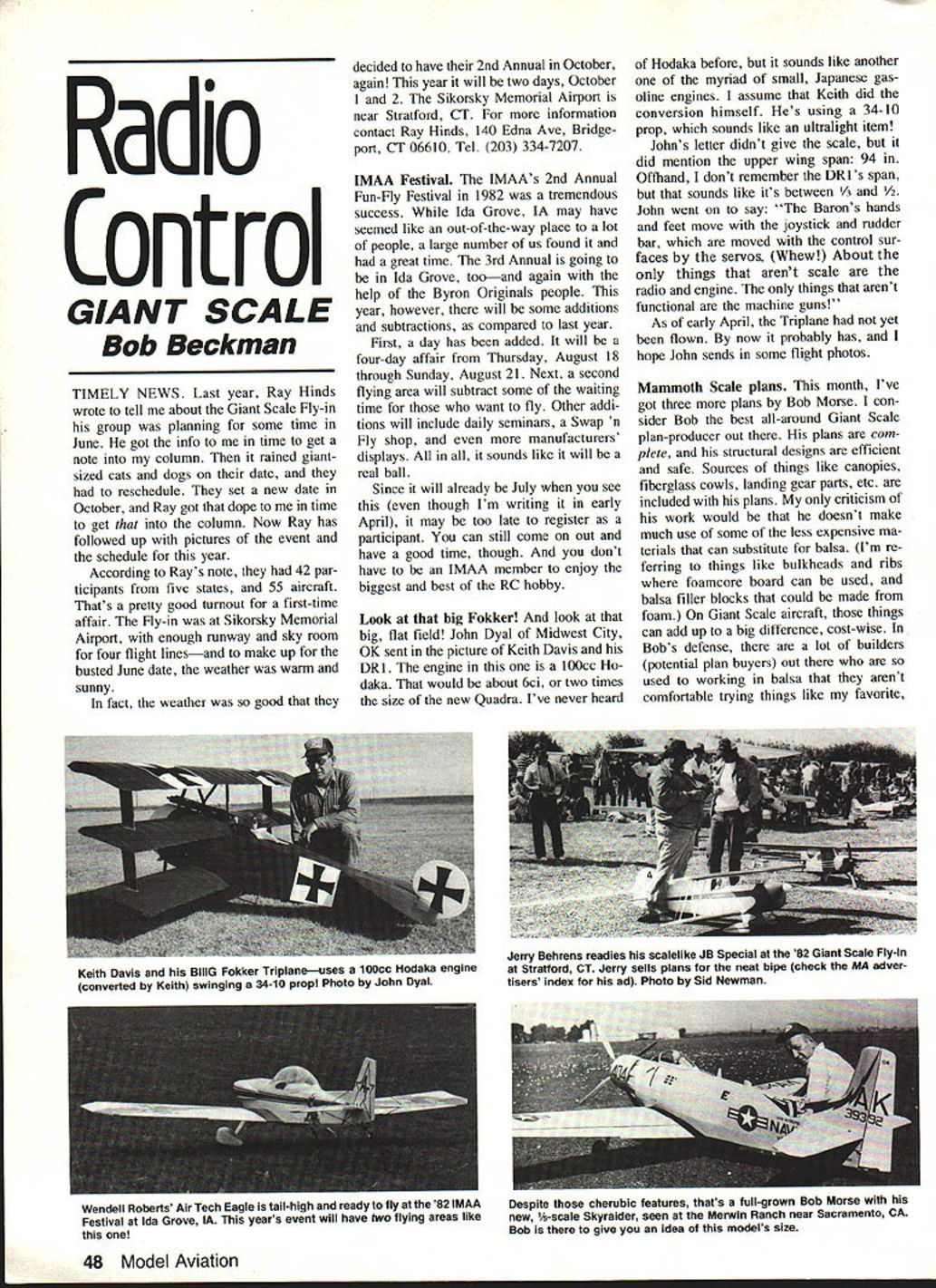
Photo: Big Fokker and Field
John Dyal of Midwest City, OK sent in the picture of Keith Davis and his DRI. The engine in this one is a 100 cc Hodaka (about 6 ci, or roughly twice the size of the new Quadra). I've never heard of Hodaka before, but it sounds like another of the myriad small Japanese gasoline engines. I assume Keith did the conversion himself. He's using a 34-10 prop, which sounds like an ultralight item.
John's letter didn't give the scale, but it did mention the upper wing span: 94 in. Offhand, I don't remember the DRI's span, but that sounds like it's between 2/3 and 1/2 scale. John went on to say: "The Baron's hands and feet move with the joystick and rudder bar, which are moved with the control surfaces by the servos. (Whew!) About the only things that aren't scale are the radio and engine. The only things that aren't functional are the machine guns!"
As of early April the triplane had not yet been flown. By now it probably has, and I hope John sends in some flight photos.
Mammoth Scale Plans
This month I've got three more plans by Bob Morse. I consider Bob the best all-around Giant Scale plan producer out there. His plans are complete, and his structural designs are efficient and safe. Sources for things like canopies, fiberglass cowls, landing gear parts, etc., are included with his plans.
My only criticism of his work is that he doesn't make much use of some less expensive materials that can substitute for balsa (for example, foam-core board for bulkheads and ribs, and foam for filler blocks). On Giant Scale aircraft those substitutions can add up to a big cost difference. In Bob's defense, many builders are so used to working in balsa that they aren't comfortable trying alternatives.
Two plans this month are designs with both flaps and retracts. Bob shows details of the systems right in the plans and gives sources for parts if you don't feel up to doing it yourself. Both flap-retract systems were designed by Phil Karafilis; both are airoperated. Information on systems, structures, control-surface hinging, and control linkage appear in Bob's plans. Bob's plans would be useful for building Giant Scale aircraft; in fact Bob's A-1H plans would be a good investment for anyone interested in building large retract-equipped models.
A-1H Skyraider
The A-1H Skyraider is a particular labor of love. Bob worked at Douglas during World War II and participated in the design of the original Skyraider. The model is one-fifth scale, spans 10 ft, with wing chord at the root over two feet, and the total wing area is over 16 sq ft (2,300 sq in). The prototype weighed in at 32 lb with fixed gear and, judging by the flight performance, was far from overloaded. Bob is building another one with the retracts shown on the plans. Power is the Kawasaki 3.15 from C.B. Associates, and certainly nothing less should be used.
North American T-28B
This 1/5-scale model of the well-known tricycle-geared trainer was designed by Phil Karafilis. It was designed and built, including the retracts, during a five-week period in 1981. Phil's twin-Quadra-powered A-20 had crashed on its first takeoff at the June 1981 Sacramento Fly-In. The post-mortem disclosed that the fuel-feed pickup in the left tank had come off, and the port-side engine quit due to fuel starvation shortly after the plane rotated on takeoff. It took Phil about three days to get over his "I'm going to get out of this $%*# hobby!" feelings and start on a new model for the Hill Country Fly-In coming up that August. It was quite an accomplishment, and the model is a magnificent flier.
Bob has done a superb job of turning Phil's working drawings into clear, detailed, and complete plans that the rest of us can follow easily. This is one of the reasons I consider Bob tops in this field: he not only draws good plans of his own designs, he can work with other modelers and help to pass their work on for all of us.
The T-28B spans 102 in, with 1,740 sq in of wing area. The original is powered with a Kawasaki 3.15 and weighs in at 44 lb. Some care in building could trim a bit off that, and you certainly don't want to go over. This is another design that was not intended for the original 2 ci Quadra, and even the new 3 ci Q-50 Quadra might be marginal.
Shoestring
This is one of my all-time favorite airplanes. Years ago I built one of the Goldberg kits, and it was one of the best sport fliers I ever had. This version is scaled at 4.9 in to the foot, which makes it a little more than one-third the size of the real one. It was designed specifically for the Kawasaki 3.15 ci engine, but anything from 2.5 to 4.0 would do. I'm even thinking of building one with a 2.2 Kawasaki. If I watch the weight, I should have a Giant Scale version of the .40-powered sport flier I liked so well.
Bob's Shoestring spans 94.5 in, with 1,492 sq in of wing area. Weight is listed as 28 lb. As usual, the plans are full of information about how to do things and where to get the materials you need.
Ordering Mammoth Plans
All of these plans are available from Mammoth Scale Plans, 3351 Pruneridge Ave., Santa Clara, CA 95051. The A-1H and T-28B are each $36, and the Shoestring is $24.50. Those prices include postage and handling, and all plans are shipped rolled in mailing tubes. An SASE to the above address will get you a complete list of their plans.
Grumman F-7F Tigercat
This was the first of Bob Campbell's Giant Scale multi-engine aircraft. Since the Tigercat he has built his famous B-29 and now his new C-130 Hercules. While planes like this aren't for everybody, they certainly are fascinating.
Bob's Tigercat weighs 65 lb, spans 9-1/2 ft, and is powered by two Q-35 Quadras. (With two Quadras available now, we have to differentiate between them: the Q-35 is the original, 2 ci version.) After some problems with earlier retract systems, Bob wound up with units from Acromarine. I have seen the model fly several times, and it is impressive. Bob says it's a dream to fly, with no bad habits.
The fuselage is keel-and-former construction, planked with 1/4-in balsa. The left half is completely planked with everything pinned down to the bench. The formers and planking are then added to the other side, resulting in a monocoque fuselage shell. The wings and stab are foam cores sheeted with balsa. The engine nacelles are built into the inner wing panels and are permanently attached to the fuselage. Only the tips of the wings are removable.
When you first look at the plans they don't seem to have much structural detail—but with this type of construction there isn't much to detail. Of course you need the foam cores, and they are available from R/C Kit Mfg. Co. Two typewritten pages of instructions printed on the plans have most of the information you need. There is not a lot of detail on control installation, but no one except a very experienced Giant Scale modeler should be trying anything like this, anyway.
I don't have the price in my notes, but you can get the plans and/or further information about prices, cores, retracts, materials, etc., from R/C Kit Mfg. Co., 706 Easton NE, Canton, OH 44721.
Bob Beckman 8248 Holly Grove Ct. Manassas, VA 22110
Transcribed from original scans by AI. Minor OCR errors may remain.

