
Radio Control: Giant Scale
Bob Beckman
Big Banger Starter
Starting our Giant Scale engines can sometimes be a bear. Many start easily by hand, but some otherwise outstanding engines can resist all efforts to get them going. For some time I had heard rumors about a simple, effective, and inexpensive starter. The other day one showed up in the mail, along with some information about it.
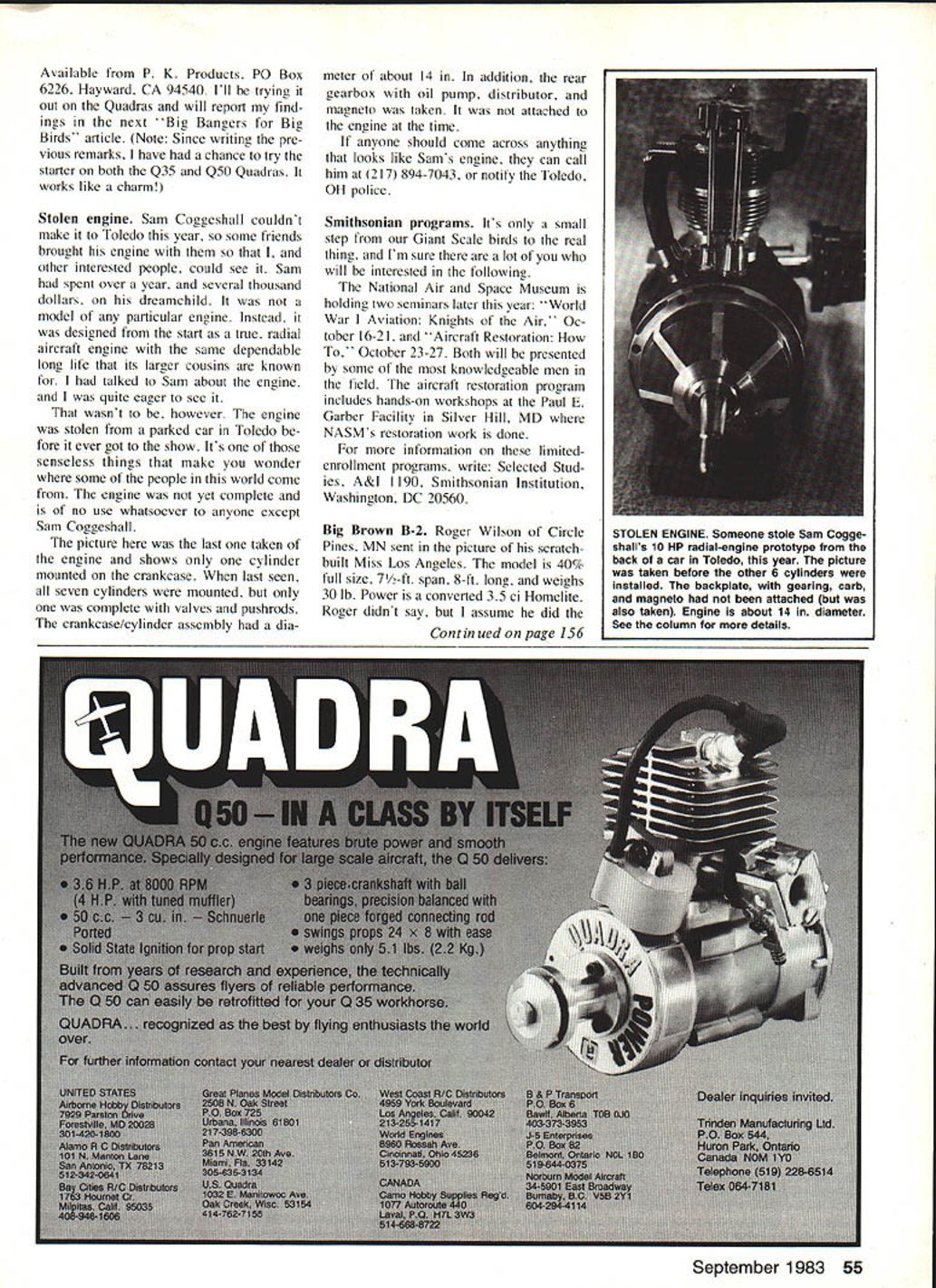
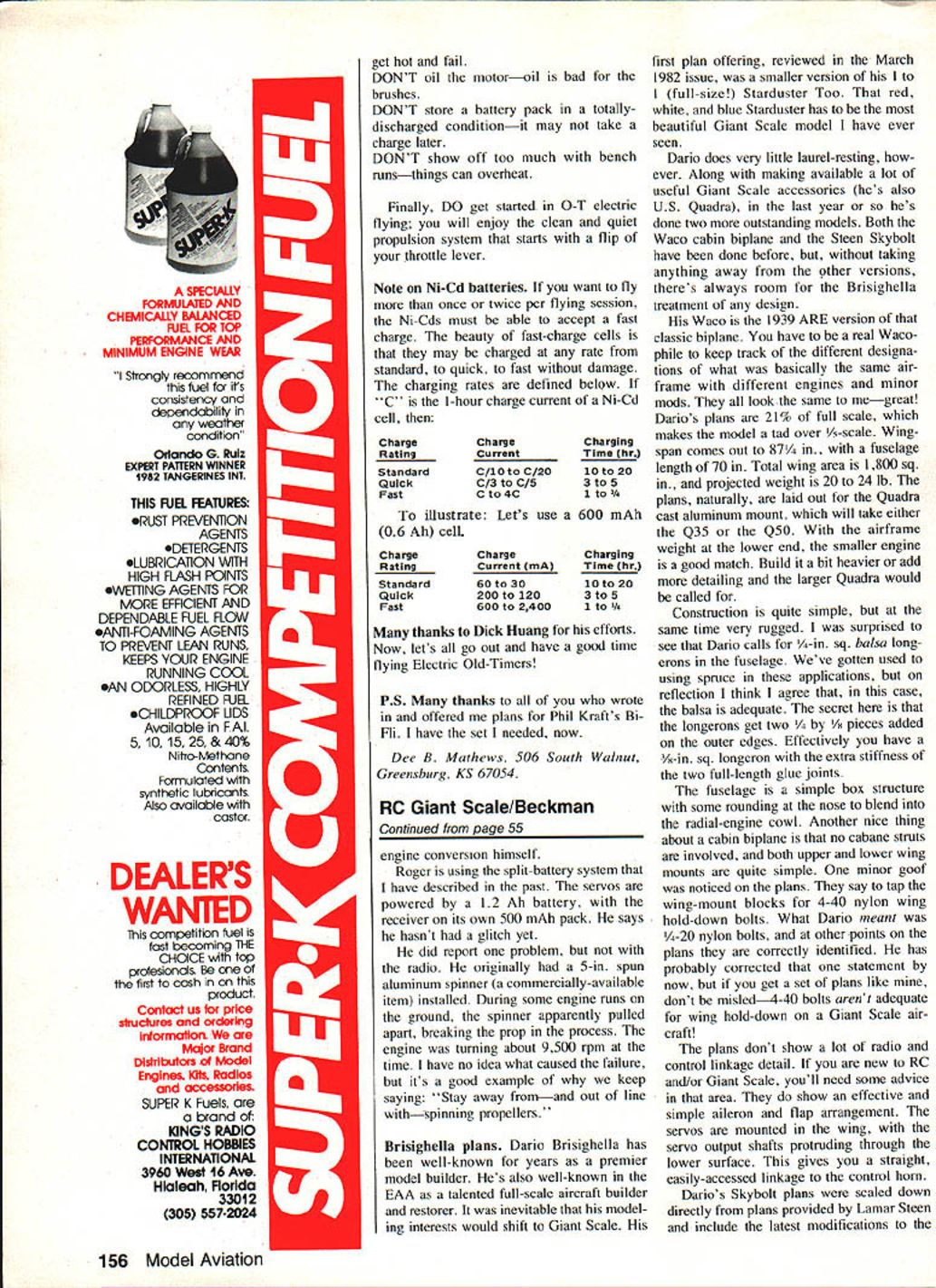
The basic idea is simple. Gerry Holdeman turned it into a practical reality and Paul Kinney made it available. All it is is a strong coil spring and a one-way clutch that mounts on the rear shaft of the engine. The clutch engages when the prop is turned backwards. Turning the prop one-half to one turn against the spring and then releasing it results in the engine being turned over two or three times — and it turns over fast enough to generate a good spark, even from CD electronic systems on some engines.
The H&K Super-Starter is available now for Quadras of both sizes and for the Magnum II. Units for other engines with rear shafts will be available soon. Introductory price is $29.95 plus $1.50 postage. Available from P. K. Products, PO Box 6226, Hayward, CA 94540.
I usually don't like to talk about something until I've had a chance to use it myself, but I'll mention it now and tell more in an upcoming "Big Bangers" article. Note: since writing the previous remarks, I have had a chance to try the starter on both the Q35 and Q50 Quadras. It works like a charm!
Stolen engine
Sam Coggeshall couldn't make it to Toledo this year, so some friends brought his engine with them so that I and other interested people could see it. Sam had spent over a year and several thousand dollars on his dream machine. It was not a model of any particular engine; instead it was designed from the start as a true radial aircraft engine, intended for the same dependable long life as its larger cousins. I had talked to Sam about the engine and was eager to see it.
That wasn't to be, however. The engine was stolen from a parked car in Toledo before it ever got to the show. It's one of those senseless things that make you wonder about some people. The engine was not yet complete and is of no use whatsoever to anyone except Sam Coggeshall.
The last picture taken shows only one cylinder mounted on the crankcase. When last seen, all seven cylinders were mounted, but only one was complete with valves and pushrods. The crankcase/cylinder assembly had a diameter of about 14 in. In addition, the rear gearbox with oil pump, distributor, and magneto was taken. It was not attached to the engine at the time.
If anyone comes across anything that looks like Sam's engine, call him at (217) 894-7043, or notify the Toledo, OH police.
Smithsonian programs
The National Air and Space Museum is holding two limited-enrollment seminars later this year:
- "World War I Aviation: Knights of the Air," October 16–21.
- "Aircraft Restoration: How To," October 23–27. This restoration program includes hands-on workshops at the Paul E. Garber Facility in Silver Hill, MD, where NASM's restoration work is done.
For more information, write: Selected Studies, A&I 1190, Smithsonian Institution, Washington, DC 20560.
Big Brown B-2
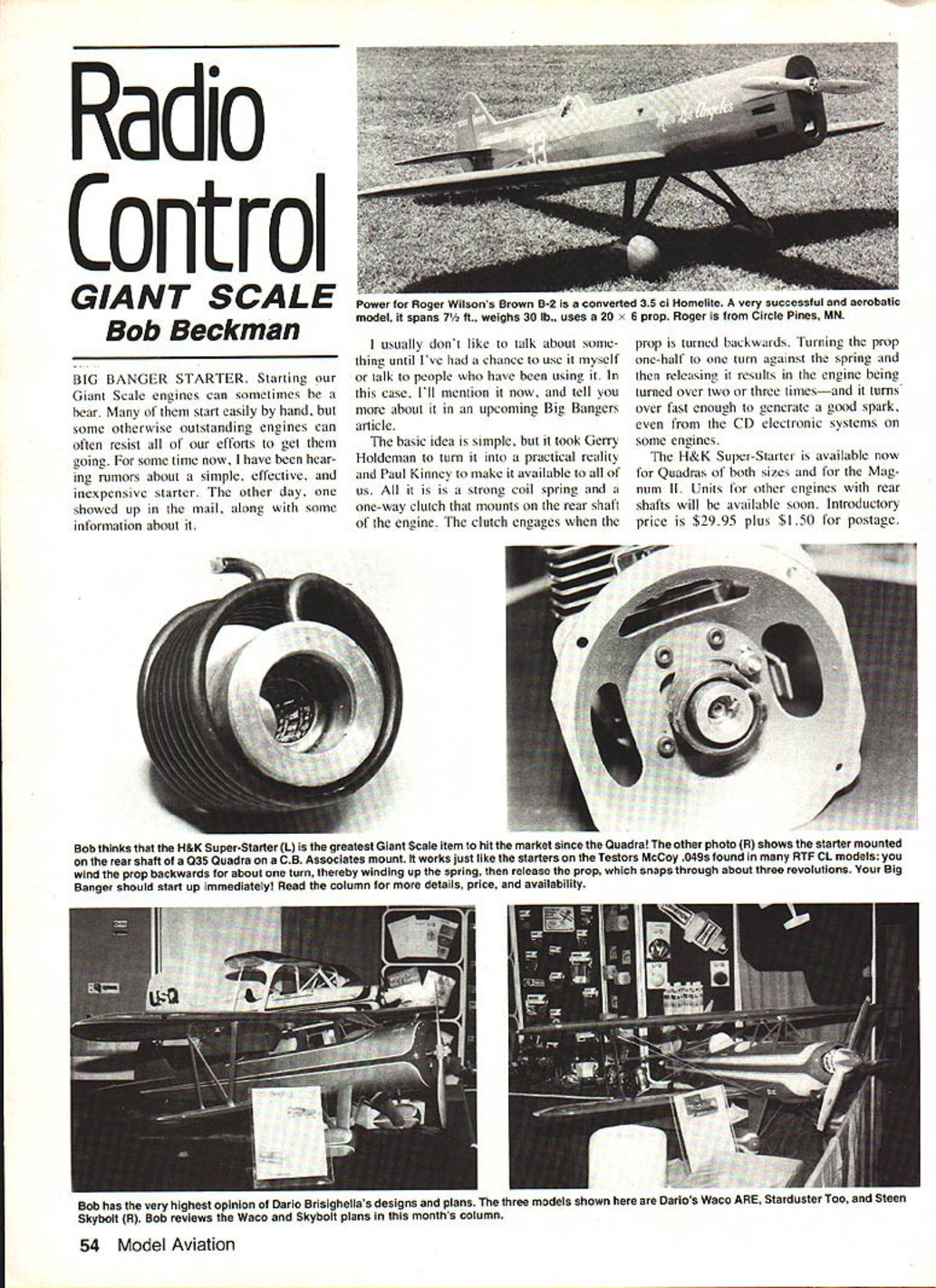
Roger Wilson of Circle Pines, MN sent a picture of his scratchbuilt Miss Los Angeles. The model is 40% full size: 7½-ft. span, 8 ft. long, and weighs 30 lb. Power is a converted 3.5 ci Homelite — Roger didn't say, but I assume he did the engine conversion himself.
Roger is using the split-battery system I've described in the past. The servos are powered by a 1.2 Ah battery, with the receiver on its own 500 mAh pack. He says he hasn't had a glitch yet.
He did report one problem, not with the radio. He originally had a 5-in. spun aluminum spinner (a commercially available item) installed. During some engine runs on the ground the spinner apparently pulled apart, breaking the prop in the process. The engine was turning about 9,500 rpm at the time. I have no idea what caused the failure, but it's a good example of why we keep saying: stay away from — and out of line with — spinning propellers.
Brisighella plans
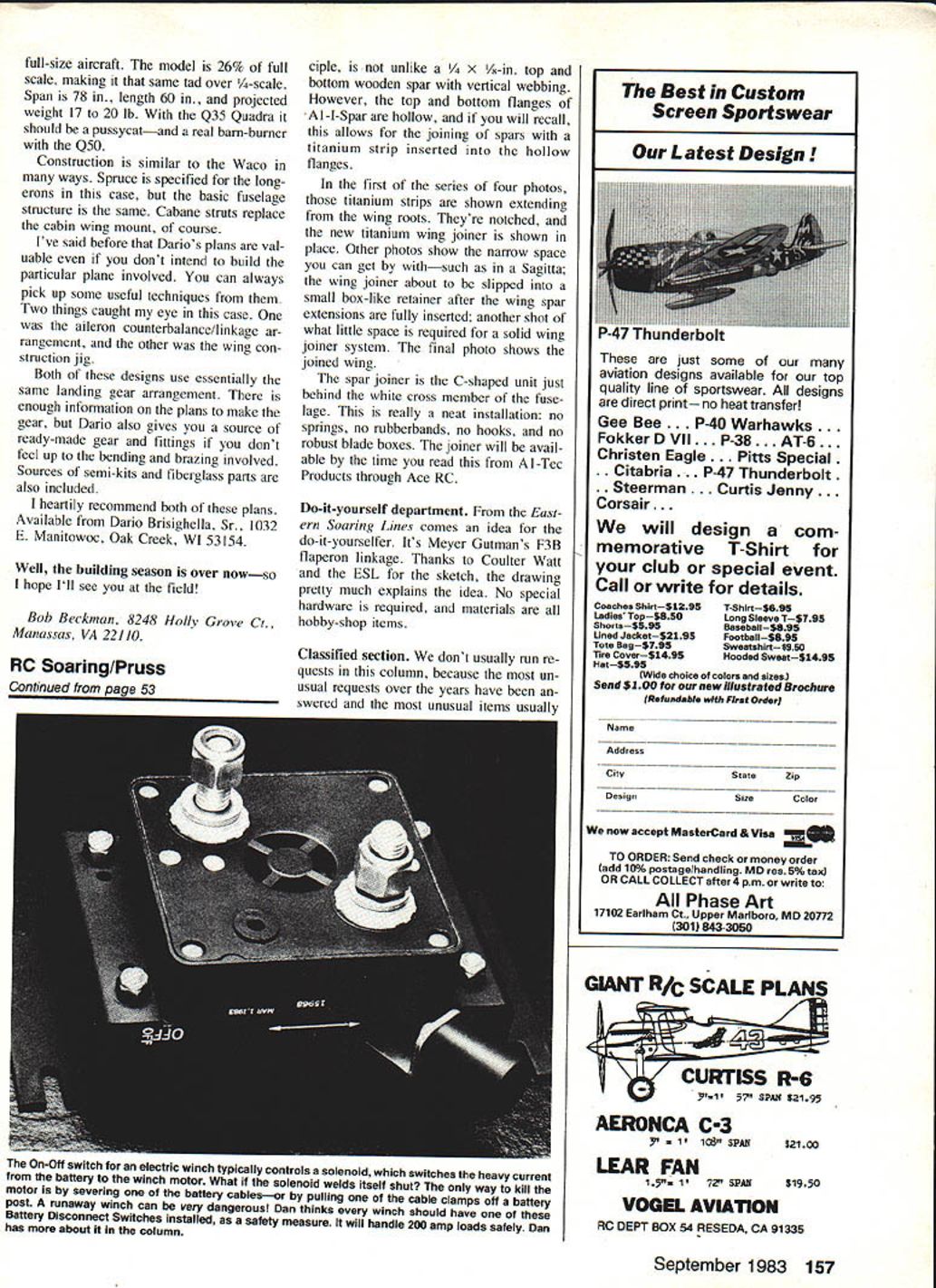
Dario Brisighella has long been known as a premier model builder and as a talented full-scale aircraft builder/restorer in the EAA. It was inevitable that his interests would shift to Giant Scale. His first plan offering, reviewed in the March 1982 issue, was a smaller version of his full-size Starduster Too. That red, white, and blue Starduster is one of the most beautiful Giant Scale models I've ever seen.
Dario does little laurel-resting. Along with making available many useful Giant Scale accessories (he's also U.S. Quadra), in the last year he's produced two more outstanding models: a Waco cabin biplane and a Steen Skybolt. Both have been done before, but Dario's treatment adds value and useful techniques for any builder.
Waco (1939 ARE version)
- Scale: 21½% of full scale (a tad over 1/5-scale)
- Span: 87½ in.
- Fuselage length: 70 in.
- Total wing area: 1,800 sq. in.
- Projected weight: 20–24 lb.
- Engine mount: plans laid out for the Quadra cast-aluminum mount (Q35 or Q50)
Construction is simple and rugged. Dario specifies 1/4-in. sq. balsa longerons in the fuselage, but they receive two 1/8-in. by 1/2-in. pieces added on the outer edges. Effectively you have a 1/2-in. sq. longeron with the extra stiffness of two full-length glue joints. The fuselage is a simple box structure with some rounding at the nose to blend into the radial cowl. A cabin biplane requires no cabane struts; both upper and lower wing mounts are quite simple.
One minor goof on the plans: they say to tap the wing-mount blocks for 4-40 nylon wing hold-down bolts. What Dario meant was 1/4-20 nylon bolts. At other points on the plans they are correctly identified. If you get a set of plans like mine, don't be misled — 4-40 bolts aren't adequate for wing hold-down on a Giant Scale aircraft.
Radio and control linkage detail is not extensive on the plans. If you are new to RC or Giant Scale, you'll need advice in that area. Dario does show an effective and simple aileron and flap arrangement: servos mounted in the wing, elevator and rudder servos in the fuselage, pushrods with clevises, and straightforward, easily accessed linkages to the control horns.
Skybolt (Lamar Steen modifications)
- Scale: 26% of full scale (a tad over 1/4-scale)
- Span: 78 in.
- Length: 60 in.
- Projected weight: 17–20 lb.
Construction is similar to the Waco. Spruce is specified for the longerons in the Skybolt, but the basic fuselage structure is the same. Cabane struts replace the cabin wing mount. Two features that stood out to me were the aileron counterbalance/linkage arrangement and the wing-construction jig. Both models use essentially the same landing gear arrangement; the plans give enough information to make the gear, and Dario also lists sources for ready-made gear and fittings if you're not up for bending and brazing. Sources of semi-kits and fiberglass parts are also included.
I heartily recommend both sets of plans. Available from Dario Brisighella, Sr., 1032 E. Manitowoc, Oak Creek, WI 53154.
Well, the building season is over now — so I hope I'll see you at the field!
Bob Beckman 8248 Holley Grove Ct. Manassas, VA 22110
Transcribed from original scans by AI. Minor OCR errors may remain.

