
Radio Control: Giant Scale
Bob Beckman
OUTTAKES
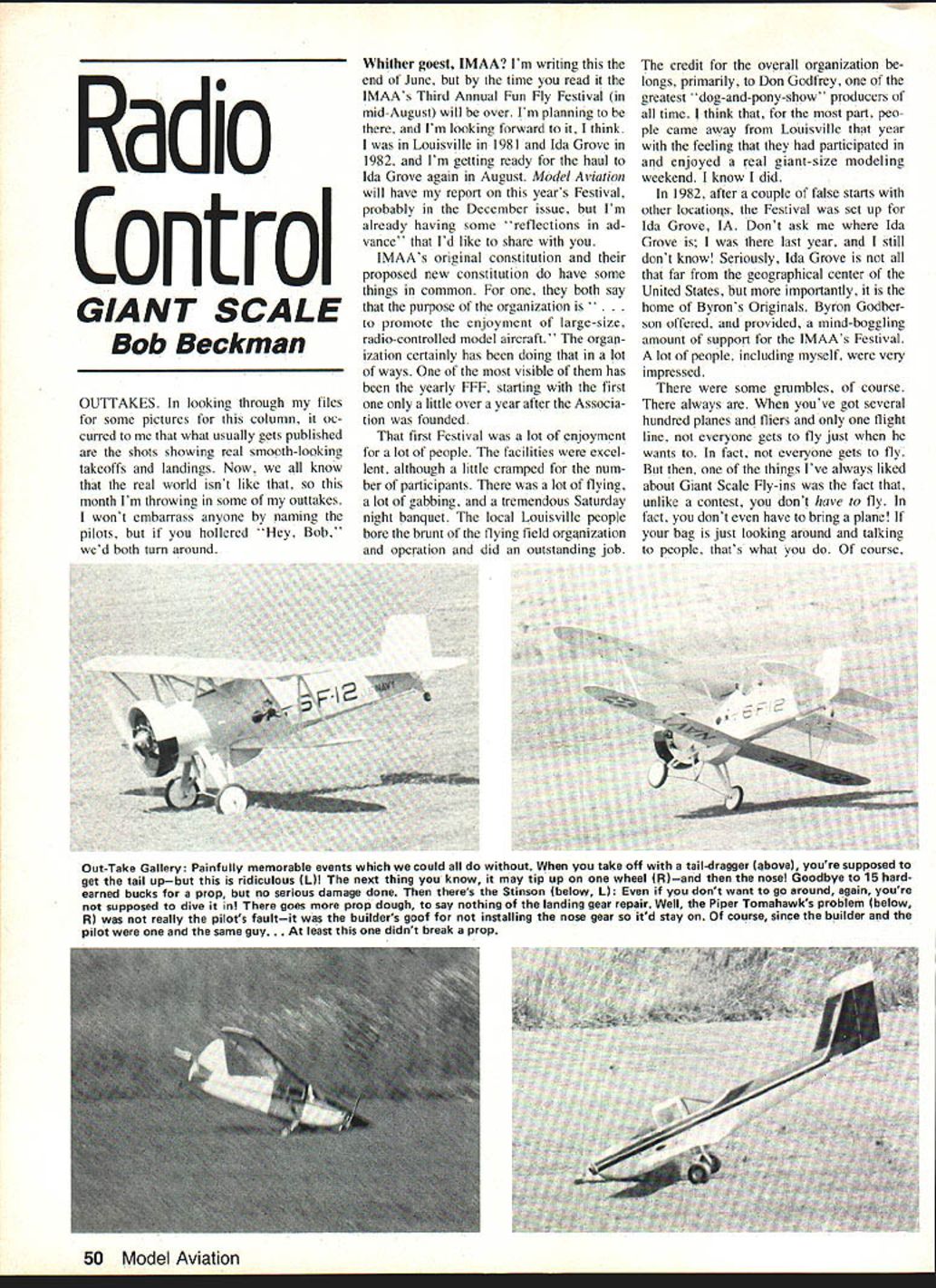
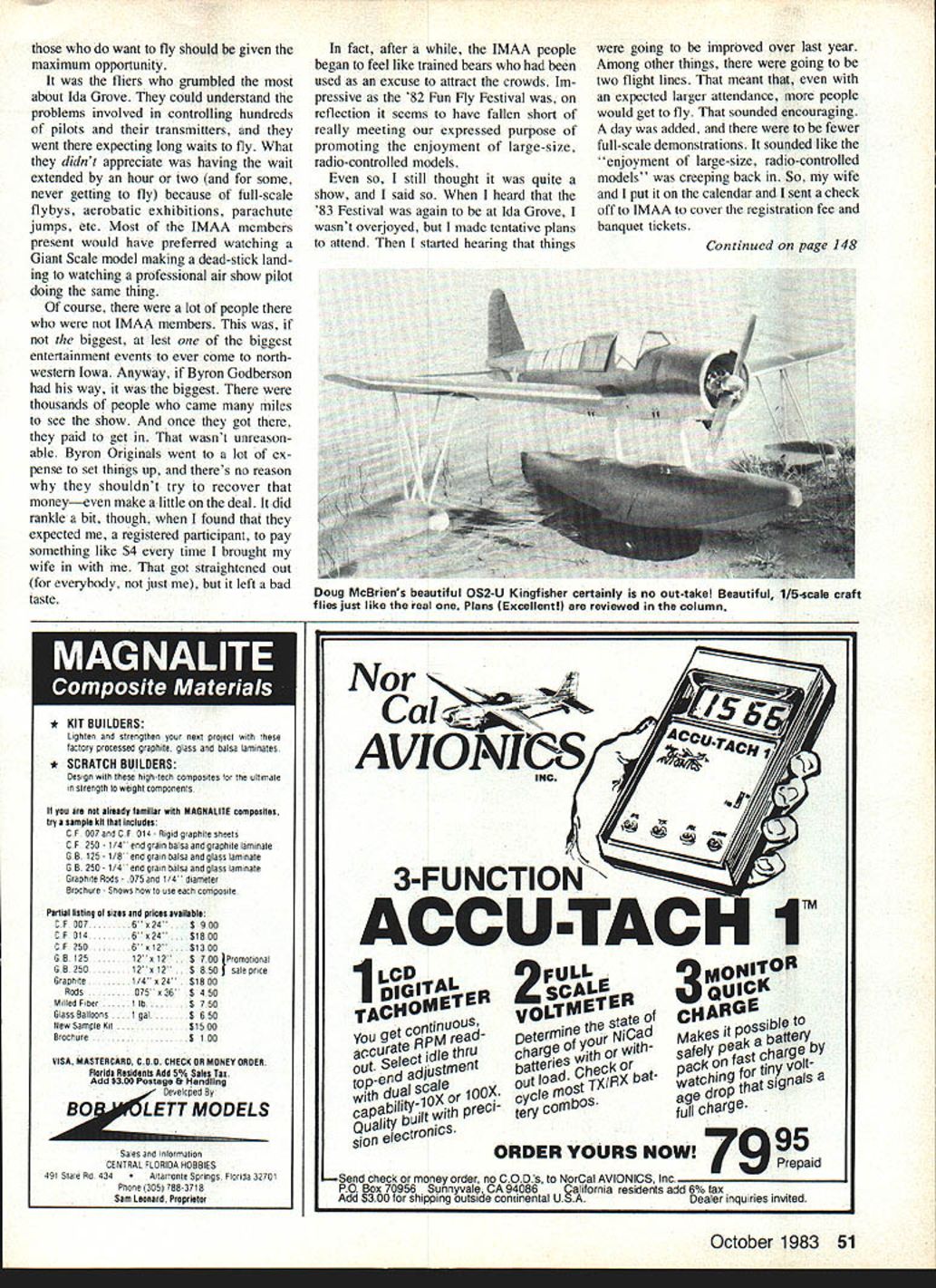
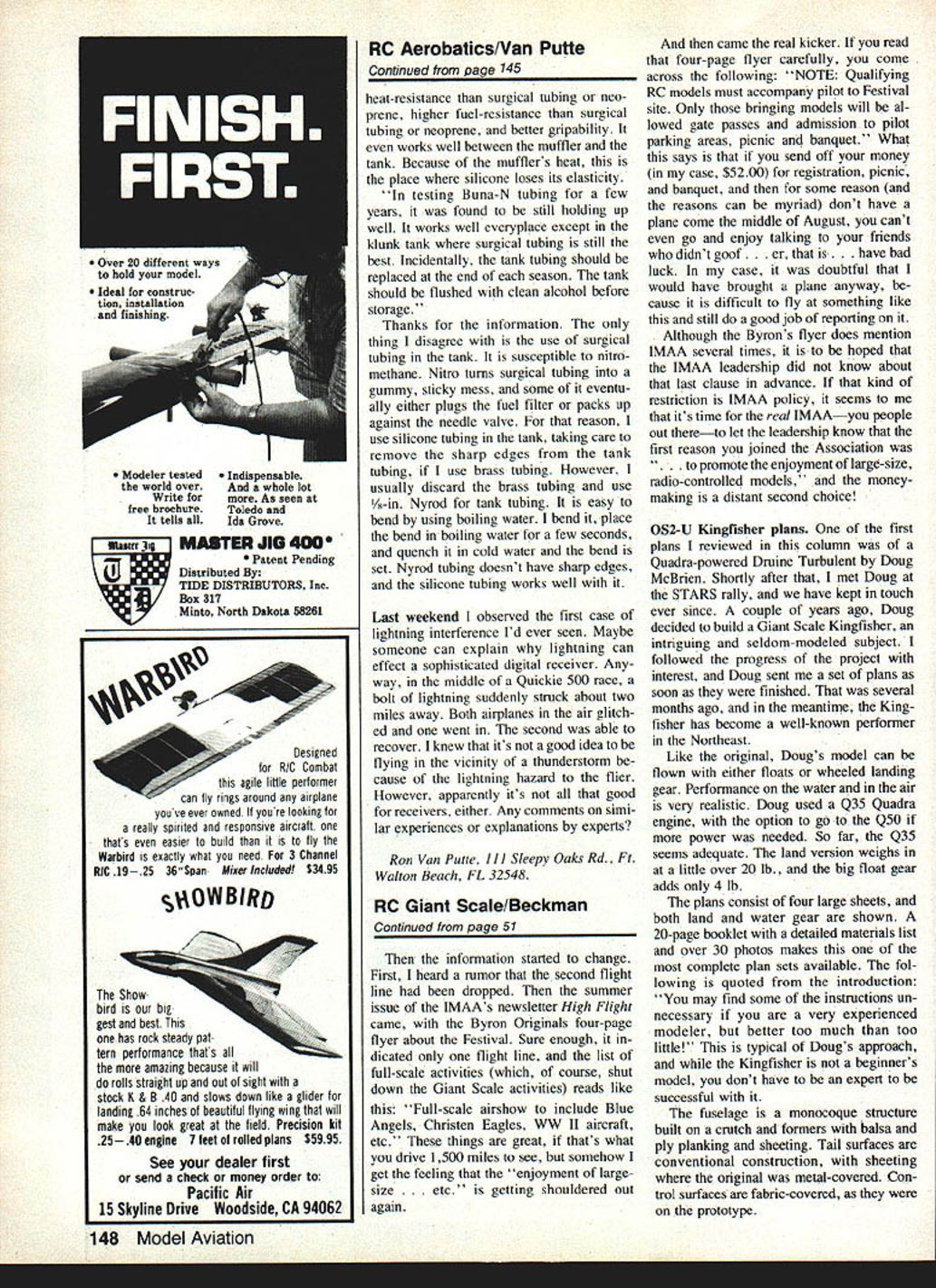
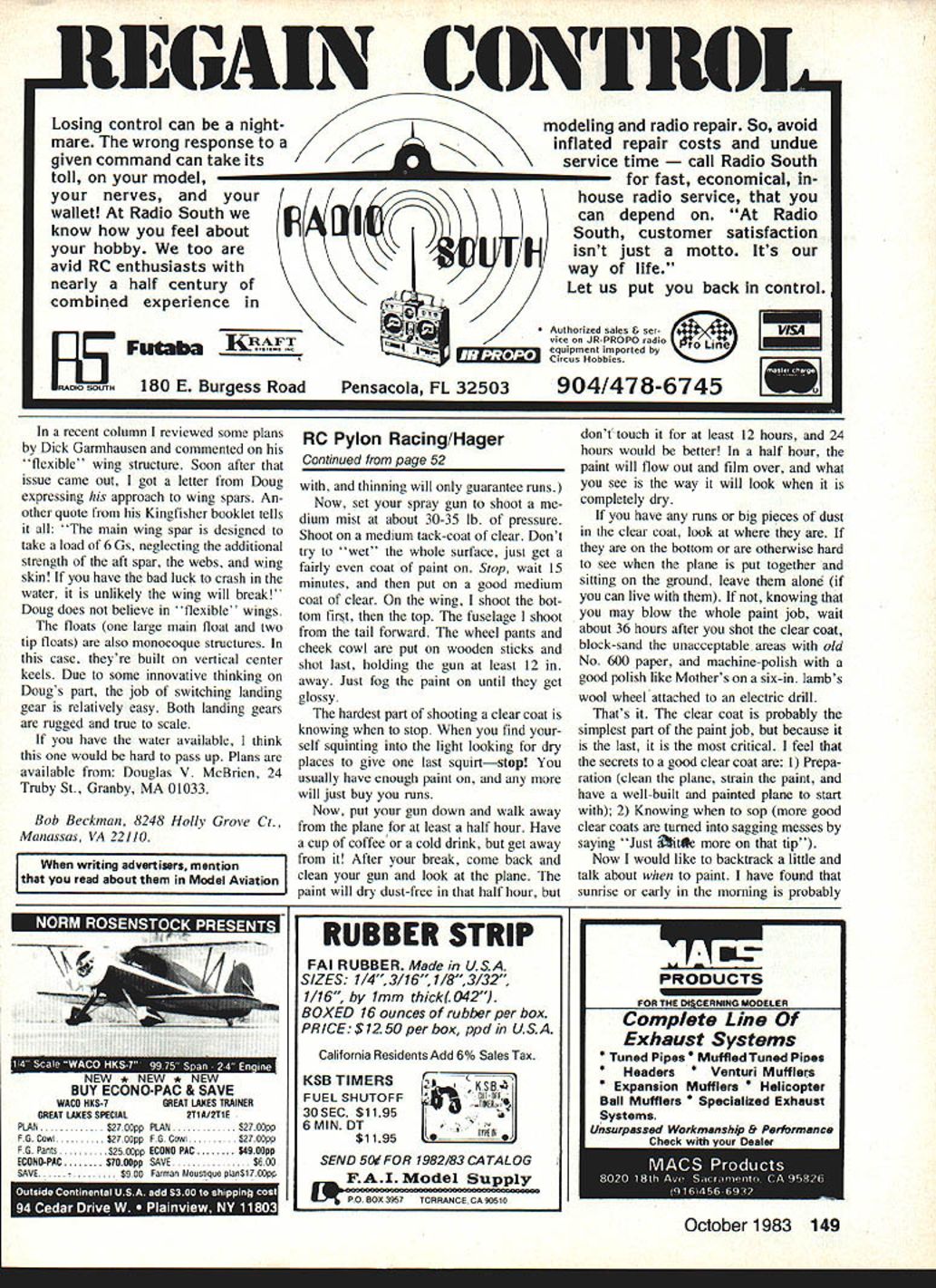
Looking through my files for pictures for this column, it occurred to me that the shots that usually get published show nice, smooth takeoffs and landings. The real world isn't like that, so this month I'm including some outtakes. I won't embarrass anyone by naming pilots, but if you hollered "Hey, Bob," we'd both turn around.
Whither goest, IMAA?
I'm writing at the end of June. By the time you read this the IMAA's Third Annual Fun-Fly Festival (mid-August) will be over. I'm planning to attend and am looking forward to it. I was in Louisville in 1981 and Ida Grove in 1982, and I'm preparing for the haul to Ida Grove again. Model Aviation will carry my report on this year's Festival, probably in the December issue, but I have some reflections in advance I'd like to share.
IMAA's original constitution and the proposed new constitution both state the purpose of the organization as "...to promote the enjoyment of large-size, radio-controlled model aircraft." The Association has certainly worked toward that goal in many ways. One of the most visible efforts has been the yearly Fun-Fly Festival, begun a little more than a year after the Association was founded.
The first Festival (Louisville) provided a great weekend for many people. Facilities were excellent, if a little cramped for the number of participants. There was a lot of flying, a lot of conversation, and a tremendous Saturday-night banquet. Credit for organizing that event goes largely to Don Godfrey, one of the best show-producers around. People left feeling they'd enjoyed a true giant-scale modeling weekend.
In 1982 the Festival was held at Ida Grove, Iowa. Ida Grove—home of Byron's Originals—provided a mind-boggling amount of support for the Festival, and many of us were impressed. Still, there were grumbles. With several hundred planes and fliers and only one flight line, not everyone got to fly when they wanted, and some didn't get to fly at all. One of the things I like about Giant-Scale fly-ins is that, unlike contests, you don't have to fly—you can just look around and talk to people. That said, those who do want to fly should be given the maximum opportunity.
What upset many fliers at Ida Grove was not only the long waits inherent with so many pilots and one flight line, but the further extension of those waits—sometimes by an hour or two—because of full-scale flybys, acrobatic exhibitions, parachute jumps, and similar events. Most IMAA members present would have preferred watching giant-scale models rather than professional air-show pilots. Of course, many local spectators were there primarily for the full-scale attractions; Byron Originals had set up a large entertainment event that drew thousands of people from many miles away.
Byron Originals did incur substantial expense to stage the show and was entitled to recover costs and even earn a modest profit. What rankled a bit was the handling of participant admission: at one point registered IMAA participants were asked to pay additional fees to bring guests (for example, about $4 to bring a wife in), a situation that was later straightened out but left a bad taste. Some IMAA volunteers began to feel like trained bears used to attract crowds.
On reflection, the '82 Festival, impressive as it was, seemed to fall short of the Association's stated purpose of promoting the enjoyment of large-size radio-controlled models. Despite that, I decided to go again in '83 when I heard it would also be at Ida Grove. I also heard that improvements were planned: two flight lines instead of one, an extra day added, and fewer full-scale demonstrations—measures that would restore the emphasis on IMAA's purpose.
Then information began to change. Rumors said the second flight line had been dropped. The Byron Originals flyer in the IMAA newsletter confirmed only one flight line and listed many full-scale acts ("Blue Angels, Christen Eagles, WWII aircraft, etc."), which would again pre-empt RC flying. Worse, the flyer included this clause: "NOTE: Qualifying RC models must accompany pilot to Festival site. Only those bringing models will be allowed gate passes and admission to pilot parking areas, picnic and banquet." In other words, if you registered for the Festival (in my case, $52.00 for registration, picnic, and banquet) but—whether by choice or unfortunate circumstance—did not bring a model, you could be denied access to pilot areas and events.
If that restriction reflects IMAA policy, it's time for the membership to remind leadership that the Association exists primarily to promote enjoyment of large-size radio-controlled models; making money should be a distant second consideration. I hope the IMAA leadership was not aware of that clause in advance. If it is not IMAA policy, at the least members should ensure their rights to participate in social and organizational aspects of the Festival are protected even when they do not bring a model.
- Common problems at Ida Grove and issues to watch:
- Single flight line leading to long waits and some pilots not getting to fly.
- Full-scale demonstrations that shut down or significantly delay RC flying.
- Admission and access restrictions for registered participants who do not bring models.
RC Giant Scale / Beckman
(Notes from the field and outtakes: tail-dragger departures that quickly become dramatic, nose-overs, tip-overs and broken props. Minor damages happen—prop and nosewheel repairs—and sometimes builder and pilot are the same person. These are part of the hobby and the stories we tell afterward.)
OS2-U Kingfisher plans
One set of plans I reviewed earlier was Doug McBrien's Quadra-powered Druine Turbulent. Doug later decided to build a Giant-Scale OS2U Kingfisher, an intriguing and seldom-modeled subject. I followed the project's progress, and when Doug finished the plans he sent me a set. The Kingfisher model has since become well known in the Northwest.
Like the original, Doug's model can be flown with floats or wheeled landing gear. Performance on the water and in the air is very realistic. Doug used a Q35 Quadra engine, with the option to go to a Q50 if more power were needed. So far the Q35 seems adequate. The land version tips the scales at a little over 20 lb; the big float gear adds only about 4 lb.
The plan set includes:
- Four large plan sheets showing both land and water gear.
- A 20-page booklet with a detailed materials list and over 30 photos.
The introduction notes: "You may find some of the instructions unnecessary if you are a very experienced modeler, but better too much than too little!" That sums up Doug's practical approach. While the Kingfisher is not a beginner's model, you don't need to be an expert to be successful with it.
Construction highlights:
- Fuselage: monocoque structure built on a crutch and formers with balsa and plywood planking and sheeting.
- Tail surfaces: conventional construction, with sheeting where the prototype was metal-covered.
- Control surfaces: fabric-covered, as on the original aircraft.
This plan set is one of the more complete and well-documented Giant-Scale kits available, suitable for the serious builder who wants a realistic Kingfisher that flies and looks right on both wheels and floats.
Transcribed from original scans by AI. Minor OCR errors may remain.

