
Radio Control: Giant Scale
Bob Beckman
STARS Spangled Rally revisited
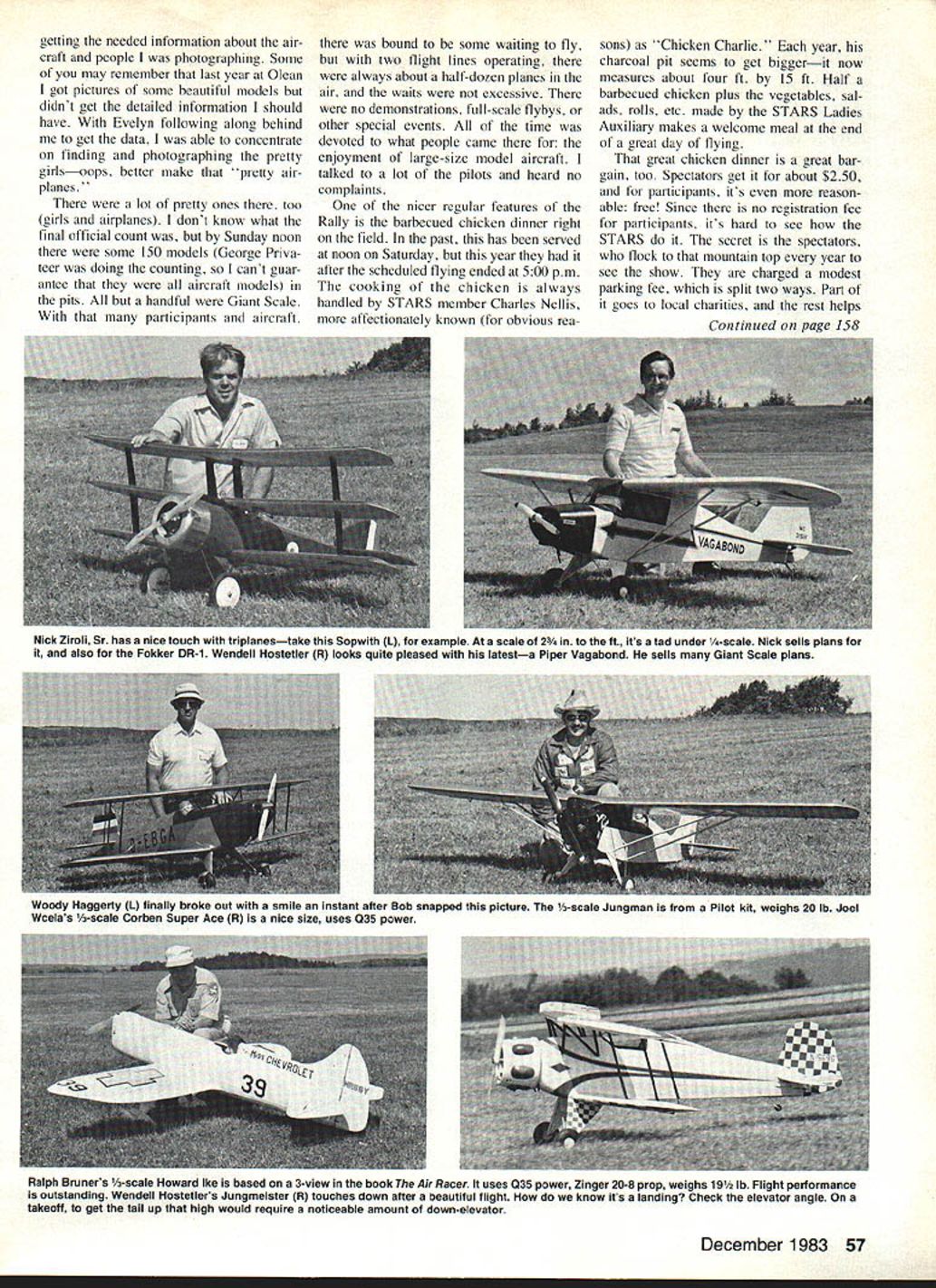
STARS Spangled Rally revisited. Four times in a row now, I have been lucky enough to get to the STARS Scale Rally in Olean, NY. For those of you who don't know, STARS stands for Southern Tier Aero Radio Society, a very active RC group located in the Southern Tier area of western New York and northern Pennsylvania. This is the group that, back in the mid-Seventies (when Giant Scale was just getting started), built a whole squadron of 1/4-scale Bristol Scouts. Their annual Scale Rally, while open to scale models of any size, has become one of the premier Giant Scale events of each year.
I have always enjoyed this event, but this year there were several differences that made it more enjoyable than ever. Usually I make the trip by myself; but this year my wife, Evelyn, came with me. That adds about an hour to the 7½-hour trip, but that extra time translates into a break for lunch—which I enjoyed and should have been taking when I was by myself. And her company helps to make any long trip more endurable.
The next difference was the weather. The Rally takes place the second weekend in July, and by that time Northern Virginia (which isn't all that far north) is getting pretty hot and humid. It's nice to get up into the cool, crisp air of the Olean area. In fact, you need a warm jacket in the evenings. Unfortunately, however, the Rally has a history of being rained out on Sunday. This year it was cool and a little drizzly Saturday morning, but by noon it was clearing up, and the rest of the weekend was delightful. I have never seen better weather for flying—and there was lots and lots of flying.
The field and flying
The Rally is held at the Olean Municipal Airport, which is closed to full-scale traffic during the Rally. The airport is located on top of a mountain, with a paved runway and taxi strips, and a large level area covered with grass. Most of the flying is off the grassed area, which is large enough to accommodate two flight lines easily. The paved areas were available for those who preferred or needed them.
My thing at a fly-in like this is to take pictures, gather information, and just plain gab. This is where another nice difference showed up this year. My wife pitched in and really helped out. She carried some of the camera equipment around for me; she joined in—and contributed to—the discussions, especially with the other wives present; and, most important, she took over the job of getting the needed information about the aircraft and people I was photographing. Some of you may remember that last year at Olean I got pictures of some beautiful models but didn't get the detailed information I should have. With Evelyn following along behind me to get the data, I was able to concentrate on finding and photographing the pretty airplanes.
There were a lot of pretty ones there, too. I don't know what the final official count was, but by Sunday noon there were some 150 models (George Privater was doing the counting, so I can't guarantee that they were all aircraft models) in the pits. All but a handful were Giant Scale. With that many participants and aircraft, there was bound to be some waiting to fly, but with two flight lines operating, there were always about a half-dozen planes in the air, and the waits were not excessive. There were no demonstrations, full-scale flybys, or other special events. All of the time was devoted to what people came there for: the enjoyment of large-size model aircraft. I talked to a lot of the pilots and heard no complaints.
Food and social events
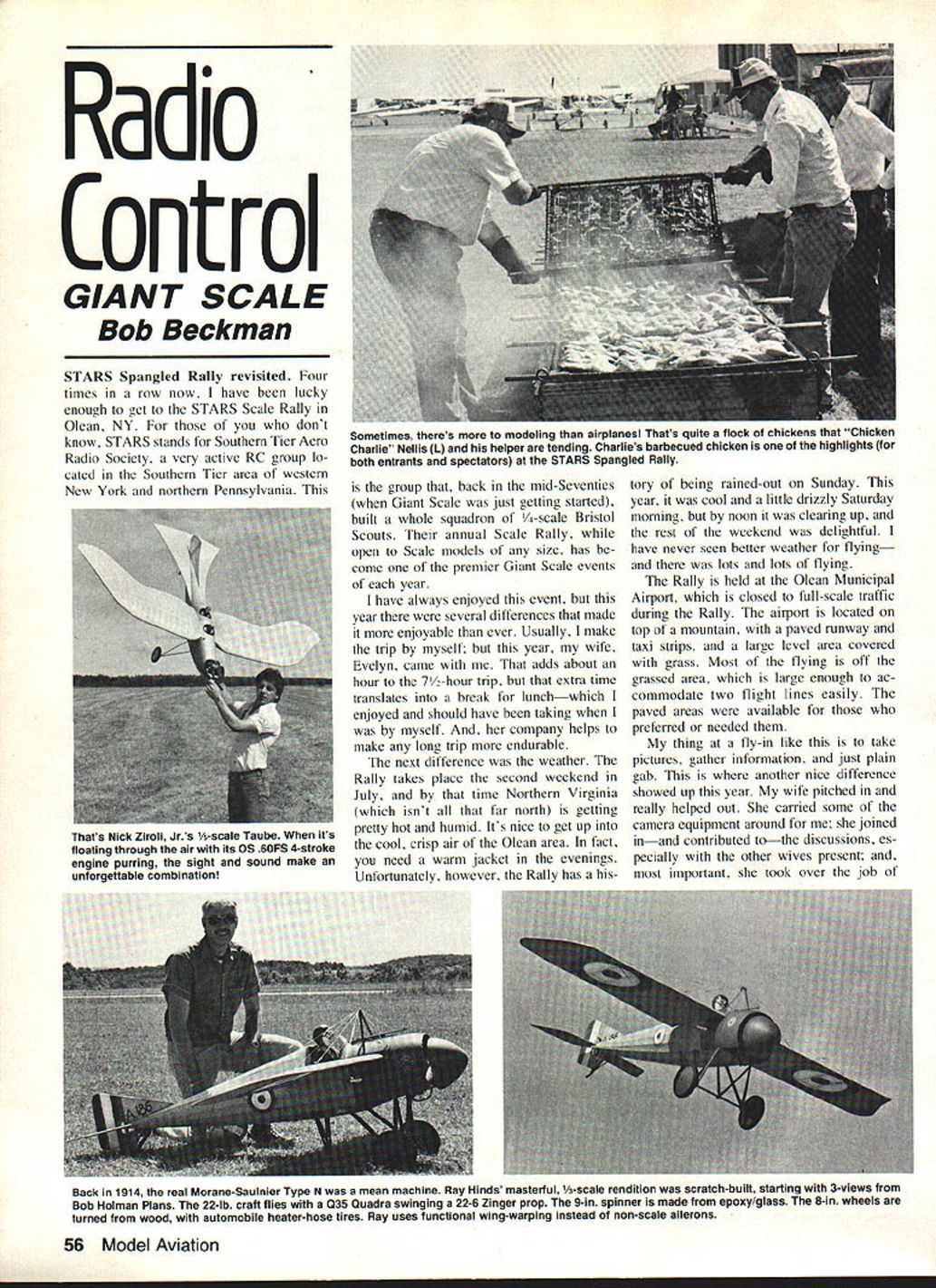
One of the nicer regular features of the Rally is the barbecued chicken dinner right on the field. In the past, this has been served at noon on Saturday, but this year they had it after the scheduled flying ended at 5:00 p.m. The cooking of the chicken is always handled by STARS member Charles Nellis, more affectionately known (for obvious reasons) as "Chicken Charlie." Each year his charcoal pit seems to get bigger—it now measures about four feet by 15 feet. Half a barbecued chicken plus the vegetables, salads, rolls, etc., made by the STARS Ladies Auxiliary makes a welcome meal at the end of a great day of flying.
That great chicken dinner is a great bargain, too. Spectators get it for about $2.50, and for participants it's even more reasonable: free! Since there is no registration fee for participants, it's hard to see how STARS does it. The secret is the spectators, who flock to that mountaintop every year to see the show. They are charged a modest parking fee, which is split two ways. Part goes to local charities, and the rest helps cover the cost of the Rally.
Another regular feature of the Rally is the Saturday-night gathering at the field. Many of the participants come in campers and motor homes which they can park right at the field, and many of the others stay on after the flying is officially over. It's a time for unwinding after a busy day and for renewing old friendships. For many of those friendships, Olean once a year is the only contact. After dark, there are movies on aviation and modeling and slide shows of previous Rallies. The whole thing gets topped off with a bonfire from which heat can be mighty welcome on that mountaintop, even in July.
It's hard to see what you could do to follow an act like Saturday, and in years past the Sundays have been somewhat dismal. Not so this year! Early morning fog in the valleys gave way to beautiful clear skies at the field. You couldn't ask for better flying conditions, and there were planes in the air continuously from early in the morning. Evelyn and I spent a delightful morning with great weather, great airplanes, and most of all, great people.
Safety and organization
John Grigg, AMA's president, was one of the people I had a chance to visit with at Olean. Most of our conversation was related to safety, and not only in Giant Scale. Despite the many doom-criers, Giant Scale has an excellent safety record. People are beginning to realize that many of our procedures make sense for any size model. At the same time, John expressed reservations about some of the recent proposals coming from IMAA. He's not the only one; there are a lot of us in IMAA who have reservations. The important thing is that we are working on the problem, and we have to keep at it. This is not a question that IMAA can settle wholly within itself. We must interface with the rest of the world, and that means (primarily) with AMA. Arbitrary and poorly thought-out statements and actions will, in the long run, hurt all of us.
All good things must come to an end, and at noon on Sunday Evelyn and I had to pack up and start the long drive home. I have always enjoyed this STARS Spangled Rally, but this year really topped them all. Evelyn and I will be back next year, expecting an even better time.
Serendipity can be defined as a greater-than-expected return on an investment. I am experiencing exactly that.
Serendipity and reader mail
In the Product Review section of the September 1983 Model Aviation, the lead item was about my book, Building and Flying Giant Scale Radio Control Aircraft. Since that issue came out, I have been getting a gratifying number of orders for autographed copies. I thank all of you who are interested enough to buy the book, but that isn't where the serendipity comes in.
What I'm excited about are the letters that are coming with many of those orders. Some of them are from long-time modelers who tell me a bit about what they are doing. A lot of those things sound like they would be interesting to all of us, and I'm shooting off requests for more details. Some of the letters are from modelers building their first Giant Scale aircraft, and they have questions to ask. The book has some of the answers, and where it doesn't (after all, it's not an encyclopedia), I'm shooting off answers when I can. A lot of the orders are coming from people who are completely new to modeling, and they really have questions.
The point is that here are a lot of people with information and/or questions who were smart enough to realize that if they were using a 20-cent stamp to send me a check, they might as well put some words in, too. But more important, they otherwise might never have sent the words!
All of the magazine columnists share two basic problems. First is getting people to send in their problems, ideas, questions, or whatever. Second is the cost of individual replies when they do. That's why all of us, from time to time, ask for SASEs if you expect a reply. I have long been convinced that there are a lot of people with useful questions and answers who feel that the things are too trivial to bother anybody with. They're wrong, because no question is trivial if you need the answer and don't have it, and that automatically makes the answer non-trivial. Also, consider this: questions are more useful than answers, because an answer only settles one question, but trying to find the answer to a question can often lead to finding answers for a lot of questions—which leads us back to serendipity.
I'm so pleased to get your letters that I'll send you the book, autographed of course, answer your questions to the best of my ability, and not even bug you about an SASE. Now that's a pretty good return on a $10.95 investment, isn't it?
Bob Beckman 8248 Holly Grove Ct. Manassas, VA 22110
Transcribed from original scans by AI. Minor OCR errors may remain.

