
Radio Control: Giant Scale
Bob Beckman
Kawasaki engines
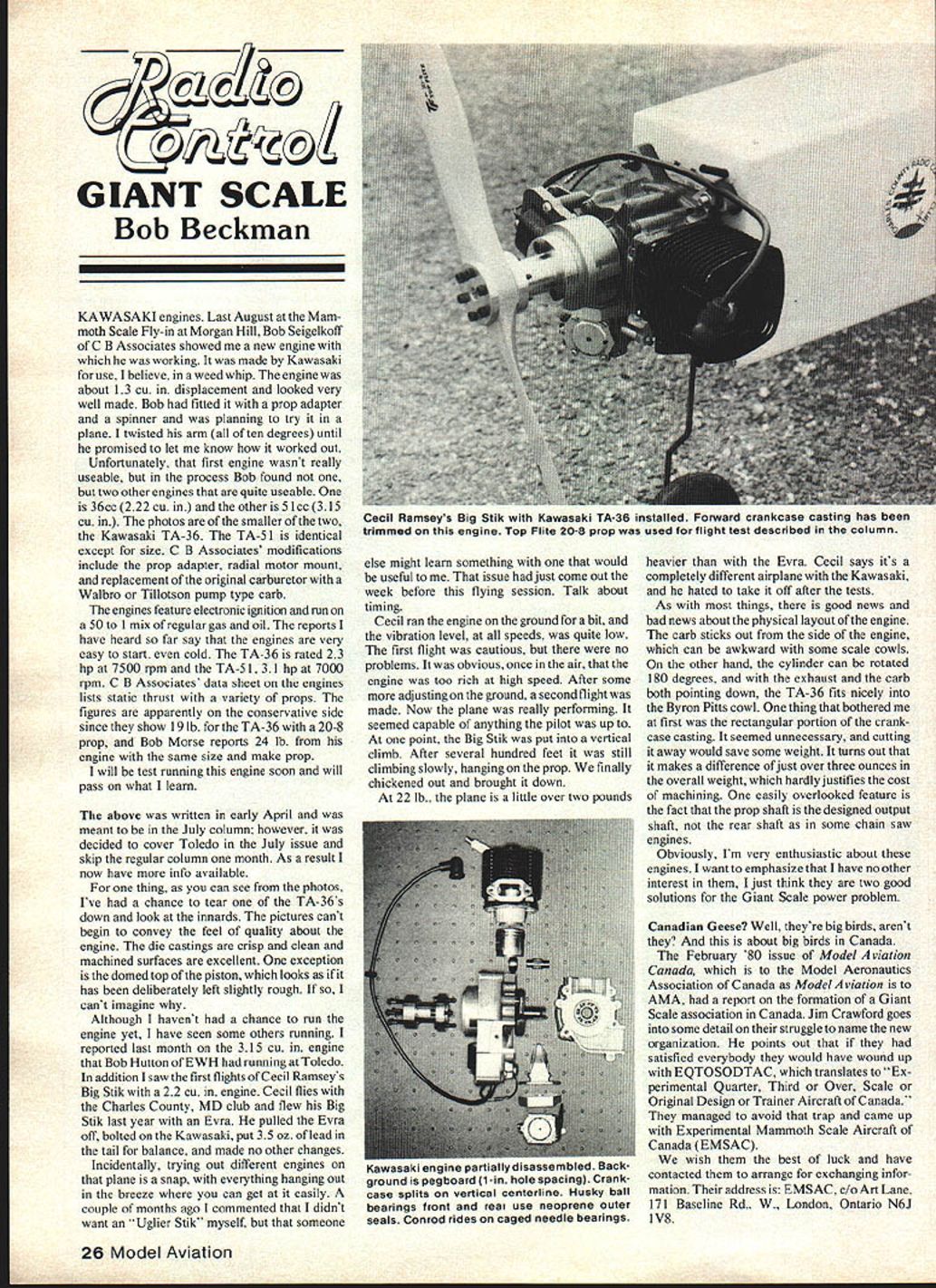
Last August at the Mammoth Scale Fly-In at Morgan Hill, Bob Seigelkoff of C.B. Associates showed me a new Kawasaki engine he was working with. The first engine he brought wasn't really usable, but in the process he found two other engines that are quite promising: a 36 cc (2.22 cu. in.) model and a 51 cc (3.15 cu. in.) model. The smaller of the two is the Kawasaki TA-36; the TA-51 is identical except for size.
C.B. Associates' modifications include:
- Prop adapter and spinner
- Radial motor mount (replacing the original rear crankcase arrangement)
- Replacement of the original carburetor with a Walbro or Tillotson pump-type carb
The engines feature electronic ignition and run on a 50:1 mix of regular gasoline and oil. Reports so far say they are very easy to start, even cold.
Engine details and reported performance
- TA-36: rated 2.3 hp at 7,500 rpm
- TA-51: rated 3.1 hp at 7,000 rpm
C.B. Associates' data sheet lists static thrust for various props. For example, the TA-36 is listed at 19 lb static thrust with a 20x8 prop, though one owner (Bob Morse) reported 24 lb with the same size and make of prop. I will be test-running a TA-36 soon and will pass along my findings.
I had an opportunity to disassemble a TA-36 and inspect the internals. The die castings are crisp and clean and the machined surfaces are excellent. One oddity is the domed top of the piston, which appears to have been left slightly rough; I can't imagine why.
Field reports and flight tests
Although I haven't run one personally yet, I've seen several in operation. Bob Hutton (EWH) ran a 51 cc engine at Toledo, and I watched Cecil Ramsey make the first flights of his Big Stik with a 2.2 cu. in. Kawasaki.
Cecil, who flies with the Charles County, MD club, removed his Evra engine, bolted on the Kawasaki, added 35 oz. of lead in the tail for balance, and made no other changes. He ran the engine on the ground for a time; vibration at all speeds was quite low. The first flight was cautious and uneventful. The engine proved rich at high speed, so after some ground adjustments a second flight was made and the airplane performed impressively. At one point the Big Stik climbed vertically and was still climbing slowly after several hundred feet before the pilot brought it down. The airplane weighed 22 lb with the Kawasaki—just over two pounds heavier than with the Evra. Cecil said it handled like a completely different airplane and was reluctant to remove the engine after testing.
Fit and installation
There are pros and cons to the engine's physical layout:
- The carburetor protrudes from the side of the engine, which can be awkward with some scale cowls.
- The cylinder can be rotated 180 degrees so both the exhaust and carburetor point down; in that orientation the TA-36 fits nicely into the Byron Pitts cowl.
- One initially puzzling feature is a rectangular portion of the crankcase casting that seems unnecessary. Removing it saves just over three ounces—hardly worth the cost and effort of machining.
- The prop shaft is the intended output shaft (not the rear shaft, as in some chainsaw engines), which is a practical design choice.
Overall, I'm enthusiastic about these engines and have no other interest in them beyond their suitability as Giant Scale powerplants. I think they offer two good solutions to the Giant Scale power problem.
Canadian Giant Scale association
The February 1980 issue of Model Aviation Canada reported the formation of a Giant Scale association in Canada. Jim Crawford detailed their amusing struggle to name the new organization—if they had tried to please everyone they might have ended up with the acronym EQTOSODTAC (Experimental Quarter, Third or Over, Scale or Original Design or Trainer Aircraft of Canada). Instead they chose Experimental Mammoth Scale Aircraft of Canada (EMSAC).
We wish them the best and have contacted them to arrange an exchange of information. Their contact address: EMSAC, c/o Art Lane, 171 Baseline Rd. W., London, Ontario N6J 1V8.
Transcribed from original scans by AI. Minor OCR errors may remain.

