
Radio Control: Giant Scale
Bob Beckman
New Quadras?
Yes, there are some new things from Quadra, and some of them may be surprising.
First, all new Quadras coming out of the factory are now equipped with Quadra's version of the spring starter that has become so popular in the last year. I still consider this starter to be the single most useful accessory ever developed for Giant Scale engines. I don't know all the details, but as I understand it, Quadra will install the starter on all new engines being manufactured; however, they will not provide starters for older engines. PK Products (P.O. Box 6226, Hayward, CA 94540) is the source of the H&K SuperStarter for earlier Quadras and several other engines.
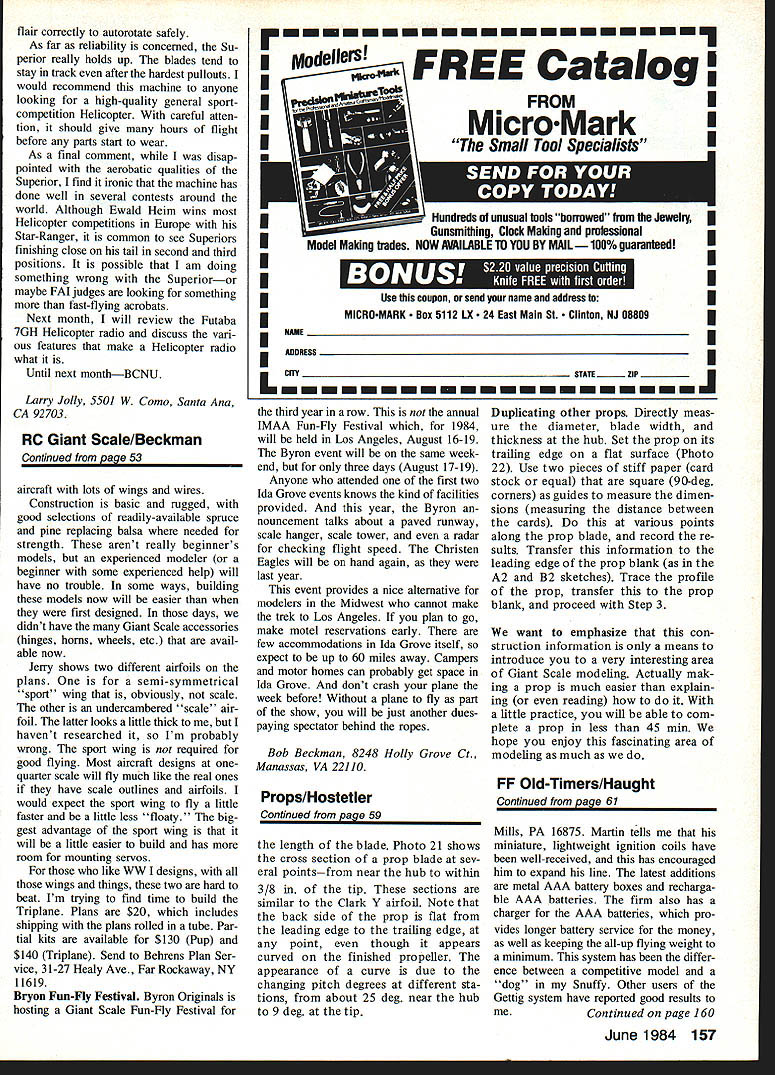
Next, the Q50 has been modified, with the new version designated Q50S. In addition to the starter, there have been some other useful changes:
- Porting has been changed; Quadra claims a 15% power increase as a result.
- The cylinder has been rotated so that the carb is now on the same side as on the Q35. This will help to simplify dropping a Q50S into a plane in place of a Q35. The carb still isn't in the exact same location, but at least it isn't clear around on the other side.
- The spark plug has been changed to a physically smaller one, which reduces the engine height slightly.
All in all, the changes sound worthwhile. I'll try to include this new version in the next Big Bangers article.
News that really surprised me was that Quadra is now offering glow-ignition versions of both the Q35 and the Q50. I once commented that a glow engine this big seemed to me to be just a device for converting money into exhaust smoke. After a long talk with Quadra's Klaus Nowak, I had to change my opinion ... a little. Klaus pointed out that they are really aiming glow versions at the European market, where gasoline-fueled engines have not been very popular. Since the price of gasoline in most European countries is not much different from methanol, there is no real economic advantage—as long as you don't need nitro-methane in the mix.
Another factor is the difference in lifestyles. In this country, most of us live in houses, usually with garages, and almost invariably with one or more gasoline-powered devices (lawn mowers, chainsaws, etc.). Most of us are used to handling gasoline and have facilities for storage. A much higher percentage of European modelers live in apartments; they seldom have garages for their cars, and for them storage of gasoline can be a problem. When looked at from that viewpoint, these glow-ignition Quadras make sense. It also explains why engines like the Bully were originally designed for glow operation and later converted to ignition for sale here.
Some U.S. modelers will be interested in the advantages offered by these engines—despite the higher operating costs. The main advantages are:
- About a half-pound weight reduction when you remove the flywheel and ignition system.
- A significant increase in power output and the resultant power-to-weight ratio.
- For scale modelers and those seeking Pattern-type performance in a large model, these benefits can be valuable.
Even so, I think the average Giant Scaler in this country will want to stick with his spark-ignition, gasoline-fueled engine.
Sixth Annual at Tom Sawyer Park
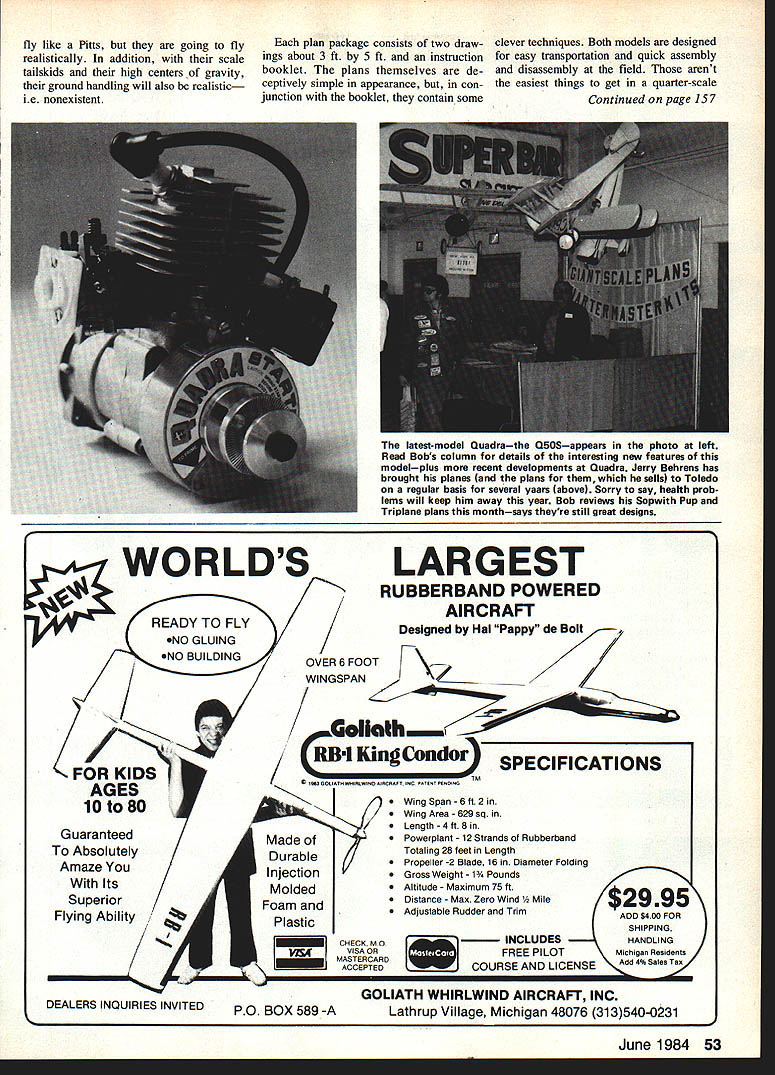
The Louisville Radio Control Club, the River City Radio Control Club, and the Tom Sawyer Flying Association are sponsoring the Sixth Annual Giant Scale Fly-In on the weekend of June 30–July 1. This has been a very popular event in the past, drawing many fliers from the Midwest and South. The site is Tom Sawyer Park, near Louisville, KY. This is one of the nicest model-flying facilities around. I was lucky enough to be there for the IMAA's (International Miniature Aircraft Association) first FFF (Fun-Fly Festival) in 1981. They have a nice paved strip, with adjacent grass for those who prefer it.
These same three clubs took on the job of running the IMAA event and did an outstanding job, with, I am sure, the largest group of participants they had ever had to handle. They know what they are doing, and the Fly-In is sure to be a well-run affair. For more information, contact Tom Bennett, 3518 Dutchman's Lane, Louisville, KY 40205; Phone (502) 451-5511.
Behrens' Triplane and Pup plans
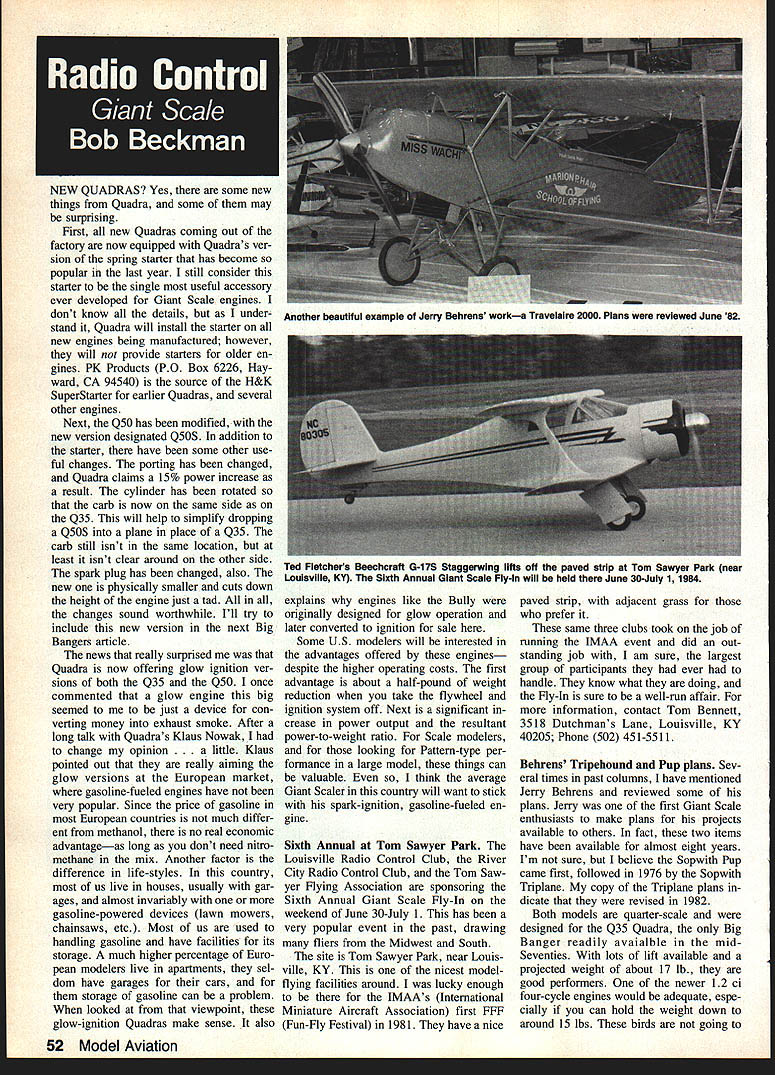
Several times in past columns I have mentioned Jerry Behrens and reviewed some of his plans. Jerry is one of the first Giant Scale enthusiasts to make his projects available to others. In fact, two items have been available for almost eight years. The Sopwith Pup came first, followed by the 1976 Sopwith Triplane copy. The Triplane plans indicate a 1982 revision.
Both models are quarter-scale designs and the Q35 Quadra Big Banger, readily available in the mid-seventies, made lots of lift available. Projected weight is about 17 lb, and they are good performers. Newer 1.2 ci four-cycle engines would be adequate, especially if you can hold the weight down to around 15 lbs. These birds are going to fly like a Pitts, but they are going to fly realistically. In addition, with their scale tailskids and their high centers of gravity, their ground handling will also be realistic—i.e., nonexistent.
Each plan package consists of two drawings about 3 ft. by 5 ft. and an instruction booklet. The plans themselves are deceptively simple in appearance, but, in conjunction with the booklet, they contain some clever techniques. Both models are designed for easy transportation and quick assembly and disassembly at the field. Those aren't the easiest things to get in a quarter-scale aircraft with lots of wings and wires.
Construction is basic and rugged, with good selections of readily available spruce and pine replacing balsa where needed for strength. These aren't really beginner's models, but an experienced modeler (or a beginner with some experienced help) will have no trouble. In some ways, building these models now will be easier than when they were first designed. In those days, we didn't have the many Giant Scale accessories (hinges, horns, wheels, etc.) that are available now.
Jerry shows two different airfoils on the plans. One is for a semi-symmetrical "sport" wing that is, obviously, not scale. The other is an undercambered "scale" airfoil. The latter looks a little thick to me, but I haven't researched it, so I'm probably wrong. The sport wing is not required for good flying. Most aircraft designs in one-quarter scale will fly much like the real ones if they have scale outlines and airfoils. I would expect the sport wing to fly a little faster and be a little less "floaty." The biggest advantage of the sport wing is that it will be a little easier to build and has more room for mounting servos.
For those who like WW I designs, with all those wings and things, these two are hard to beat. I'm trying to find time to build the Triplane. Plans are $20, which includes shipping with the plans rolled in a tube. Partial kits are available for $130 (Pup) and $140 (Triplane). Send to Behrens Plan Service, 31-27 Healy Ave., Far Rockaway, NY 11619.
Byron Fun-Fly Festival
Byron Originals is hosting a Giant Scale Fun-Fly Festival for the third year in a row. This is not the annual IMAA Fun-Fly Festival which, for 1984, will be held in Los Angeles, August 16-19. The Byron event will be on the same weekend, but for only three days (August 17-19).
Anyone who attended one of the first two Ida Grove events knows the kind of facilities involved. And this year, the Byron announcement talks about a paved runway, scale hangar, scale tower, and even a radar for checking flight speed. The Christen Eagles will be on hand again, as they were last year.
This event provides a nice alternative for modelers in the Midwest who cannot make the trek to Los Angeles. If you plan to go, make motel reservations early. There are few accommodations in Ida Grove itself, so expect to be up to 60 miles away. Campers and motor homes can probably get space in Ida Grove. And don't crash your plane the week before! Without a plane to fly as part of the show, you will be just another dues-paying spectator behind the ropes.
Bob Beckman 8248 Holly Grove Ct., Manassas, VA 22110.
Transcribed from original scans by AI. Minor OCR errors may remain.

